Paris-Nice is one of the most reputable and toughest stage-races in the World Tour calendar and every single year it hosts many of the world's best climbers, sprinters and classics riders. This year the race takes place from the 9th to 16th of March. We take a look at the profiles.
The race features a mix of stages where most will have a chance to shine. There will, noticeably, be a team time-trial that can be important for the overall classification; three mountain stages (two of them with medium-length summit finishes), a hilly stage with a very steep hilltop finish and three days for the sprinters to thrive.


Stage 1: Le Perray-en-Yvelines - Le Perray-en-Yvelines, 156.2 kilometers
The race opens up with a stage for the sprinters. It will be a loop in the city of Le Perray-en-Yvelines, following the race's traditional start with a stage that should end in a bunch sprint but... There are chances of a late attack succeeding, it's not impossible.
156 kilometers on the menu, it won't be too difficult or long of a day and certainly one where all the attention will be in the end, unless weather conditions force the riders to act otherwise. There will be a small hilltop finishing with 21.5 kilometer to go, but the main one comes later.
So there is an intermediate sprint on the top of the final little climb, which is 1 kilometer long at 6.2%. With a yellow jersey and some seconds to hand out, some riders will want this and potentially also try to carry on with the attack/sprint. This comes with only 9.5 kilometers to go.
From there on a straight road, flat without descent, and we'll have a finale that should be easy to control for an organized peloton. The fight for the bunch sprint will be fast and furious into the final corner which comes with 700 meters to go. From there on, a small bend to the right, positioning will be key into the corner without a doubt.


Stage 2: Montesson - Bellegarde, 186.9 kilometers
Stage 2 will be the second and clearest opportunity for the sprinters throughout the race, having a mostly flat 186-kilometer long day that has almost no climbing whatsoever and a finale in Bellegarde.
There isn't really anything meaningful to analyse in the day. The organizers have made sure the sprinters would have at least one day where they wouldn't have to think about small climbs or anything, and they can just focus on the final kilometers.
And these will be... ideal? Well they should be safe, let's put it like that. The final kilometers are in a completely straightforward road, no roundabouts, no corners, no gradients. A pure bunch sprint.
Read also


Stage 3 (TTT): Circuit Nevers Magny-Cours - Nevers, 28.6 kilometers
Day 3 of the race will be the team time-trial, a discipline that has risen in use this year due to it's presence at the Tour de France. Some teams will be testing their setups here in the 28-kilometer long course, one that is not completely flat and will be interesting for teams to pace.
This will begin in the Magny-Cours race track, the first kilometers will be on perfectly smooth terrain before heading into a long straight road into the town of Nevers. In the town, there will be a small climb of 900 meters at 6%, with a small ramp featuring double-digit gradients. The final kilometers will then be slightly downhill, very fast until the uphill rise to the line. It won't be an easy one to pace certainly.


Stage 4: Vichy - La Loge des Gardes, 163.8 kilometers
Stage 4 is the first day that features quite a bit of climbing. 2700 meters of climbing on the menu, doesn't make it a true mountain stage but you can't neglect it, and it will be the day where the riders will truly understand their form going uphill.
Don't expect anything crazy before the last kilometers, all legs will be saved for the final ascent to La Loge des Gardes where the last time around it was Tadej Pogacar who won. An explosive ascent, but one where it's possible to make differences.
This climb will be 6.7 kilometers long at 7.1% average gradient. All-in-all a mostly constant climb without too many gradient shifts, but it will be hard right from the base. Attacks are expected in the final kilometers, because if a group goes into the final 1.5 kilometers there will be a small moment to rest there, and otherwise things could come down to a sprint.
Read also


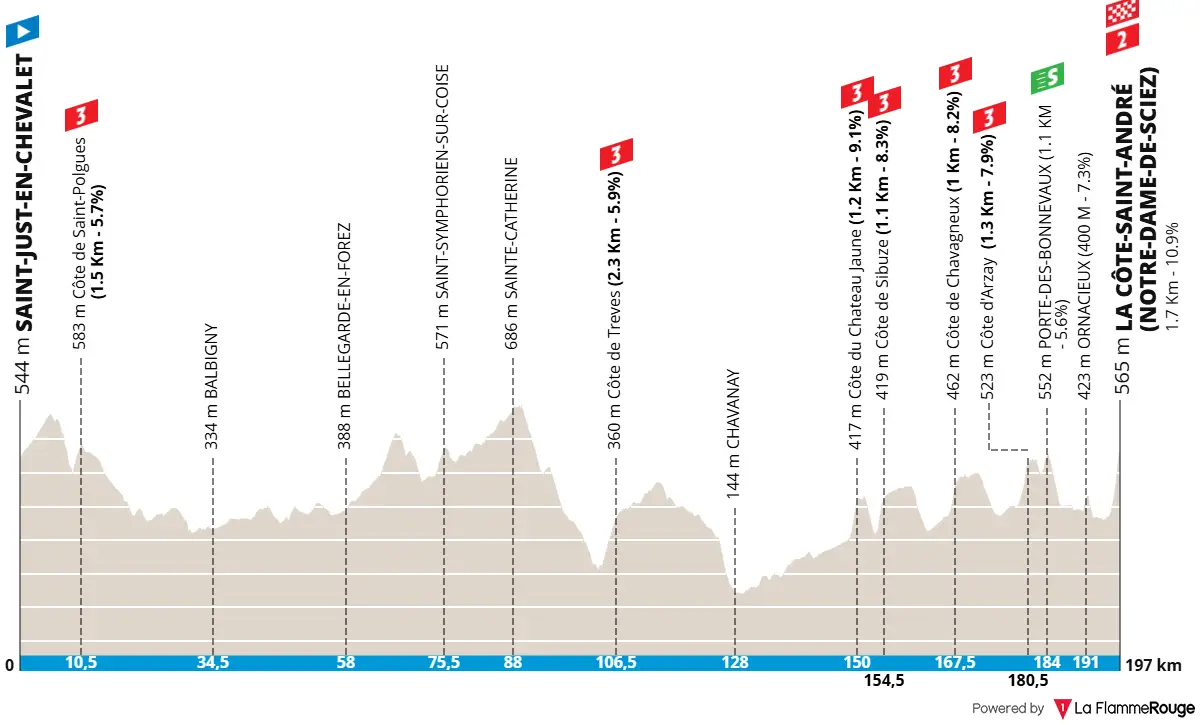
Stage 5: Saint-Just-en-Chevalet - La Côte-Saint-André (Notre-Dame-de-Sciez), 203.5 kilometers
Stage 5 is the day where the organizers best organized something for the classics specialists. This is terrain just like the Ardennes, and the finale is incredibly similar to La Fléche Wallonne. There will be plenty short and sharp climbs in the final hour of racing, where some stage hunters and GC riders will mix for an exciting finale.
In the last 40 kilometers, besides the final climb, there will be five small hilltops. Most are steep, but none of large duration. With 37, 32.5, 29.5, 16.5 and 13 kilometers to go there will be the end of some important spots on the day. The run-up to the final climb in itself isn't completely flat, instead it also has a small ramp.
But it's in the ascent to the Notre-Dame-de-Sciez (with gradients up to 18%) to the line that we'll have the most fireworks. Don't expect early attacks, it's a suffocating climb that slowly rises in gradient until 18% (or perhaps 24%, depending on which profile you trust more)... Creating gaps is impossible, so one way or another it will come down to a sprint. However, if someone decides to go early, it will be one of the most painful sprints of their lives. Gaps are expected at the summit, it's a purely anaerobic effort, with a technical start to the climb meaning there will be a big fight for positioning.


Stage 6: Saint-Julien-en-Saint-Alban - Berre-l'Étang, 210.1 kilometers
The sixth day of racing will be the final opportunity for the sprinters. A bunch finish at Berre-l'Étang is expected, but with 210 kilometers on the menu and a few climbs spread all throughout the course, there may be a surprise.
Right at the start there is a small uphill drag and this, being the final opportunity for most riders in the race, could lead to a lot of attacks and a strong group forming. Throughout the day we have some ascents, but only the last one feels important. It will have an intermediate sprint at the top, it will be 900 meters long at 6% with 19.5 kilometers to go. Unlikely to make a difference, but riders will have to keep an eye.
Then, the expected sprint finish. It will be an urban one, not very technical, but with a few roundabouts to navigate. With 2.2, 1.9 kilometers to go and 600 meters to go there will be roundabouts. (Unlike the map shows, the riders won't go all around the roundabout, but cut it through the left). They will be small features where the peloton will line out, where speeds will be very high and so will positioning. The finishing straight is pan-flat and right by the sea.


Stage 7: Nice - Auron, 148.5 kilometers
Stage 7 is the day where the race heads into the Alps. It is a short day on the bike, with only 148 kilometers on the menu, and neither of the climbs will be steep so it won't be brutal on anyone. Early in the day there are two small ascents where the breakaway is expected to be formed, before the real action really kicks in.
At the Col de la Colmiane a lot of damage can be done, the climb is 16 kilometers long at over 5%, with the final 7 being a bit steeper than the first half. This ascent finishes with 53 kilometers to go, attacks are very unlikely, but the teams that want to make an impact in the final ascent can do quite some damage here.
Then of course, the ascent to Auron. Officially, only 7.3 kilometers at 6.9%, which is enough to make some differences - but don't overestimate them, it's not a long ascent. What can really make damage is the run-up to the climb, as the 25 kilometers leading up to it have a slight uphill gradient throughout the valley. If a team commits to pushing very hard in these kilometers, then the final climb can for sure already start with some exhausted riders.
Read also


Stage 8: Nice - Nice, 120.7 kilometers
The final day of race. Paris-Nice always delivers in it's final Sunday, we've got 120 kilometers on the menu only but six climbs, many technical descents, many hairpins and one final steep climb where everything can be decided. This time around an easier start, with a few added kilometers but only one climb instead of a fast combo of three before Peille.
This will be the Col de la Porte, 7 kilometers at 6.9%, ending with 70 kilometers to go and featuring a very technical descent. It will quickly lead up to the Côte de Peille which is 6.5 kilometers at 6.9%, full of hairpins, a climb where winning attacks have happened in the past. This summits with 41 kilometers to go.
However this time around there are still two tough ascents to go. The riders have an intermediate sprint at the Col d'Èze which is 1.6 kilometers at over 9%, this summits with 25 kilometers to go. Attacks certainly can happen here, because the following fast descent leads directly into the final climb of the day.
This is the Col des Quatre Chemins - part of the Col d'Éze. It is 3.6 kilometers at 8.8%, but the final half is quite steeper. The ramps go up to 18%, brutal and enough to create differences. The race can end atop this ascent, it summits with 9 kilometers to go and from there on it's almost downhill all the way to the finish line at the Promenade des Anglais.

☀ Voici le parcours de #ParisNice 2025 !
— Paris-Nice (@ParisNice) December 17, 2024
☀Here is the route of #ParisNice 2025! pic.twitter.com/ynMCs4sVut
Rúben SilvaEditor-in-Chief
A founding contributor to CyclingUpToDate since its launch in January 2022, Ruben Silva has played a central role in shaping the site’s editorial direction and long-term growth. Before joining the project, he built his experience through independent blogging at Echelons Hub and by producing race previews for Ciclismo Internacional, developing a strong analytical voice rooted in daily engagement with professional cycling.
Beyond editorial work, he has been closely involved in the expansion and coordination of CyclingUpToDate’s wider network, helping establish and support sister platforms across multiple languages. This includes ongoing collaboration with CiclismoAlDia (Spanish), CiclismoAtual (Portuguese), WielrennenUpToDate (Dutch), and RadsportAktuell (German), contributing to a shared editorial vision and consistent international coverage.
He also helps oversee editorial governance across the network, setting standards for accuracy and consistency and coordinating updates or corrections when needed.
Originally from the Porto metropolitan area in Portugal, he holds a bachelor’s degree in Geography. His path into cycling journalism was shaped not through formal media training, but through independent reporting, community engagement, and sustained on-the-ground involvement in the sport.
Over the course of his career, he has conducted approximately 100 interviews across road cycling and cyclocross, ranging from one-to-one conversations and online formats to press conferences and on-site pre- and post-race coverage. His interviews include leading riders, team managers, and prominent figures within cycling media: Tadej Pogacar, Jonas Vingegaard, Mathieu van der Poel, Primoz Roglic, Wout van Aert, Joao Almeida and Tom Pidcock; managers like Patrick Lefevere and Joxean Matxin; and YouTube personality Bryan Kennedy (BKXC)...
Within 18 months of launch, he helped grow CyclingUpToDate’s English-language platform into one of the most-read cycling news websites, built entirely from the ground up. As both a professional journalist and lifelong cycling enthusiast, his focus remains on delivering accurate, timely, and well-contextualized coverage.
claps 1visitors 1
Just in

Popular news

Latest comments
- again, nothing is going to be resolved. it is a discussion board. I simply said I didn't see how MS impeded LBs sprint. the UCI doesn't care about my thoughts, and I am really not that emotionally invested in it.mij09-11-2026
- provoke change, lol. this is a discussion board. nothing is going to change by what I say here. just commenting that it didn't look like MS impeded Brand. beyond that not trying to go too deep.mij09-11-2026
- as excellent as maga rednecks chloe dygert (and quinn simmons)?Ketterechts09-11-2026
- so what i understand is: i left a comment calling out the endless author CVs for being an unnecessary flex of expertise, and you responded by lecturing me (and others) on discrimination and value systems. hats off to you. you definitely lost me!Ketterechts09-11-2026
- I just love the flood of Americans into the top ranks of world cycling. In addition to being studs on the bike, they all seem to be excellent emissaries for our country.Occam09-11-2026
- ANATOMY OF A G.O.A.T. EDDY MERCKX about TADEJ POGAČAR: Merckx: “He has revived a style of cycling that we had almost forgotten. He is now better than me.” Key statements by Merckx about Pogačar in 2026: - Acknowledging his superiority: This time, Merckx openly admitted, without any subsequent backtracking or reservations, that Pogačar had surpassed him and was now above him. This contrasts with 2024, when he quickly softened his remarks about Pogačar being faster. - The possibility of a historic triple (Giro, Tour and Vuelta): During the July Tour de France (where Pogi claimed his fifth title), Merckx stated that Pogi was the only cyclist in history capable of winning all three Grand Tours (the Giro d'Italia, Tour de France and Vuelta a España) in a single season, provided the conditions were right and he had sufficient team support. - Lack of serious competition: Merckx emphasised that Pogačar has no real rivals in the mountains since 2024, thanks to his extraordinary climbing ability and the fact that he continues to improve despite still being under 28 (he turned 28 in autumn 2026). - Praise for his racing style: Merckx highlighted how Pogačar is bringing back the aggressive, uncompromising spirit of cycling's golden era, when races were not merely about calculated stages and tactical conservatism, but about attacking from long distances. PS: This is not "boring" ... this is called making real history, not only statistical history. Capish?PogiSloFans09-11-2026
- It’s off-season mate, I’m bored and fed up with the mediocrity of people unwilling to provoke change when they admit things aren’t right. What have you done lately to make anyone realise you won’t put up with things? What conversation, are you dictating to me which part of the incident I have to be interested in or telling me other parts are taboo? That’s what I guess the UCI would really like, let them moan, let it blow over for them pass on to the next thing, let’s keep the status quo, let’s try our best not reviewing or revealing anything about decision-making just like every time before, they’re used to it by now so we can take the risk they’ll never give us grief.Jumpyjohn09-11-2026
- As far as CUTD headlines go this is far from the worst. It helps if you look at it twice and realise it’s a list of descriptions from distinct events. You can’t deny the reality of being a rival if you consider the picture immediately below, frontrunner is unfortunate but I’m guessing this time it’s more a linguistic failure than a clickbaiting opportunity. Just a reminder that this is not an anglo website, for those who find it too tedious to interpret text to get the gist of things which are rarely of great importance (as opposed to eg purposely biaised DOJ extradition translations in order to achieve hidden agendas), there are plenty of anglo cycling websites google can suggest.Jumpyjohn09-11-2026
- Ah, finally someone willing to be a bit proactive.Jumpyjohn09-11-2026
- So? Do you understand the way instructions, decisions and authority work? Do you think in a football match if after a match (or even after play has gone on) a player tells the referee he did touch the ball with his hands when the referee didn’t award opponents a penalty that they will revise the score or force a replay? You really don’t get my point, it’s not against the rider but everyone here is so emotional for her they can’t get back to an issue which needs resolving for the future and the first step (or maybe second) is to try to understand how and why it happens, none of you have contributed in the least to that. All everyone is interested in is letting everyone know they agree how unjust it was, not even sure anyone thinks that could affect anything.Jumpyjohn09-11-2026
Loading
Write a comment