From the 24th to the 30th of March the World Tour peloton returns to Spain, more specifically Catalunya, for one of the most exciting and difficult stage-races in the calendar. The Volta a Catalunya is always a massive test for the climbers, but equally other riders will also get their opportunities. We take a look at the profiles.
The race consists of seven stages, three of them mountainous with a summit finish at the end of the stage. The first and last stage are already classics, whilst the sprinters will have two extra opportunities to succeed - as long as they can survive the climbing challenges that are thrown into the route on occasion.
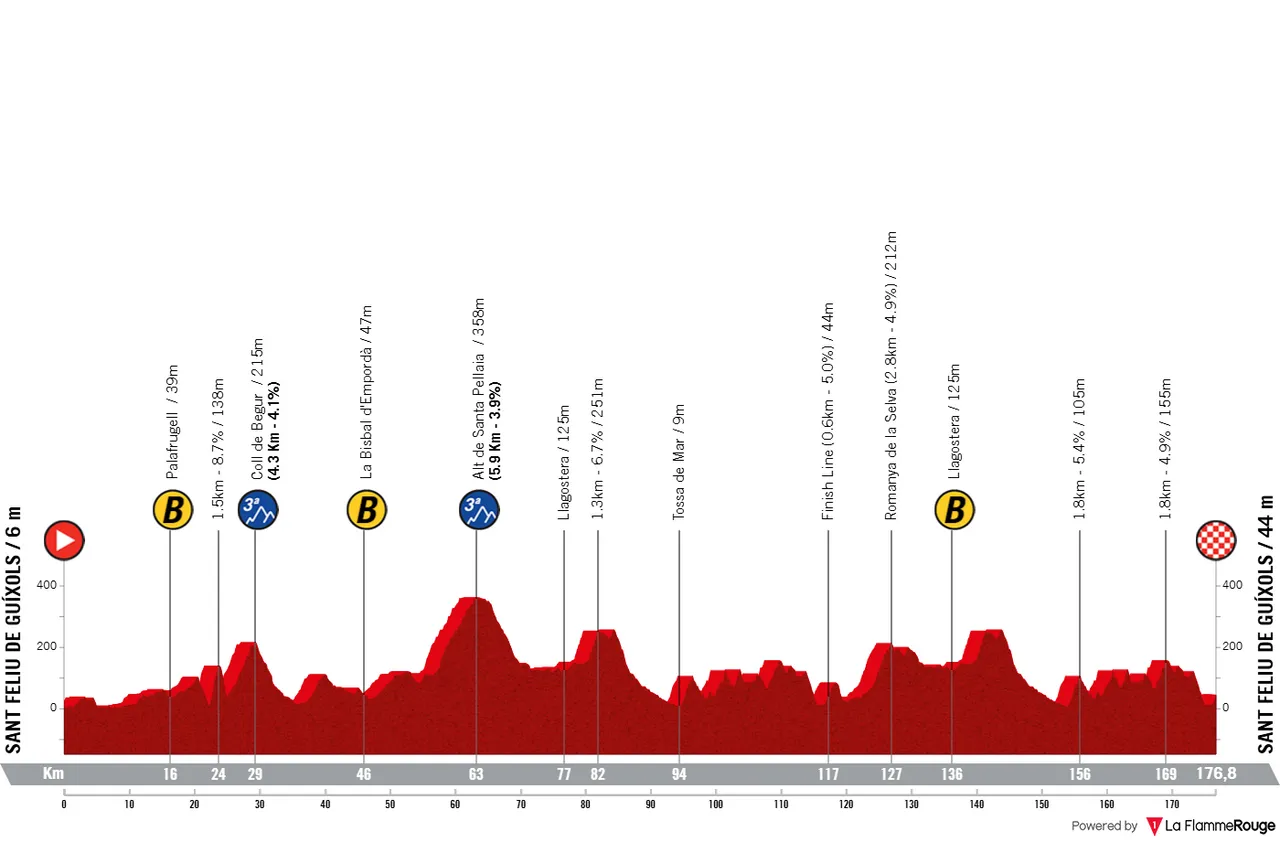
Stage 1: Sant Feliu de Guixols - Sant Feliu de Guixols, 176.7 kilometers
The seven-day race begins once again in Sant Feliu de Guíxols where some sprinters and puncheurs will fight for victory in the same uphill finish as the past few years. The stage features a few ascents early in the day where a strong breakaway can be formed.
Before the riders go on to finish the race, they find another small hilltop ends with 7.8 kilometers to go, and then most of the way into town is a very fast and twisty descent.
The final 750 meters then have a 5% gradient. It is not nothing, sprinters will certainly arrive here but this is an effort of over a minute that can be all-out from bottom to top. A sprint is almost certain but some riders will not have the legs, whilst some puncheurs and climbers may surprise because they will be better capable of putting in an actual sprint.

Stage 2: Banyoles - Figueres, 176.1 kilometers
Stage 2 should be another day for the sprinters but again there is a meaningful obstacle. There are a couple climbs in the middle of the stage that are decently hard, and if pushed it can certainly cause irreparable damage to the peloton. They will be 4.8Km at 5% and 7.7Km at 6.4%, the latter ending with 79 kilometers to go - still two hours of racing left at this point.
The road is not pan-flat then towards Figueres but there is no major obstacle and a bunch sprint is likely. This will be an interesting one though, not technical at all but with an uphill ramp to the line in the final 500 meters.

Stage 3: Viladecans - La Molina, 218.6 kilometers
Stage 3 takes the riders into the Pyrenees for the well known finale into La Molina. A mountain stage with quite a lot of climbing towards the end - where differences are of course expected - however the gradients in all of the climbs are relatively shallow and so the strongest might find themselves in a tactical battle above all.
It is a long day however and one finishing almost 1700 meters above the starting altitude. The spotlight will be on the final two ascents, the first one quite long with 20 kilometers at over 5% which will ultimately split things up and thin down the peloton - but don't expect any major attacks.
The summit finish will be at La Molina at 1692 meters of altitude, not the toughest of summit finishes but one where the endurance aspect may prove crucial. 8.3 kilometers at 6.5% makes the first and hardest part of the climb, before a small descent that allows for some recovery. However, the explosive uphill ramp to the line at 10% always make for an interesting finale.
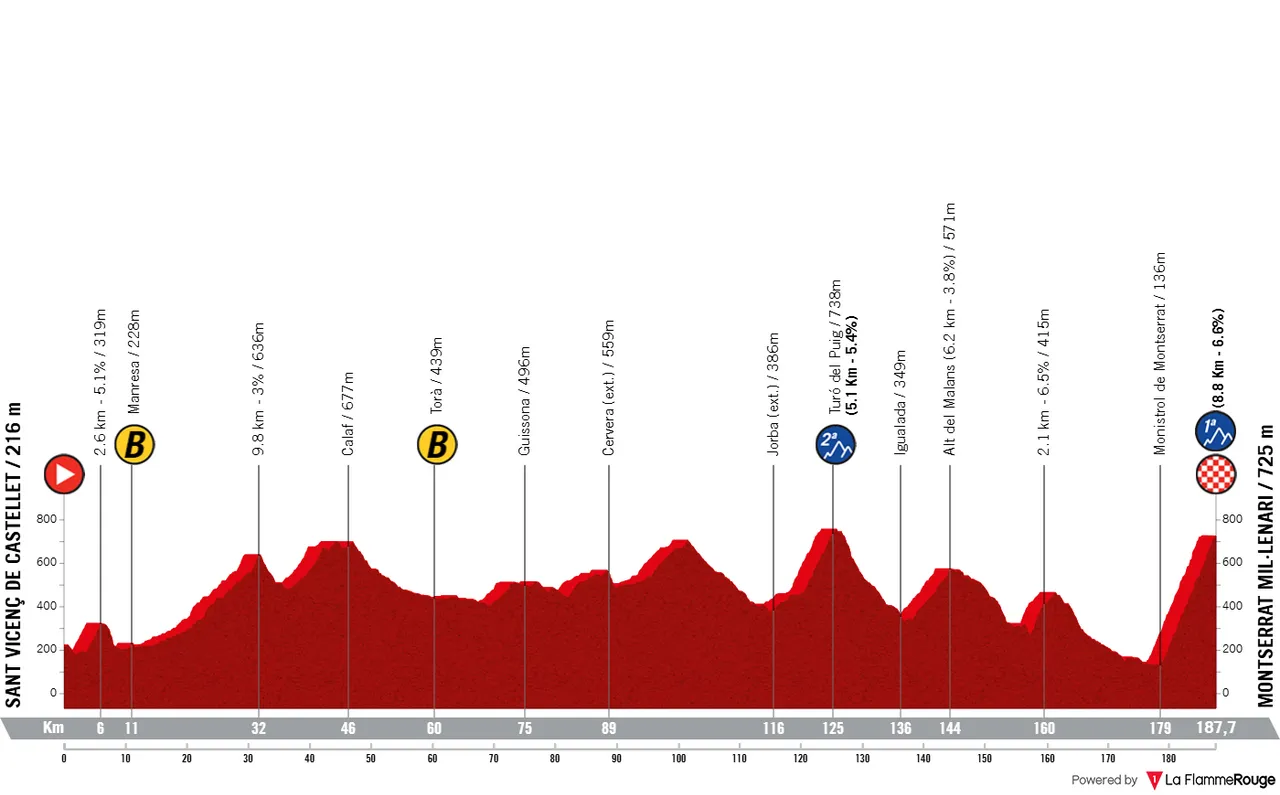
Stage 4: Sant Vicenc de Castellet - Montserrat, 187.7 kilometers
Stage 4 is where the race organizers innovated this year, bringing in a day packed with small climbs but all in anticipation to the final one in Montserrat. The typical 'rompe-piernas' kind of day, where the fatigue will build throughout the day. There are 300 meters of climbing on the day, but all eyes will be on the final climb and for good reason.
The ascent is 8.8 kilometers long at 6.6% and it should be ridden at an incredibly high pace. An explosive climbing effort when comparing to the other two mountain stages, it can also potentially favour some riders that would ordinarily not be able to make the difference.

Stage 5: Terres de l'Ebre (Paúls) - Terres de l'Ebre (Amposta), 172 kilometers
The easiest stage of the race - even though early on we've got some climbing. However on this day, ridden in and around the Terres de l'Erbre, the sprinters will have their way in what is a completely flat finale.
There isn't much to analyse on this day, and the truth is we should have a regular bunch sprint on a finale that has nothing technical about it.
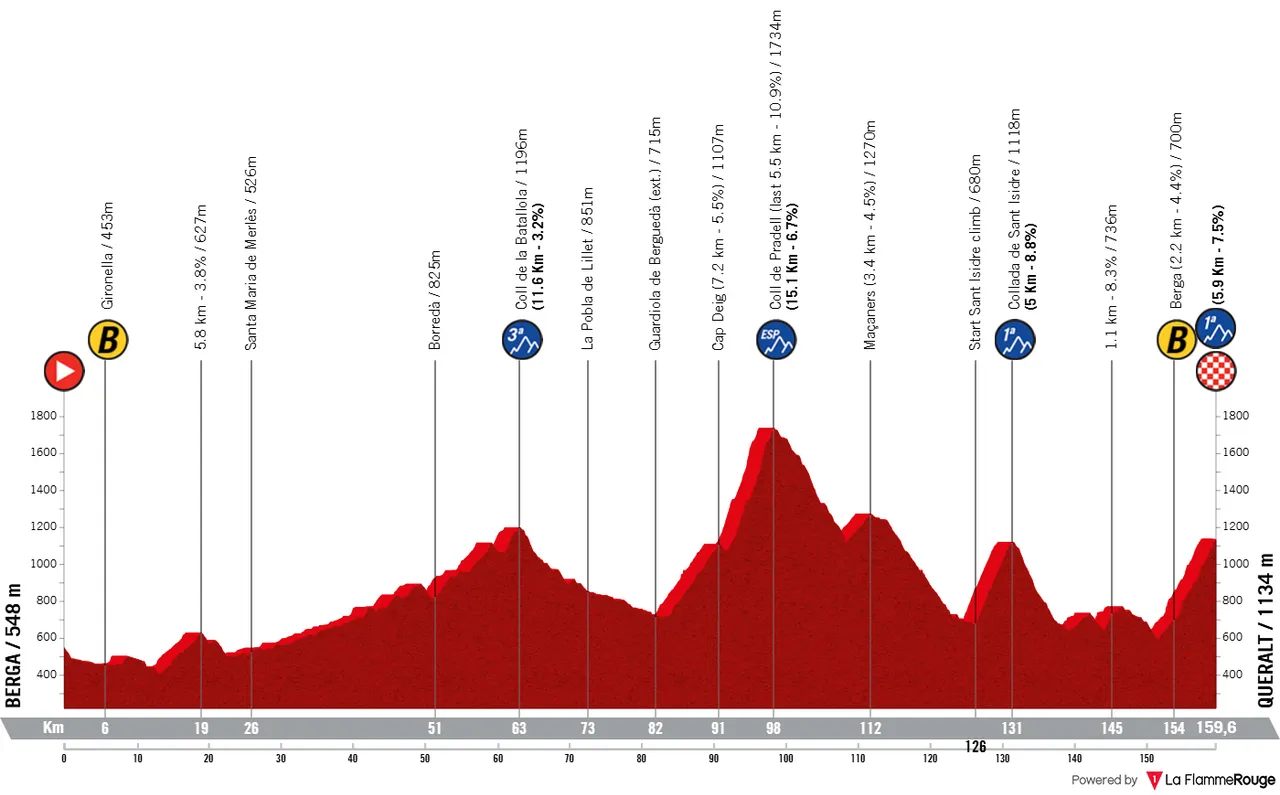
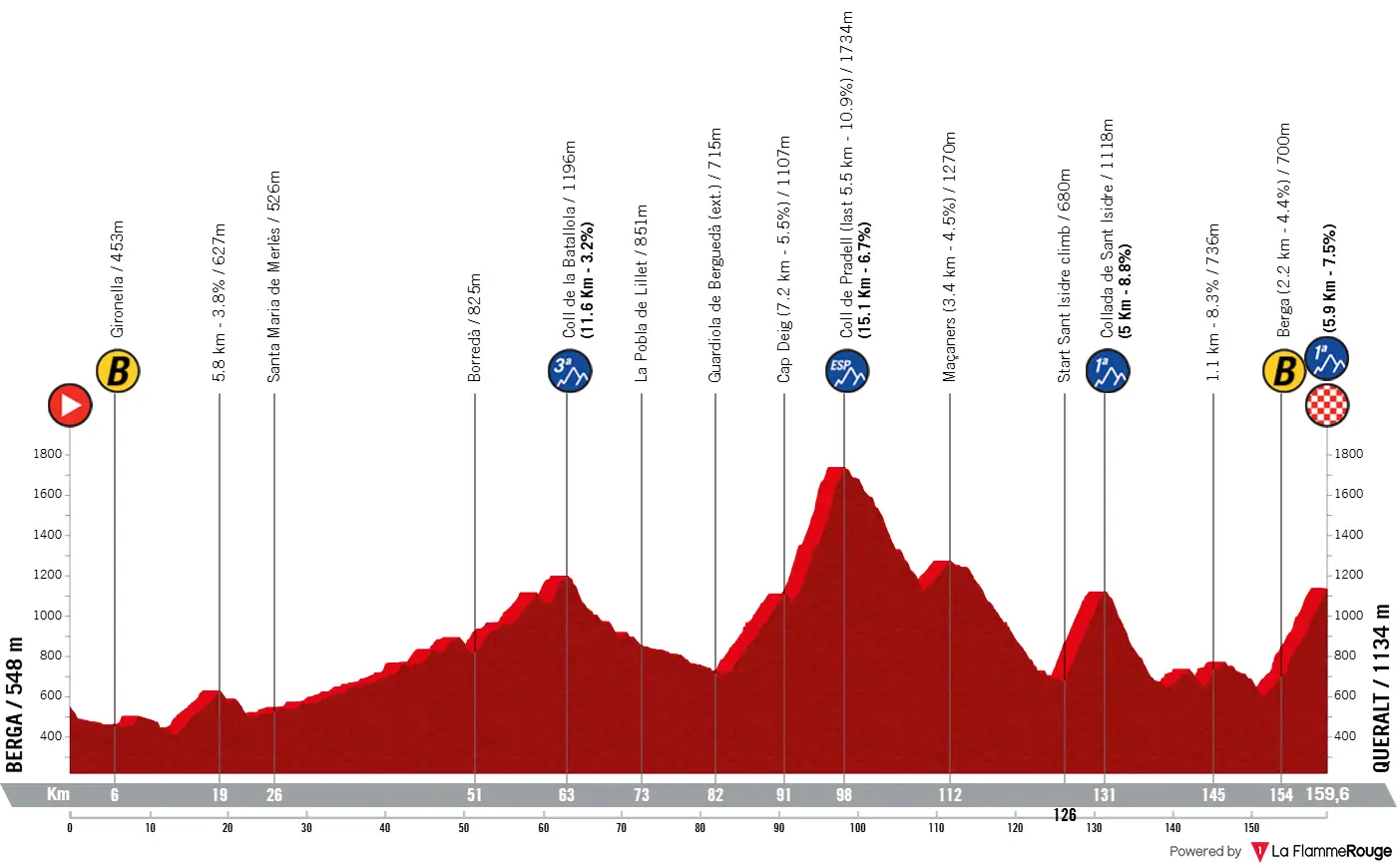
Stage 6: Berga - Queralt, 159.6 kilometers
Stage 6 has a summit finish at Queralt, which comes in a day with six categorized climbs including a special category halfway through the day. A new challenge that should seal the overall classification in what is a short day of racing. However, despite having only 154 kilometers in distance, there are a whole 3800 meters of climbing.
Early in the day they are not too hard, they are slight ascents that are rather inconsistent, featuring false-flat roads and some slight ascents where groups can go up the road. However there won't be too much relaxing time. The descent off the second one leads directly into the brutal Coll de Pradell.
This climb is brutal. 14.7 kilometers at 6.9%, it's one of two halves. The first 7 kilometers are at a constant 5-6%, then there is a small descent even, and then the final 6 kilometers which average 10% average. In here, the grades go up to a crazy 18% and it's not a short ramp. This ascent is the hardest of the race and could blow the entire race apart, ending with 60 kilometers to go.
A long descent follows - with a small hilltop in the middle which leads into climb number four of the day - when it comes to the categorized ones. It's 4.9 kilometers at 8.8% which ends with 28 kilometers to go. Another very hard climb where attacks can happen, however it is possible that some riders will still wait for the final one.
After a set of rolling roads the riders return to Berga but head into the Santuario de Queralt. It is not the hardest climb of the day, but after so much fatigue it can still make serious differences. 6 kilometers at 7.3%, it will be a proper and scenic finale to a brutal day of racing.
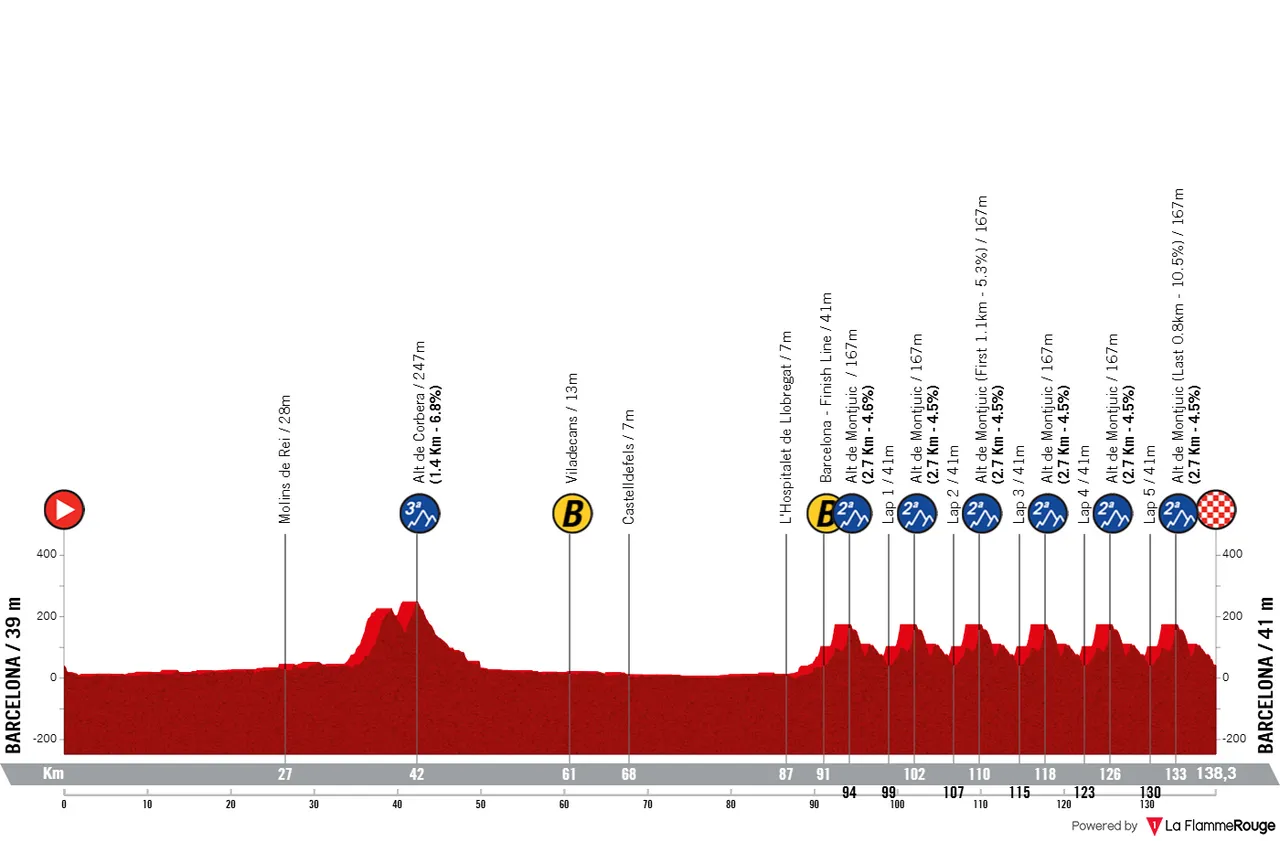
Stage 7: Barcelona - Barcelona, 138.2 kilometers
The final day, the traditional circuit in Barcelona. Regularly, a day for a breakaway, however many scenarios can decide such a day. There are only 138 kilometers to be ridden, as the riders leave Barcelona and have a mostly flat profile until coming back.
The race is to be decided in the final circuit though. Six laps over the Alto de Montjuic, it’s a tough circuit, which usually benefits early attackers as there is almost no flat within it’s 8 kilometers. The descent off the Montjuic is very fast and allows riders to take a rest after every ascent.
Ascent which is 2.4 kilometers at 4.7%, however the gradient is very misleading as it includes a flat section. The true hilltop is quite explosive, it has 900 meters at 10% which is enough to create damage in the peloton, and also splits that may prove crucial for the overall classification. In the final lap, it will come only 5 kilometers away from the summit, all of them downhill except for a small uphill pitch next to the city’s Olympic stadium, 2 kilometers away from the finish.
🚴♂️ Aquest és el 𝐫𝐞𝐜𝐨𝐫𝐫𝐞𝐠𝐮𝐭 𝐜𝐨𝐦𝐩𝐥𝐞𝐭 de la Volta a Catalunya masculina 2025!
— Volta a Catalunya (@VoltaCatalunya) March 14, 2025
🗺️ ¡Aquí tenemos el 𝐫𝐞𝐜𝐨𝐫𝐫𝐢𝐝𝐨 𝐨𝐟𝐢𝐜𝐢𝐚𝐥 de la #VoltaCatalunya 2025!
😍 The 𝐨𝐟𝐟𝐢𝐜𝐢𝐚𝐥 𝐫𝐨𝐮𝐭𝐞 for #VoltaCatalunya104! pic.twitter.com/iwRRWNkADn
Rúben SilvaEditor-in-Chief
A founding contributor to CyclingUpToDate since its launch in January 2022, Ruben Silva has played a central role in shaping the site’s editorial direction and long-term growth. Before joining the project, he built his experience through independent blogging at Echelons Hub and by producing race previews for Ciclismo Internacional, developing a strong analytical voice rooted in daily engagement with professional cycling.
Beyond editorial work, he has been closely involved in the expansion and coordination of CyclingUpToDate’s wider network, helping establish and support sister platforms across multiple languages. This includes ongoing collaboration with CiclismoAlDia (Spanish), CiclismoAtual (Portuguese), WielrennenUpToDate (Dutch), and RadsportAktuell (German), contributing to a shared editorial vision and consistent international coverage.
He also helps oversee editorial governance across the network, setting standards for accuracy and consistency and coordinating updates or corrections when needed.
Originally from the Porto metropolitan area in Portugal, he holds a bachelor’s degree in Geography. His path into cycling journalism was shaped not through formal media training, but through independent reporting, community engagement, and sustained on-the-ground involvement in the sport.
Over the course of his career, he has conducted approximately 100 interviews across road cycling and cyclocross, ranging from one-to-one conversations and online formats to press conferences and on-site pre- and post-race coverage. His interviews include leading riders, team managers, and prominent figures within cycling media: Tadej Pogacar, Jonas Vingegaard, Mathieu van der Poel, Primoz Roglic, Wout van Aert, Joao Almeida and Tom Pidcock; managers like Patrick Lefevere and Joxean Matxin; and YouTube personality Bryan Kennedy (BKXC)...
Within 18 months of launch, he helped grow CyclingUpToDate’s English-language platform into one of the most-read cycling news websites, built entirely from the ground up. As both a professional journalist and lifelong cycling enthusiast, his focus remains on delivering accurate, timely, and well-contextualized coverage.
claps 1visitors 1
Just in
Popular news
Latest comments
- Hope he is given free rein. Great and underated rider who should be given leadership with team. The amount of times he has worked his socks off for other winners. Pedersin would not have won the jersey or stage if QS had been allowed to attack. Pederson is a classics guy where QS can adapt to all classics and stage races.paultryan200227-11-2026
- proof readers were fired a long time ago ...Ketterechts27-11-2026
- There’s no way he’s missing 2027 Worlds! Not by choice anyway!Lozza27-11-2026
- You all know what the funny thing is? When Pogi won the Tour in 2020 and started getting better and better, everyone was saying, the media and the cycling experts, that Pogi faces much bigger competition in this era of cycling than Merckx did in his. Pogi's main rivals were and still are: Jonas Vingegaard, Primož Roglič, MVDP, V. Aert, Remco... today also Seixas. But then somethind happened; in 2024 the "improved version" of Pogi came out and started beating everyone. He was beating his strongest competition and because of that... oh, Pogi suddenly doesn't have strong competition anymore???? Hey Merckx, stop your BS crap, stop finding new excuses against Pogi and admit that he's the biggest athlete, not only cyclist, that ever lived on our planet. Ad acta!!!PogiSloFans27-11-2026
- Kalender skillzMidnightRider27-11-2026
- last year was 2025vanja27-11-2026
- i guess we should be happy they did 't say 'Mathieu VanDer Poul sprinted to victory' 🤣Zone0Rider27-11-2026
- i dont know what he is talking about. Pogi was defeated by Jonas Twice and MVDP doesn't allow him any respite in the classics. You dont need many opponents to make your life difficult , you need just one.abstractengineer27-11-2026
- he lost his factory ride as Cannondale Factory Racing ended their MTB team. probably looking for more opportunities.mij27-11-2026
- hello he aint a domestic or super domestic , he is a genuine 3 week GC rider capable of winning. I wouldnt be surprised with his stance that he never wins a TDF just settles for runner up. . must be a well paid lackie.go figure
 Davide26-11-2026
Loading
Write a comment