"A lot of riders are able to survive the first attack of Pogacar" - Nathan van Hooydonck explains Tadej Pogacar's Milano-Sanremo hoodoo
Cycling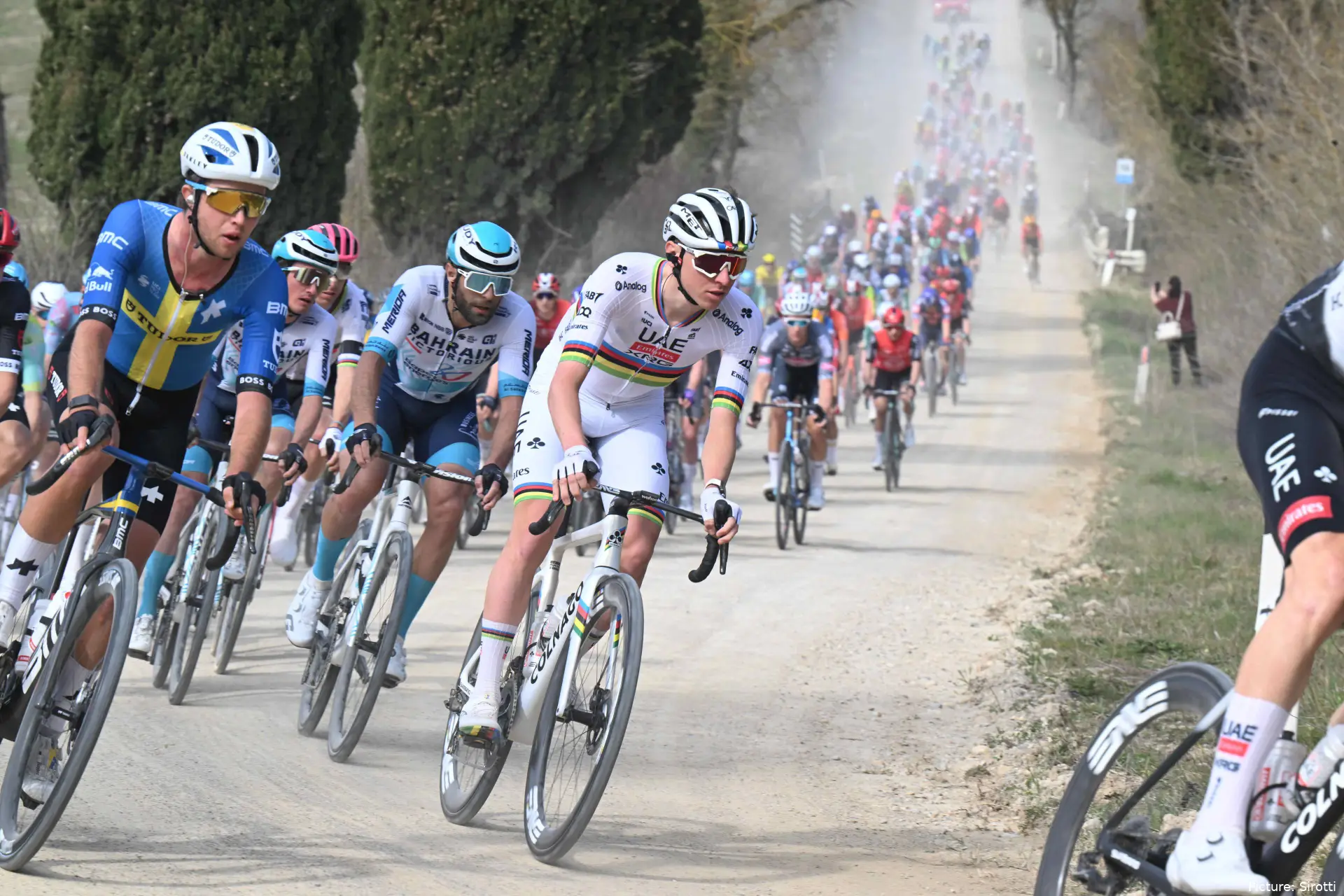
When Tadej Pogacar sets his sights on winning a race, there is usually only one outcome - the Slovenian crossing the finish line with his arms aloft in celebration. For that reason, the lack of success Pogacar has had at Milano-Sanremo over the years sticks out as a point of note. So just why has the UAE Team Emirates - XRG leader found winning Milano-Sanremo so difficult?
Well according to former Team Visma | Lease a Bike rider and now Eurosport pundit Nathan van Hooydonck, the answer is actually pretty simple. Milano-Sanremo is simply too easy for Pogacar to create real separation. "It's not hard enough for him, I think. He's definitely the strongest rider of his generation, the most versatile rider of his generation, but this race is super long, the concentration of difficulty is completely towards the final [parts of the race]," explains the Belgian on TNT Sports' Ultimate Cycling Show.
"It's difficult, but not too difficult, and a lot of riders are able to survive the first attack of Pogacar, some people are even able to match that attack," Van Hooydonck adds. "Whenever somebody is able to match that attack, tactics are going to play a role and then the race can go either way."

All of the talk surrounding Pogacar's Milano-Sanremo quest this year is about the Cipressa, a climb that is normally considered too early to make the winning move at Milano-Sanremo. "He's trying [to win it], he tries every year. On the Cipressa, the climb before the Poggio, it's a longer and harder climb than what the Poggio is," adds former British national champion Adam Blythe. "The last two years, he's really tried on there to split things up. But there's such a gap between the climbs where it's on the coast, and there's not enough climbing on there to make it hard, the groups will probably always come back together."
"For me, that's his problem. If it was closer together, he could attack earlier on the Cipressa. But I think there's 15 or 11 kilometres in between those climbs. It's a chance for him to recover, but it's also a chance for the sprinters to recover as well," continues Blythe. "If you can follow the first attack of Tadej, then it becomes a tactical battle, but when there are more people involved in a tactical battle, it becomes increasingly hard to win, because there's one rider going this way, one rider going that way, whereas Tadej has got one job to do and all eyes, sadly for him, are on that one move, so it becomes increasingly harder for him to win."
So ultimately, whilst Blythe doesn't fully rule Pogacar out (who would!?), the Brit doesn't believe the world champion will prevail this weekend. "I think it's becoming increasingly harder for him to get away because riders are changing the way they're training, becoming adapted to races such as this," he concludes. "I don't think he can't win it, but it's going to be harder and harder and harder to win it."

Pogacar took a dominant win at Strade Bianche last time out
"He can definitely win it," Van Hooydonck insists in response to Blythe. "The Cipressa is the climb coming just before the Poggio, but the Cipressa is hard enough if you can ride a very fast pace from the bottom to the top. Tadej Pogacar cannot do it by himself, he needs his team to do so."
"His team needs to pace as fast as possible from the bottom to the top and that's how you can put the different sprinters under pressure and you can already distance them," he concludes. "Once he gets his team-mates over the Cipressa and onto the Poggio, they can again start riding a very, very fast pace and then he can launch the decisive attack."


Kieran WoodDeputy Editor-in-Chief
Kieran Wood is a sports journalist based in Wales and has been active in journalism since 2022. He regularly contributes to DartsNews.com and CyclingUpToDate.com, where he covers professional cycling and darts. In cycling, his work includes liveblogs from major races, including the Tour de France, the Giro d’Italia, and La Vuelta a España, alongside race reports and analysis. He has also conducted interviews with professional riders.
His reporting spans the full racing calendar, from one-day classics to stage races, with a focus on accurate, real-time coverage and clear contextual analysis. For statistics, results, and historical context, he regularly uses resources such as ProCyclingStats. To support reporting on rider activity and training context where relevant, he also references Strava.
In his work, Kieran places strong emphasis on careful sourcing, editorial accuracy, and updating articles as new, verified information becomes available.
claps 2visitors 2
Just in


Popular news
Latest comments
- Are you MrMauMau 2.0? Nothing you are saying is really relevant. Vaguely connected, but irrelevant. The conversation is whether Schreiber impeded Brand or not.
 Rafionain-Glas08-11-2026
- He is boring
 leedorney08-11-2026
- To Twoje przemyślenia te bla, bla :)
 Dariusz08-11-2026
- Uwielbiam patrzeć, jak wyjeżdża na czoło peletonu i zaczyna się rzeź...Dariusz08-11-2026
- Yeah, unreal.
 parisbound0008-11-2026
- there needs to be space in life for pointless comments!Ketterechts08-11-2026
- That is a very lazy way of putting it but so far on this website it seems like everyone is happy to look at everything lazily, even things that annoy them intensely. All they want to do is state their feeling and position but ask most to analyse a problem or come up with solutions or improvements and you’re stunned by silence. Nobody even really knows how this all happens. It’s very simple and quick to just say the UCI did it but I bet you they didn’t, I bet you not more than 2 people were involved, more likely just 1. The UCI may be ultimately responsible but it is not their decision, this is about hierarchy, power and delegation. The fact that protest is possible also means it isn’t over and that MORE people could get involved for a thorough review which could throw up anything. It is highly likely it was a sole commissar who decided and has that power in a first round. Therein might lie the problem the UCI has to consider, is it acceptable to give so much authority to one single person when it is quite possible for them to have a natural bias or be too easily susceptible to imposed bias. Who is to say an individual in this position isn’t susceptible to collaboration with outside players with interests in the results, nations, families, teams, betting companies, etc. On the one hand we have sports where these problems have been worked on way more to reduce such problems, on the other hand we have sports with far stricter and more draconian rules not even concerning safety or obstruction that nobody really questions like false starts or stepping out of lane or zones in athletics. If cycling hastowork on itself, it would be good if protagonists (all kinds) would start doing a little more than just moaning over outcomes.Jumpyjohn08-11-2026
- Yes, so why not make comments less pointless?Jumpyjohn08-11-2026
- What a race! I didn't expect Vanthourenhout to collapse like that, and Wyseure did take the fight to Nys, but there was no doubt at the end. I also wonder what Aubin Sparfel would be capable of were he to race in the elites now. In the U23 ranks he is making good work of Giel Lejeune, who himself is among the better riders in the elites, and a top 10 contender in the big races (3rd at Kleebergcross, 8th at Berencross and 5th at Heerderstrand). In the French Cup, Sparfel is significantly better than Romain Debord (8th at Koppenbergcross and 10th at the Euros) and Rémi Lelandais (12th at Koppenbergcross and 19th at the Euros).Rafionain-Glas08-11-2026
- There really was nothing in it. Schreiber was so much faster, and Brand was fighting to stay in the wheel in the sprint. Schreiber did move a bit, but to say she closed the door doesn't make sense because Brand couldn't enter it anyway, abd she wasn't impeded.Rafionain-Glas08-11-2026
Loading
1 Comments