Yesterday, Geraint Thomas bid farewell to professional
cycling on a fitting stage, at home in Wales, completing his final race at the
2025 Tour of Britain. The 39-year-old Welshman ends a 19-year career that has
spanned track and road, humble support roles and Tour de France glory. Famously
self-deprecating, Thomas might downplay the fanfare, but the spotlight rightly
falls on a rider who gave so much to others’ victories while amassing plenty of
his own. This analytical look back covers his journey from an eager Cardiff
schoolboy to an Olympic champion, Tour de France winner, and a beloved figure
in British cycling. It examines the highs and the lows, that defined Thomas’s
career.
Track beginnings
Geraint Howell Thomas was born on 25 May 1986 and raised in
Cardiff, Wales. Growing up on the outskirts of Cardiff, Thomas lived just a
stone’s throw from the Maindy cycling track. “If I didn’t live so close to
Maindy or if I didn’t live in Cardiff, I may never have ridden a bike, never
have had the career I had, the life I’ve had,” Thomas reflected to the BBC.
By 2006, he was on the British Cycling Academy and even
earned a stagiaire (trainee) spot with pro team Saunier Duval, gaining valuable
experience on the road. Thomas then signed his first professional contract with
the Barloworld team in 2007, setting the stage for the next chapter of his
journey.
Golden era on the track
Before fully focusing on road racing, Thomas built an
impressive palmarès on the track, contributing to a golden era for British
track cycling. As a team pursuit specialist, he claimed three World
Championship titles and was part of Great Britain’s all-conquering team pursuit
squads at the Olympics.
He struck Olympic gold in Beijing 2008 and again on home
soil at London 2012, each time helping Britain’s quartet smash the world record
en route to victory. Those back-to-back Olympic gold medals underscored
Thomas’s status as an elite track rider. He also accumulated multiple
Commonwealth Games medals on track, including a gold, representing Wales.
Thomas’s track success earned him an MBE in 2009 at just 22 years old, and
later, after his Tour de France heroics, an OBE in 2019.
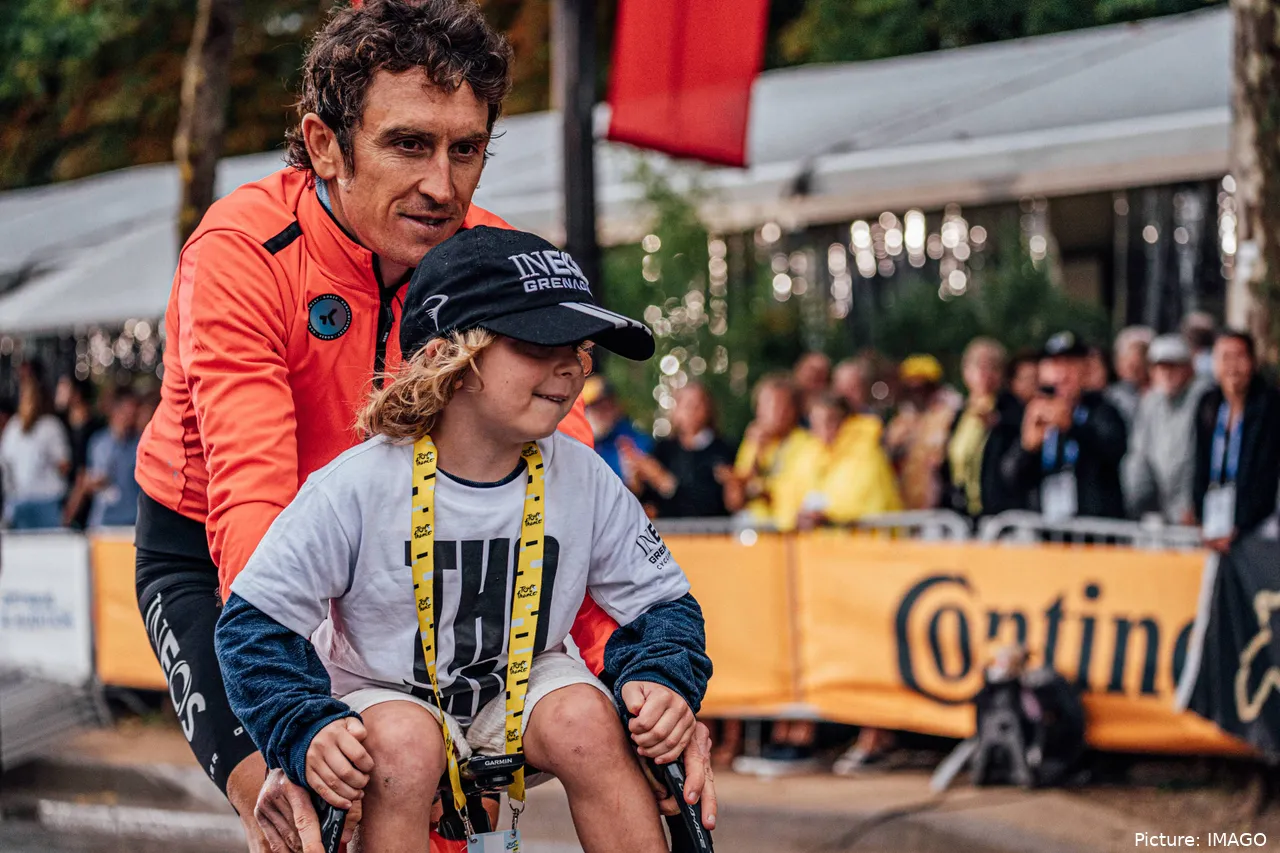
Geraint Thomas waved goodbye to the peloton on Sunday
Team Sky
Thomas entered the top tier of road cycling just as a
cycling revolution was underway in Britain. He made his Tour de France debut in
2007 at age 21, the race’s youngest rider that year, but his break came in 2010
with the launch of Team Sky.
Thomas was signed to the ambitious new British team from its
inception, beginning what would be a 16 year stint with the team (Team Sky
later becoming Team Ineos and Ineos Grenadiers). In Sky’s debut Tour de France
in 2010, Thomas immediately made an impact: he won the British National Road
Championship that year and then wore the Tour’s white jersey of best young
rider after a strong first week.
Over the next few seasons, Thomas became a dependable
domestique deluxe for Sky’s grand tour leaders while still developing his own
abilities. In 2013, he famously rode the Tour de France with a fractured
pelvis, crashing on stage one yet soldiering on to Paris in support of Chris
Froome’s first yellow jersey.
By the mid-2010s, Geraint Thomas had proven himself a true
all-rounder. He could muscle over cobblestones in Flanders, drill a team time
trial, or pace high mountains in the Alps. In 2015, Thomas hit new heights with
a breakthrough classics win at E3 Harelbeke, becoming the first British rider
to win that prestigious Belgian one-day race. In the 2015 Tour de France, he
played a crucial support role to Froome’s win and impressively held 4th place
overall himself as late as stage 18, showing
he had grand tour potential himself.
He carried that momentum into 2016, which saw him clinch Paris–Nice,
one of cycling’s biggest week-long races, with a victory over Alberto Contador.
With another repeat win at Algarve and strong showings in the spring, Thomas
was now viewed as a legitimate stage race leader. He still dutifully aided
Froome to another Tour de France title in 2016, even while finishing 15th
overall himself.
Yellow jersey dream
All the pieces fell into place in 2018, the crowning year of
Geraint Thomas’s career. The season began strongly with podiums at
Tirreno–Adriatico and the Tour of the Algarve, and a victory at the Critérium
du Dauphiné, the most important Tour de France warm up race. Even so, Thomas
entered the 2018 Tour de France officially as a co-leader alongside Chris
Froome.
There was nothing “co” about the leadership however.
Midway through the Tour, in the high Alps, Thomas attacked
to win Stage 11 (La Rosière) to take the yellow jersey, and then won again atop
the legendary Alpe d’Huez on Stage 12. Those back-to-back mountain wins,
especially conquering Alpe d’Huez in the maillot jaune, were iconic moments
that symbolized Thomas’s transformation from helper to champion.
He carried the race lead unflinchingly through the Pyrenees
and into Paris, defending against all challengers along the way. On July 29,
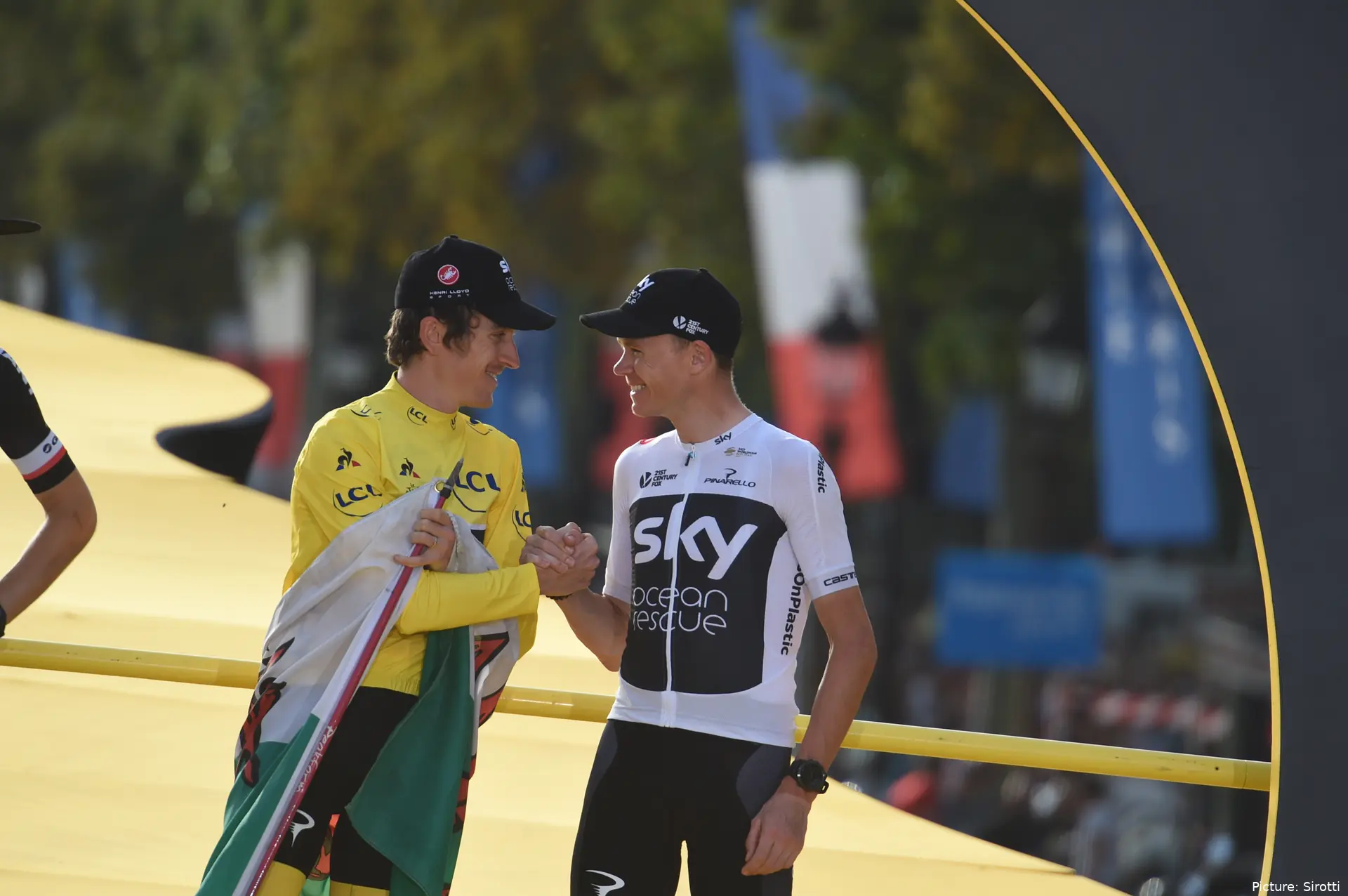
2018, Geraint Thomas became the first Welshman ever to win the Tour de France,
joining Sir Bradley Wiggins and Chris Froome as only the third British male to
do so.
His victory was celebrated across Britain. Riding to the
Champs-Élysées with a Welsh flag draped over his shoulders, Thomas cemented his
status as a national hero. That winter he was named BBC Sports Personality of
the Year, edging out Formula 1’s Lewis Hamilton and footballer Harry Kane in a
public vote. A month after the Tour, 8,000 fans packed Cardiff Castle for his
homecoming celebration, and the Welsh National Velodrome in Newport was renamed
the Geraint Thomas National Velodrome in his honour.
Setbacks
Thomas’s journey to the top was anything but smooth, and
even after reaching it, he continued to experience cycling’s cruel twists of
fate. Broken bones became an unfortunate theme throughout his long career. In
addition to the 2013 fractured pelvis (which he astonishingly endured through
the entire Tour), he crashed out of the 2017 Giro d’Italia as co-leader after a
freak incident with a stray motorbike, ruining a shot at the podium. Just weeks
later in the 2017 Tour de France, after a brilliant opening time trial win that
put him in the yellow jersey for four days, Thomas crashed on a descent during
Stage 9 and exited with a broken collarbone.
He kept picking himself up. In 2019, wearing dorsal number 1
as defending Tour champion, Thomas faced another challenge: a crash before the
Tour and the rapid rise of a young teammate named Egan Bernal. Thomas battled
through the Alps in a leadership duel that was ultimately decided by
weather-shortened stages. He finished second overall in the 2019 Tour while
helping Bernal secure the win, even fending off France’s Julian Alaphilippe to
do so. Gracefully accepting the runner-up spot, Thomas proved himself a team
player yet again, though he had firmly established that 2018 was no fluke.

Thomas and Cavendish were close friends off the bike too
The following years saw more twists. The pandemic-disrupted
2020 season saw Thomas target the Giro d’Italia instead of the Tour, only to
crash on Stage 4 after hitting loose debris, suffering a fractured pelvis and
an agonizing exit. Undeterred, he came back in 2021 to win the Tour de Romandie
and contend at the Dauphiné, but bad luck struck at the Tour de France where an
early crash left him injured and out of GC contention.
In 2022, at age 36, when many riders contemplate retirement,
Thomas hit another late-career high. He won the Tour de Suisse, becoming the
first Briton to do so, and then rode a brilliantly consistent Tour de France to
place third overall behind much younger stars (Jonas Vingegaard and Tadej Pogacar).
Thomas’s final GC battle came at the 2023 Giro d’Italia,
and it encapsulated the highs and lows of his career. He led the race for
several days and entered the penultimate stage in the pink jersey, only to have
victory snatched away in the final time trial by a surging Primoz Roglic.
Thomas finished a heart-breaking second by just 14 seconds.
The final years
Through all the ups and downs, Geraint Thomas remained a
constant presence on Britain’s premier pro team. As Team Sky evolved into Ineos
Grenadiers, Thomas became the core of the team: a road captain, mentor, and
link to the squad’s founding ethos of excellence. Such was his leadership, that
rumours suggest he will be moving into a management role in 2026.
Fittingly, Thomas chose to conclude his career on his own
terms. He announced earlier this year that the 2025 Tour of Britain would be
his final race, a “farewell tour” winding from England to his hometown of
Cardiff: “I just feel so lucky to be able to call time on my career on my own
terms, when I’m finishing and even more lucky to decide where as well”
The Tour of Britain last week turned into a rolling
celebration of his career, huge crowds turned out daily for autographs and
selfies, far more interested in Thomas than the race’s outcome. Ever modest,
Thomas balanced racing with soaking up the adulation: “It’s racing, but I’ve
also been enjoying it and doing the whole fan thing because I feel like it’s
going to be the last time that I do it… I’ve been enjoying it because soon
people won’t be asking for selfies and autographs.”
On Sunday, 7 September 2025, Geraint Thomas rolled down the
start ramp one last time and a few hours later crossed the finish line in
Cardiff to close out his professional racing days. He admitted beforehand that
“it’s obviously going to be emotional come the end in Cardiff… to finish my
career when I want is rare for an athlete, so to be able to do that on home
roads and into Cardiff, I feel really lucky.”
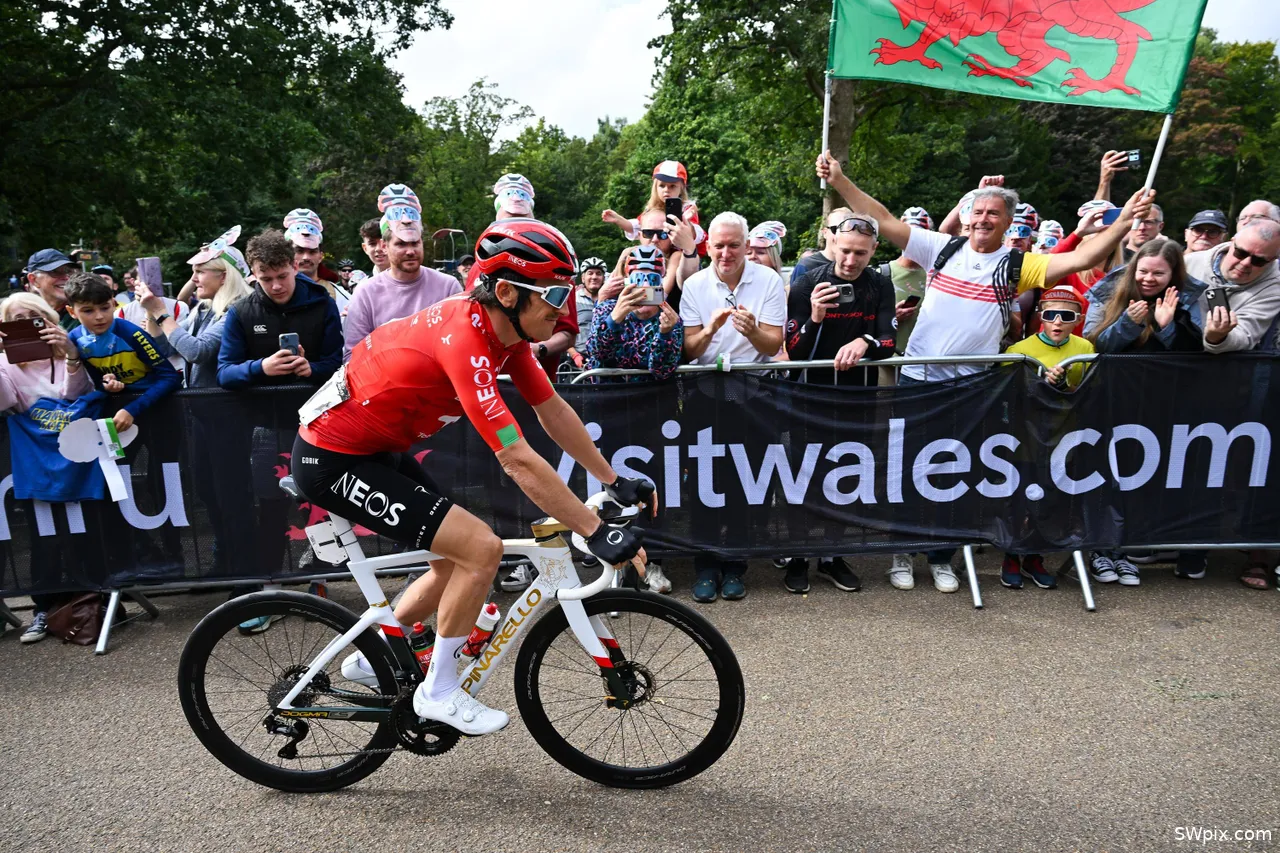
Geraint Thomas in Pontypool Park, Wales
Sure enough, as he completed the final stage, tears flowed
from Thomas, from his family and friends waiting at the line, and from
countless supporters lining the streets of the Welsh capital. Wearing a special
red dragon-emblazoned jersey designed for the occasion (complete with a sketch
by his young son on the back), Thomas took a slow lap of honour in Cardiff.
A true legend of British cycling
Geraint Thomas retires as one of Britain’s most decorated
and influential cyclists, and his legacy extends far beyond his race results.
He was part of a golden generation of British cycling, emerging from the same
grassroots that produced stars like Sir Chris Hoy, Victoria Pendleton, Bradley
Wiggins and Mark Cavendish.
Thomas’s career has been closely intertwined with British
Cycling’s rise on both track and road. His longevity (nearly two decades at the
elite level) meant he bridged eras: from the Beijing and London Olympic
domination, through Team Sky’s Tour de France dynasty, and into the present day
where a new wave of British talent is rising.
One moment sums up the sort of rider Thomas was more than
most. The day after his Giro 2023 heartbreak to Roglic, most riders would have
hidden and sulked in the shadows. Not Geraint Thomas. As the race came to a
close, he led out his friend Mark Cavendish to sprint for victory. That sort of
action is what makes Thomas a true champion and legend.
Thomas will be remembered as much more than an athlete who
won big races. He was the reliable lieutenant who could bury himself on the
front of the peloton for a teammate’s cause, and also the champion who never
forgot his roots at the Maindy track in Cardiff. As young teammate Sam Watson
put it, “All the British guys – the likes of G, Wiggins, Froome, Cav – were on
TV and inspiring. It’s special being in the race with G now… You learn from him
by watching what he’s doing.”
Looking ahead, Thomas isn’t straying far from the sport. He
has hinted at moving into a management or mentorship role with INEOS Grenadiers
after hanging up his wheels. With his vast experience, affable personality, and
respect within the community, he seems destined to continue shaping British
cycling’s future off the bike.
Thank You, Geraint
Geraint Thomas once said of the Tour de France, “I dreamt of
racing it, of winning it, but I never for a second thought I would. Kids from
Cardiff don’t ride the Tour.” Yet he did ride 14 Tours, and he won one.
In doing so, the kid from Cardiff became a legend far beyond it.
Thank you, Geraint Thomas, for the memories, the
inspiration, and the example of what a true sportsman can achieve. Diolch, G!
💛💛 @GeraintThomas86 💛💛 https://t.co/SwTDNORfwl
— Tour de France™ (@LeTour) September 7, 2025

Fin MajorCycling Journalist
Fin Major is a UK-based writer at CyclingUpToDate and has been part of the team since 2024. He is the site’s main writer for FAQs and evergreen explainers and has written around 2,000 pieces for the platform. Alongside this work, he focuses on in-depth analysis and covers the biggest races on the calendar, including the Tour de France, the Giro d’Italia, and La Vuelta a España, providing clear context around performance trends, tactics, and key storylines.
In his reporting, Fin uses reputable data sources such as ProCyclingStats for results, statistics, and historical context. He places strong emphasis on careful sourcing, editorial accuracy, and updating articles promptly when new, verified information becomes available. Outside of writing, Fin is an active cyclist, which supports his practical understanding of the sport and its demands.
claps 3visitors 3
Just in

Popular news
Latest comments
- What races would you like to see Pog ride next year?Hills3320-10-2026
- What great news for the team and how great for Sivakov to ride for a French phenom. He showed his loyalties to the Slovenian phenom (see worlds '24), and I'm sure his colleagues at UAE are congratulating him on a great move. Sivakov is a great rider, and moves like these are going to even out the playing field and make for more tactical races in the future, I hope. Yes yes, riders launch earlier than in the past, but it's a team sport, and the teams really do matter a lot.RidesHills20-10-2026
- Mind’s gone blank, SB?Jumpyjohn20-10-2026
- I do not understand where you find all this energy to comment everythings where we talk about Pogi, you have to do a collection You should learn about this last sentence of your comment tbhLaYaute20-10-2026
- Don’t agree with your redemption conclusion. It can just as well be disappointment from his side. We are systematically biased by the traditional use of the word, a recap of the use of redeem will remind you of the versatility redemption offers.Jumpyjohn20-10-2026
- Good news. I guess that means Seixas stays put after all? Must have missed an episode. Will be very curious to see how PS2’s performance evolves.Jumpyjohn20-10-2026
- I would prefer him to do the Giro and Vuelta, and leave Seixas, Remco and Jonas to fight it out in France. Btw 'redemption' implies he has disappointed us and has something to prove. I don't think he has anything to prove, but of course ticking off the Vuelta would be good. Pity he can't get a 'prior learning credit' for the first week in the Vuelta, and join in for the last two weeks!Hills3320-10-2026
- Bet you 90% of Slovenians will stop watching cycling once your boy stops. But. More pertinently, have you prepared for his retirement? I think you have extreme difficulties in understanding the difference between being a fan of cycling and being fan of a cyclist.Jumpyjohn20-10-2026
- I would keep a VERY open mind.Jumpyjohn20-10-2026
- Listen, maybe he did, maybe it’s more complicated but unless there are images* or witnesses, I wouldn’t go on stats alone. There are so many factors, terrain, wind, pacing, psychological/hormonal effects, etc. and that’s without consideration of Remco maybe changing his effort. As a rider I know all too well the effect of being overtaken can have, just like it’s always easier to push yourself when you are racing instead of training where you have no target to catch or pressure from behind. * obviously there is going to be a lack of commissaires in TTs to keep a constant eye on things but hey it’s 2026, these problems can be solved cheaply with on-board cameras or drones, they could even increase revenue and attractiveness through broadcasting right.Jumpyjohn20-10-2026
Loading
1 Comments