“Tim Wellens and Jonathan Narvaez will be missed” - UAE boss Gianetti admits Pogacar’s Milano-Sanremo dream has been complicated by injuries
CyclingThursday, 19 March 2026 at 13:00

For all the attention on Tadej Pogacar, Mathieu van der Poel and the familiar question of how Milano-Sanremo will be won, Mauro Gianetti has put his finger on a less glamorous part of the problem for UAE Team Emirates - XRG.
The route has not changed. The tactical dilemma has not changed. Pogacar still needs to make the race hard enough on the Cipressa or Poggio to crack one of the few rivals capable of surviving his violence. But heading into this year’s edition, UAE are trying to solve that puzzle without two of the riders best suited to helping him do it.
Speaking to Cyclism'Actu, Gianetti admitted the absence of Tim Wellens and Jonathan Narvaez matters precisely because of how specific Milano-Sanremo is. “The qualities of Tim Wellens and Jonathan Narvaez in this specific race - being able to position themselves well without spending too much energy, then still having the resources for very high speed on the Cipressa - will be missed,” he said.
That is not a minor detail in this race. It goes to the heart of the modern Pogacar problem at Sanremo.
Why those absences matter so much
Milano-Sanremo has long resisted simple solutions, but in Pogacar’s case, the challenge has become unusually clear. He does not need to prove he can light the race up. He has already done that. He has turned the finale into something far more selective than the old sprinters’ classic image suggests, most clearly in 2025 when his attack on the Cipressa detonated the race and left only Van der Poel and Filippo Ganna able to stay with him.
The issue is what comes before that move, and what remains after it.
To give Pogacar the best possible launchpad, UAE need riders who can guide him into the crucial sector, save his energy, thin the bunch and raise the pace before the killing blow. That is why Gianetti’s explanation of Wellens and Narvaez’s importance carries so much weight. He was not talking vaguely about strong teammates. He was describing exactly the kind of riders this race demands. “They are experienced riders,” Gianetti said.
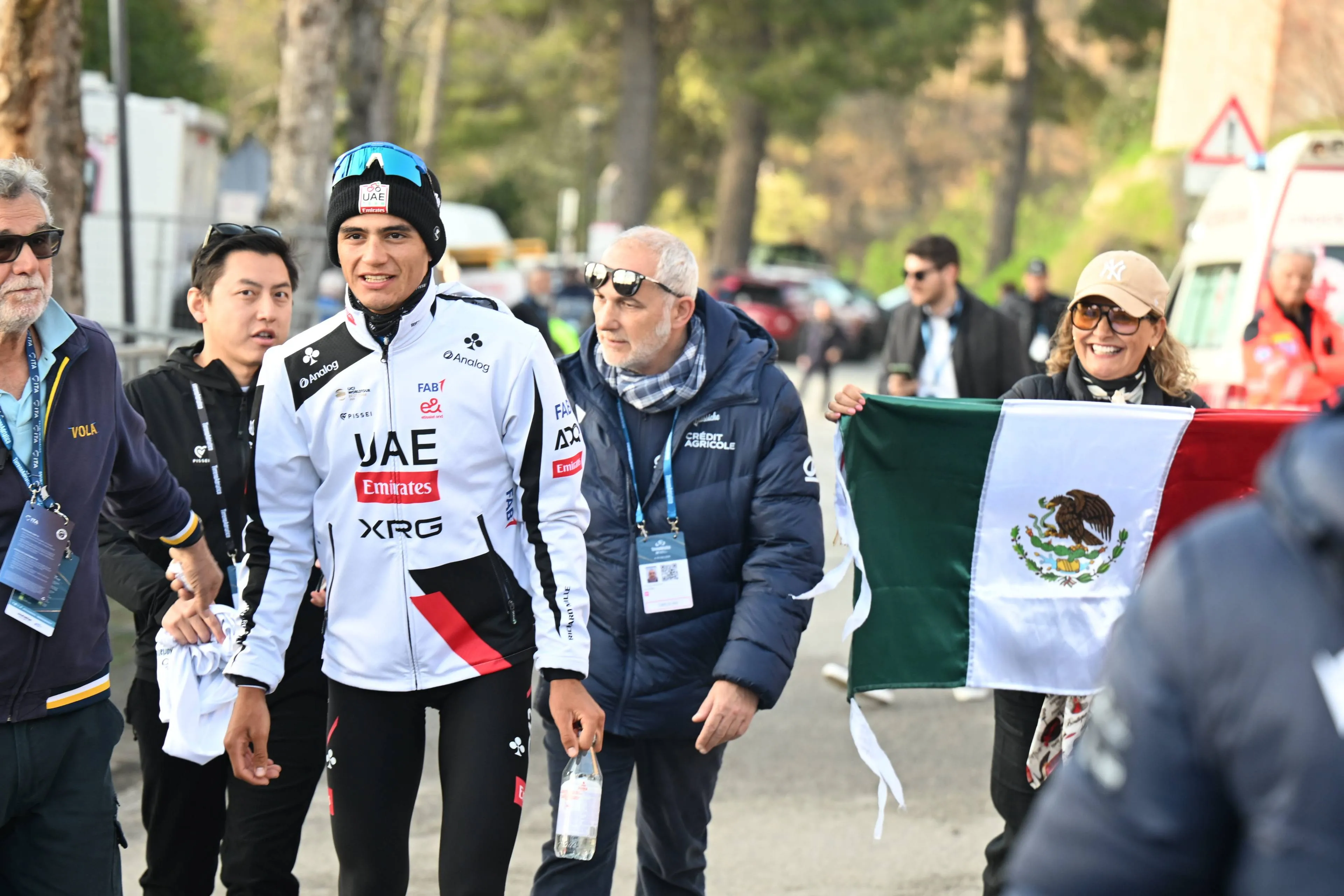
Without them, the burden shifts towards younger options. Gianetti pointed to Isaac Del Toro, Jan Christen and Brandon McNulty as riders with “very good qualities”, adding: “Maybe not the same experience, but the same desire to do well. So we deal with it.”
That is a realistic assessment rather than a dramatic one. UAE still have talent. Del Toro in particular arrives in outstanding form. But Gianetti’s point is that wanting to do the job and having years of craft in a race like this are not always the same thing.
The real key is the entrance to the Cipressa
Gianetti’s tactical explanation was revealing because it stripped away the mythology and went straight to the decisive point of the race. “First of all, you have to be stronger than the others,” he said. “Tadej is highly motivated; he has raced this year at Strade Bianche and has trained well. As always, he is a serious professional.”
That part is expected. Pogacar’s condition has not really been in doubt. The more interesting part came next. “The truth is that he has trained a lot this year on the Milano-Sanremo route, to study it, even though he knows it by heart, but also to motivate himself on those roads.”
That line fits with everything around Pogacar’s recent relationship with the race. This is not a Monument he treats casually. It is one he keeps returning to with clear intent, and one that has probably asked more tactical questions of him than any other. Paris-Roubaix may also remain missing from his Monument palmares, but Sanremo is the race that has repeatedly forced him into the same uncomfortable calculation: how to make enough of a difference on roads that do not always allow enough damage.
Gianetti did not pretend there was an easy answer. “Tactically, it is quite complicated, because he will need to be able to manage situations and take opportunities. It’s no secret: the place where you can make a difference is either the Cipressa or the Poggio. It’s not easy anywhere else.”
That much is already familiar. What sharpened the point was the next part of his answer. “Everyone will be watching him, but everyone cannot forget Van der Poel or Ganna, who are also ready for this race.”
That is the modern Sanremo in a sentence. Pogacar is the rider most likely to attack, but he is not the only one rivals have to fear. Nor is he the only rider whose presence shapes the finale. Van der Poel, above all, has become the man who turns Pogacar’s aggression into a duel rather than a solo.
And that brings the focus back to the riders now missing from UAE’s ideal support unit. “He will need a team around him, but that is also complicated, because arriving at the Cipressa at the front with several teammates is difficult. Everyone has the same goal, not just us. There are not many positions at the front. So the real key is the entrance to the Cipressa.”
That is the line that defines the article and, in many ways, defines Pogacar’s Sanremo challenge. Not the final sprint. Not even the first acceleration. The entrance to the Cipressa.
Because if UAE cannot deliver Pogacar there in control, with enough support and without too much wasted energy, then the whole plan becomes less clean before the decisive attack has even begun.
A year of waiting for revenge
Gianetti’s comments also made clear how long this race has been sitting in the team’s mind. “We’ve been waiting a year for revenge at Milano-Sanremo, both as a team and for Tadej, of course,” he said. “It’s an extraordinary race, very interesting, very difficult in its simplicity. We are really motivated to see what will happen on Saturday between Milan and Sanremo.”
That word, revenge, says plenty. Last year’s edition was not simply another missed opportunity. It was one of those races that lingers because the plan came so close to working. Pogacar succeeded in making the race brutally selective. He succeeded in dragging the fight into the exact kind of finale he wanted. Yet even there, Van der Poel stayed with him and won.
That is why Gianetti’s injury angle matters so much. UAE are not heading back to Sanremo trying to invent a whole new identity. They are trying to improve the existing formula by small margins. Lose two riders who are tailor-made for the lead-in to the Cipressa, and those margins become harder to find.
Gianetti admitted the wider start to the season has not helped. “Our start to the season has been a bit disrupted by several crashes, with many riders out for long periods: Jay Vine, Narvaez, Wellens, Mikkel Bjerg, Vegard Stake Laengen. It has complicated things, but we have still managed a good start to the season.”
That last clause matters too. This is not a team in crisis. UAE have still produced a strong opening block of the season. But for one very specific race, and one very specific plan, the disruption has come in an awkward place.
Pogacar’s challenge is bigger than one race
Gianetti was also asked about Pogacar’s own suggestion that winning Milano-Sanremo or Paris-Roubaix this year might matter even more than the Tour de France. His answer was measured, but revealing. “We take it race by race. Milano-Sanremo is a very important race, but if I personally could choose, I would go for the Tour.”
That is hardly shocking from a team boss. But Gianetti immediately widened the frame. “But the Tour will come later. For now, we are focused on Milano-Sanremo and, of course, Paris-Roubaix. Tadej’s challenge is extraordinary. I think the public is lucky to witness a unique moment: seeing a rider capable of competing at Strade Bianche, Milano-Sanremo, Paris-Roubaix, the Tour of Flanders, Liege, and then the Tour de France. It’s unique, it’s extraordinary. We have to enjoy it.”
That is true, and it also helps explain why Sanremo carries this particular fascination around Pogacar. He has shown he can bend so many races to his will. He has won Monuments on climbing attrition, on repeated attacks, on brutal long-range superiority. Milano-Sanremo keeps asking something slightly different. It asks for timing, restraint, support, positioning, patience and violence in the correct order.
That is why the absence of Wellens and Narvaez is more than a team update. It cuts into the race at the exact point where Pogacar needs the cleanest possible platform.
UAE still believe
None of Gianetti’s answers sounded defeatist. If anything, they carried the tone of a team that understands the challenge more clearly than ever.
There is motivation. There has been reconnaissance. There is still belief in the riders who are available. There is also a frank acceptance that this race is not won simply by turning up with the strongest champion.
Gianetti made clear what he wants to see from Saturday’s race: “First of all, a great race, a great battle. We are living in an extraordinary era of cycling with incredible champions. And of course, we hope to finally win Milano-Sanremo.”
That hope remains intact. But if Pogacar is to finally win the Monument that has given him more tactical trouble than any other, he may now have to do it with a support structure that is slightly less suited to the job than UAE would have wanted.
claps 0visitors 0
Just in
Popular news

Latest comments
- Lance was not the efficient climber type though, don’t know why he’s even a reference for climbs. A real climber doped the same way would probably still be holding records.Mistermaumau19-03-2026
- I think most betting folks make the same predictions so it’s hardly an indicator of a form of intelligence.Mistermaumau19-03-2026
- You’re obviously not in such a happy place if this kind of thing obsessed you. You’re worthy of being on the podium with Trump and Hegseth for complexes.Mistermaumau19-03-2026
- What fairy tale are you living in? "Wout V Aert can beat him tho or if he has to do a long sprint" To beat him in a sprint WVA has to be in a group with Tadej on The Via Roma. Mission impossible!MajorPayne19-03-2026
- Rather insulting to compare him to Froome.Mistermaumau19-03-2026
- 100% to thismobk19-03-2026
- Maybe e-sports isn't the most solid background for bike skills. Tadej by comparison was probably honing his skills in junior cyclocross races in the offseasonmobk19-03-2026
- I would love to see Primoz win it.Jezla19-03-2026
- Jasper Philipsen: "Milano-Sanremo is too important to skip"... @arnauddelie
 Rafionain-Glas19-03-2026
 - Florian, the GossipBoy of UAE :-)
 maria2024202419-03-2026
Loading
3 Comments