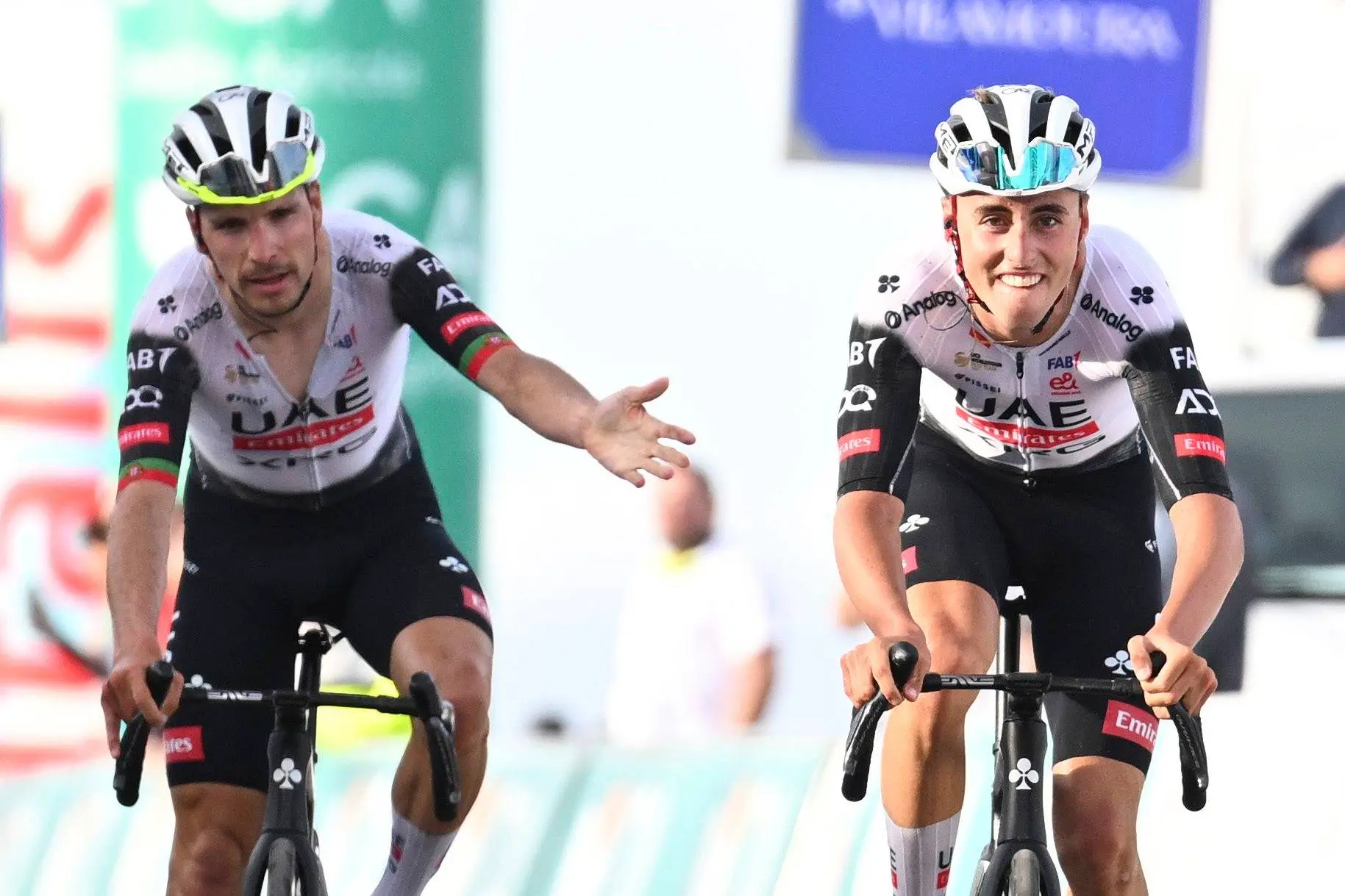
The 2026 Volta ao Algarve will take place from the 18th to 22nd of February, and as is the case every year, will be one of the most fought out early-season stage-races. It features stages for the sprinters, climbers, timetrialists and classics specialists all to fight for results and work on their form. We preview the race ahead.
The 'Algarvia' is Portugal's most prestigious international race, and a race with immense amount of history as well as many different phases. Its first edition was in 1936, won by Joaquim Fernandes, but it would have to wait until 1960 to have its second edition. After three consecutive years, the event took another large break and only in 1977 was the event finally on its tracks and taking place on a yearly basis. Until 1997, it was a race that was won by Portuguese riders, with the exception of the Brasilian Cássio Freitas.
Many of the country's best, some of which remain very active in the current peloton as team owners or event organizers, can be found ont he list of winners such as Joaquim Andrade, Joaquim Gomes, Fernando Carvalho, Vitor Gamito and Cândido Barbosa. In 2000, Alex Zulle won the race, coming from a second place at the previous year's Tour de France. The race at this time transitioned into an event where more and more the international teams took control over the top results, and the startlists began showing more quality than even a large part of the World Tour calendar.
Floyd Landis won it back in 2004; Alessandro Petacchi won it in 2007; Stijn Devolder won it in 2008 ahead of his first Tour of Flanders win; Alberto Contador won it in 2009 and 2010 - building on two Tour de France wins... And the list of winners has simply not had a single miss when it came to huge talents (except for the 2021 triumph of João Rodrigues who was later suspended for doping.
Tony Martin, Richie Porte, Michal Kwiatkowski, Geraint Thomas, Primoz Roglic, Tadej Pogacar, Remco Evenepoel (on three occasions), Daniel Martínez and Jonas Vingegaard have been the riders who have won this race since 2020. These riders have won multiple Tour de France editions, all Grand Tours; multiple world titles both on the road and time trial; and several of them have been the most dominating figures of their respective (and current) generations. It is a race where just making it onto the podium is often a monumental task. In 2025, Jonas Vingegaard beat João Almeida in the race after winning the final time trial into the Alto do Malhão.
Read also

Profile stage 1: Vila Real de Santo António - Tavira

Stage 1: Vila Real de Santo António - Tavira, 185.6 kilometers
The race begins with a challenge for the sprinters as usual, with the race starting in the very eastern edge of the Algarve in Vila Real de Santo António and going on to finish in Tavira. 185 kilometers of mostly flat roads, a day purposefully designed not to be too hard so as to allow the fast men to take the spotlight and battle it out in a high-speed finish to the stage.
Profile stage 2: Portimão - Fóia

Stage 2: Portimão - Fóia, 157.1 kilometers
Potentially the queen stage this year, over the time trial, the second day of racing from Portimão to the Alto da Fóia is going to be a key day for the overall classification. The run-up to the final ascent is easier than previous years, but as always it is hilly.
The final climb is familiar by name, but don't expect to see the same roads. The Alto da Fóia can be climbed through many different routes, as is the case with many of Portugal's mountains, and although the riders climb it from Monchique once again this year, they have not climbed this side before in recent years.
The ascent will be 8.8 kilometers long at 6.2% but will perhapse be the side that suits the climbers best out of all alternatives, as both the start of the climb and the final half feature long sections at almost 10% that stretch out long enough to put in serious attacks. It's a rather inconsistent climb, but we can see the climbers make meaningful differences here.
Profile stage 3: Vilamoura - Vilamoura

Stage 3 (ITT): Vilamoura - Vilamoura, 19.5 kilometers
Stage 3 is the race's time trial, this year back to its traditional format as a flat individual challenge against the clock. It is 19.5 kilometers long and will be a loop around Vilamoura. The profile can be misleading, it is mostly flat but certainly the riders will not say that, there are small ascents and descents all throughout the stage in which small differences and changes to pacing strategy can be put to place. Not a fully constant effort, as it features some technical areas as well.
Profile stage 4: Albufeira - Lagos

Stage 4: Albufeira - Lagos, 182.1 kilometers
Stage 4 is the second and last opportunity for the sprinters, riders that are always prioritized in this race. The stage will be taking place from the city of Albufeira to Lagos, going through 182 kilometers that involve a bit of climbing, but nothing dramatic. It is a stage where the fast men will be able to chase a result in a bunch sprint.
Profile stage 5: Faro - Malhão

Faro - Malhão, 153.1 kilometers
The race finishes, as is usual, on the Alto do Malhão - the region's most famous climb. It is a stage that features its traditional format, not overly difficult but still a day that can be key if the gaps are not too big. Mostly flat on its first half, but in the second we've got some short and sharp climbs that will hurt the legs of many.
The Malhão will be climbed for the first time with 43 kilometers to go, it's 2.6 kilometers long at 9% but features very steep sections. There is a small ascent to Soidos this year which ends with a mere 13 kilometers to go, 2 kilometers at 7%, which does allow for some more tactical racing. The Malhão will then be climbed again, coinciding with the finish, where the climbers can usually make some differences as it's an an all-out effort right from the bottom, not a climb that slowly ramps up to the finish.
Prediction Volta ao Algarve 2026 overall classification:
*** João Almeida, Brandon McNulty, Daniel Martínez
** Paul Seixas, Juan Ayuso, Kévin Vauquelin, Florian Lipowitz
* Matthew Riccitello, Julian Alaphilippe, Marco Frigo, Tom Gloag, António Morgado, Thymen Arensman, Filippo Ganna, Oscar Onley, Max Poole, Max Schachmann, Jarno Widar
** Paul Seixas, Juan Ayuso, Kévin Vauquelin, Florian Lipowitz
* Matthew Riccitello, Julian Alaphilippe, Marco Frigo, Tom Gloag, António Morgado, Thymen Arensman, Filippo Ganna, Oscar Onley, Max Poole, Max Schachmann, Jarno Widar
Pick: Brandon McNulty
Original: Rúben Silva
Rúben SilvaEditor-in-Chief
A founding contributor to CyclingUpToDate since its launch in January 2022, Ruben Silva has played a central role in shaping the site’s editorial direction and long-term growth. Before joining the project, he built his experience through independent blogging at Echelons Hub and by producing race previews for Ciclismo Internacional, developing a strong analytical voice rooted in daily engagement with professional cycling.
Beyond editorial work, he has been closely involved in the expansion and coordination of CyclingUpToDate’s wider network, helping establish and support sister platforms across multiple languages. This includes ongoing collaboration with CiclismoAlDia (Spanish), CiclismoAtual (Portuguese), WielrennenUpToDate (Dutch), and RadsportAktuell (German), contributing to a shared editorial vision and consistent international coverage.
He also helps oversee editorial governance across the network, setting standards for accuracy and consistency and coordinating updates or corrections when needed.
Originally from the Porto metropolitan area in Portugal, he holds a bachelor’s degree in Geography. His path into cycling journalism was shaped not through formal media training, but through independent reporting, community engagement, and sustained on-the-ground involvement in the sport.
Over the course of his career, he has conducted approximately 100 interviews across road cycling and cyclocross, ranging from one-to-one conversations and online formats to press conferences and on-site pre- and post-race coverage. His interviews include leading riders, team managers, and prominent figures within cycling media: Tadej Pogacar, Jonas Vingegaard, Mathieu van der Poel, Primoz Roglic, Wout van Aert, Joao Almeida and Tom Pidcock; managers like Patrick Lefevere and Joxean Matxin; and YouTube personality Bryan Kennedy (BKXC)...
Within 18 months of launch, he helped grow CyclingUpToDate’s English-language platform into one of the most-read cycling news websites, built entirely from the ground up. As both a professional journalist and lifelong cycling enthusiast, his focus remains on delivering accurate, timely, and well-contextualized coverage.
claps 3visitors 1
Just in

Popular news
Latest comments
- I would prefer him to do the Giro and Vuelta, and leave Seixas, Remco and Jonas to fight it out in France. Btw 'redemption' implies he has disappointed us and has something to prove. I don't think he has anything to prove, but of course ticking off the Vuelta would be good. Pity he can't get a 'prior learning credit' for the first week in the Vuelta, and join in for the last two weeks!Hills3320-10-2026
- Bet you 90% of Slovenians will stop watching cycling once your boy stops. But. More pertinently, have you prepared for his retirement? I think you have extreme difficulties in understanding the difference between being a fan of cycling and being fan of a cyclist.Jumpyjohn20-10-2026
- I would keep a VERY open mind.Jumpyjohn20-10-2026
- Listen, maybe he did, maybe it’s more complicated but unless there are images* or witnesses, I wouldn’t go on stats alone. There are so many factors, terrain, wind, pacing, psychological/hormonal effects, etc. and that’s without consideration of Remco maybe changing his effort. As a rider I know all too well the effect of being overtaken can have, just like it’s always easier to push yourself when you are racing instead of training where you have no target to catch or pressure from behind. * obviously there is going to be a lack of commissaires in TTs to keep a constant eye on things but hey it’s 2026, these problems can be solved cheaply with on-board cameras or drones, they could even increase revenue and attractiveness through broadcasting right.Jumpyjohn20-10-2026
- Do you watch dog racing too? Do you remember what Einstein said about madness? What are you watching specifically, the way his ass moves over the saddle more efficiently? You should really ask yourself some psychological questions if what you enjoy is watching someone do exactly the same as all the others only slightly faster some of the time but not in any way noticeably without the immediate proximity of competitors. Would you watch time trials if no results or times were taken? You should really think about the real reasons why you enjoy watching someone much more than others (or why you can’t enjoy watching others doing the same). If you would argue it was for other reasons than simply wanting to watch the best (and I’m pretty sure you don’t watch e.g. cyclocross or kayaking because you want to dictate a hierarchy in sport) I would have more understanding (nothing else) for your choices (nationalism, ego, prediction talents, etc.)Jumpyjohn20-10-2026
- In theory you’re right but sometimes news is sparse or not funny or the discussion rather limited or predictable so a little lighthearted mocking can be a welcome distraction. Also, it doesn’t hurt to attract to agendareers and schemers.Jumpyjohn20-10-2026
- A suggestion to commentators, prepare to include interesting unrelated material when there’s little to report on. This is why the TdF grew an audience, it attracted more than hardcore cycling fans or fans of particular riders who’d find it interesting to hear or even discuss their choice of toilet paper at home. If you can’t keep viewers’ attention with surroundings, history, tourist information, etc. there’s always, highlights, best of past races, betting odds, international newsflashes, weather forecasts, etc. or the suggestion to go make a cup of tea. In fact, maybe the whole idea of one long live broadcast is the problem, a general sports update during the race would probably interest many, like the format in football where they flip across matches where goals or interesting events happen. Can’t see the point of comparing watching a guy turning his pedals in a constant fashion on an empty road with one hitting a tennis ball in a different strategic place each time or moving around a football field in an infinite number of unpredictable combinations wrt teammates and opponents every minute.Jumpyjohn20-10-2026
- Says Mr Non-stop repeating himselfJumpyjohn20-10-2026
- Phew I hope we do not get Jiffygate 2🤣🤣🤣🤣🤣 oh and by the way Bradley still has not answred the question re jiffygate even in his latwst book🙄🙄🙄🙄paultryan200220-10-2026
- What a stupid comment. If they are as good and if not better why should they sit on seasoned pros wheels. Sexias is a prime example . Move with the times they are fitter and more hungry and more ambition. If you cannot abide being 2nd string find a new profession.paultryan200220-10-2026
Loading
Write a comment