“I have to be honest: Tadej Pogacar was slightly below his best” - Wout van Aert surprisingly downplays one of his most iconic wins
CyclingWednesday, 04 March 2026 at 18:16
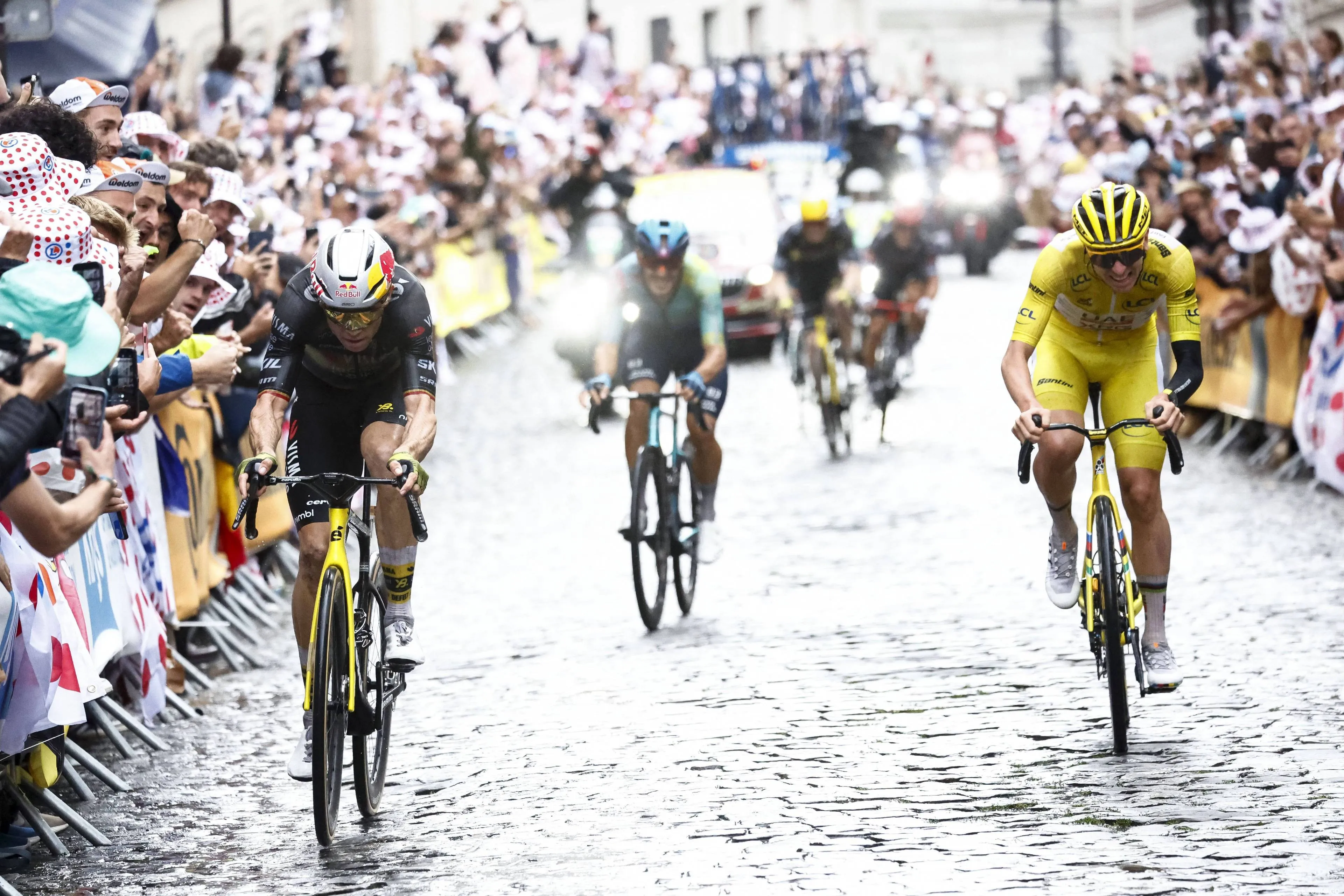
When Wout van Aert powered clear on the final climb of Montmartre during the closing stage of the 2025 Tour de France, the images quickly became some of the most replayed moments of that year’s race. Dropping Tadej Pogacar on the streets of Paris and riding solo to victory on the Champs Élysées felt like a rare and symbolic triumph.
Yet months later, Van Aert himself is strikingly modest about what many fans regard as one of the most memorable wins of his career.
Reflecting on that stage in a recent interview, the Belgian suggested the circumstances of the race played a role in the outcome. “I have to be honest: he was slightly below his best, maybe because of that knee injury,” Van Aert said in conversation with Knack.
The remark is notable because the Montmartre duel was widely framed as a dramatic showdown between two of the sport’s most versatile riders. Instead, Van Aert himself prefers to place the moment in a more measured context.
Montmartre finale turned the traditional Paris stage into a real race
The final stage of the 2025 Tour de France broke with long-standing tradition. Rather than the usual ceremonial run in to a bunch sprint on the Champs Élysées, organisers introduced multiple ascents of the Côte de la Butte Montmartre, transforming the finale into a selective circuit through the narrow streets beneath the Sacre Coeur.
Heavy rain earlier in the evening had already changed the dynamics of the stage. With the general classification neutralised before the decisive circuits began, the race for yellow jersey honours was effectively settled. Pogacar only needed to finish safely to secure the overall victory.
What followed, however, produced a dramatic late battle.
After attacks reshaped the front group on the Montmartre climb, Pogacar launched an acceleration on the final ascent. Van Aert was the only rider able to stay with him. Near the summit, the Belgian countered and quickly opened a gap, riding alone through the final kilometres back towards the Champs Élysées.
Behind him, the chase never closed. Van Aert crossed the line solo in Paris, sealing one of the most unusual stage victories ever seen on the Tour’s final day.

Van Aert took one of the most iconic wins of his career on the final stage of the 2025 Tour de France
Van Aert plays down the performance
Despite the spectacle of the moment, Van Aert insists the ride itself was less extraordinary than it may have appeared from the outside.
“For my abilities, I didn’t do anything extraordinary,” he explained. “It was very difficult, but it was ‘only’ an hour of real racing. I wasn’t completely exhausted for a week afterwards.”
His comments offer a rare glimpse into how riders themselves evaluate such performances. What looked to many observers like a defining duel between two of cycling’s biggest stars was, in Van Aert’s eyes, simply a short and intense finale rather than a monumental physical effort.
That perspective also helps explain why the Belgian was quick to acknowledge Pogacar’s circumstances on the day. The Slovenian had already effectively secured the Tour and was racing in difficult weather conditions, factors that may have influenced how aggressively he approached the finale.
A crucial moment after a difficult Tour
Even with the caveats, the victory carried significant personal meaning for Van Aert.
The 2025 Tour had not unfolded easily for the Belgian or for his team’s broader ambitions. Opportunities for stage success had been limited, and the race had offered few moments of personal reward.
That context made the Montmartre duel all the more important psychologically. “Imagine if Tadej had dropped me there on Montmartre, after a difficult Tour without any personal success or a chance at the overall victory with Jonas… then I would have gone home with a bad feeling.”
Instead, the final evening in Paris delivered a very different ending.
While Van Aert may now downplay the performance itself, the image of him riding away from Pogacar on the cobbled slopes of Montmartre remains one of the defining scenes of the 2025 Tour de France.
claps 3visitors 3
Just in
Popular news
Latest comments
- Definitely a solid respectful human being. I’m a bit sad that he is past the apex of his career. I hope we at least see some occasional flashes of “peak Wout”.mobk04-03-2026
- why I love WVA. instead of bragging, or being crass - he is always a gentleman. I appreciate a rider that says he has no fear for an opponent, or someone that says their goal is to beat him now. if you go in assuming you’re going to lose, why go? but the measured words of Wout shows respect for his opponent, the sport, etc. and then his legs did the talking. he is the best.mij04-03-2026
- I'm not a chauvinist, I'm an atheist. I don't give a f*** about religion. Capish?Mou-Cro-HR04-03-2026
- I mostly agree with you. But in this case, I definitely don't. I think religion is a personal thing. And no one should be judged for their religion, whatever it is. I think you come across as a chauvinist.MajorPayne04-03-2026
- At least WVA is an honest and sincere man, unlike his fans on this portal.MajorPayne04-03-2026
- Mou is short for Moustafa, btw.
 Rafionain-Glas04-03-2026
 - Did it to yourself ahole.
 MrCampy04-03-2026
 - Remco Mustafa, Rat Ayuso, MVDP and tht Danish Anchovy are missing from Strade Bianche. Remco is missing from San-Remo. Remco is also missing from Flanders and Roubaix. Vini the fish is missing from Lombardy and the worlds. The UCI should call these people out, they are real pussies and cowards... missing out in the biggest races. They race in second and third class races, so they can get BS wins and avoid Pogi. Pogi is in all the big races, even if he keeps losing Milan SanRemo and Paris Roubaix, but he keeps trying every year. That's what real competitive cyclists do. They don't hide in rabbit holes.Mou-Cro-HR04-03-2026
- Managers maybe but sponsors? I very much doubt data would be so easily accessible and it’s a long way to interpret raw data to reverse engineer training methods. Far easier to sign up a rider from your team of interest in order to interrogate them on what sauces were being cooked with. The people involved would probably be working on anonymous files and anything suspicious would be treated by someone without access to the whole file. As we know, it is only to be used as an INDICATOR for who to focus on. Also, if the sauce is just regular normal progression or comparable, it won’t be of interest to ANYONE.Mistermaumau04-03-2026
- The cycling season starts on Saturday and the 1st of 8 races in 2026. Strade Bianche, 5 Monuments, Tour de France, World championships in Montreal. Everything else is a farmer's league, false self-confidence, ego boosting ala Remco Mustafo style, but it's all fake... it's all BS. The real situation is in these 8 races that I call crème de la crème. Ad acta!!!Mou-Cro-HR04-03-2026
Loading
3 Comments