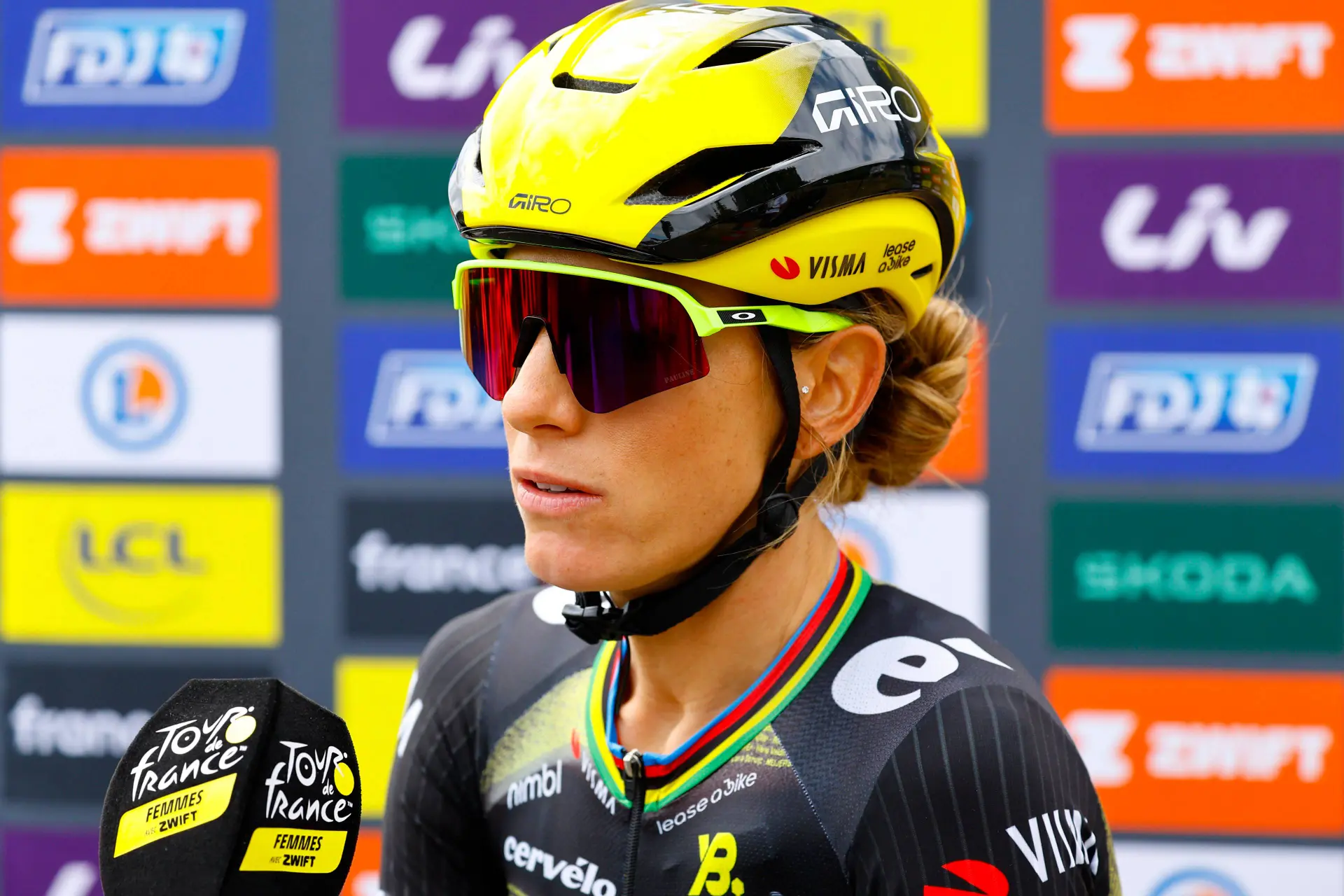
"Pauline is next level" – Armstrong and The Move podcast unpacks the 2025 Tour de France Femmes
Cycling
As the dust settles on the 2025
Tour de France Femmes Avec Zwift, The Move podcast team, Lance Armstrong, Mari
Holden, and Alison Tetrick, reflected on a nine-day race that was both
unpredictable and, in the end, utterly dominated by one rider. Pauline
Ferrand-Prévot’s emphatic win, secured by a margin of three minutes and
forty-two seconds over Demi Vollering, became the centrepiece of the
discussion. Ferrand-Prevot became the first French person, man or women, to win
the Tour since 1989, and has confirmed her status as one of the greatest ever
al round cyclists. But the crew also took a deeper look at what the race
revealed about the state of women’s cycling, the emotional arc of rising stars
like Sarah Gigante, and what makes Ferrand-Prévot’s performance so significant.
“She was just so clearly
dominant,” Armstrong said early in the episode, a sentiment that became a
running thread. While the Tour featured numerous attacks and high-speed
descents, Ferrand-Prévot always seemed one move ahead. The American noted that
even in the opening stages, where her presence wasn’t immediately felt, she was
always lurking, always calculating. “She was in control the whole time,” Armstrong
said. “Not just... uphill, downhill, positioning in the peloton.”
The discussion emphasised the
subtlety in Ferrand-Prévot’s approach. “Everyone was talking about Sarah,
talking about Demi... and then she just came out and, you know, she did,” Holden
said. The team never doubted Ferrand-Prévot’s preparation or intention, but her
ability to let the race unfold around her before striking decisively was
praised as a masterclass in racecraft. “Pauline is like literal next level,”
Tetrick said, summing up the feeling that her victory wasn’t just dominant, it
was something beyond.
But the team didn’t shy away from
discussing moments where Ferrand-Prévot showed signs of stress, even on the
last day. “She did say she felt a little pressure in the yellow jersey,”
Tetrick noted. “She got gapped off in the beginning,” she continued,
referencing a moment when two groups formed early on the final stage. Still,
Ferrand-Prévot corrected course quickly: “Wait, what am I doing? I’m going to
get at the front and then I’m going to win in yellow,” she told the media after
the race. Even her brief lapses were met with immediate self-correction.
Read also
While Ferrand-Prévot soared, Sarah
Gigante’s late-stage collapse became one of the more emotional storylines.
Heading into the final stage in second overall, Gigante ended the day in sixth,
losing her podium position due to difficulties descending off the Col de Joux
Plane. “She goes from second in GC... down to sixth... because of descending,”
Armstrong said. “This was brutal.”
Holden, Tetrick, and Armstrong all
made a point to stress how fixable descending issues can be, though they
acknowledged the psychological toll. “It’s learnable,” Armstrong said. “It’s
not about gaining an advantage. It’s about minimizing your losses or eliminating
your losses.” Tetrick, speaking from personal experience, added, “I was
definitely not born with that fearless gene.” All three expressed concern over
the online criticism Gigante faced: “She does not need some troll critiquing
her descending,” Tetrick said.
What made Gigante’s struggle more
painful to watch was how isolated she became on the road. “She was truly in no
woman’s land,” Armstrong said. The physical gap was obvious, but the mental one,
knowing the podium was slipping away without a mechanical, crash, or climb, was
even harder. Armstrong called it “a hard game” that exposes both talent and
vulnerability.

Nobody could come close to Ferrand-Prevot
Beyond individual performances,
the panel praised the evolution of the sport itself. “Four French women in the
top 10. That’s huge,” Armstrong said. Tetrick called it “mind-blowing,”
especially considering how recently French women were absent from the top tier
of the sport. Ferrand-Prévot wasn’t the only French rider making waves, Juliette
Labous drew admiration for her selfless ride in support of the GC battle. “She
was like the bus of that breakaway group,” Tetrick said. “Domestique life,” she
added with a mix of admiration and sympathy.
The group also touched on the
broader implications of the race. “If you didn’t look at gender... this was a
better sporting event [than the men’s],” Armstrong said. From a purely
competitive standpoint, action-packed stages, late GC drama, and a commanding
champion, the women’s race delivered. “We’re in such an exciting place,”
Tetrick noted. “The more we watch women, the more women win.”
And then there’s the question of
what’s next for Ferrand-Prévot. With her win in the Tour, her known prowess in
mountain biking, and the looming world championships, the door is open for one
of the most decorated and versatile seasons any rider could imagine. “Can you
imagine winning worlds on the road, winning the Tour, and winning the Olympic
gold medal all within 12 months?” Holden wondered. “I think she can imagine
that actually.”
As the episode closed, the panel
reflected on how much the women’s peloton has evolved in just a few years. From
sponsorship growth to deeper fields and sharper race tactics, the shift is
real. And thanks to athletes like Ferrand-Prévot and the continued support of
sponsors like Zwift, the platform is only getting bigger. “It’s not just a
movement anymore,” Tetrick said. “This is just reality.”

Fin MajorCycling Journalist
Fin Major is a UK-based writer at CyclingUpToDate and has been part of the team since 2024. He is the site’s main writer for FAQs and evergreen explainers and has written around 2,000 pieces for the platform. Alongside this work, he focuses on in-depth analysis and covers the biggest races on the calendar, including the Tour de France, the Giro d’Italia, and La Vuelta a España, providing clear context around performance trends, tactics, and key storylines.
In his reporting, Fin uses reputable data sources such as ProCyclingStats for results, statistics, and historical context. He places strong emphasis on careful sourcing, editorial accuracy, and updating articles promptly when new, verified information becomes available. Outside of writing, Fin is an active cyclist, which supports his practical understanding of the sport and its demands.
claps 0visitors 0
Just in

Popular news
Latest comments
- The article makes it sound like a great thing and something to be applauded. The reality is is gives the Americans another 6 years to fleece European cycling fans or force them to hunt around Europe with VPN’s for free feeds. Not something to be celebrated in my book. Before someone points out that coverage of this depth costs money, yes, I agree but not £30+ per month a fee I will wager will gradually increase now this deal has been cemented.Paul53119-10-2026
- Great. Thrilled. Oh, how I miss the days of GCN. Still wear my GCN hoodie with pride.anonymouscyclist19-10-2026
- You could also look at it another way. How many riders have had better or more consistent results since the Tour?Jumpyjohn19-10-2026
- Whilst I love Tadej (and Remco, who deserves to be mentioned here, too), @JumpyJohn makes a valid point, and he isn’t wrong @MajorPayne. It is a fact that today’s official broadcasters of cycling struggle to keep our attention once the likes of Tadej (or Remco) attacks at ~80km or so. In the 142nd issue of Rouleur, Ned Boulting reflects on the often stressful paradox of commentating on a race that is effectively over before the broadcast window even hits its stride. In this edition, he centres on Remco’s 1hr solo at the Challenge Mallorca this year, and captures the panic and dread shared by the commentators when a dominant rider kills off the racing tension early. I recommend you read it, it’s a fascinating insight into the world of commentary, and the true viewing figures of today’s cycling. I must add here, I love Tadej and Remco, but I would be lying if my heart rate wasn’t higher when watching the World Championships this year. And I’m sure Rob Hatch would say something akin regarding his commentary!anonymouscyclist19-10-2026
- The shattered women’s marathon record was clean and highly surprising and then a few months later the athlete was very positive in another test for something not taken by mistake when recording far less impressive results. Sounds to me like the problem is still the age old one, detection is often way behind. Just like with crime, it’s not because you can’t catch the criminals that you aren’t aware of the crime.Jumpyjohn19-10-2026
- Listen, you have a point but on the other hand in cycling, once some of the riders go solo and build a minute’s gap, there’s hardly any action left to watch. Cycling is definitely not for today’s generations of accelerated viewing. Other people find skydiving or chess exciting but you can’t force everyone to feel the same.Jumpyjohn19-10-2026
- That’s a funny one. Yeah obviously he’s more aero than some but most of the aero effect at elite level is the bike. Now you have me starting to feel sorry for the guy behind him when he pulls a groupetto.Jumpyjohn19-10-2026
- Knew a World Tour promotion was coming for Ben this season. Thrilled for him, and can't wait to see what he can do at this level. Another one to watch at the TTs.anonymouscyclist19-10-2026
- It honestly breaks my heart to see this. I had a feeling this might happen over the last few years, but I kept praying it wouldn't, and that Joey would find his niche, especially back racing alongside his brother. After growing up racing alongside PH-MAS, the Pidcock brothers have always felt like one of our own, as we’ve watched them grow from Club level all the way up to PC and WT. I wish Joey nothing but the best of luck in whatever he does next, but selfishly… I do wish for him to move into the role of Q36.5 team staff.anonymouscyclist19-10-2026
- Predictable, sure! But boring??? OMG! Was Mike Tyson predictable and boring in his prime? Air Jordan? Schumacher or Senna? OMG!!!MajorPayne19-10-2026
Loading
1 Comments