Overnight ferries loaded with busses, border crossings and airport loaded with pro cyclists - Alberto Contador details Giro's journey from Bulgaria to Italy
Cycling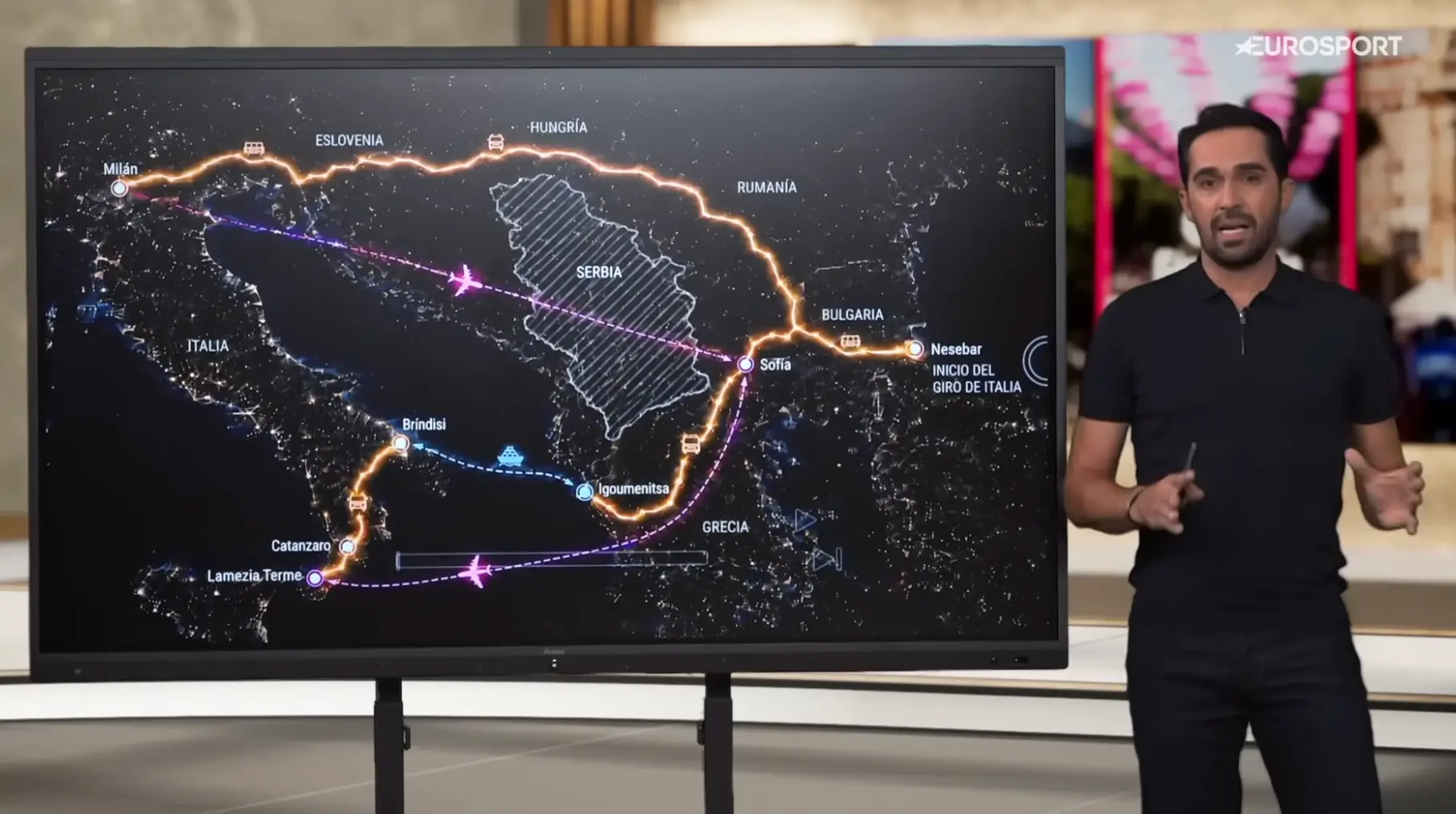
The Giro d’Italia transfer from Bulgaria to southern Italy has turned into a true logistical odyssey for the teams. After the opening three stages on Bulgarian soil, riders, staff, and vehicles face a complex journey of thousands of kilometres to resume the race in Catanzaro. Alberto Contador, a former pro rider and current part of the Eurosport (and Team Polti VisitMalta) teams, details what is perhaps the busiest day for the staff at the Corsa Rosa.
On Eurosport’s La Montonera, Alberto Contador detailed the major challenges this move is creating for the peloton’s infrastructures, as someone who has been part of them in the past as a rider; but is on the other side of the spectrum this time around.
“It has been a real challenge for all the teams,” said the Madrilenian, noting how many squads are based in central Europe and had to travel huge distances just to reach the start in Bulgaria.
Team Polti VisitMalta, for example, had to drive from Milan to Nesebar, the Giro’s Grande Partenza city, a trip of around 2,700 kilometres. According to Contador, the staff had to make three stops along the way and alter the planned route to avoid Serbia due to customs issues.

The 2026 Giro d’Italia began in Bulgaria
“They had to pass through Hungary, Romania, and finally into Bulgaria,” the Giro winner explained, describing the route taken by buses, vans, and equipment-laden vehicles.
Meanwhile, the riders flew into Sofia before transferring by road to Nesebar. However, the most complicated part came after stage three.
Contador explained that much of the team staff left even before the finish to save time on a marathon transfer. From Bulgaria, the buses had to cover roughly 700 kilometres to the Greek port of Igoumenitsa to board a ferry bound for Calabria.
“On the ferry, along with the rest of the vehicles, they’re going to spend eight hours before reaching Calabria,” he said.
The riders, for their part, will take a direct flight from Sofia to southern Italy, a journey of about one hour and forty minutes. One innovation this year is that the bikes will also fly to be available as soon as possible on Italian soil.
Even so, the logistical effort does not end there. Once ashore in Italy, many staff members still face close to 500 more kilometres by road to Catanzaro, where the race will resume after the rest day - aside from the need to settle in and unpack all of the supplies and bikes once again.
“A logistical challenge”
“A genuine logistical challenge, a real slog for the teams and especially for the staff,” Contador summed up on air.
Also joining the segment was Óscar Pastrana, head of logistics at Polti VisitMalta, who confirmed the team crossed the Greek border hours before boarding for Italy.
“If all goes well, tomorrow (this Monday, ed.) we’ll be arriving at the team hotel to link up with the rest of the squad,” he said while still en route.
Rúben SilvaEditor-in-Chief
A founding contributor to CyclingUpToDate since its launch in January 2022, Ruben Silva has played a central role in shaping the site’s editorial direction and long-term growth. Before joining the project, he built his experience through independent blogging at Echelons Hub and by producing race previews for Ciclismo Internacional, developing a strong analytical voice rooted in daily engagement with professional cycling.
Beyond editorial work, he has been closely involved in the expansion and coordination of CyclingUpToDate’s wider network, helping establish and support sister platforms across multiple languages. This includes ongoing collaboration with CiclismoAlDia (Spanish), CiclismoAtual (Portuguese), WielrennenUpToDate (Dutch), and RadsportAktuell (German), contributing to a shared editorial vision and consistent international coverage.
He also helps oversee editorial governance across the network, setting standards for accuracy and consistency and coordinating updates or corrections when needed.
Originally from the Porto metropolitan area in Portugal, he holds a bachelor’s degree in Geography. His path into cycling journalism was shaped not through formal media training, but through independent reporting, community engagement, and sustained on-the-ground involvement in the sport.
Over the course of his career, he has conducted approximately 100 interviews across road cycling and cyclocross, ranging from one-to-one conversations and online formats to press conferences and on-site pre- and post-race coverage. His interviews include leading riders, team managers, and prominent figures within cycling media: Tadej Pogacar, Jonas Vingegaard, Mathieu van der Poel, Primoz Roglic, Wout van Aert, Joao Almeida and Tom Pidcock; managers like Patrick Lefevere and Joxean Matxin; and YouTube personality Bryan Kennedy (BKXC)...
Within 18 months of launch, he helped grow CyclingUpToDate’s English-language platform into one of the most-read cycling news websites, built entirely from the ground up. As both a professional journalist and lifelong cycling enthusiast, his focus remains on delivering accurate, timely, and well-contextualized coverage.
claps 6visitors 6
Just in

Popular news
Latest comments
- That nearly is 7 mins and you win GTs comfortably by 2 mins. Remco fans - he almost won the TDF, He beat Pogi twice in the mountains this year.abstractengineer23-10-2026
- What would be your preferred Tour design then? Just out of interestwrsty23-10-2026
- I like Remco but even I'll admit he didn't get anywhere close to Pogacar, just like everyone else.megasmacky23-10-2026
- That's what y'all said this year, "remco will come fifth"bruins3022-10-2026
- That used to be the norm, 100 kms of TTs. Now look at the '87 route...acem8222-10-2026
- Well, crashes can happen, so it's not impossible...acem8222-10-2026
- that would be kinda cool. there is a lot of untapped potential. which I'm sure the UCI will overlook. in order to get sock length correct.mij22-10-2026
- Nice! Now Remco can finally show that he cannot win the Tour!!! 😂😂😂PogiSloFans22-10-2026
- Nice! Now Remco can finally show that he cannot win the Tour. 😂PogiSloFans22-10-2026
- 10 K or 100k , Pogi will gain the same amount of time on Remco No balls in 1 stage. All this shows is that they have run out of ideasabstractengineer22-10-2026
Loading
1 Comments