Is Visma leading the way for a safer peloton? Fighting for position on sprint stages "is no longer the approach we want"
Cycling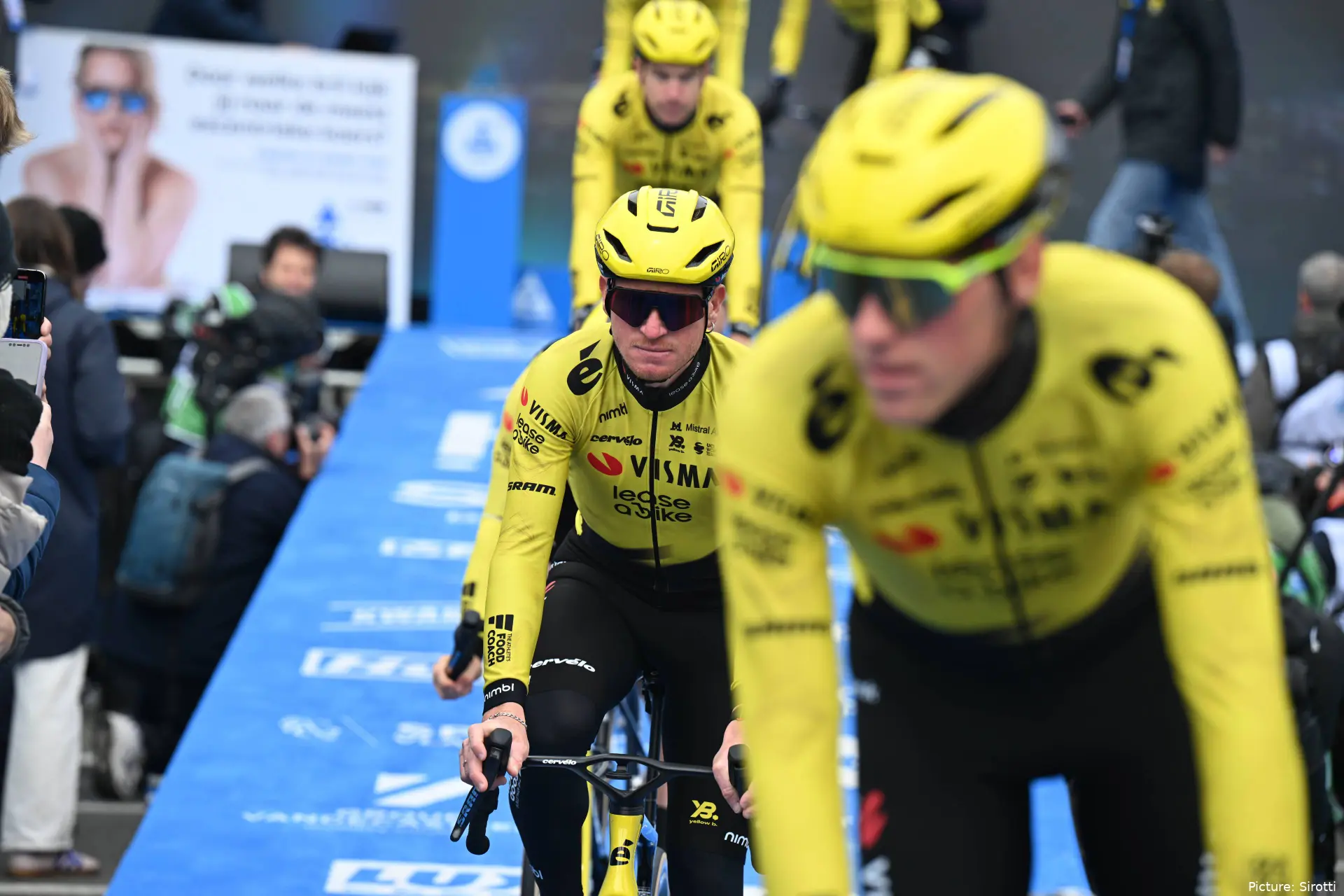
Team Visma | Lease a Bike has made the decision to not fight for positioning during the sprint stages at the Giro d'Italia. The Dutch team believes the risks of crashing outweigh those of being caught in a split, and are deciding to race with a tactic that they have experimented earlier in the season with Jonas Vingegaard.
"We already discussed this in the winter. We spent a lot of energy trying to avoid the hectic pace and the danger, but that is no longer the approach we want," team DS Marc Reef said in an interview on The Cycling Podcast.
In recent years, fighting for positioning has become more and more a point of focus for all top teams, with their own logistics organized - such as team staff driving through entire stages to point out pinch points and possible dangerous locations.
In order to keep their GC leaders as far ahead as possible, on sprint stages it is now fully common to have the head of the peloton swarmed by climbers and their leadouts, until the 3 kilometer to go sign - where a crash does not lead to a time loss.
However, this increases the number of riders, the overall speed and the risks being taken to be in position. The start of this Giro captured a clear image of these tense fights for positioning, with two mass crashes on the opening days of the race.
Read also
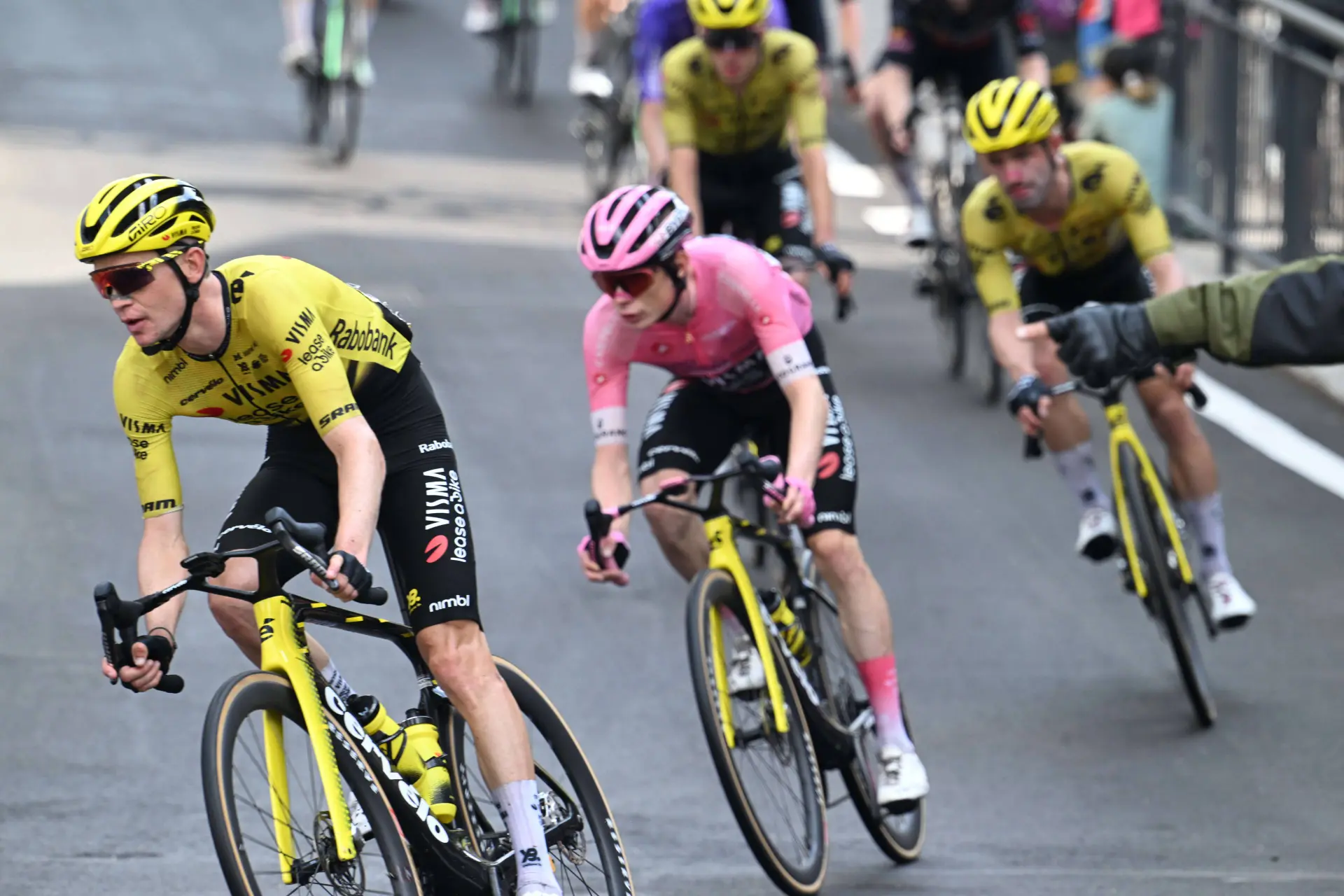
However on both stages 1 and 3, where bunch sprints were expected, there was a distinct yellow colour at the back of the peloton. Jonas Vingegaard, surrounded by his Team Visma | Lease a Bike teammates. That is a purposeful decision.
"We discussed this in the winter, also with Jonas and the other riders," Reed explains. At Paris-Nice and the Volta a Catalunya, they already experimented with the new approach, as is now being done at the Giro. "What struck us was that other general classification teams also dropped back, leaving only the sprinter teams at the front."
So far the strategy has not led to any unnecessary time losses. Visma hope that, even if crashes or splits do occur, that they are ready to close gaps by having their whole team together. Ultimately, the goal is to avoid the head of the peloton and the dangers that come from it.
"But if you look at all the Giro stages, this tactic can work well. We looked at the sprint stages in Grand Tours of recent years. Once or twice a general classification rider lost time. But back then, they weren't ready to rectify anything".

Jonas Vingegaard at stage 3 of the 2026 Giro d'Italia
Visma sitting at the back of the peloton during Giro sprint stages
Whilst on stage 2 it was leading up to a climb, not a bunch sprint, it was possible to see how even when well positioned, a crash can heavily affect the team in question. UAE Team Emirates - XRG were one of the teams leading the peloton during a descent when five of their riders crashed. Adam Yates, Jay Vine and Marc Soler were forced to abandon; whilst two Visma riders were also involved in the crash.
"It is either spending a lot of energy or sitting safely at the back. We believe that if the whole team is there, something can be rectified should something happen. In the first stage, for example, there wasn't a single turn in the finale. Furthermore, it helps with the overall safety of the sport."
"The first experience in Paris-Nice was good, the riders were positive. We might have a situation where it will be our undoing, but in other situations it helps us. It ensures that we save a lot of physical and mental energy," Reef concluded.
Rúben SilvaEditor-in-Chief
A founding contributor to CyclingUpToDate since its launch in January 2022, Ruben Silva has played a central role in shaping the site’s editorial direction and long-term growth. Before joining the project, he built his experience through independent blogging at Echelons Hub and by producing race previews for Ciclismo Internacional, developing a strong analytical voice rooted in daily engagement with professional cycling.
Beyond editorial work, he has been closely involved in the expansion and coordination of CyclingUpToDate’s wider network, helping establish and support sister platforms across multiple languages. This includes ongoing collaboration with CiclismoAlDia (Spanish), CiclismoAtual (Portuguese), WielrennenUpToDate (Dutch), and RadsportAktuell (German), contributing to a shared editorial vision and consistent international coverage.
He also helps oversee editorial governance across the network, setting standards for accuracy and consistency and coordinating updates or corrections when needed.
Originally from the Porto metropolitan area in Portugal, he holds a bachelor’s degree in Geography. His path into cycling journalism was shaped not through formal media training, but through independent reporting, community engagement, and sustained on-the-ground involvement in the sport.
Over the course of his career, he has conducted approximately 100 interviews across road cycling and cyclocross, ranging from one-to-one conversations and online formats to press conferences and on-site pre- and post-race coverage. His interviews include leading riders, team managers, and prominent figures within cycling media: Tadej Pogacar, Jonas Vingegaard, Mathieu van der Poel, Primoz Roglic, Wout van Aert, Joao Almeida and Tom Pidcock; managers like Patrick Lefevere and Joxean Matxin; and YouTube personality Bryan Kennedy (BKXC)...
Within 18 months of launch, he helped grow CyclingUpToDate’s English-language platform into one of the most-read cycling news websites, built entirely from the ground up. As both a professional journalist and lifelong cycling enthusiast, his focus remains on delivering accurate, timely, and well-contextualized coverage.
claps 2visitors 2
Just in

Popular news
Latest comments
- That nearly is 7 mins and you win GTs comfortably by 2 mins. Remco fans - he almost won the TDF, He beat Pogi twice in the mountains this year.abstractengineer23-10-2026
- What would be your preferred Tour design then? Just out of interestwrsty23-10-2026
- I like Remco but even I'll admit he didn't get anywhere close to Pogacar, just like everyone else.megasmacky23-10-2026
- That's what y'all said this year, "remco will come fifth"bruins3022-10-2026
- That used to be the norm, 100 kms of TTs. Now look at the '87 route...acem8222-10-2026
- Well, crashes can happen, so it's not impossible...acem8222-10-2026
- that would be kinda cool. there is a lot of untapped potential. which I'm sure the UCI will overlook. in order to get sock length correct.mij22-10-2026
- Nice! Now Remco can finally show that he cannot win the Tour!!! 😂😂😂PogiSloFans22-10-2026
- Nice! Now Remco can finally show that he cannot win the Tour. 😂PogiSloFans22-10-2026
- 10 K or 100k , Pogi will gain the same amount of time on Remco No balls in 1 stage. All this shows is that they have run out of ideasabstractengineer22-10-2026
Loading
Write a comment