“You can’t replace Remco – but we’re not collapsing like a pudding”: Why Soudal - Quick-Step see opportunity, not crisis, after Evenepoel
Cycling
The departure of Remco Evenepoel was always going to be framed as an existential moment for Soudal - Quick-Step. A generational rider left behind a team built around him, and the easy narrative wrote itself. Collapse. Irrelevance. An identity crisis.
Quick-Step's Wilfried Peeters has no time for that.
“It is a fact that you cannot replace Remco,” the long-time sports director admits in conversation with Wielerflits, before drawing a firm line in the sand. “But our team is not collapsing like a pudding. Anyone who says that has no idea what they are talking about.”
That blunt dismissal is more than rhetoric. It frames how Quick-Step have chosen to interpret this moment not as an ending, but as a release from dependence.

Evenepoel leaves as the sport raises the bar
Peeters’ respect for Evenepoel remains absolute. “Remco is currently the strongest rider in the peloton,” he says, before sharpening the context. “For Remco, the challenge is to win against Tadej Pogacar and Jonas Vingegaard.”
That distinction matters. In an era defined by Tadej Pogacar and Jonas Vingegaard, dominance is no longer measured by collecting wins, but by beating specific rivals. Evenepoel’s move to Red Bull - BORA - hansgrohe reflects that reality. He leaves Brussels for a project designed to give him the mountain depth and Grand Tour infrastructure needed to fight at that level.
Early signs in 2026 underline why Red Bull invested so heavily. Evenepoel has already been winning, immediately justifying the faith placed in him. From the outside, that only amplifies the sense of loss for his former team.
Inside Quick-Step, the interpretation is different.
Pressure did not disappear, it redistributed
One of the loudest criticisms following Evenepoel’s exit was that he had absorbed pressure for others. Peeters rejects the idea outright. “What is pressure, really?” he asks. “If a rider does not deliver uphill after we have ridden all day for him, that is not good either.”
Pressure, in this reading, is structural. It does not vanish with a superstar. It simply shifts. When Evenepoel was present, responsibility was concentrated. Without him, it spreads across the roster.
That redistribution is not accidental. It is strategic. “With him in the team, those young guys would never have had those chances,” Peeters says. “That is the big difference.”
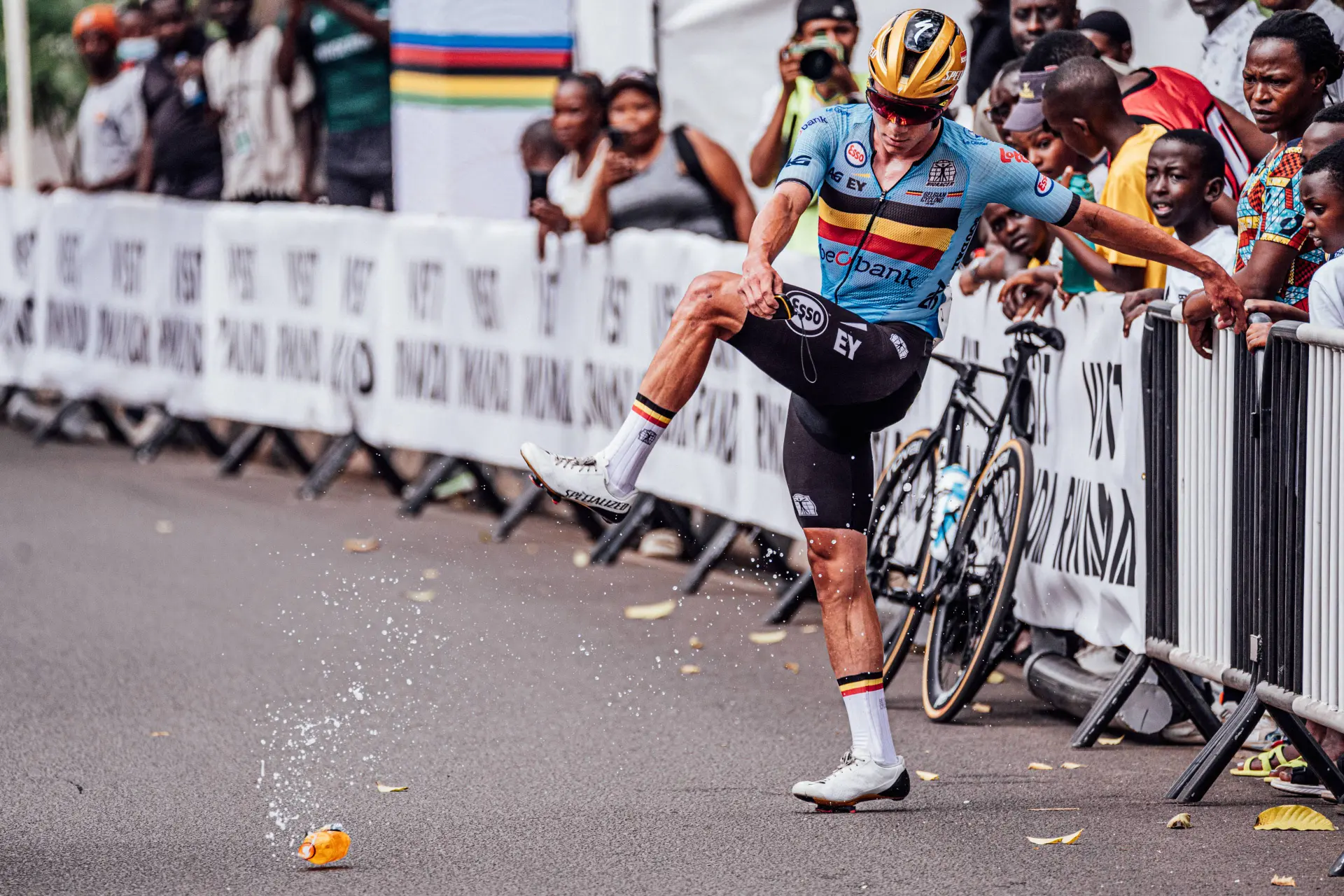
Opportunity through absence
Those words reveal the real pivot. Quick-Step are not attempting to recreate an Evenepoel-shaped project. They are deliberately moving away from one.
Early races of 2026 have already reflected that shift. Young riders have been visible, active, and trusted with leadership roles that would not have existed previously. The emphasis has moved back toward a collective model that once defined the team.
“The strength of the team was always the team spirit, and that many riders could win,” Peeters explains. “We have seen in the first weeks of the season that the atmosphere is there and that everyone is hungry for victories.”
It is a familiar identity, but one that had been partially suppressed by the demands of supporting an elite stage race leader.
Resetting expectations around the next generation
That recalibration is clearest in how Quick-Step are handling Paul Magnier. Internally rated extremely highly, Magnier is being protected from the temptation of instant coronation. “Do not expect him to win the Tour of Flanders right away,” Peeters cautions.
In a market addicted to hype, expectation management becomes a form of strategy. Magnier is being developed, not marketed as a saviour. Alongside experienced winners like Jasper Stuyven and Dylan van Baarle, the focus is on growth, positioning, and timing rather than shortcuts.

Post dependence, not post Remco
Quick-Step’s 2026 season is not about denial. Peeters is explicit that Evenepoel was “perhaps the best rider we have ever had.” It is about refusing to let excellence become a single point of failure.
The sponsor backing remains strong. Contracts have been extended. The sporting structure has been loosened rather than hollowed out. The team no longer bends around one rider’s calendar, training camps, or objectives.
That freedom changes everything. Pressure spreads. Opportunity multiplies. Identity reasserts itself.
Evenepoel will chase Pogacar and Vingegaard in Red Bull colours. Quick-Step will chase something else entirely: relevance through numbers, not reliance.
In Peeters’ eyes, that is not a step back. It is a return to what they were always best at.

Kieran WoodDeputy Editor-in-Chief
Kieran Wood is a sports journalist based in Wales and has been active in journalism since 2022. He regularly contributes to DartsNews.com and CyclingUpToDate.com, where he covers professional cycling and darts. In cycling, his work includes liveblogs from major races, including the Tour de France, the Giro d’Italia, and La Vuelta a España, alongside race reports and analysis. He has also conducted interviews with professional riders.
His reporting spans the full racing calendar, from one-day classics to stage races, with a focus on accurate, real-time coverage and clear contextual analysis. For statistics, results, and historical context, he regularly uses resources such as ProCyclingStats. To support reporting on rider activity and training context where relevant, he also references Strava.
In his work, Kieran places strong emphasis on careful sourcing, editorial accuracy, and updating articles as new, verified information becomes available.
claps 1visitors 1
Just in
Popular news
Latest comments
- i think he can continue to race for maybe another 2 years till he drops out of podium contention. With his TT and his follow the leader in the Mountains,he should not need too many teammates too.abstractengineer14-10-2026
- Aren't they still shopping around for a main sponsor for next year?wrsty14-10-2026
- How broke is visma now? wtf they cant even fight moviestar and decathlon for riders and lose both their mid targets based on their budget and they cant even get those? Crazy...:/miguel13-10-2026
- TT But he won by a minute so he could have cut down on some of it
 Rafionain-Glas13-10-2026
 - weight is measurable. power is measurable. So why didn't he prepare that way from the TDF if he wanted to beat Pogi and after Pogi wasn't going to be there, to win.abstractengineer13-10-2026
- I hope Thibau and Tibor don't do the sameRafionain-Glas13-10-2026
- Seixas is exactly what I would like Pogi to be mentally and in his statements. Both come across as shy and who don't talk much but with Seixas, you can see that he enjoys success, that it boosts his ego, unlike Pogačar who seems to feel increasingly uncomfortable the more he wins. He's won so many times, people are saying he's boring. The french media hate him for winning so much, the french cycling fans are booing him... etc. etc. But remember one thing, Seixas will never physically reach Pogi's level. He's excellent, but he isn't at that level nor will ever be. His talking to the media, his relationship with people is already at a high level.PogiSloFans13-10-2026
- Paul Seixas is now the second-best rider in the world.megasmacky13-10-2026
- When will they start dropping Pogi? Oh yeah, when Pogi reaches 40+ years, that's when young cyclists will start dropping him. But until then... eat your hearts out and cry. Pogi will remain the G.O.A.T. for years to come. Capish?PogiSloFans13-10-2026
- I figure he would have found out how to outsprint Paul and take the win, maybe. He's 28 now but I would say he's right at the peak of his powers. It was great race though, Paul showed me something different about himself.awp13-10-2026
Loading
1 Comments