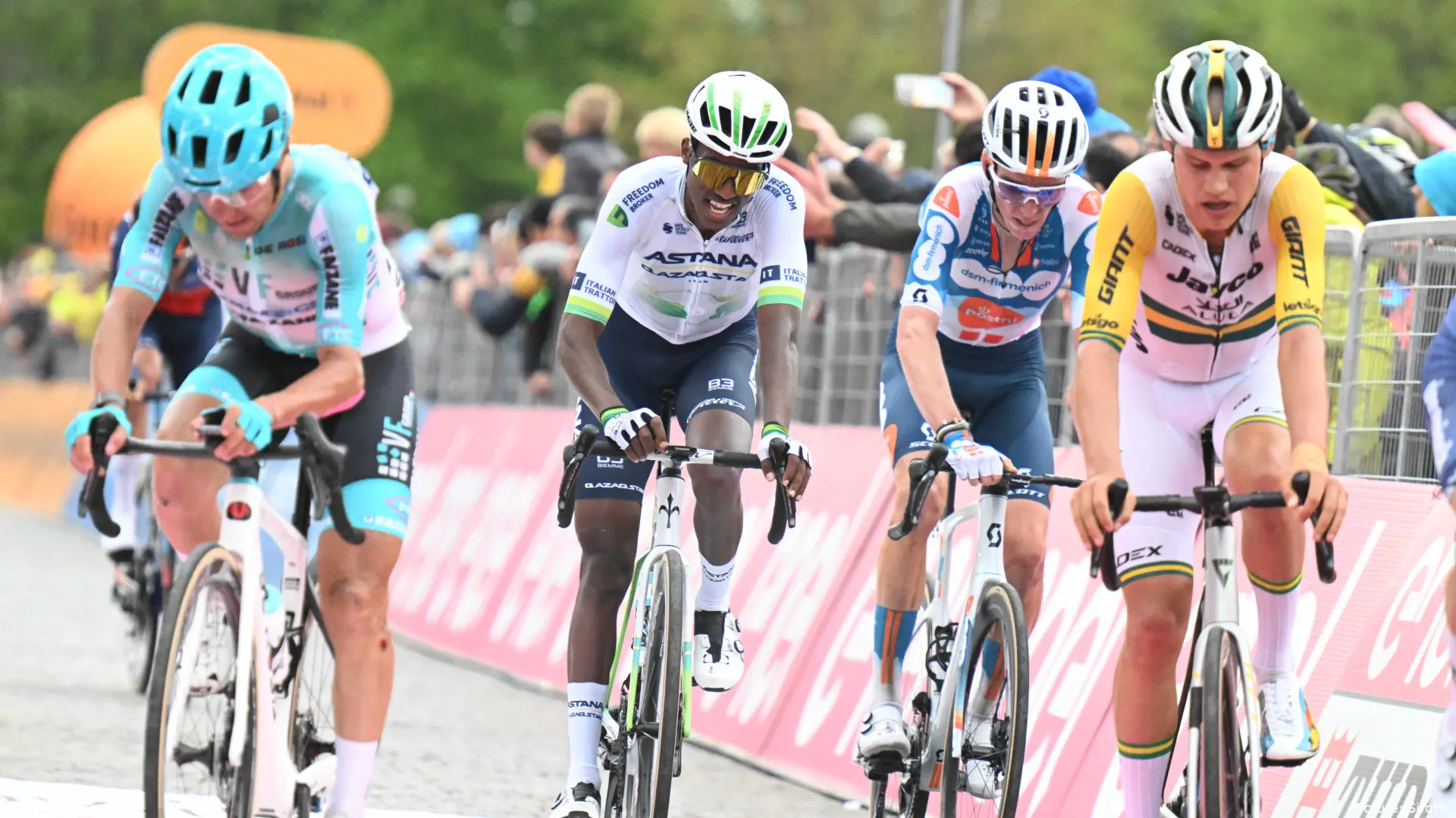
Henok Mulubrhan’s career makes most sense when viewed from the fringes of world cycling. He didn’t start in Europe or grow up within a calendar full of opportunities. His starting point was Eritrea and, from there, every step was shaped by more than performance alone: the simple chance to be seen.
Early results at national level allowed him to leave the country and join the UCI World Cycling Centre in Switzerland. That change meant more than better training; it meant learning a completely different culture. “They teach you everything about professional life. It was very useful to learn what cycling is really like,” he told Domestique. For Mulubrhan, that education laid the groundwork to imagine himself one day in the WorldTour.
The experience came in a difficult context. The pandemic coincided with his move away from home and prolonged family absences. Even so, he never saw it as an insurmountable obstacle. “It was for the goal, for the future. My family understood the sacrifice. My father gives me motivation every second,” he said. That constant support was a reference point when the environment turned uncertain.
The next step looked decisive: the Qhubeka NTT development team. He was one step from the elite, but the project fell apart before it could solidify. The blow was heavy. “It’s disappointing when a team folds. You sign WorldTour and then you have to find another team,” he recalled. He had to start over, this time without guarantees.
Rebuilding came with Bike Aid, a German Continental team. There he turned need into momentum and results followed quickly. In 2022 he won the African road title, a crown he would claim three times. “It’s not easy to be a three-time African champion. I’m very happy about that; it’s history,” he said, aware of the symbolic and sporting value of the feat.
His performances opened the door to Green Project Bardiani CSF Faizanè and with it his first Grand Tour: the Giro d’Italia. It was a crash course in what the top level demands. “Grand Tours are 21 days full gas. You need power to do it,” he summed up. That experience strengthened an idea he had never abandoned. “My dream was always a WorldTour contract. I finally got it with Astana,” he said, thanking Alexandre Vinokourov, whom he cites as decisive in that step.
African cycling
Mulubrhan insists that the issue for many African riders is not quality but context. The scarcity of UCI races on the continent severely restricts international exposure. “We have a hard path to reach WorldTour teams because there aren’t many races in Africa,” he explained. For him, the calendar is key. “It would be very good to have more 2.1 races or classics.” In practice, the Tour du Rwanda has become almost a compulsory test. “If you don’t have results in Rwanda, it’s hard to get a contract. Teams don’t usually look at local races,” he added. He recognises the work of existing structures but sums it up clearly: “They work hard for African riders, but we need races.”
Beyond his own calendar, Mulubrhan looks to Eritrea with optimism. He believes a generation is ready to step up if it finds the right stage. “We have many young riders with great talent. If they have opportunities to show themselves, they can go higher than now,” he said. The impact of Biniam Girmay has been crucial to that shift in mindset. “When someone from your country has done it, you believe you can too. It’s about sacrifice and training hard.”

Mulubrhan, one of the leading African riders today
Juan LarraCycling Journalist
Juan Larra is a writer for Cyclinguptodate and editor-in-chief of Ciclismoaldia, where he has played a central role since its inception. Under his leadership, the website has become a trusted source for professional cycling coverage, offering in-depth analysis, news, and feature stories.
A sports journalist with over 20 years of experience, Juan earned his degree in Journalism from the University of Seville in 2007. He began his career covering a wide range of sports—including football, basketball, Formula 1, MotoGP, tennis, and cycling—for platforms such as the official La Liga app, Vodafone and Movistar websites, NBA Blogdebasket, and Cadena Cope, honing his skills in writing and editorial management.
In addition to his work at Ciclismoaldia, Juan contributes to Cyclinguptodate and serves as editor-in-chief for the tennis-focused site Tenisaldia. Throughout his career, he has conducted exclusive interviews with cyclists and sports figures, provided detailed analysis of competitions ranging from local Spanish races to major international events, and acted as a special correspondent at prestigious races including Paris-Roubaix, the Tour de France, and the Vuelta a España.
Juan’s combination of experience, expertise, and direct access to athletes has established him—and the platforms he leads—as authoritative voices in professional cycling.
claps 0visitors 0
Just in
Popular news
Latest comments
- Nothing. Against Pogi nothingabstractengineer18-10-2026
- He didn't even try to sprint all outvappaxbipmv18-10-2026
- Campenaerts looked like a rolling pumpkin with that all orange leaders skinsuit !frieders318-10-2026
- He can take his dumb a$$ politics somehwere else !frieders318-10-2026
- good to have her back. fingers crossed she‘ll be able to stay!Ketterechts17-10-2026
- A tenner and he wins the Tour next year, too 😂anonymouscyclist17-10-2026
- the answer is either stick to classics or GTs but not bothabstractengineer17-10-2026
- the exodus already stared with Ciccone. Already they were struggling with two sprinters, now there are three. Also Ganna will demand leadership. Gall is the most proven GC, Ayuso has the most potential. GC leadership for everybody will be impossible. Literally a UAE style mess without pogi.abstractengineer17-10-2026
- I raced as an amateur for 12 years, including six years on my country’s national road cycling team. I secured two national titles and competed in three World Championships plus more than 15 international stage races. At 23, we travelled to Italy for a training camp—or so I assumed. On a rest day, we watched a presentation about adopting a more “professional” training approach. It was crystal clear what “professional” meant. That moment first exposed me to this dilemma. After returning from Italy, I left cycling—at least at the competitive level I had known. Over the following two years, the whole team was caught doping. I hold that everyone is innocent until proven guilty. In my view, current stakeholders operate on a different scale, and the sums involved are vast. I am unsure whether any doping would ever be revealed. I try to stay positive and enjoy the show. My 2c.
 vannpelt17-10-2026
 - Fiver he wins 🤣
 leedorney17-10-2026
Loading
Write a comment