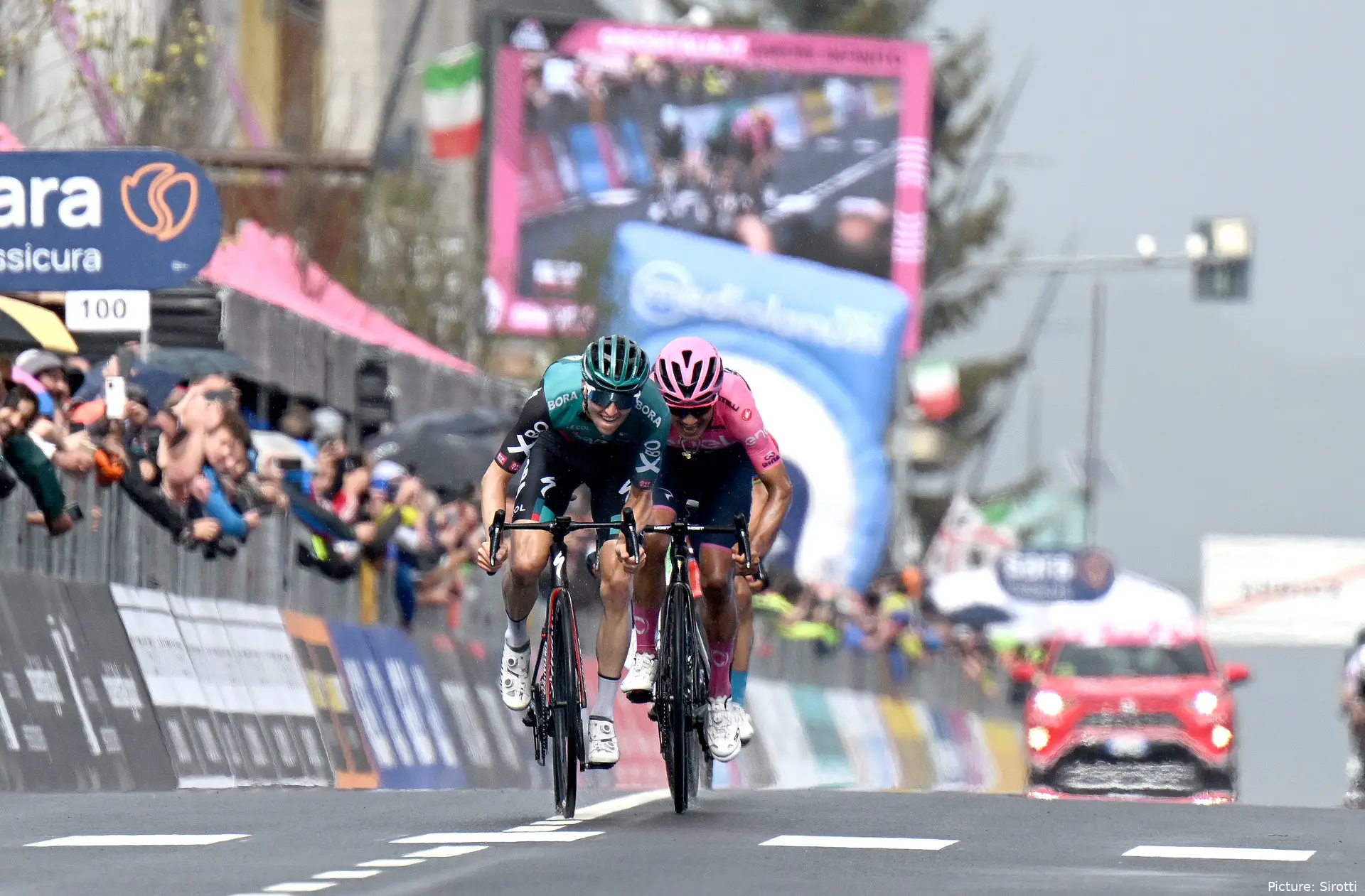
The third and final Grand Tour of the season: the Vuelta a Espana! On the August 19th the Spanish Grand Tour will have it's start in Utrecht, Netherlands, and later go through most of the Spanish territory with it's infamous mountainous and hilly stages, aswell as countless scenic days which promise to deliver spectacle on all aspects.
The profiles of the 2022 editions have been published by the race organizers, containing a route that starts off with three days in the Netherlands which will see team time-trial and two flat stages. Back in Spain the race will go through the Basque Country and Asturias until the second rest day, and will later on travel through southern Spain and the Sierra Nevada, before travelling inland towards the central mountain range and the grand finale in the country's capital of Madrid.
Click here to create your own team for the Fantasy Vuelta a España. At least 20,000 Euro in prizes!

The final startlist includes the likes of: Primoz Roglic, Rohan Dennis, Ben O'Connor, Miguel Ángel López, Vincenzo Nibali, Alexey Lutsenko, Mikel Landa, Gino Mäder, Santiago Buitrago, Sam Bennett, Jai Hindley, Sergio Higuita, Bryan Coquard, Esteban Chaves, Thibaut Pinot, Richard Carapaz, Dylan van Baarle, Ethan Hayter, Pavel Sivakov, Louis Meintjes, Chris Froome, Michael Woods, Alejandro Valverde, Enric Mas, Julian Alaphilippe, Remco Evenepoel, Simon Yates, Kaden Groves, Thymen Arensman, Mads Pedersen, João Almeida, Juan Ayuso, Pascal Ackermann and Tim Merlier.

Key stages for the general classification

Stage 6: Bilbao - Ascensión al Pico Jano. San Miguel de Aguayo, 180Km
Stage 6 will be the first summit finish where the GC riders will be in true action. The attacks and damage are to come on the ascent to Pico Jano. A climb of two halves, but definitely not an easy one. There will be a false-flat run-up to the ascent, and it’s first 7 kilometers average almost 8%, definitely enough to attack the race. There will be a small flat restbite before the final 4.5Km where the gradients will largely be around the 7% mark, without any ramps that are too steep throughout it.

Stage 9: Villaviciosa - Les Praeres. Nava, 175.5Km
The ninth day will be the last in the north of Spain, and although it doesn’t look like the traditional mountain day, it will be a very important one for the GC as the race will head deep into the rugged mountains of the Asturias en route to tackle on of it’s hardest and steepest ascents. That will be to Les Praeres, officially it is a 3.9Km climb at 12.6% average gradient, incredibly steep however the first two 2.5 kilometers are mostly around gradients of 15%, a brutal effort from start to top where the peloton will just slowly be grinded until only the very best sit in front.

Stage 10 (ITT): Elche - Alicante, 31.1Km
Stage 10 will be the race’s only individual time-trial, and one where gaps will be created and can be very important. After a week of complicated racing in the mountains, the time-trial will be completely flat and a big change to the legs of the riders who’ve been constantly pushing hard. The 31-kilometer route will start in Elche and head towards the sea, and the second half of the time-trial will be by the sea. It will finish in the popular coastal city of Alicante.

Stage 12: Salobreña - Peñas Blancas. Estepona, 195.5Km
Stage 12 will see the ascent to Peñas Blancas, that will be just outside of Estepona. Officially it is 18.9 kilometers at 6.5% a serious mountain ascent that takes the riders from sea level to 1260 meters of altitude in the coastal mountains. It is a climb that’s relatively constant. It does feature some areas with a little smaller and higher gradient, but there is never truly much restbite, and the long effort will weigh on the legs of many on what is the first mountain stage of the second week where the fatigue will start to be felt on some riders.

Stage 15: Martos - Sierra Nevada, 148.1Km
Perhaps the queen stage of the Vuelta a Espana? There will be plenty stages where real gaps can be made, however surely will have this day in mind for a long time, and many will fear the climbs they will face. The first ascent will be the Alto del Purche, it is 9 kilometers long at 7.5%, however that features a small but steep descent close to the summit.
Sierra Nevada will host the finish, but the riders will climb via the Alto de Hazallanas which features it’s first 5 kilometers at over 10% average gradient with countless switchbacks. The climb is in total 19.4 kilometers long at 7.9%, and after it’s steep start it never features any restbite, and the last third becomes a straightforward ascent with no locations to surprise. A gruelling test of climbing prowess, a day for the pure climbers to show what they’re made of.

Stage 20: Moralzarzal - Puerto de Navacerrada, 175.5Km
The final mountain stage of the Vuelta. At the end of three weeks of racing it will be a complicated day, but the Sierras de Madrid often offer dramatic race, and with 4000 meters of climbing on the day that will be a make-or-break ride for many. The ascents of the Puerto de Navacerrada, Puerto de Navafria, Puerto de Canencia, Puerto de Morcuera and Puerto de Cotos will be the final test for the GC riders.

CyclingUpToDate prediction for overall classification:
**** Richard Carapaz
*** Jai Hindley, Simon Yates
** João Almeida, Primoz Roglic, Sergio Higuita
* Remco Evenepoel, Miguel Ángel López, Thymen Arensman, Pavel Sivakov

CyclingUpToDate prediction for points classification:
**** Ethan Hayter
*** Primoz Roglic, Mads Pedersen
** João Almeida, Pascal Ackermann, Kaden Groves
* Remco Evenepoel, Tim Merlier, Sam Bennett, Julian Alaphilippe

Rúben SilvaEditor-in-Chief
A founding contributor to CyclingUpToDate since its launch in January 2022, Ruben Silva has played a central role in shaping the site’s editorial direction and long-term growth. Before joining the project, he built his experience through independent blogging at Echelons Hub and by producing race previews for Ciclismo Internacional, developing a strong analytical voice rooted in daily engagement with professional cycling.
Beyond editorial work, he has been closely involved in the expansion and coordination of CyclingUpToDate’s wider network, helping establish and support sister platforms across multiple languages. This includes ongoing collaboration with CiclismoAlDia (Spanish), CiclismoAtual (Portuguese), WielrennenUpToDate (Dutch), and RadsportAktuell (German), contributing to a shared editorial vision and consistent international coverage.
He also helps oversee editorial governance across the network, setting standards for accuracy and consistency and coordinating updates or corrections when needed.
Originally from the Porto metropolitan area in Portugal, he holds a bachelor’s degree in Geography. His path into cycling journalism was shaped not through formal media training, but through independent reporting, community engagement, and sustained on-the-ground involvement in the sport.
Over the course of his career, he has conducted approximately 100 interviews across road cycling and cyclocross, ranging from one-to-one conversations and online formats to press conferences and on-site pre- and post-race coverage. His interviews include leading riders, team managers, and prominent figures within cycling media: Tadej Pogacar, Jonas Vingegaard, Mathieu van der Poel, Primoz Roglic, Wout van Aert, Joao Almeida and Tom Pidcock; managers like Patrick Lefevere and Joxean Matxin; and YouTube personality Bryan Kennedy (BKXC)...
Within 18 months of launch, he helped grow CyclingUpToDate’s English-language platform into one of the most-read cycling news websites, built entirely from the ground up. As both a professional journalist and lifelong cycling enthusiast, his focus remains on delivering accurate, timely, and well-contextualized coverage.
claps 1visitors 1
Just in
Popular news
Latest comments
- great analysis thanks! appreciate you posting this. I didn't realize CX had a different standard for deviation. this is even more egregious it seems.mij10-11-2026
- As he isn't currently with Red Bull, I guess if he want to race for one more year he needs to find a team. He's 37 so this will be his last year I would guess, unless he wants to race for almost nothing like Froome did.awp10-11-2026
- I think some are making much ado about nothing. Even though Jonas is getting older, before his crash in the Tour, he looked like a solid 2nd all the way home. No one can really climb with Tadej until this year, Eric Mas showed himself which I think was a one off year for him and Paul Seixas has been able to be pretty close to him. Whatever stage race Jonas enters as long as Tadej is not there he is a favorite to win.awp10-11-2026
- Giro or not Giro, he won't win the Tour!MajorPayne10-11-2026
- Very true.awp10-11-2026
- Ciccone had a very strong end of season. Consistently attacking and livening up races. Hope he makes that last leap in progress and starts notching some significant wins. Great rider to watch.Occam10-11-2026
- Me too!!!!!Occam10-11-2026
- they can sign any 100 of top riders today but Pogi will win over Remco any time at the TDF unless something goes wrongabstractengineer10-11-2026
- the time for a GC rider to retire is when they cannot win stages, or have a significant level drop like from winner/podium into top 5/10 consistently. Roglic is still competitive and Froome raced even though he became pack fodder.abstractengineer10-11-2026
- He should be in a different team. It was detrimental. For them it does not matter if he does not develop. He should have gone to a team where they need him to succeed.abstractengineer10-11-2026
Loading
Write a comment