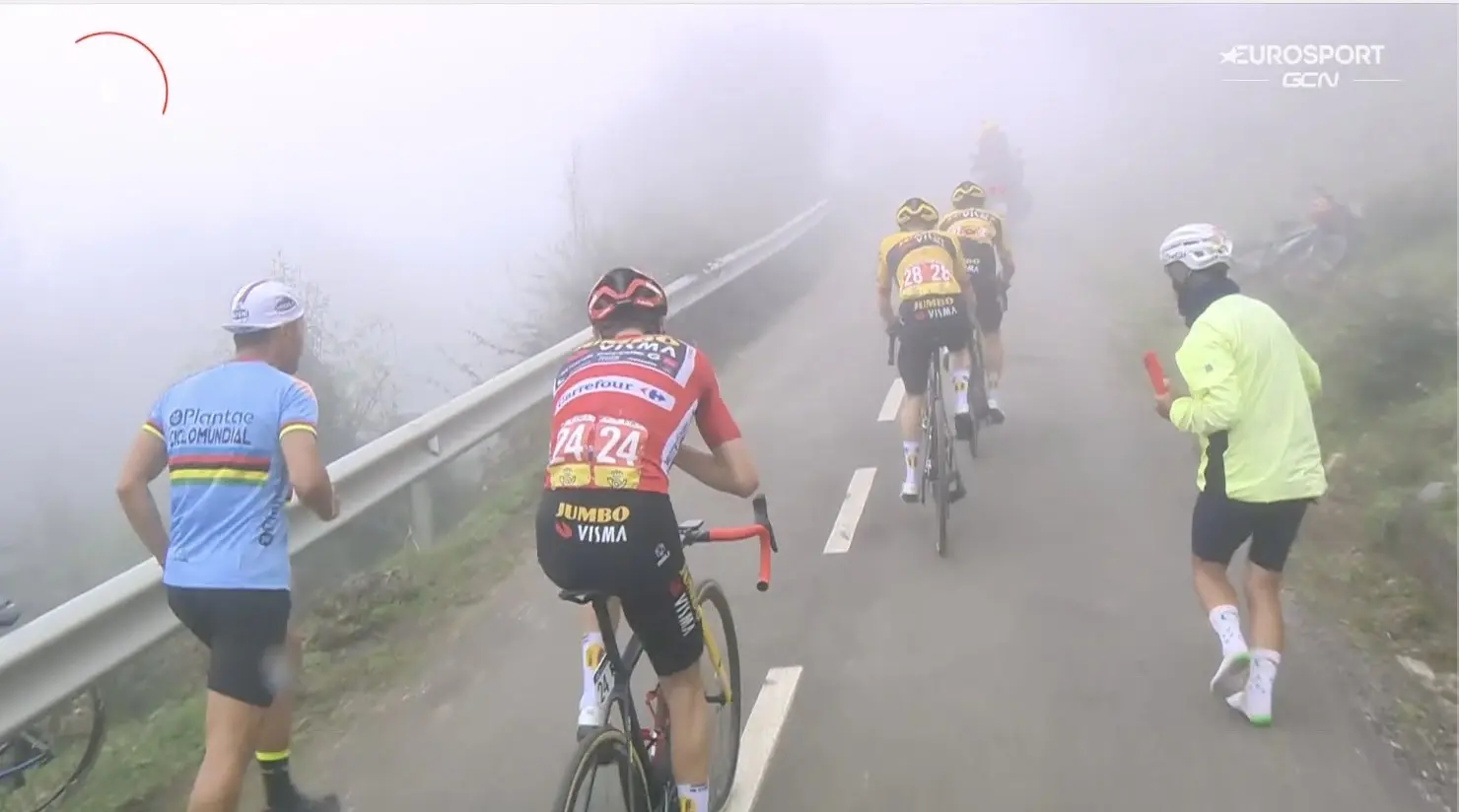
The Vuelta a España has always thrived on cruel climbs, but
none carries the weight and menace of the Alto de l’Angliru. Rising from the
misty roads of Asturias, this mountain has carved its place as the most feared
ascent in modern cycling. First introduced to the race in 1999, the Angliru was
designed to give Spain a climb that could rival the legends of Alpe d’Huez,
Mont Ventoux, and the Mortirolo. Paved in the late 1990s specifically to be
included in the race, the once-gravel track quickly became infamous for its
brutally challenging slopes.
Today, on Stage 13 of the 2025 Vuelta, the peloton once
again faces this brutal test. The route from Cabezón de la Sal stretches over
203 kilometres, much of it deceptively flat before the race tips upward into a
sequence of climbs that culminates with the Angliru. For those fighting for the
general classification, it is a day that could shape the final outcome of the
race. In fact, the podium could be decided today with other a week of racing
still left.
What makes the Angliru so terrifying is not simply its
length, though its 12.4 kilometers of climbing are punishing enough. It is the
combination of relentless gradients and sudden ramps that tear the rhythm from
a rider’s legs. The average gradient hovers at 10%, but that figure conceals
the monstrous reality. The opening five kilometres sit at around eight percent,
a challenging but manageable pace. Beyond that point, the road tilts into
double-digit territory and barely lets go until the finish, with a gradient of
24% at its steepest. Only the final kilometer offers a brief reprieve.
The most infamous stretch is known as Cueña les Cabres,
where the gradient pitches to a staggering 23 percent on average. Riders often
appear to crawl, zigzagging across the road just to keep momentum. This part of
the climb is known to turn the greatest climbers into amateurs again.
History on the Angliru has produced unforgettable drama.
José María “Chava” Jiménez claimed the first victory there in 1999, overtaking
Pavel Tonkov in the final meters on a day of rain and fog. Roberto Heras set an
astonishing record in 2000 with a time of 41:55, still unmatched decades later.
Alberto Contador, Spain’s modern icon, added his name to the mountain’s lore in
2008 with a stage win that helped secure the red jersey, and returned in 2017
to claim victory again in what became his farewell performance. Hugh Carthy
conquered the climb in 2020, his triumph playing out on eerily empty slopes
during the Covid-19 pandemic.
The 2023 edition reminded fans why the climb is unmatched in
its brutality. Primoz Roglic emerged victorious, his ascent time of 42:27
placing him among the fastest ever to scale the Angliru. He and Jonas
VIngegaard shared the same time, having dropped teammate and red jersey leader
Sepp Kuss earlier in the climb, in an incredibly moment of internal-team drama.
Part of the difficulty lies not only in the climb itself but
in the way it is used by race organizers. The Angliru rarely stands alone. It
often follows other punishing ascents, such as the Alto del Cordal, which
softens legs with steep gradients before sending riders plunging down a
treacherous descent. By the time the peloton reaches the foot of the Angliru,
fatigue has already taken hold. From that moment, it becomes a battle of
survival, where the strongest climbers expose the weaknesses of their rivals
and time gaps explode.
Today’s Stage 13 is no different. After more than 160
kilometers of rolling terrain, the riders will face the Cordal before turning
onto the road that leads to the Angliru. It is expected to be the defining day
of this year’s race, the kind of stage where the red jersey can be won or lost.
For the favourites, the challenge is not simply to survive but to attack,
knowing that history remembers those who conquer this mythical summit.
The Angliru has always been more than a climb. It is a
symbol of the Vuelta’s identity, a statement that Spain’s grand tour will not
shy away from brutality in its search for spectacle. Fans line its slopes in
thousands, often reduced to narrow corridors through which riders claw their
way upward. The atmosphere is part carnival, part battlefield, with every meter
demanding total commitment. The mist and fog that we often see on the climb add
to the drama, as the riders ascend into the clouds.

As the peloton tackles the mountain once again today, the
Angliru will write a new chapter in its fearsome history. Some will crack,
others will rise, and one rider will etch their name alongside Jiménez, Heras,
Contador, Carthy, and Roglic. What is certain is that the climb will once again
prove why it is feared, respected, and revered as cycling’s most punishing
ascent.
Who do you believe will come out on top today?

Fin MajorCycling Journalist
Fin Major is a UK-based writer at CyclingUpToDate and has been part of the team since 2024. He is the site’s main writer for FAQs and evergreen explainers and has written around 2,000 pieces for the platform. Alongside this work, he focuses on in-depth analysis and covers the biggest races on the calendar, including the Tour de France, the Giro d’Italia, and La Vuelta a España, providing clear context around performance trends, tactics, and key storylines.
In his reporting, Fin uses reputable data sources such as ProCyclingStats for results, statistics, and historical context. He places strong emphasis on careful sourcing, editorial accuracy, and updating articles promptly when new, verified information becomes available. Outside of writing, Fin is an active cyclist, which supports his practical understanding of the sport and its demands.
claps 0visitors 0
Just in
Popular news
Latest comments
- Nothing. Against Pogi nothingabstractengineer18-10-2026
- He didn't even try to sprint all outvappaxbipmv18-10-2026
- Campenaerts looked like a rolling pumpkin with that all orange leaders skinsuit !frieders318-10-2026
- He can take his dumb a$$ politics somehwere else !frieders318-10-2026
- good to have her back. fingers crossed she‘ll be able to stay!Ketterechts17-10-2026
- A tenner and he wins the Tour next year, too 😂anonymouscyclist17-10-2026
- the answer is either stick to classics or GTs but not bothabstractengineer17-10-2026
- the exodus already stared with Ciccone. Already they were struggling with two sprinters, now there are three. Also Ganna will demand leadership. Gall is the most proven GC, Ayuso has the most potential. GC leadership for everybody will be impossible. Literally a UAE style mess without pogi.abstractengineer17-10-2026
- I raced as an amateur for 12 years, including six years on my country’s national road cycling team. I secured two national titles and competed in three World Championships plus more than 15 international stage races. At 23, we travelled to Italy for a training camp—or so I assumed. On a rest day, we watched a presentation about adopting a more “professional” training approach. It was crystal clear what “professional” meant. That moment first exposed me to this dilemma. After returning from Italy, I left cycling—at least at the competitive level I had known. Over the following two years, the whole team was caught doping. I hold that everyone is innocent until proven guilty. In my view, current stakeholders operate on a different scale, and the sums involved are vast. I am unsure whether any doping would ever be revealed. I try to stay positive and enjoy the show. My 2c.
 vannpelt17-10-2026
 - Fiver he wins 🤣
 leedorney17-10-2026
Loading
Write a comment