“We are here to ride bikes, not to be political” – Biniam Girmay ‘doesn’t care’ about past Israeli identity of NSN team
Cycling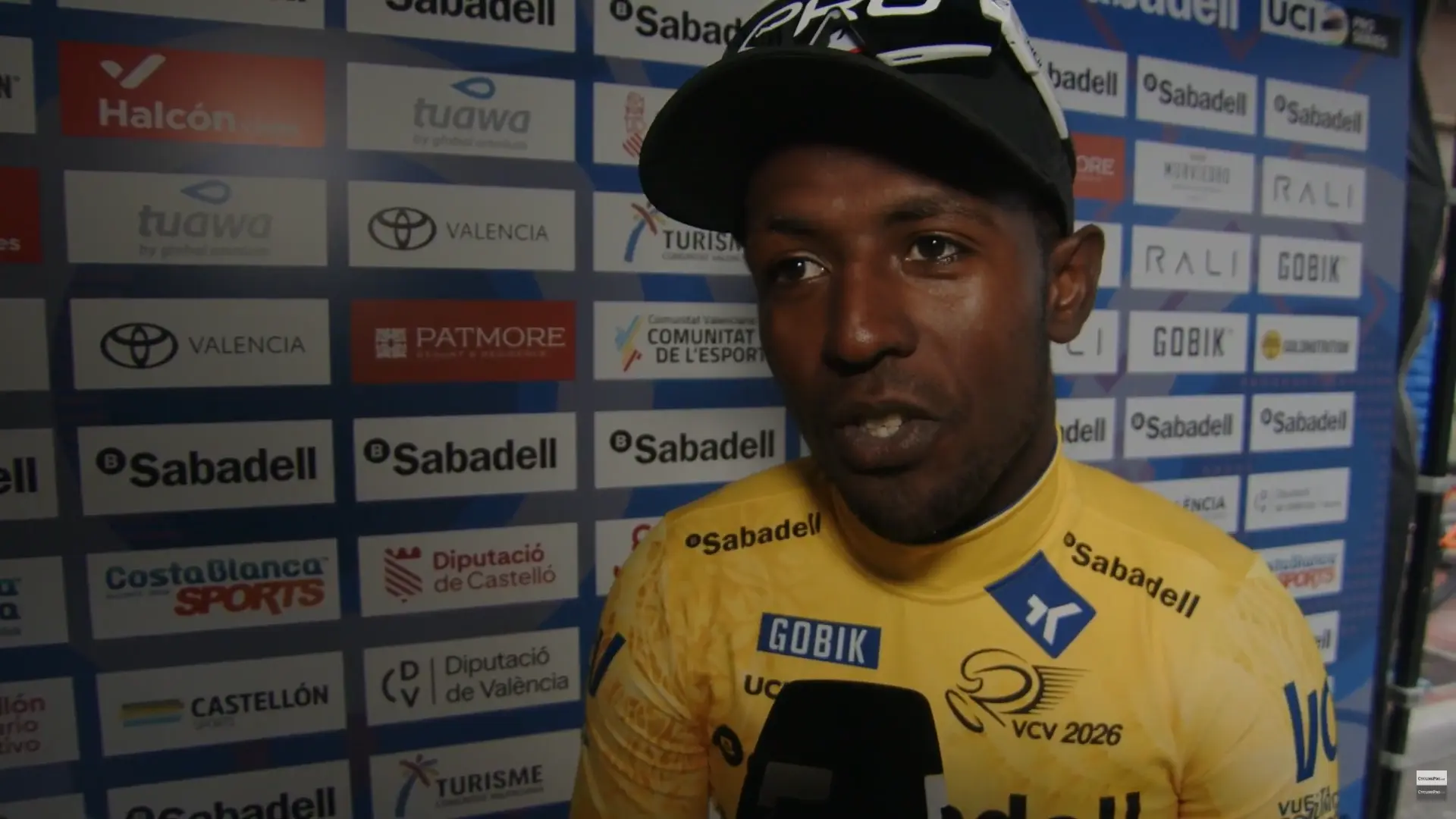
For Biniam Girmay, the start of his new chapter at NSN Cycling Team has been defined by clarity rather than baggage. After opening his season with a stage win and the points jersey at the Volta a la Comunitat Valenciana, the Eritrean sprinter addressed the subject that has followed the team through its rebrand from Israel – Premier Tech.
Asked directly in an interview with Marca whether the structure has completely left behind its Israeli identity, Girmay was blunt.
“To be honest, I don’t care. The only thing that matters to me is the people in the team and the family atmosphere we have. We are here to ride bikes, not to be political. A name is just a name, but we want to compete. We have ambition, and I am here to win.”
It is a statement that draws a clear line between rider and institution. For Girmay, the debate that surrounded the team through 2025 is not something he intends to carry into his first full season in new colours.

A team shaped by protest, disruption and rebrand
The context behind the question is unavoidable. Under its former Israel - Premier Tech identity, the team became a focal point of sustained protest during the 2025 season, most notably at the Vuelta a Espana. Stages were disrupted, riders were targeted, security concerns escalated, and organisers were placed under increasing pressure simply by the team’s presence.
While the UCI licence itself was never revoked, the consequences were tangible. Invitations became politically sensitive, race operations were repeatedly affected, and sponsors faced growing reputational strain. By the end of the season, the structure publicly acknowledged that continuing under the same identity was no longer viable.
The result was a wholesale reset. The team rebranded as NSN Cycling Team, moved to a Swiss licence and repositioned itself as a global, non-national project. The shift was framed not as an ideological statement, but as a practical necessity to ensure riders could race without disruption.
Girmay’s response to that history is notable precisely because of what it refuses to do. Rather than engaging with the politics that engulfed the organisation, he dismisses the relevance of identity altogether.

Protests against Israel - Premier Tech marred the 2025 Vuelta a Espana
Focused on racing, ambition and mindset
That refusal to be drawn into off-bike debate mirrors how Girmay has framed his own career reset. After a season of inconsistency following his standout 2024 campaign, he has spoken openly about pressure and learning.
“They are different years and different circumstances, but last year I had many ups and downs,” he said. “This season, there is a lot of pressure both within the team and on me, but I’ve learned from everything that happened last year. This year, I’m only concentrating on finding a winning mentality.”
His description of life inside NSN reinforces the sense of separation from the team’s former public image.
“It’s completely different. Here we are, a more global and international team, with many nationalities. I like this atmosphere. It’s a very well-organised team that plans everything very carefully with each rider. NSN has higher-quality riders and staff. I’ve also found great teammates.”
In that context, the early result in Spain functions less as a statement and more as confirmation that the reset is working on sporting terms.

Looking ahead, not back
Girmay has been clear that his ambitions remain centred on the biggest stages.
“The Tour de France is the main objective, because it’s the race everyone wants to win. The Classics will also be one of my big goals,” he said, adding that the green jersey remains a realistic target because it rewards consistency.
For NSN, his stance is equally significant. The team’s ability to move forward depends not only on structural changes, but on riders who are willing to treat the rebrand as a line drawn under a turbulent period. Girmay’s words do exactly that.
By stating that he does not care about the team’s former Israeli identity, he is not endorsing or rejecting its past. He is simply stripping it of relevance. In a sport that learned in 2025 how vulnerable teams can be to forces beyond competition, that distinction matters.
For Girmay, the message is uncomplicated. He is there to race, to win and to build something new. Everything else, by his own definition, is noise
Kieran WoodDeputy Editor-in-Chief
Kieran Wood is a sports journalist based in Wales and has been active in journalism since 2022. He regularly contributes to DartsNews.com and CyclingUpToDate.com, where he covers professional cycling and darts. In cycling, his work includes liveblogs from major races, including the Tour de France, the Giro d’Italia, and La Vuelta a España, alongside race reports and analysis. He has also conducted interviews with professional riders.
His reporting spans the full racing calendar, from one-day classics to stage races, with a focus on accurate, real-time coverage and clear contextual analysis. For statistics, results, and historical context, he regularly uses resources such as ProCyclingStats. To support reporting on rider activity and training context where relevant, he also references Strava.
In his work, Kieran places strong emphasis on careful sourcing, editorial accuracy, and updating articles as new, verified information becomes available.
claps 4visitors 4
Just in
Popular news
Latest comments
- i think he can continue to race for maybe another 2 years till he drops out of podium contention. With his TT and his follow the leader in the Mountains,he should not need too many teammates too.abstractengineer14-10-2026
- Aren't they still shopping around for a main sponsor for next year?wrsty14-10-2026
- How broke is visma now? wtf they cant even fight moviestar and decathlon for riders and lose both their mid targets based on their budget and they cant even get those? Crazy...:/miguel13-10-2026
- TT But he won by a minute so he could have cut down on some of it
 Rafionain-Glas13-10-2026
 - weight is measurable. power is measurable. So why didn't he prepare that way from the TDF if he wanted to beat Pogi and after Pogi wasn't going to be there, to win.abstractengineer13-10-2026
- I hope Thibau and Tibor don't do the sameRafionain-Glas13-10-2026
- Seixas is exactly what I would like Pogi to be mentally and in his statements. Both come across as shy and who don't talk much but with Seixas, you can see that he enjoys success, that it boosts his ego, unlike Pogačar who seems to feel increasingly uncomfortable the more he wins. He's won so many times, people are saying he's boring. The french media hate him for winning so much, the french cycling fans are booing him... etc. etc. But remember one thing, Seixas will never physically reach Pogi's level. He's excellent, but he isn't at that level nor will ever be. His talking to the media, his relationship with people is already at a high level.PogiSloFans13-10-2026
- Paul Seixas is now the second-best rider in the world.megasmacky13-10-2026
- When will they start dropping Pogi? Oh yeah, when Pogi reaches 40+ years, that's when young cyclists will start dropping him. But until then... eat your hearts out and cry. Pogi will remain the G.O.A.T. for years to come. Capish?PogiSloFans13-10-2026
- I figure he would have found out how to outsprint Paul and take the win, maybe. He's 28 now but I would say he's right at the peak of his powers. It was great race though, Paul showed me something different about himself.awp13-10-2026
Loading
2 Comments