“It was a tough period. It completely consumes you” – Derek Gee on transfer uncertainty, pressure and a reset that reshaped his Lidl-Trek move
Cycling
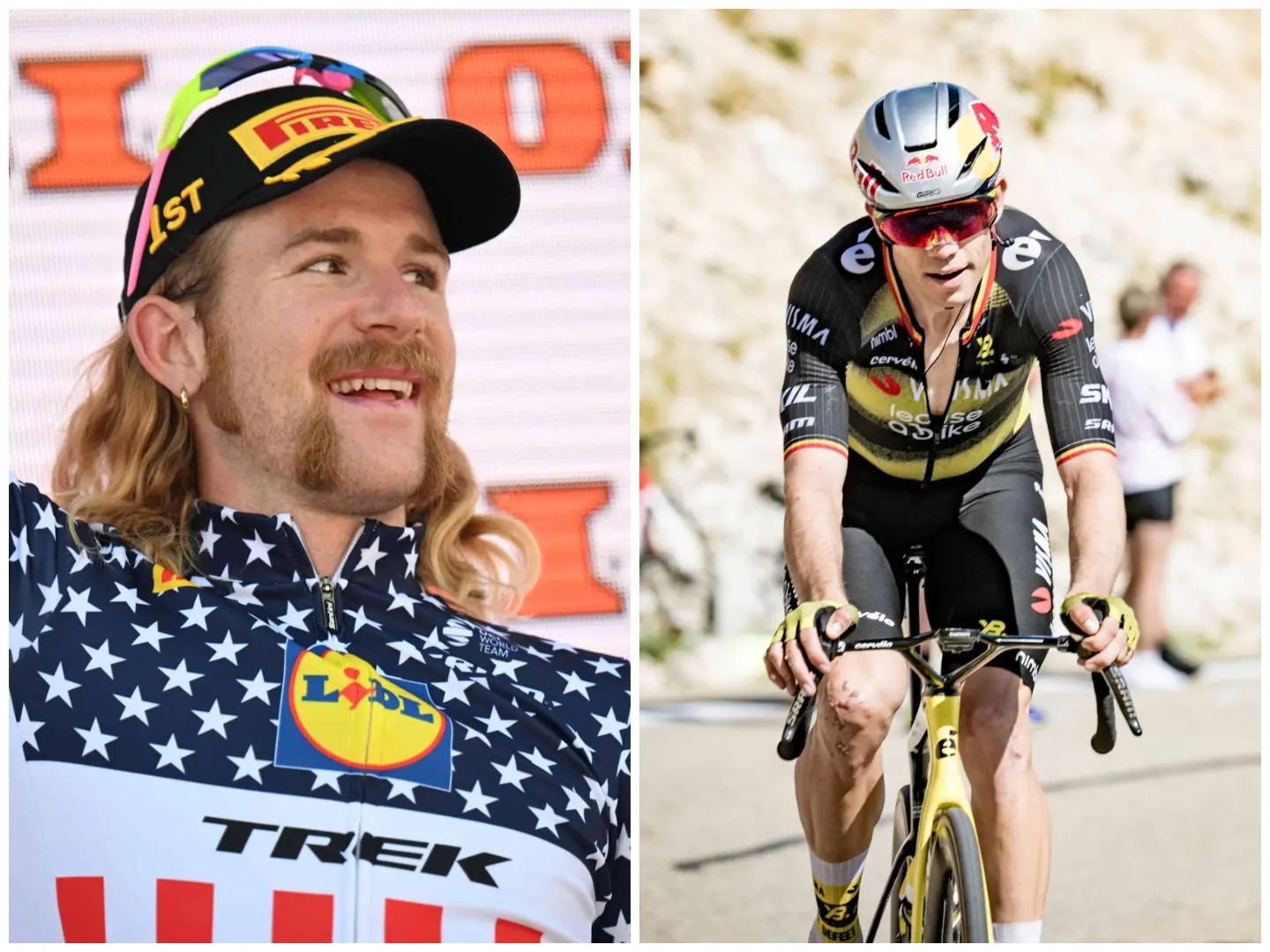
For a rider who has built his reputation on calm progression and steady learning curves, the past months landed very differently. Derek Gee arrived at his new team late, under a cloud of uncertainty, after a period that sat far outside the neat rhythms of training blocks and race calendars. The racing never stopped in his head, but the future did not feel settled.
“It was a tough period,” Gee admits in conversation with Bici.Pro. “It’s the kind of thing that completely consumes you, because it’s your everyday life.”
That sense of pressure matters because Gee is not a rider changing teams from a position of comfort. His rise into Grand Tour contention came later than the modern pathway usually allows, shaped by a gradual transition from track racing and a short apprenticeship as a general classification rider.
Momentum had finally arrived, then suddenly paused. What followed was not noise or drama, but something quieter and more corrosive: uncertainty.
Training through the unknown
Even while his situation remained unresolved, Gee describes refusing to let the process stall. “Even when my future was uncertain, I was training hard, knowing that there would be an outcome in the negotiations,” he says. The line reveals less about contracts and more about mindset. Preparation became the constant when everything else felt provisional.
That self-directed approach fits a rider who has never leaned heavily on systems or inherited leadership roles. Gee’s learning curve has been compressed, not smoothed. Two seasons of genuine GC ambition have come after a late turn professional, leaving room to improve but also little margin for drift. When stability disappeared, training became a form of control.
The release only came when the move was complete. “When you arrive at the new team’s training camp, the tension really disappears very quickly,” he says. That relief is an important context. This was not a celebratory switch, but a reset that allowed him to refocus on racing rather than resolution.
A reset, not just a transfer
Arriving late can unsettle any group, but Gee insists the environment he stepped into felt ready rather than rigid. “Despite arriving incredibly late, I found a very well-organised team,” he says. “I felt integrated very quickly during the December training camp.”
That sense of fit is central to how Gee frames the move. He does not present it as an escape or a rescue, but as a chance to recalibrate. The appeal was ambition, not comfort. “The objective of being in a team like this can only be to aim for the podium,” he says. “I joined this team essentially because they are incredibly ambitious.”
Those ambitions align with how Lidl-Trek now see their stage race future. Gee was brought in with a defined role. “I was brought in to focus on the general classification and try to shift the balance in that direction,” he explains. The clarity contrasts with the months that preceded it.

Pressure, perspective and what comes next
Gee is candid about how consuming the limbo became, but equally clear that it has not lingered. “So it hasn’t left any scars, and I feel re motivated, ready to return to racing,” he says. That matters because his ambitions are not limited to one race or one season. He still views himself as a work in progress, physically and tactically.
“By today’s standards, I turned professional very late, at 25,” he says. “I’ve only had two years of attempts at riding for the general classification.” The implication is not doubt, but upside. There are no glaring weaknesses, he says, but no single dominant strength either, which leaves small margins to find across every discipline.
The reset at Lidl-Trek is therefore less about starting over and more about removing friction. The uncertainty is gone, the pressure now familiar rather than abstract. What remains is a rider who has already learned how quickly momentum can be interrupted, and how deliberately it must be rebuilt.
For Gee, that perspective may be the most valuable outcome of all.


Kieran WoodDeputy Editor-in-Chief
Kieran Wood is a sports journalist based in Wales and has been active in journalism since 2022. He regularly contributes to DartsNews.com and CyclingUpToDate.com, where he covers professional cycling and darts. In cycling, his work includes liveblogs from major races, including the Tour de France, the Giro d’Italia, and La Vuelta a España, alongside race reports and analysis. He has also conducted interviews with professional riders.
His reporting spans the full racing calendar, from one-day classics to stage races, with a focus on accurate, real-time coverage and clear contextual analysis. For statistics, results, and historical context, he regularly uses resources such as ProCyclingStats. To support reporting on rider activity and training context where relevant, he also references Strava.
In his work, Kieran places strong emphasis on careful sourcing, editorial accuracy, and updating articles as new, verified information becomes available.
claps 3visitors 3
Just in

Popular news
Latest comments
- Slowly, very slowly... 5-7 yrs. ;)MajorPayne13-10-2026
- Up to this point: "It is just not yet at the level of Vingegaard and Pogacar." First Jonas, and then level of Tadej. Period!MajorPayne13-10-2026
- The sport has long had a divide between the more diesel-like riders and the more explosive riders. Where does Pogačar fit? His explosive attacks are followed by a high speed diesel climb and he's rarely been caught in the past 5 years (people can name the moments, it's so rare). Seixas is young and we have no idea where his body will end up on this spectrum (just like we didn't with Pogačar when he was 20 and being a diesel up the Vuelta mountains of 2019). Speculation is fun, being a fan while it unfolds is going to be more fun.RidesHills13-10-2026
- yeah it'll be an epoch shift when Pog can't drop people, and/or when they start dropping him.wrsty13-10-2026
- Yes, he won't ride away yet, but he will and that day will be notable
 leedorney13-10-2026
 - Expect the young French rider to slowly asphyxiate the Slovenian into retirement.
 Front24213-10-2026
 - My thinking is that Pog's experience and strength would have outweighed any fatigue in Il Lombardia. But the sad thing is, we'll never see peak Pog (call it Pog 2) go head to head with Seixas. However well he recovers from his crash, he'll return as Pog 3, with the shadow of severe concussion always there.Hills3313-10-2026
- Some speculation and opinion. Had Tadej not crashed out of the Vuelta he would have been less fresh and I'm not sure he would have beaten Seixas in this race. Maybe he would have been able to contest the race in a sprint and maybe not. Believe me when I say I keep up with many of Tadej's climbing feats and records and I understand how great he is but the Paul we just saw at Il Lombardia was not that far behind Tadej.awp13-10-2026
- Firstly, someone who says parenting is babysitting is delusional and shouldn't be taken seriously. Secondly, with pro athletes it is not the same as a normal worker. They are being rewarded for doing something for which they have a talent which doesn't actually help people (besides inspiration). It's quite a different dynamic
 Rafionain-Glas12-10-2026
 - only way for him to effectively learn to microdose is to go to uae. other than that there is no reason for him to go to uae.whkman12-10-2026
Loading
Write a comment