"This is one of the favorite trainings" - How Tadej Pogacar likes to train in the winter and ahead of the monuments
Cycling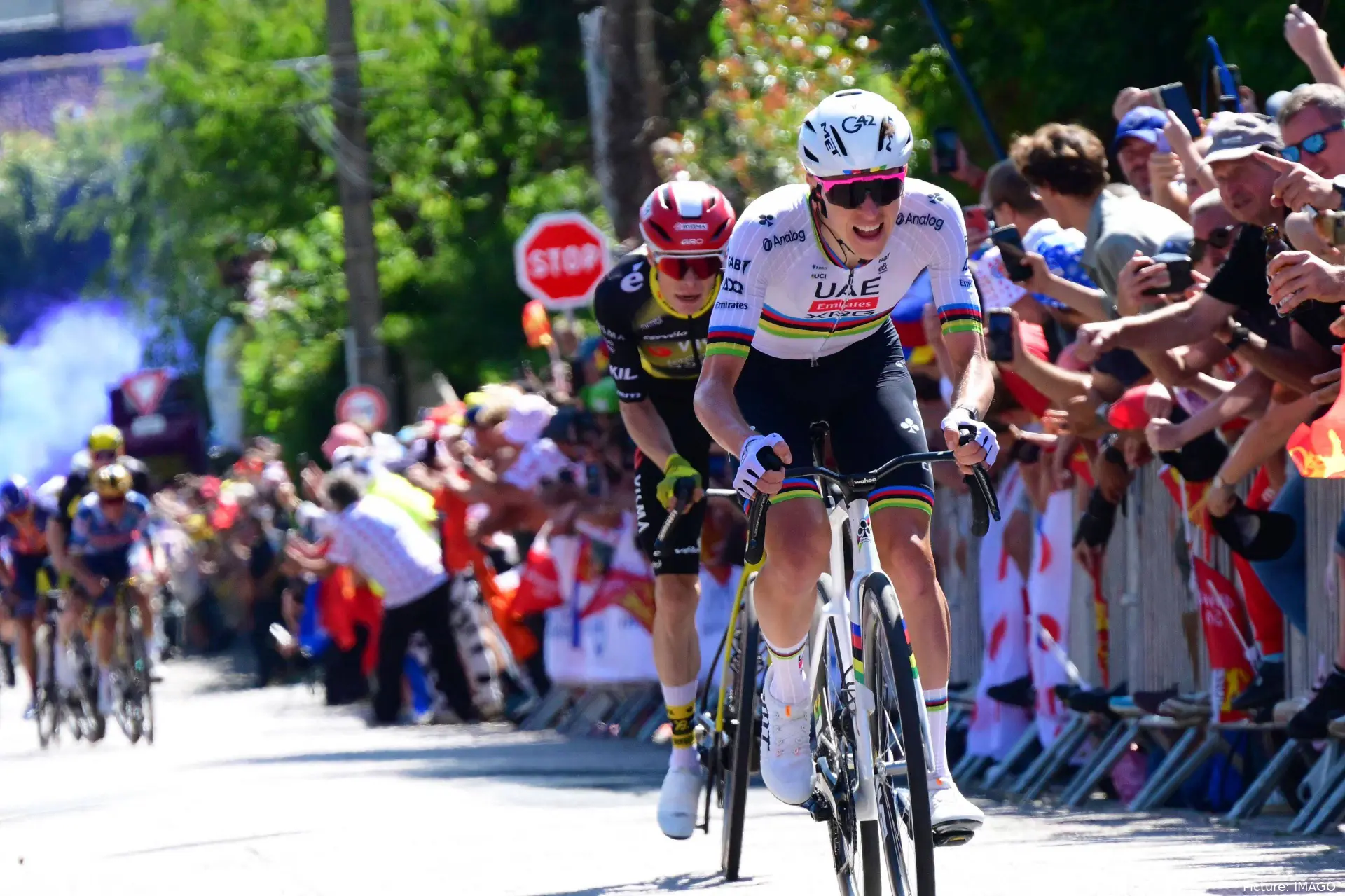
Tadej Pogacar is the best pro cyclist in the current peloton and without a doubt the most successful rider of this generation. Everything from his nutrition to training is explored in the tiniest of detail by riders of all sizes and levels in order to find aspects in which to improve, based on a rider of unmeasurable dimensions. The World Champion has talked a bit about what his favourite type of training is.
Pogacar turned pro in 2017 and in 2019 he was signed by UAE Team Emirates - XRG, where within year and a half he became a Tour de France winner and absolute star. But the rider that already ruled at the time was still distant from his top level, and specially after changing coaches into the 2024 season, the change was again meaningful and the Slovenian has reached a level that no other can match. He is now coached by Javier Sola, the Spaniard who has been termed a key figure in UAE Team Emirates' dominance.
Hence, the relationship between the two is also good and Pogacar is not shy of praising him: “We speak to Javier every day; he’s an incredible guide and we have a perfect connection," he said in a recent interview with Gazzetta dello Sport.
“I also don’t like too much explosive stuff. And when the coach puts just riding and ten sprints at the beginning and ten in the end or something, this is the worst training, you know what I mean," Pogacar said in the Fuglsang i Feltet podcast from Danish news outlet Feltet.
However, whatever needs to be done in the sake of performance is done, something which is key for riders of such level, who already have so many aspects of the sport dialed in. In the interview with the Italian news outlet, Pogacar also said that evolving as a rider is one of the things that motivates him the most, even if it doesn't necessarily brings him the results: "But there is one thing that motivates me more than anything else. Seeing how far I can push myself to improve. Training, racing, everything. Finding new ways to move forward, to stay on top. In short: remaining the best version of myself.”
For this, the riders of Pogacar's caliber usually have a very full schedule throughout the year, consisting of course of between 50-70 races days, but also training camps and recon days for special races. This will at the end of the year lead to a very packed schedule from December to October usually.
In 2024 for example, Pogacar rode the team's training camp in December and although he had a late start to the season, he raced Strade Bianche, Milano-Sanremo, Volta a Catalunya; had a three-week altitude camp, raced Liège-Bastogne-Liège; raced the Giro d'Italia (where he won) followed by another three-week training camp and then the Tour de France. When fatigue is managed and there is lack of injuries and illnesses, such a schedule can lead to improvements, specially as at the time Pogacar was still 25 years old.
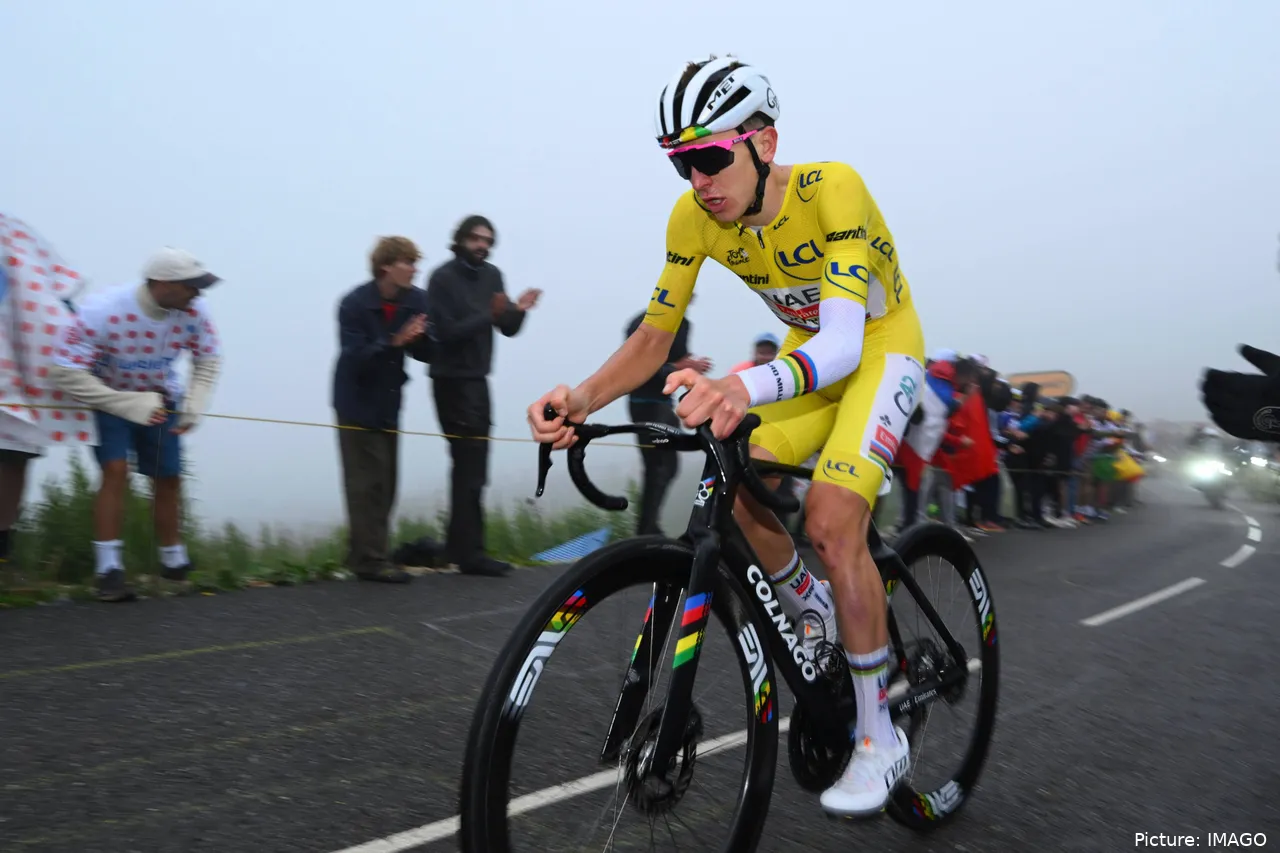
Pogacar has dominated both 2024 and 2025 Tour de France, with training and nutrition methods that were not used a decade ago
Remaining healthy is also a big part of it, taking the rivalry between Mathieu van der Poel and Wout van Aert as a great example. Van der Poel, since the start of 2023, has lived out in Spain where the weather is good all-year long and has largely avoided major setbacks; whilst van Aert in 2024 alone suffered two massive crashes at Dwars door Vlaanderen and Vuelta a España. These not only create physical and psychological obstacles for the Belgian, but have also stripped away months of racing or training that would've aided his evolution, whilst instead, he required recovery instead.
Now more than ever, riders are also training harder and harder in the winter. That is the case for Pogacar too, take the words of his teammate Nils Politt in a recent interview in the Ulle and Rick podcast: “At our December camp, there is basically never a clear plan. Some teams do team time trial practice, some do lead outs. With us, it is just full gas. I remember one training ride last year where I looked at the file afterwards, and the numbers were exactly the same as in the Tour of Flanders, where I finished third. And that was training.”
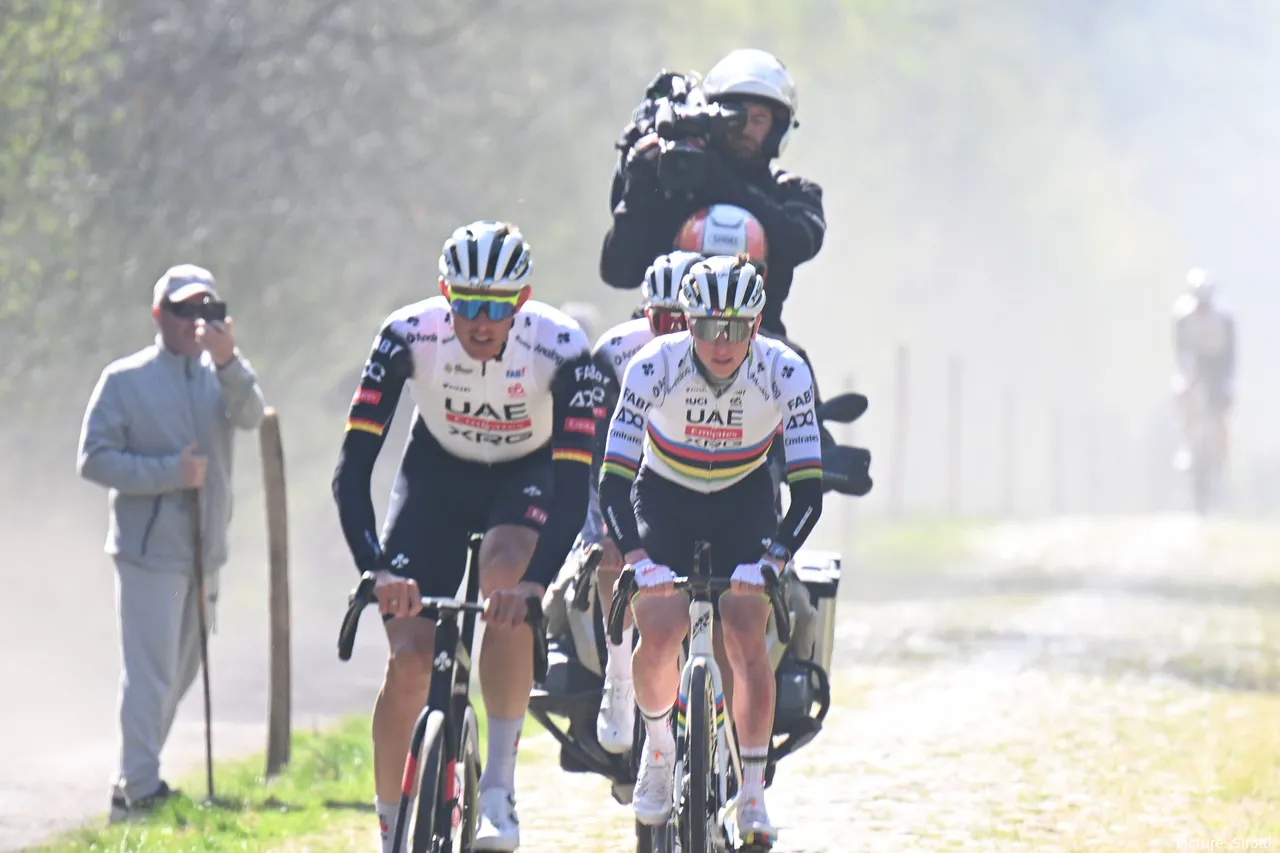
Nils Politt and Tadej Pogacar exploring the route of Paris-Roubaix before the World Champion's debut in 2025. @Sirotti
So what does Pogacar enjoy?
But Pogacar likes to take it easier: "In the winter, I just love just zone 2, 5-6 hours. Especially when you’re just going alone and do a big loop or something. I really love this, keep the power high. You come home a bit tired and wrecked but. Also, you go all day fast, feeling so good to do it".
This is also what he does ahead of the big races where endurance is key. Of course, these mostly include the monuments, which often go up to or above six hours of racing; but also the Grand Tours where recovery is a key factor for a top rider and the GC specialists are forced to take on heavy training schedules in order to be able to absorve the high demands of day-after-day racing at a high intensity.
"But then in the summer or before the big one-day races, I like to do six hours again, quite high pace through the day," he says. "Behind the motor 1-1.5 hours, push it a little bit and then some explosive into the last hour. This is one of the favorite trainings.” This sort of high-paced training for hours on end is also part of why the Slovenian thrives in long-range attacks, and this is more and more often implemented on pro riders' routines.
It is also necessary to train at a very high intensity so as to train other aspects of the sport, such as the high-intensity efforts after many hours of racing; but above all the nutrition requirements that the riders have in the modern peloton that are necessary to have the power outputs that continue to beat records. Pogacar for example, during a mountain stage at this year's Tour de France, had an average consumption of 90 grams of carbs for 5 hours as reported by Velon, and so it is necessary for riders to be well adapted not only in their legs, but also in their head and stomach.
Rúben SilvaEditor-in-Chief
A founding contributor to CyclingUpToDate since its launch in January 2022, Ruben Silva has played a central role in shaping the site’s editorial direction and long-term growth. Before joining the project, he built his experience through independent blogging at Echelons Hub and by producing race previews for Ciclismo Internacional, developing a strong analytical voice rooted in daily engagement with professional cycling.
Beyond editorial work, he has been closely involved in the expansion and coordination of CyclingUpToDate’s wider network, helping establish and support sister platforms across multiple languages. This includes ongoing collaboration with CiclismoAlDia (Spanish), CiclismoAtual (Portuguese), WielrennenUpToDate (Dutch), and RadsportAktuell (German), contributing to a shared editorial vision and consistent international coverage.
He also helps oversee editorial governance across the network, setting standards for accuracy and consistency and coordinating updates or corrections when needed.
Originally from the Porto metropolitan area in Portugal, he holds a bachelor’s degree in Geography. His path into cycling journalism was shaped not through formal media training, but through independent reporting, community engagement, and sustained on-the-ground involvement in the sport.
Over the course of his career, he has conducted approximately 100 interviews across road cycling and cyclocross, ranging from one-to-one conversations and online formats to press conferences and on-site pre- and post-race coverage. His interviews include leading riders, team managers, and prominent figures within cycling media: Tadej Pogacar, Jonas Vingegaard, Mathieu van der Poel, Primoz Roglic, Wout van Aert, Joao Almeida and Tom Pidcock; managers like Patrick Lefevere and Joxean Matxin; and YouTube personality Bryan Kennedy (BKXC)...
Within 18 months of launch, he helped grow CyclingUpToDate’s English-language platform into one of the most-read cycling news websites, built entirely from the ground up. As both a professional journalist and lifelong cycling enthusiast, his focus remains on delivering accurate, timely, and well-contextualized coverage.
claps 10visitors 7
Just in
Popular news
Latest comments
- Can we get a comment from the UCI on this. The silence from Aigle is deafening! Come on cycling journalists , start annoying them to get a comment please.Paul53111-10-2026
- A shame to see him retire, I really liked him as a rider. His dignified tribute along with Matej Mohorovic to Gino Mader after his death was class and will always live in my memory. Enjoy your retirement.GregT11-10-2026
- A shame to see him retire, I really liked him as a rider. His dignified tribute along with Matej Mohorovic to Gino Mader after his death was class and will always live in my memory. Enjoy your retirement.GregT11-10-2026
- I thought Seixas had hit the end of the road from a fatigue standpoint, after the WC meltdown - and he still finished ok. This was impressive and an amazing return.mij11-10-2026
- totally, eating crow for breakfast this morning. after the world championships I thought we were looking at a late season fade from fatigue. way to go Paul!mij11-10-2026
- Well if UAE the best team in history comes knocking their the only team in the world who can get Seixas. Seixas will become unbeatable and incredible there. Lets see if he stays at decathlon or goes to UAE.miguel11-10-2026
- Pogi would have won the Vuelta at around 10 min. But it would have been boring for fools like you. Capish?PogiSloFans11-10-2026
- Rather than me describing the technology at length on here, If you google. Line-scan cameras. They are also sometimes called Slit-Scan cameras. Either search will fill you in. You can read all about how they. work. Enjoy! Just to be clear the cyclist is saying he wants to see exactly where the digital finish line is in relation to the actual physical finish. At this point we only have the word of the authority that the digital line corresponds to the exact starting edge of the physical finish line. That seems like a reasonable request to me.Prorodsandstuff11-10-2026
- 100% @Jumpyjohn, good point well raised.anonymouscyclist11-10-2026
- The media keep stirring the soup.. or spitting in it
 leedorney11-10-2026
Loading
Write a comment