“The risk versus reward is just too high” – Luke Rowe and Bradley Wiggins debate cobbled stages in grand tour
Cycling
With the 2025 Tour de France now in the books, rumours are
already starting to swirl for the 2026 edition. Will the race return to Alpe d’Huez?
And will there be a cobble or gravel stage like we have seen previously? As for
the latter, Luke Rowe’s view on cobbles in the Tour de France is blunt and
carries the weight of a rider who’s been trusted to guide Tour champions across
the toughest terrain in the sport. Appearing on the “Sir Brad’s Café” podcast
with Bradley Wiggins and Graham Willgoss, Rowe didn’t hold back in questioning
the place of cobblestone stages in the world’s biggest race.
“The risk versus reward is just too high,” he said. “That
one day of excitement can cost you two weeks of racing with a guy who’s
prepared for six months.”
Rowe, widely considered the gold standard for modern road
captains, knows exactly how brutal a cobbled day can be. He praised the
spectacle for fans but argued that the inclusion of such unpredictable surfaces
in a Grand Tour simply isn’t worth the fallout. “Richie Porte was absolutely
flying… he crashed out and we missed Richie Porte for the last two weeks,” Rowe
recalled, referencing the 2017 Tour. “You lose more than what you get.”
Wiggins admitted the cobbles are as brutal as they look,
calling them “the worst ones to ride, but the best ones to watch,” while also
reminiscing about the nostalgic draw of racing on roads that haven’t changed in
a hundred years. But he still wasn’t sold on romance. “They were never made for
the type of bikes we see in the peloton now,” he said. “They were built for
farmers to get their carts between fields.”
Even when Rowe made his Tour debut in 2015, one of the key
reasons for his selection being his eighth-place finish in Paris-Roubaix, he
admitted he was far from ready. “I was absolutely useless that day,” he said,
blunt as ever. “I let the team down.” That stage, loaded with cobbled sectors
and chaos, made clear just how high the stakes are. Since then, Team Sky, and
now INEOS, have prohibited riders selected for the Tour from racing the British
Nationals beforehand. “Sorry to any riders who are in Team Ineos and can’t ride
the Nationals,” Rowe joked. “I think I got a bit of a responsibility for that
one.”
Though he respects the demands of cobbled stages, Wiggins
not shy about how punishing they are on the body. “Your knuckles the next day…
it’s just constant bouncing,” he said. No matter the bike tech, the roads are
still the same unforgiving ones used for centuries. “You can do whatever you
want,” Wiggins agreed, “but ultimately, it’s a cobbled stretch of road.”
The conversation also explored the mental and logistical
strain of racing the cobbles during a three-week Tour. “The logistics of
cobblestone stage days are enormous for every team,” Wiggins explained. “In
some ways, it’s an arms race to who can pack out the sectors the most.” From
tire choices to positioning personnel along the route, preparation starts as
soon as the Tour route is announced the previous October.
And when the race hits the cobbles, everything moves fast, and
painfully slow. “You’re constantly making small calculated risks,” Rowe said.
“If you use a rider like Kwiato (Michał Kwiatkowski) every day, after a week
he’s in a body bag. That’s how good he is, he’s an asset every single day.”
The leadership dynamic between road captains and team
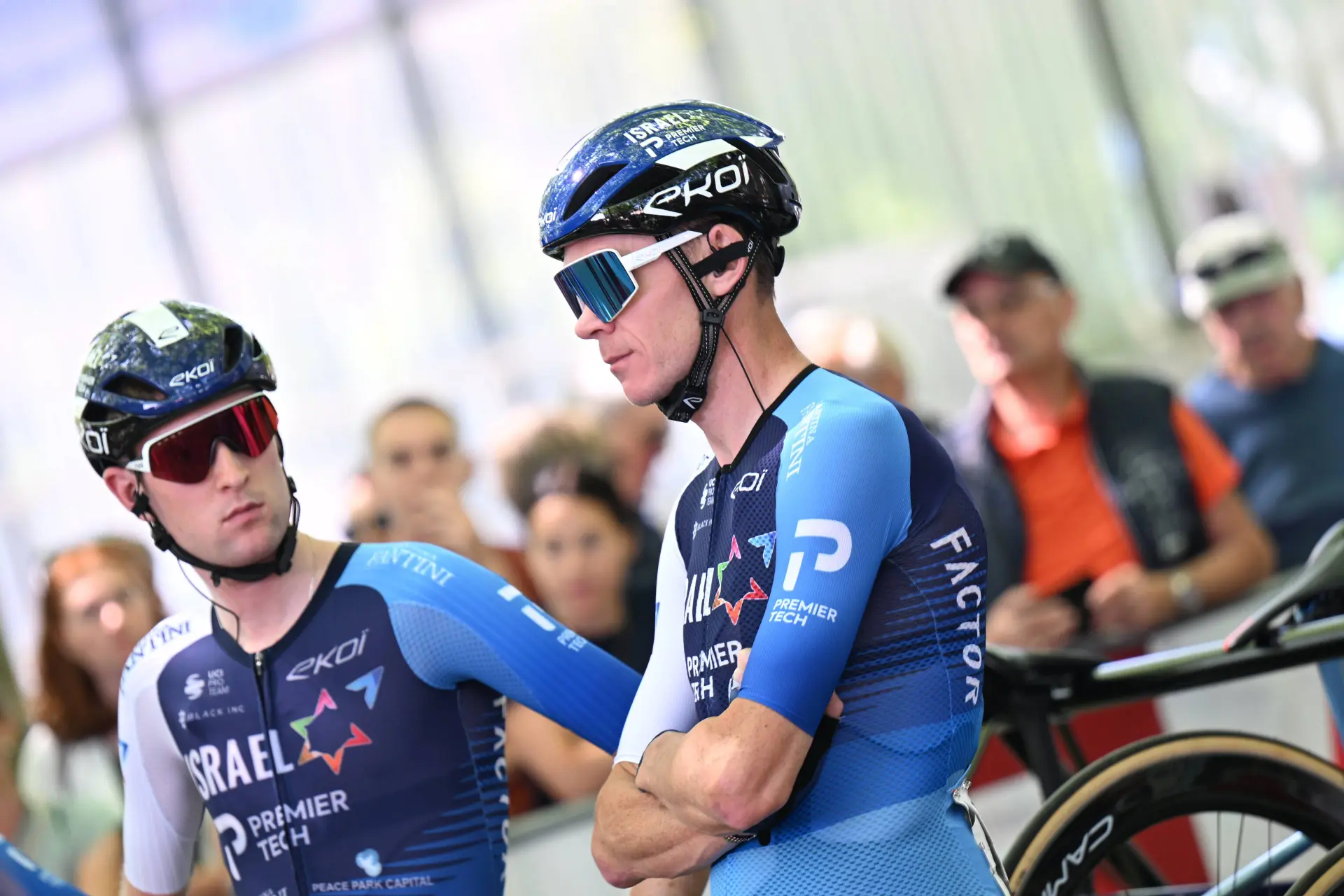
leaders was another major thread. Rowe spoke about how trust from riders like
Chris Froome made his job easier. “Once you’ve got their full buy-in… it became
quite easy,” he said. “You get that buy-in not from being the loudest in the
room, but by doing the job day after day.”
Wiggins backed that up, calling Rowe “a wise head on a young
pair of shoulders,” recalling moments when his calm, assertive guidance stood
out. “There’s something comforting in someone with a calmness and confidence in
what they’re saying,” he said.
Rowe was candid about the challenges, too, including the bad
decisions. “A lot of people who are road captains will only ever talk about the
good decisions they make, but I tell you, I made a lot of bad ones,” he said.
“It’s easy to walk on and get the praise. But if it all goes tits up, that was
also me. Sorry, boys.”
When asked about teammates who were difficult to lead, Rowe
didn’t dodge. “With Ethan Hayter, I struggled. He wouldn’t buy in. He wouldn’t
commit.” He also described a tense moment with Rohan Dennis that eventually
resolved with mutual respect.
As for whether the cobbles belong in the Tour, Rowe’s stance
remains unwavering. “To win the Tour, you’ve got to get to Paris first,” he
said. And no matter how spectacular the TV footage looks, it’s riders like him,
those tasked with getting leaders through carnage, who understand the true
cost. “If you’re good, good things happen,” he said. “If you’re not, you’re in
the wrong place and it’s over before it starts.”

Fin MajorCycling Journalist
Fin Major is a UK-based writer at CyclingUpToDate and has been part of the team since 2024. He is the site’s main writer for FAQs and evergreen explainers and has written around 2,000 pieces for the platform. Alongside this work, he focuses on in-depth analysis and covers the biggest races on the calendar, including the Tour de France, the Giro d’Italia, and La Vuelta a España, providing clear context around performance trends, tactics, and key storylines.
In his reporting, Fin uses reputable data sources such as ProCyclingStats for results, statistics, and historical context. He places strong emphasis on careful sourcing, editorial accuracy, and updating articles promptly when new, verified information becomes available. Outside of writing, Fin is an active cyclist, which supports his practical understanding of the sport and its demands.
claps 0visitors 0
Just in
Popular news
Latest comments
- What a cheater Jay Vine is. Remco gained on everyone else pretty much evenly. But Vine? After he was caught, the gap grew at a suspiciously slow rate. Typical UAE
 Rafionain-Glas18-10-2026
 - Strade? Never saw him as a gravel rider that can handle it.mij18-10-2026
- It surprises me that anyone still believes any professional (or amateur!) sport is clean--much less wants it to be. The best you can hope for is a reasonably level playing field that doesn't expose young, ambitious athletes to health risks they don't understand. In that regard, World Tour cycling appears to do a better job than almost any sport with independent, random testing. There are certainly fewer mysterious midnight "heart attacks" these days. If you want to see what an uneven playing field looks like, show up to masters nationals. It is also certainly the case that no major pharmaceutical corporation has developed a multi-billion dollar miracle drug just to give it only to one or two anointed ectomorphs in a minor non-revenue sport. If you don't like that all sports run on PEDs these days and you can't be bothered to contribute as a tester, a federation official, or pharmaceutical representative, then just turn off the TV and play outside.
 MarkFour18-10-2026
 - Good grief, who proofreads this stuff? Errors abound.wrsty18-10-2026
- You can add weight to a bike and limit gears or make it single speed if you like. I doubt that would reduce crashes. It would just add another dymanique. All good and well, but It wont stop cars getting on to the course.Cyclingsbestfan18-10-2026
- Seixas is probably second best in the World on short climbs. But that hasn't translated as well to long climbsRafionain-Glas18-10-2026
- Idiotic fellaRafionain-Glas18-10-2026
- Nothing. Against Pogi nothingabstractengineer18-10-2026
- He didn't even try to sprint all outvappaxbipmv18-10-2026
- Campenaerts looked like a rolling pumpkin with that all orange leaders skinsuit !frieders318-10-2026
Loading
Write a comment