“The agreement is not about money” – Insider reveals how the Giro d'Italia persuaded Jonas Vingegaard to race in Italy
Cycling
When a rider of Jonas Vingegaard’s calibre changes his season around a race that is not the Tour de France, people assume there must be something big behind it. Big money. Big pressure. Big deals.
According to Giuseppe Martinelli, who has managed champions like Marco Pantani, Alberto Contador and Vincenzo Nibali, the reality is far simpler and far more sporting.
“The agreement is not about money,” Martinelli said in an interview with Bici.Pro. “For me it is difficult to believe they really pay a rider or a team. There is a reimbursement of expenses, but that is the same for everyone.”
Martinelli, who has inside knowledge of these kinds of situations from his own career, says that if a race like the Giro d’Italia wants a Tour-level superstar like Vingegaard, the conversation starts somewhere else entirely.
How the Giro gets a Tour star
For Martinelli, the first and most important part of any understanding between a Grand Tour and a champion is the route. “The first thing to understand together, if you want a rider at Vingegaard’s level, is the route,” he explained. Not a course designed to flatter organisers, but one that fits into a rider’s bigger season.
That matters especially for Vingegaard because the Giro in 2026 is not his main target. The Tour de France still is.
In his own words, Vingegaard has said that his build-up to the Tour has followed the same pattern for five years, and that choosing the Giro is about trying something new. Martinelli believes that only works if the Giro itself is shaped in a way that makes a Giro-Tour double realistic.
In practical terms, that means a course that is not excessively hard and does not leave a rider destroyed before July. In Martinelli’s view, this is exactly why the Giro can make sense for Vingegaard now.
Why the Giro suits Vingegaard
After two second places at the Tour de France behind Tadej Pogacar, Vingegaard’s 2026 season is being read through one lens: does this help him beat Pogacar?
Some experts have argued that riding the Giro could weaken him for the Tour. Others believe it could sharpen him. Martinelli falls into the second camp. “It almost suits Vingegaard more to come to the Giro than the other way round,” he said. After two straight runner-up finishes in France, a Giro win would not just add a trophy, but complete the set of Grand Tour victories.
That matters for motivation. Vingegaard himself has openly spoken about wanting to win in Italy after already winning in France and Spain. For him, the Giro is not a consolation prize. It is a missing piece.
Martinelli’s view is that the Giro does not simply benefit from having Vingegaard. Vingegaard benefits from having the Giro in his season.
A decision made long ago
Another part of Martinelli’s explanation is timing. “The fact that Vingegaard announced it on 13 January is a formal date,” he said. “Between Visma and the Giro, in my opinion, contacts started much earlier.”
In other words, this is not a late winter gamble. It is a plan that has likely been forming since last season, possibly even since the end of the Tour. That fits with what Vingegaard and Visma have said about wanting a new path after repeating the same Tour preparation for years.
This is also why Martinelli dismisses the idea of short-term incentives. A decision like this is about the entire season, not about appearance fees.
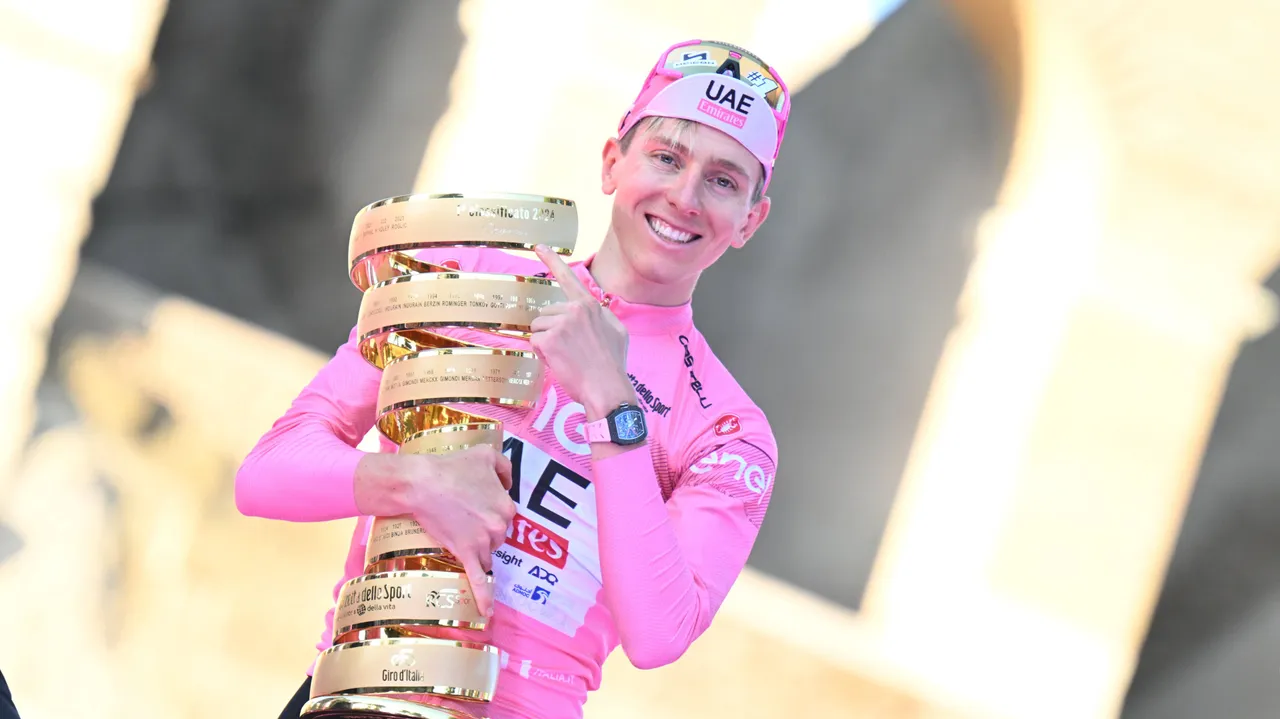
Pogacar himself completed the Giro-Tour double in 2024
Not about money, about meaning
Martinelli is blunt about the idea of paying riders to show up. “I cannot even imagine an organisation paying a rider just to take part, and I would not find it correct,” he said. For him, the prestige goes both ways. A great champion lifts a race, but a great race also lifts a champion’s career.
If Vingegaard were to win the Giro, he would complete the so-called Triple Crown of Grand Tour victories. That is not something you buy. That is something you build a career around.
In that sense, Martinelli believes Visma’s thinking is simple. They are not chasing financial side deals. They are chasing the best sporting path.
Between ambition and rivalry
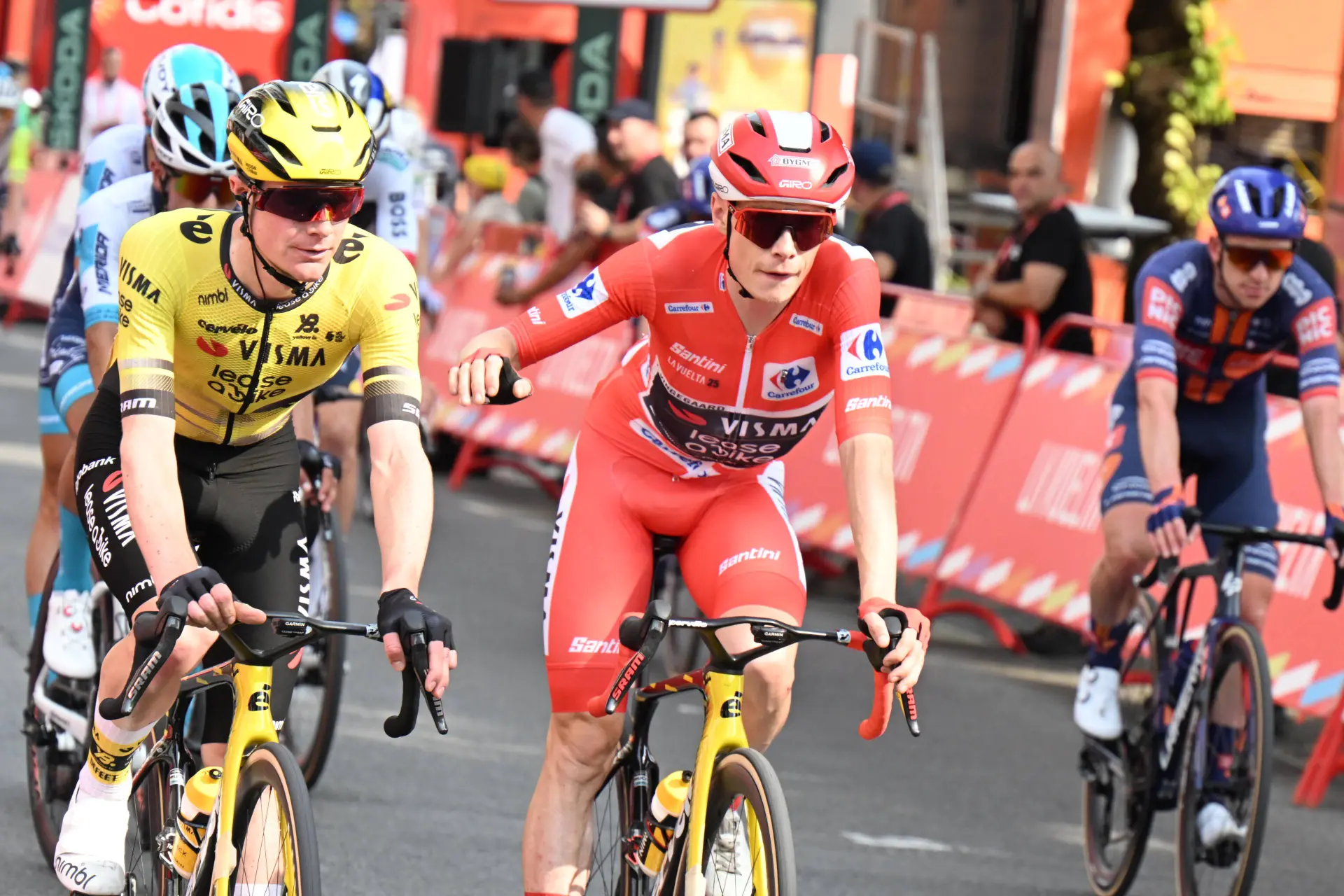
None of this exists in a vacuum. Everything Vingegaard does in 2026 will be judged against Pogacar.
Some see the Giro as a risk. Others see it as a way to change the terms of the rivalry. Martinelli’s explanation suggests a third view: that the Giro is not an escape from the Tour, but part of the same long game.
If the route suits him, if the build-up is controlled, and if the motivation is right, then the Giro is not a distraction. It is a tool.
And if Martinelli is right, the reason Jonas Vingegaard is going to Italy in 2026 is not money, not pressure, and not compromise.
It is because, in purely sporting terms, the Giro finally fits exactly what he needs.

Kieran WoodDeputy Editor-in-Chief
Kieran Wood is a sports journalist based in Wales and has been active in journalism since 2022. He regularly contributes to DartsNews.com and CyclingUpToDate.com, where he covers professional cycling and darts. In cycling, his work includes liveblogs from major races, including the Tour de France, the Giro d’Italia, and La Vuelta a España, alongside race reports and analysis. He has also conducted interviews with professional riders.
His reporting spans the full racing calendar, from one-day classics to stage races, with a focus on accurate, real-time coverage and clear contextual analysis. For statistics, results, and historical context, he regularly uses resources such as ProCyclingStats. To support reporting on rider activity and training context where relevant, he also references Strava.
In his work, Kieran places strong emphasis on careful sourcing, editorial accuracy, and updating articles as new, verified information becomes available.
claps 3visitors 3
Just in
Popular news
Latest comments
- Campenaerts looked like a rolling pumpkin with that all orange leaders skinsuit !frieders318-10-2026
- He can take his dumb a$$ politics somehwere else !frieders318-10-2026
- good to have her back. fingers crossed she‘ll be able to stay!Ketterechts17-10-2026
- A tenner and he wins the Tour next year, too 😂anonymouscyclist17-10-2026
- the answer is either stick to classics or GTs but not bothabstractengineer17-10-2026
- the exodus already stared with Ciccone. Already they were struggling with two sprinters, now there are three. Also Ganna will demand leadership. Gall is the most proven GC, Ayuso has the most potential. GC leadership for everybody will be impossible. Literally a UAE style mess without pogi.abstractengineer17-10-2026
- I raced as an amateur for 12 years, including six years on my country’s national road cycling team. I secured two national titles and competed in three World Championships plus more than 15 international stage races. At 23, we travelled to Italy for a training camp—or so I assumed. On a rest day, we watched a presentation about adopting a more “professional” training approach. It was crystal clear what “professional” meant. That moment first exposed me to this dilemma. After returning from Italy, I left cycling—at least at the competitive level I had known. Over the following two years, the whole team was caught doping. I hold that everyone is innocent until proven guilty. In my view, current stakeholders operate on a different scale, and the sums involved are vast. I am unsure whether any doping would ever be revealed. I try to stay positive and enjoy the show. My 2c.
 vannpelt17-10-2026
 - Fiver he wins 🤣
 leedorney17-10-2026
 - “…measures to reduce speeds.” Might as well shorten the race course to just 50km as well? ASO generates at minimum €300m a year and 30- 40% profit. Maybe stop being greedy and spend more of the profit to protect the riders instead.b3tlla17-10-2026
- he also had quite the life off the bike during his pro years. he used his celebrity status to full affect.mij17-10-2026
Loading
Write a comment