The Volta a Catalunya is scheduled from March 18th to 24th. This Spanish stage race consistently attracts many of the world's top climbers, and this year's edition promises to be no different with a spectacular route on offer. Let's take a closer look at the stage profiles.


Stage 1: Sant Feliu de Guíxols - Sant Feliu de Guíxols, 173.9 kilometers
The seven-day race begins once again in Sant Feliu de Guíxols where some sprinters and puncheurs will fight for victory in the same uphill finish as the past two years - one unfortunately known for being the location of Sonny Colbrelli's heart failure, last year's a thrilling sprint between Primoz Roglic and Remco Evenepoel. The stage features a few ascents early in the day where a strong breakaway can be formed.
With 20 kilometers summits a small climb that is 8 kilometers long at 4%. It is not a day for the sprinters as not only does this climb put some damage in the peloton, but the following descent and run-up to the finish is very fast, punchy and technical. Another small hilltop ends with 7.8 kilometers to go, and then most of the way into town is a very fast and twisty descent.
The final 750 meters then have a 5% gradient. It is not nothing, sprinters will certainly arrive here but this is an effort of over a minute that can be all-out from bottom to top. A sprint is almost certain but some riders will not have the legs, whilst some puncheurs and climbers may surprise because they will be better capable of putting in an actual sprint.
Read also


Stage 2: Mataró - Vallter 2000, 186.5 kilometers
The second stage goes from the Mediterranean sea right into the heart of the Pyrenees. The first kilometers of the stage are literally by the sea; the peloton then heads through Girona and slowly climb inland and into the base of the climb that will decide the day.
An ascent summits with 47.6 kilometers to go, it is 10 kilometers long at 5.4%. It does not have a real descent afterwards, just a tiny one and then a continuous false-flat rise into Setcases. There the riders find the base of Vallter 2000, a climb that summits at 2146 meters of altitude. A climb that is relatively constant, it's the mix of all variables that makes it a difficult challenge - also as it will be the first real climb of the race.
It is 12.5 kilometers long at 7.3%, featuring a few switchbacks at first, and then plenty in the final two kilometers to go. There are gradients of over 10% in the first two halves. The ascent isn't as steep towards it's end but it is still meaningful and is hard enough to create differences.


Stage 3: Sant Joan de les Abadesses - Port Ainé, 176.7 kilometers
The third day of racing in Catalunya is quite hard and it goes through some ascents that are familiar to those that have already spent time in Catalunya. A flat start, but then the peloton heads towards the first difficult climb, the Port de Toses which is, towards it's summit, 3.7 kilometers at 9%.
it's a slow rise until that time, and the climb goes up to almost 1800 meters of altitude. What follows is a very long and downhill valley run that will take the riders into the next ascent. This will be a longer one, very inconsistent one, but ultimately also a warm-up in the big picture of the day. The second climb of the day is the Port del Cantó which is 24-7 kilometers at 4.4%. The start of the ascent is the hardest section, and it's another ascent going above 1700 meters of altitude, with the top at 43 kilometers to go.
A descent follows and then the riders go into Port Ainé. This is a tough old climb. A traditional in the race, it features both distance and gradients. A climb with several direction changes, it is over 18 kilometers in length averaging 6.5%. It is also relatively inconsistent, following much steeper gradients right at the base but specially in the final kilometers. At almost 2000 meters of altitude, it is another summit finish where this can be a factor in play.


Stage 4: Sort - Lleida, 169.2 kilometers
Stage 4 into Lleida should be the only regular bunch sprint. A day that is overall not too hard honestly, it has an overall downhill profile, starting at over 700 meters of altitude and finishing close to sea level. Hence we can expect a fast day, only with a small climb in the first half as an obstacle.
The riders head into Lleida, after 169 kilometers. It is a regular bunch sprint into the city center, which will not be overly technical. It should be a furious and fast finale, with a right-hander with 1.8 kilometers to go, and a series of roundabout set to stretch the peloton right after. The final kilometer will have nothing to note however and there will still be time to reorganize before the sprint to the line.


Stage 5: Altafulla - Viladecans, 167.3 kilometers
The 167-kilometer stage is hilly and will be a day that suits breakaways quite well. Catalunya is known for the roads that suit this type of racing, and plenty riders can succeed from a day like this. A sprint could also decide the day, but it is complicated. This is because the opening hour of racing will be quite explosive and rolling.
A climb of 7.5 kilometers at over 4% will be in the first half of the day, with a few rolling roads and descent following. This will all be before the final combination of climbs which could decide the day. A small hilltop will come before the Alt de la Creu d'Aragall. The climb is 6.5 kilometers at 6% and summits with 29 kilometers to go. It is close enough that it can decide the day, as an equally long descent follows.
The final 15 kilometers then will be pan-flat, and a sprint could happen at the end of these. Into Viladecans the roads will be suited to a chase, and then over the final kilometers there will be a few small obstacles that can stretch out the peloton. Ultimately, the final kilometer is straightforward - although the riders go through a slight roundabout with around 300 meters to go - and should be a regular finale.


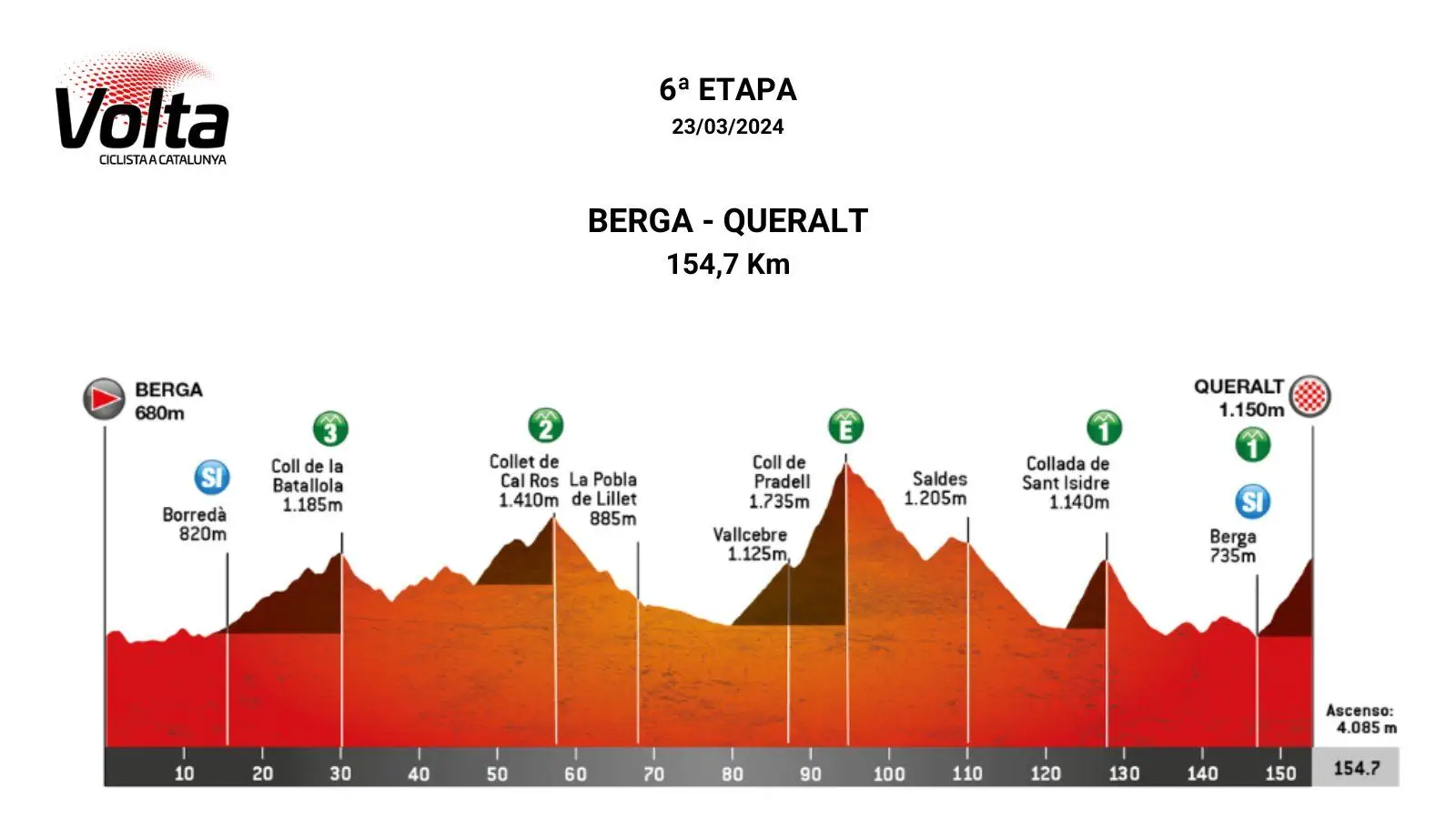
Stage 6: Berga - Queralt, 154.7 kilometers
Stage 6 has a summit finish at Queralt, which comes in a day with six categorized climbs including a special category halfway through the day. A new challenge that should seal the overall classification in what is a short day of racing. However, despite having only 154 kilometers in distance, there are a whole 4000 meters of climbing.
Early in the day they are not too hard, they are slight ascents that are rather inconsistent, featuring false-flat roads and some slight ascents where groups can go up the road. However there won't be too much relaxing time. The descent off the second one leads directly into the brutal Coll de Pradell.
This climb is brutal. 14.7 kilometers at 6.9%, it's one of two halves. The first 7 kilometers are at a constant 5-6%, then there is a small descent even, and then the final 6 kilometers which average 10% average. In here, the grades go up to a crazy 18% and it's not a short ramp. This ascent is the hardest of the race and could blow the entire race apart, ending with 60 kilometers to go.
A long descent follows - with a small hilltop in the middle which leads into climb number four of the day - when it comes to the categorized ones. It's 4.9 kilometers at 8.8% which ends with 27 kilometers to go. Another very hard climb where attacks can happen, however it is possible that some riders will still wait for the final one.
After a set of rolling roads the riders return to Berga but head into the Santuario de Queralt. It is not the hardest climb of the day, but after so much fatigue it can still make serious differences. 6 kilometers at 7.3%, it will be a proper and scenic finale to a brutal day of racing.
Read also


Stage 7: Barcelona - Barcelona, 145.3 kilometers
The final day, the traditional circuit in Barcelona. Regularly, a day for a breakaway, however many scenarios can decide such a day. There are only 145 kilometers to be ridden, as the riders leave Barcelona and face some rolling roads where the breakaway will be established.
The race is to be decided in the final circuit though. Six laps over the Alto de Montjuic, it’s a tough circuit, which usually benefits early attackers as there is almost no flat within it’s 8 kilometers. The descent off the Montjuic is very fast and allows riders to take a rest after every ascent.
Ascent which is 2.4 kilometers at 4.7%, however the gradient is very misleading as it includes a flat section. The true hilltop is quite explosive, it has 900 meters at 10% which is enough to create damage in the peloton, and also splits that may prove crucial for the overall classification. In the final lap, it will come only 5 kilometers away from the summit, all of them downhill except for a small uphill pitch next to the city’s Olympic stadium, 2 kilometers away from the finish.

Rúben SilvaEditor-in-Chief
A founding contributor to CyclingUpToDate since its launch in January 2022, Ruben Silva has played a central role in shaping the site’s editorial direction and long-term growth. Before joining the project, he built his experience through independent blogging at Echelons Hub and by producing race previews for Ciclismo Internacional, developing a strong analytical voice rooted in daily engagement with professional cycling.
Beyond editorial work, he has been closely involved in the expansion and coordination of CyclingUpToDate’s wider network, helping establish and support sister platforms across multiple languages. This includes ongoing collaboration with CiclismoAlDia (Spanish), CiclismoAtual (Portuguese), WielrennenUpToDate (Dutch), and RadsportAktuell (German), contributing to a shared editorial vision and consistent international coverage.
He also helps oversee editorial governance across the network, setting standards for accuracy and consistency and coordinating updates or corrections when needed.
Originally from the Porto metropolitan area in Portugal, he holds a bachelor’s degree in Geography. His path into cycling journalism was shaped not through formal media training, but through independent reporting, community engagement, and sustained on-the-ground involvement in the sport.
Over the course of his career, he has conducted approximately 100 interviews across road cycling and cyclocross, ranging from one-to-one conversations and online formats to press conferences and on-site pre- and post-race coverage. His interviews include leading riders, team managers, and prominent figures within cycling media: Tadej Pogacar, Jonas Vingegaard, Mathieu van der Poel, Primoz Roglic, Wout van Aert, Joao Almeida and Tom Pidcock; managers like Patrick Lefevere and Joxean Matxin; and YouTube personality Bryan Kennedy (BKXC)...
Within 18 months of launch, he helped grow CyclingUpToDate’s English-language platform into one of the most-read cycling news websites, built entirely from the ground up. As both a professional journalist and lifelong cycling enthusiast, his focus remains on delivering accurate, timely, and well-contextualized coverage.
claps 0visitors 0
Just in

Popular news
Latest comments
- This is such a black eye to women's professional cyclocross if this result remains. Marie Schreiber won this race fairly. This finish is not unlike others in cyclocross. Lots of moving around to get to the finish not to cut anyone off , but to generate a sprint on soft wide tires caked with mud and sand. This is not nearly the same as a road race between two riders sprinting to the finish on faster bikes and thinner firmer tires. The powers in charge need to use some common sense, reverse this result and remember this is Cyclocross not Road racing. Unbelievable. . .Zencycle09-11-2026
- Tis beyond your comprehension fine sir so best not to look on with blind eyes to THE GOATS greatness.
 Brucegel09-11-2026
- McNulty winning was beneficial in ensuring the rainbow jersey would not remain winless
 Front24209-11-2026
- Eccelente! That's 7 riders in total in Red Bull who come from the devo team, 8 if you include Lipo
 Rafionain-Glas09-11-2026
- again, nothing is going to be resolved. it is a discussion board. I simply said I didn't see how MS impeded LBs sprint. the UCI doesn't care about my thoughts, and I am really not that emotionally invested in it.mij09-11-2026
- provoke change, lol. this is a discussion board. nothing is going to change by what I say here. just commenting that it didn't look like MS impeded Brand. beyond that not trying to go too deep.mij09-11-2026
- as excellent as maga rednecks chloe dygert (and quinn simmons)?Ketterechts09-11-2026
- so what i understand is: i left a comment calling out the endless author CVs for being an unnecessary flex of expertise, and you responded by lecturing me (and others) on discrimination and value systems. hats off to you. you definitely lost me!Ketterechts09-11-2026
- I just love the flood of Americans into the top ranks of world cycling. In addition to being studs on the bike, they all seem to be excellent emissaries for our country.Occam09-11-2026
- ANATOMY OF A G.O.A.T. EDDY MERCKX about TADEJ POGAČAR: Merckx: “He has revived a style of cycling that we had almost forgotten. He is now better than me.” Key statements by Merckx about Pogačar in 2026: - Acknowledging his superiority: This time, Merckx openly admitted, without any subsequent backtracking or reservations, that Pogačar had surpassed him and was now above him. This contrasts with 2024, when he quickly softened his remarks about Pogačar being faster. - The possibility of a historic triple (Giro, Tour and Vuelta): During the July Tour de France (where Pogi claimed his fifth title), Merckx stated that Pogi was the only cyclist in history capable of winning all three Grand Tours (the Giro d'Italia, Tour de France and Vuelta a España) in a single season, provided the conditions were right and he had sufficient team support. - Lack of serious competition: Merckx emphasised that Pogačar has no real rivals in the mountains since 2024, thanks to his extraordinary climbing ability and the fact that he continues to improve despite still being under 28 (he turned 28 in autumn 2026). - Praise for his racing style: Merckx highlighted how Pogačar is bringing back the aggressive, uncompromising spirit of cycling's golden era, when races were not merely about calculated stages and tactical conservatism, but about attacking from long distances. PS: This is not "boring" ... this is called making real history, not only statistical history. Capish?PogiSloFans09-11-2026
Loading

🚴♂️Aquest és el recorregut complet de la Volta a Catalunya masculina 2024! 😊 🗺️ ¡Este es el recorrido oficial de la #VoltaCatalunya 2024! 😍 This is the route for #VoltaCatalunya103!

Write a comment