“People said my win was a blessing for the sport” – Mattias Skjelmose recalls famous Amstel Gold Race upset of Tadej Pogacar and Remco Evenepoel
Cycling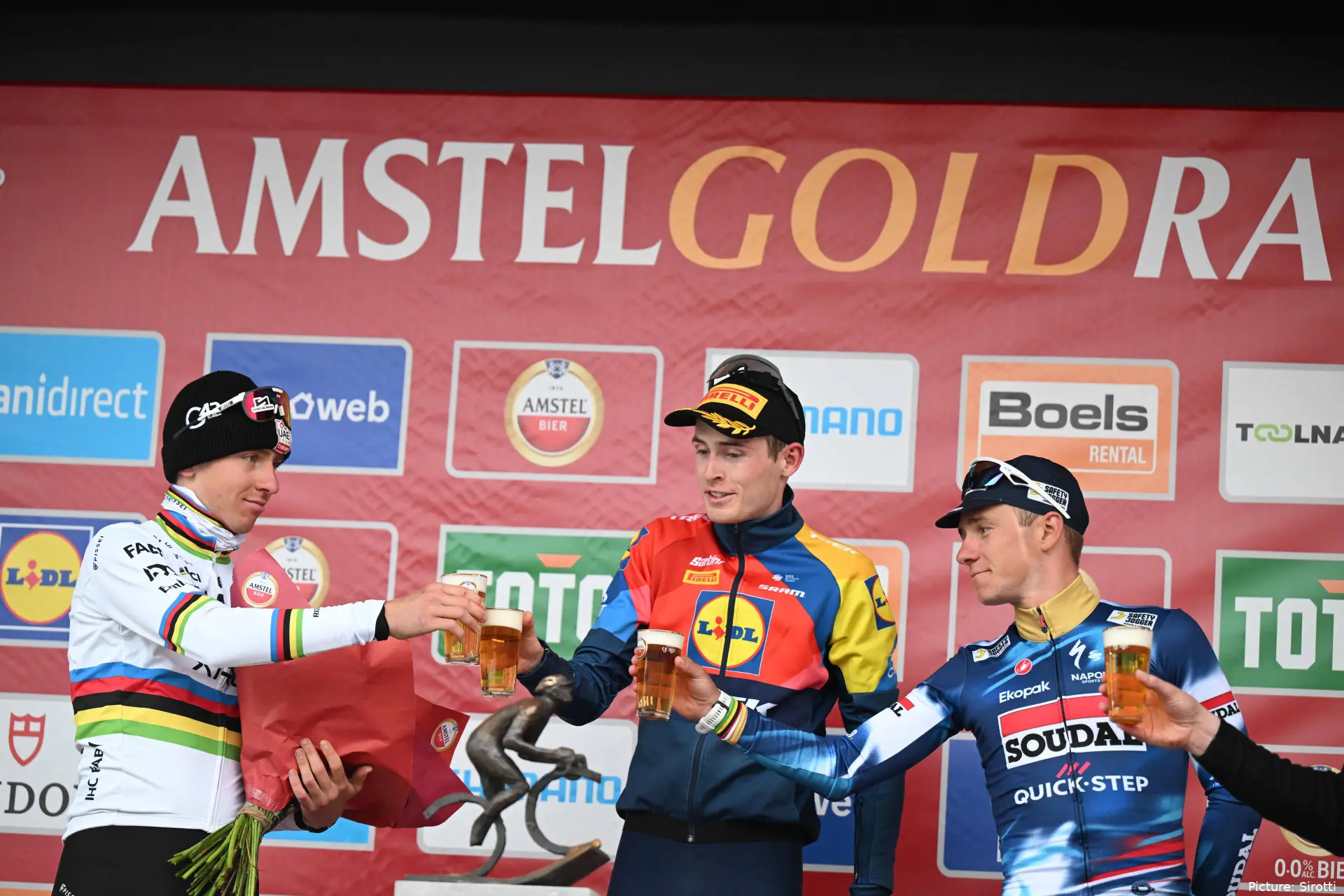
Mattias Skjelmose says the reaction to his 2025 Amstel Gold Race victory went far beyond simple congratulations. Riders and staff told him his triumph was “a blessing for the sport”.
Not because he was an unlikely winner, but because of what the win represented: proof that even when Tadej Pogacar and Remco Evenepoel appear to have a race under control, they can be beaten.
More often than not, races involving arguably the sport’s two biggest superstars have followed a familiar pattern: Pogacar going clear, Evenepoel driving the pace behind, and the rest left fighting for the minor places.
That is exactly why this edition stood out — despite Pogacar attacking alone and Evenepoel helping to lift the speed behind, the gap came down, the race came back together, and Skjelmose out-sprinted them both.
“I missed the connection by five metres… but that was the right tactic”
Speaking to Wieler Revue, Skjelmose revisited the key moment on the Gulperberg when Julian Alaphilippe attacked, with Pogacar instantly responding.
“When Alaphilippe attacked, I was somewhat blocked by Ben Healy,” he said. “Afterwards I missed the connection by five metres, partly because I decided not to completely blow myself up. Looking back, that was the right tactic.”
It meant riding his own pace rather than detonating his effort early. “Obviously I had a very good day, but purely in terms of feeling, I’ve had better days in 2025.”
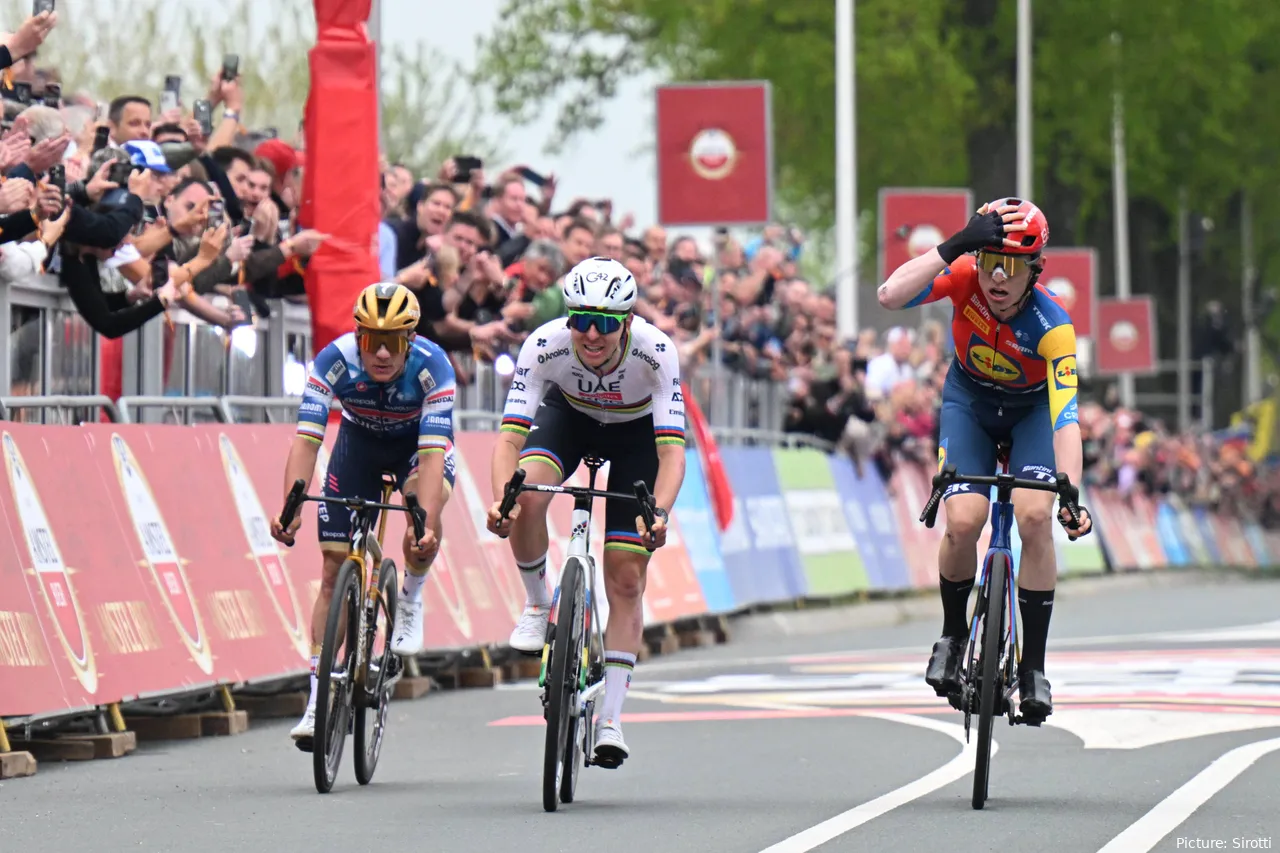
Skjelmose was left in disbelief as he crossed the line ahead of Pogacar and Evenepoel
“I had control on the Cauberg” – Skjelmose on going head-to-head with two of the sport’s arguably biggest modern superstars
By the last ascent of the Cauberg, Skjelmose, Pogacar and Evenepoel were locked together, setting up an unexpected three-way showdown. “The last time Cauberg, I had control,” Skjelmose recalled. “I think Remco was mainly riding tempo and wasn’t necessarily trying to drop us. We all trusted our sprint.”
As the finish approached, he refused to let the scale of the opportunity disrupt his mindset. “Was I nervous in the final? No, why would I be? I wanted to do the best sprint I could — then I’d finish first, second or third.”
More importantly, he says he didn’t allow the reputations beside him to cloud his judgement. “It’s a quality not to overthink everything. I focused on what I had to do and didn’t think about the size of the race or the chance to beat two of the best riders in the world.”
Moments later, he threw his bike the hardest and took the most symbolic victory of his career.

“We were all on the limit” – the sprint that decided everything
Skjelmose said the numbers from the final were far from spectacular — the race had been too hard for that. “The gap to the chasers was big enough that I could play the game by not always pulling,” he explained. “I’ve no idea how many watts I pushed in the sprint, but it wasn’t very impressive. The race had been so hard that we were all on the limit.”
He doesn’t have a framed reminder at home, but he does keep one particular image saved. “I don’t have a photo hanging on the wall, but I saved a few nice ones. The best is where we all throw our bikes at the line.”
Skjelmose admits the wider year wasn’t straightforward. “I’ve had a pretty tough season, but it’s nice that afterwards I can say: ‘However difficult it was, I still won the Amstel Gold Race.’ And that against Pogacar and Evenepoel. Nobody will ever be able to take that away from me.”
What stood out after the finish, he said, were the unexpected messages and comments from inside the peloton — including those who told him his win felt like “a blessing for the sport.”
For many observers, it was a reminder that even two of the sport’s arguably biggest modern superstars can be beaten when the racing opens up — a sentiment echoed in the reactions Skjelmose received in the days after his victory.
Read also


Kieran WoodDeputy Editor-in-Chief
Kieran Wood is a sports journalist based in Wales and has been active in journalism since 2022. He regularly contributes to DartsNews.com and CyclingUpToDate.com, where he covers professional cycling and darts. In cycling, his work includes liveblogs from major races, including the Tour de France, the Giro d’Italia, and La Vuelta a España, alongside race reports and analysis. He has also conducted interviews with professional riders.
His reporting spans the full racing calendar, from one-day classics to stage races, with a focus on accurate, real-time coverage and clear contextual analysis. For statistics, results, and historical context, he regularly uses resources such as ProCyclingStats. To support reporting on rider activity and training context where relevant, he also references Strava.
In his work, Kieran places strong emphasis on careful sourcing, editorial accuracy, and updating articles as new, verified information becomes available.
claps 0visitors 0
Just in
Popular news
Latest comments
- A shame to see him retire, I really liked him as a rider. His dignified tribute along with Matej Mohorovic to Gino Mader after his death was class and will always live in my memory. Enjoy your retirement.GregT11-10-2026
- A shame to see him retire, I really liked him as a rider. His dignified tribute along with Matej Mohorovic to Gino Mader after his death was class and will always live in my memory. Enjoy your retirement.GregT11-10-2026
- I thought Seixas had hit the end of the road from a fatigue standpoint, after the WC meltdown - and he still finished ok. This was impressive and an amazing return.mij11-10-2026
- totally, eating crow for breakfast this morning. after the world championships I thought we were looking at a late season fade from fatigue. way to go Paul!mij11-10-2026
- Well if UAE the best team in history comes knocking their the only team in the world who can get Seixas. Seixas will become unbeatable and incredible there. Lets see if he stays at decathlon or goes to UAE.miguel11-10-2026
- Pogi would have won the Vuelta at around 10 min. But it would have been boring for fools like you. Capish?PogiSloFans11-10-2026
- Rather than me describing the technology at length on here, If you google. Line-scan cameras. They are also sometimes called Slit-Scan cameras. Either search will fill you in. You can read all about how they. work. Enjoy! Just to be clear the cyclist is saying he wants to see exactly where the digital finish line is in relation to the actual physical finish. At this point we only have the word of the authority that the digital line corresponds to the exact starting edge of the physical finish line. That seems like a reasonable request to me.Prorodsandstuff11-10-2026
- 100% @Jumpyjohn, good point well raised.anonymouscyclist11-10-2026
- The media keep stirring the soup.. or spitting in it
 leedorney11-10-2026
 - Yes, he has won many races... second class races. He isn't the real deal... Seixas is the real deal. Capish?PogiSloFans11-10-2026
Loading
Write a comment