“It didnt make me happy to just ride along” – Wout van Aert admits he has struggled mentally dealing with lasting effects of 2024 crashes
Cycling
Wout van Aert enters the winter with a clearer sense of who he is as a rider — but getting to that point took longer, and cut deeper, than most realised.
Speaking candidly to Het Nieuwsblad after what he describes as one of the hardest years of his career, the 31-year-old reflected on the mental fallout from his brutal 2024 season and how a quieter, risk-averse approach early this year almost broke the joy he once took for granted.
He may have ended 2025 with two victories that will live in the memory — that explosive triumph on the gravel into Siena and, of course, dropping Tadej Pogacar on Montmartre — but the road that led there was messy, fragile and full of moments when the sport felt more draining than fulfilling.
A spring spent holding back
Van Aert didn’t hide from the uncomfortable truth: the scars of 2024 followed him far more stubbornly into 2025 than he expected.
At times in the spring, he said he found himself caught between relief at avoiding danger and frustration at feeling unable to fully commit. “Then I didn’t dare throw myself into it, and I was balancing between being glad that I didn’t crash, but frustrated that I wasn’t in position,” he said.
He recognised quickly that the overly cautious style he drifted into wasn’t who he was at all. “I found out that it didn’t make me happy to just ride along.”
This wasn’t a question of fitness or form alone. He openly accepted that positioning problems — glaring during some of the biggest Classics — were amplified by hesitation, not just legs.
Where earlier versions of Van Aert would instinctively dive into gaps, this year he often checked himself. Coming to terms with that shift was a complicated but necessary step. “I maybe made too big a thing of it, because I noticed I was in position when I wasn’t thinking about it,” he said.
After the Tour, clarity
The reset only truly arrived once the Tour de France was behind him. Van Aert chose a quieter autumn, but found it unsatisfying — a reminder of his competitive DNA. “I rode a handful of races without pressure to perform, and because of that I didn’t reach my best level and was just sort of there. Looking back, I’d have been better off skipping those, because I didn’t really enjoy them,” he admitted.
That period crystallised what he now sees as essential: he needs to race at the limit, not merely participate. “I now know very clearly that racing for me means reaching my absolute highest level and giving everything.”
Dwars door Vlaanderen: a moment that cut deeper than expected
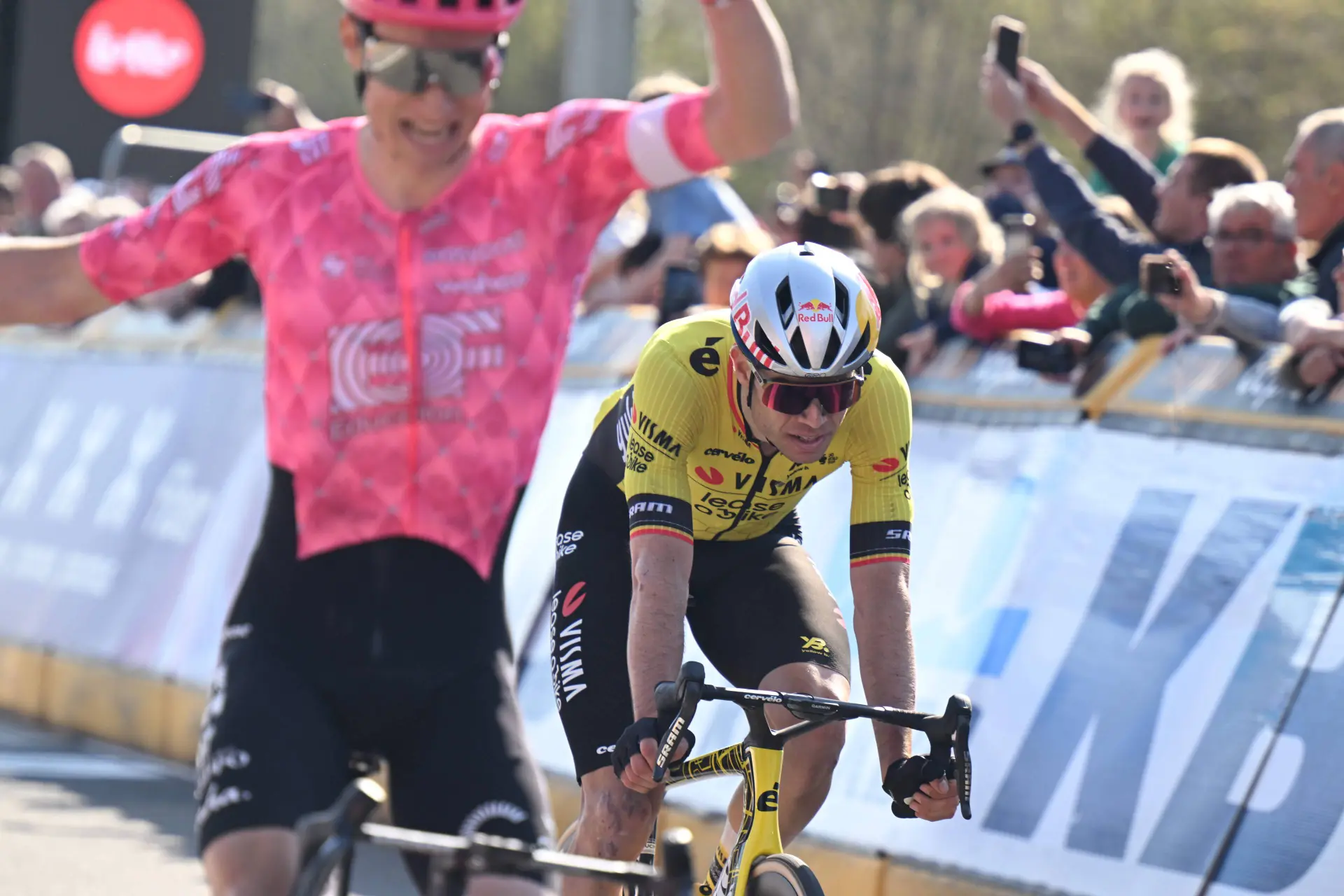
One of the year’s most public flashpoints came at Dwars door Vlaanderen, where Visma lost a three-against-one advantage to American rider Neilson Powless. The spotlight quickly centred on Van Aert, who chose to sprint himself rather than set up a teammate — a move he regretted immediately.
“I was extremely disappointed in myself because when I made the decision to sprint, I wasn’t staying true to who I am,” he said. He wanted the win too badly, worried a teammate might take the chance from him.
Crucially, his teammates and DS Grischa Niermann didn’t pile on. The support he felt was grounding, not crushing. “It helped me enormously that I didn’t feel any frustration or anger from anyone towards me,” Van Aert said.
The hunger to win was still there — the instinct, the drive — but he knew the decision had been wrong. Not embarrassing, not catastrophic, just wrong.
Pressure, expectations, and the need to prove something
As the season began, the outside world expected Van Aert to immediately rediscover his old level. That expectation, he admitted, lingered more than he realised.
Demi Vollering publicly defended him on social media, pointing out how top athletes sometimes make imperfect choices under pressure — especially when the outside world has no idea what storms they’re managing internally.
Van Aert didn’t disagree. “You might not primarily want to win for yourself, but more to say: look, I can still win,” he said. Not for headlines, not for haters — but to reassure himself.
And that sense of needing an answer grew as the performances in Opening Weekend and the E3 Saxo Classic didn’t come. “Without even realising it, you maybe want to give an answer to that,” he reflected.
Rediscovering why he races
Ultimately, the thread running through everything he said — from the spring doubts to the autumn frustration — was the search for joy. Not comfort. Not safety. Actual fulfilment.
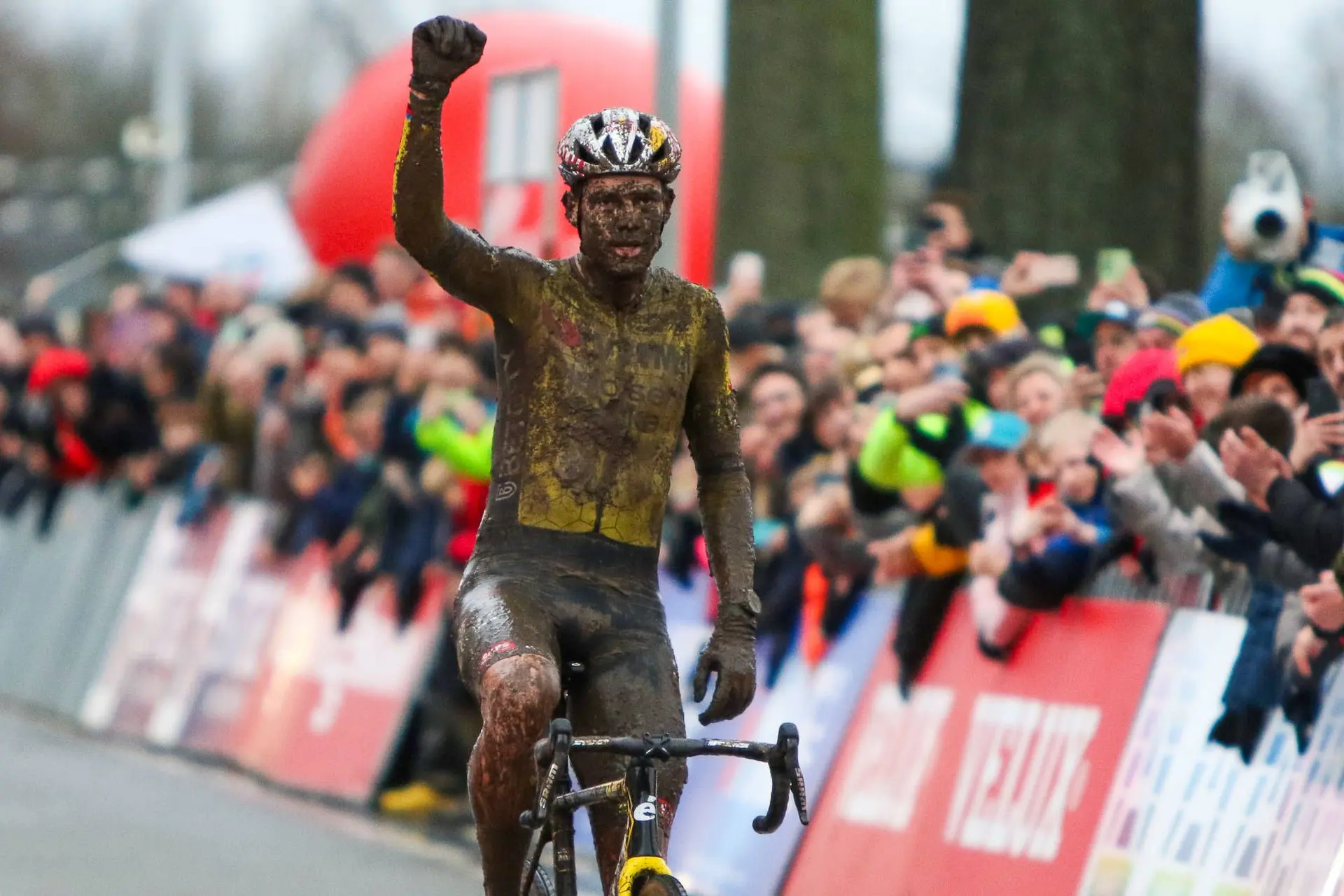
That feeling returned in Siena, under the dust and chaos of the Giro, when he won despite not believing the day suited him at all. “There aren’t many wins where the feeling comes close. I get goosebumps talking about it,” he said. “It was a difficult period that finally turned into something positive. Everything came together.”
It was a turning point that came from a place of genuine struggle. Earlier in that Giro he admitted, “On day five I wondered whether it even made sense to stay.” But the victory flipped the emotional script.
Kieran WoodDeputy Editor-in-Chief
Kieran Wood is a sports journalist based in Wales and has been active in journalism since 2022. He regularly contributes to DartsNews.com and CyclingUpToDate.com, where he covers professional cycling and darts. In cycling, his work includes liveblogs from major races, including the Tour de France, the Giro d’Italia, and La Vuelta a España, alongside race reports and analysis. He has also conducted interviews with professional riders.
His reporting spans the full racing calendar, from one-day classics to stage races, with a focus on accurate, real-time coverage and clear contextual analysis. For statistics, results, and historical context, he regularly uses resources such as ProCyclingStats. To support reporting on rider activity and training context where relevant, he also references Strava.
In his work, Kieran places strong emphasis on careful sourcing, editorial accuracy, and updating articles as new, verified information becomes available.
claps 11visitors 11
Just in

Popular news
Latest comments
- FYI. Pogi made his World Tour debut at the TDU in 2019. I remember it well because someone said watch out for Pogi as he did a good time up Corkscrew during training. Who would have thought he'd end up as the GOAT.Santiago25-10-2026
- FYI. Pogi's first World Tour race was at the TDU in 2019. I remember it well because someone said watch out for Pogi as he did a good time up Corkscrew during training. Who would have thought he end up as the GOAT.Santiago25-10-2026
- 50 million isnt low. But if you hire super domestiques for a million and 3rd rung leaders for 3-5 million, natural you dont have money left not the results expected. Most monuments and TDF are out of reach due to Pogi. But there were a promising 2nd rung leaders on the market and they went for broke to get Onley and Kevin. I put their entire troubles due to mismanagementabstractengineer25-10-2026
- I think it’s becoming clear that cycling got way ahead of itself for a few reasons and is now coming to the realisation that some rider salaries just exploded without justification and it snowballed until sponsors started pulling money out because THEY did not see any return on increased costs. Cycling is still a dying sport (that never moved out of the niche family) and will remain so if it doesn’t embrace and promote new ventures or manage to attract new markets. Even within cycling, fans are basically compartimentalised, (almost nobody here follows track for example), and the multiplication of possibilities hasn’t grown the sport, it has just split it into a larger number of smaller branches. If it weren’t for nation state sponsors (far too numerous already) other teams would never have (had to resort to) raised bigger budgets that are now leading to sponsor abandonment. That’s the difference between long-term steady growth and financial doping, the latter can also just blow up in your face. I will venture to wager that apart from one or two exceptional cases, rider salaries will no longer go up and are quite likely to actually drop over the next decade.Jumpyjohn25-10-2026
- You know you can post all this on idlprocycling too with your account(s) don’t you? There’s a whole bunch more articles and people there to inform.Jumpyjohn25-10-2026
- That’s the kind of word my foreign grandma would have rendered fashionable again, like flabbergasted (at her time) ;-) Perhaps he should get a pro to fill out his papers and pack his bag too, customs have become keen on controlling anyone from the balkans.Jumpyjohn25-10-2026
- Alternatively, just call Rod StewardJumpyjohn25-10-2026
- I will be in Adelaide in a shot if Pogi comes to the Tour Down Under. Fingers and toes crossed that this will eventuate, he has just got to remember to stay aware of kangaroo’s, as Jay Vine can attest to. Though can’t be any worse than some of the passionate fans in EuropeSearider25-10-2026
- "The Spaniard also highlighted Florian Lipowitz, third in the recent World Championship time trial, as a rider to watch as he continues to gain experience." Please stop the AI slop
 Rafionain-Glas24-10-2026
 - I think it's great! Now there's a real reason forcing the people-who-don't-fix-the-potholes to fix the potholes... or notRafionain-Glas24-10-2026
Loading
Write a comment