“In many ways it was harder than cancer” – Lance Armstrong on the collapse of his Tour de France empire
Cycling
The debate around Lance Armstrong refuses to fade. Years after his public confession and stripped Tour de France titles, the former cycling icon is still dissecting the mentality that powered both his dominance and his downfall.
In a revealing appearance on the Frodeno Going Mental podcast, Armstrong shifts the focus away from trophies and towards something more uncomfortable: fear.
A seven-time Tour de France winner whose victories were later annulled for doping, a cancer survivor and the central figure in one of sport’s most notorious scandals, Armstrong now frames his life through a different lens. “My life, in many ways, has been defined by some form of survival,” he says.
At 54, he speaks less about triumph and more about endurance, not just physically but mentally and emotionally.
“I’ve had a life of fighting and survival”
Armstrong traces that mentality back to childhood. “I’ve had a life of fighting and survival,” he explains, recalling that he was born in Dallas to a 17-year-old mother. The need to prove himself and to overcome the odds became a constant theme.
Cancer at 25 intensified that instinct. “That’s when you’re truly fighting to survive in the literal sense of life or death,” he says. Yet he argues the most painful chapter was the public collapse of his career in 2012 and 2013. “In many ways, it was harder than the two previous things.”
With five children and a family to support, the pressure felt heavier than ever. “The pressure was even greater.”
For Armstrong, pushing himself mentally was never about heroics. “Going to the mental limit was trying to solve it.”
He reduces the idea of resilience to something practical. “Everyone, at some point in their life, has to solve something. And many times it feels impossible.”
From obsession to therapy on the bike
Unlike many retired champions, Armstrong still rides regularly. “Yes, I still ride, and I love it, even if it sounds cheesy.”
But the purpose has changed. “The only reason I like riding now is to escape.”
Cycling is no longer about beating rivals. It is about clearing his head. “There’s nothing that resolves things faster than going out alone on a bike.” Two hours alone can settle internal conflicts. “For me, that’s a form of therapy, it’s mental therapy.”
That relationship with movement became crucial after his confession to Oprah Winfrey. “The only tool I had in my toolbox was that I wasn’t going to let my health deteriorate.”
He adds: “I wasn’t going to curl up in a corner and cry. I was going to move.”
His obsessive streak, first sharpened during cancer treatment, later defined his cycling career. “The diagnosis, in some way, took me to another level. I became obsessive about the details.”
He chose his hospital like selecting a team. “I was picking the best team.” He immersed himself completely. “I told them: no, no, I want to see them too.”
That mindset carried into the Tour years. “The process is everything.”
Even in Paris, the dominant thought was not celebration but avoidance of failure. “In my head the whole time I was thinking: just don’t lose.”
The defining line of his mentality is stark. “I hated losing more than I loved winning.”
Crossing the finish line brought relief rather than joy. “I just wanted to go home.” Looking back, he concedes: “Now I don’t think that’s healthy.”
He frames it as a question. “Are we trying to win to be euphoric, full of joy… or are we just saying: thank God I didn’t lose?”
In his case, it was the latter. “I hated losing, and I still hate it to this day.”
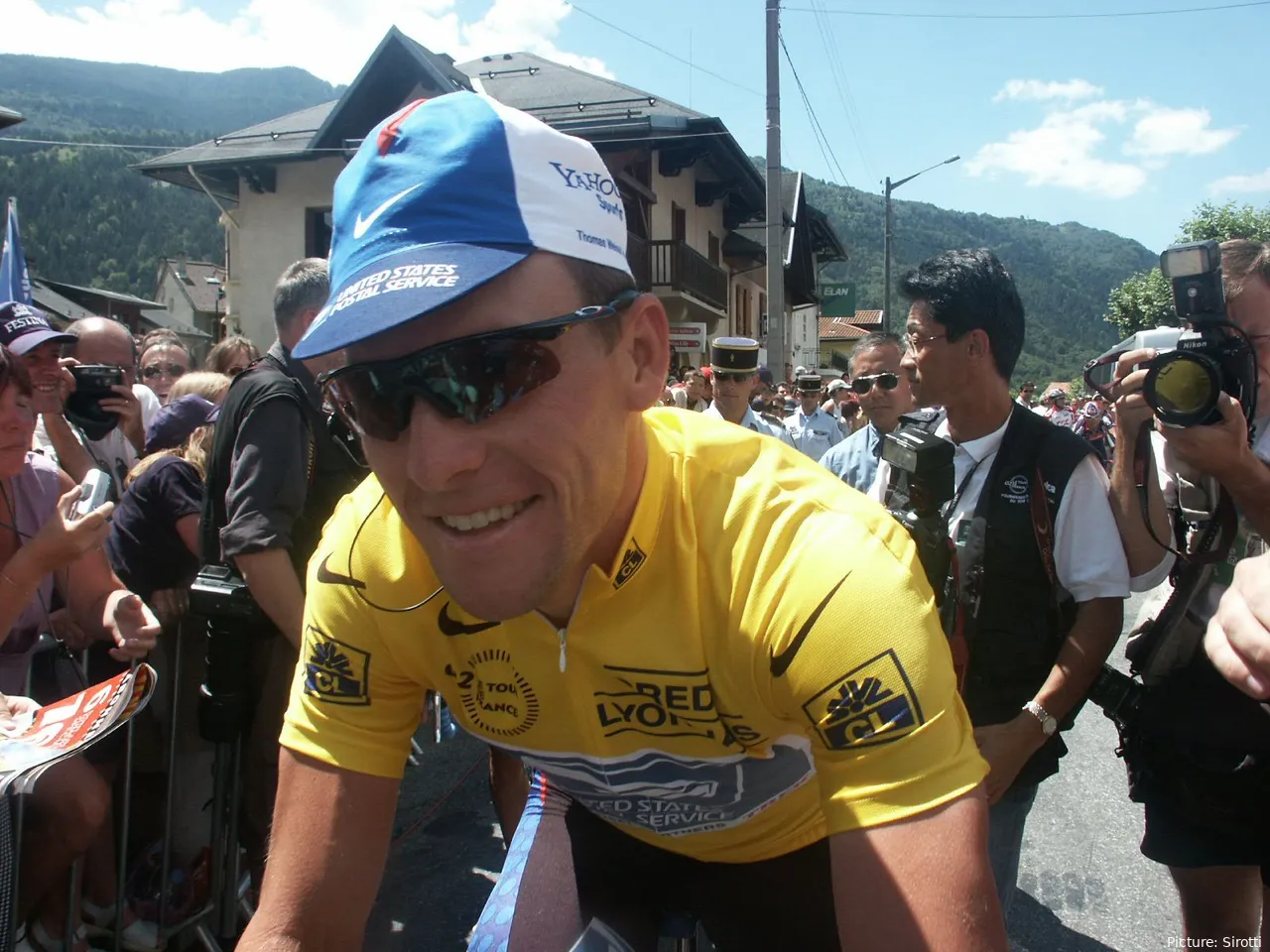
Lance Armstrong in the Tour de France Maillot Jaune for US Postal
Rivalries, regret and mental health
Armstrong admits he fuelled rivalries deliberately, particularly with Jan Ullrich. “Every fibre of my being wanted to defeat him.” With time, perspective shifted. “It’s been a very interesting journey with these guys.”
He says he wanted to support Ullrich during his struggles. “I can’t tolerate a hero like him being destroyed.”
He is blunt about the cost of his approach. “I took it to the extreme.”
The verdict is simple. “It worked on the bike, but it didn’t work off the bike.”
For decades, he relied purely on willpower. “I powered through with muscle and will. I never thought about mental health.”
Therapy only entered his life six or seven years ago. “I didn’t discover that part of the toolbox until six or seven years ago.”
He calls it “the most transformative thing I’ve done in my life in terms of a rigorous process.”
He describes intensive therapy as something closer to surgery. “There’s a form of therapy that’s more like surgery. And that’s what I chose to do.”
It required full commitment. “If you don’t surrender to the process, it doesn’t work.”
For someone who once rejected the idea of surrender entirely, the shift was profound. “I surrendered to the process.”
He adds simply: “I needed help.”
Now, his priorities are different. “The only thing that matters to me in life is my family.”
After the scandal, the focus was not reputation but responsibility. “How am I going to provide for my family? That’s all I care about.”
Armstrong sums up his journey without polish. “Life is a mess.”
Between obsession, fear of defeat and an instinct to survive at all costs, he presents the portrait of a competitor driven less by the love of victory than by the terror of losing.
Kieran WoodDeputy Editor-in-Chief
Kieran Wood is a sports journalist based in Wales and has been active in journalism since 2022. He regularly contributes to DartsNews.com and CyclingUpToDate.com, where he covers professional cycling and darts. In cycling, his work includes liveblogs from major races, including the Tour de France, the Giro d’Italia, and La Vuelta a España, alongside race reports and analysis. He has also conducted interviews with professional riders.
His reporting spans the full racing calendar, from one-day classics to stage races, with a focus on accurate, real-time coverage and clear contextual analysis. For statistics, results, and historical context, he regularly uses resources such as ProCyclingStats. To support reporting on rider activity and training context where relevant, he also references Strava.
In his work, Kieran places strong emphasis on careful sourcing, editorial accuracy, and updating articles as new, verified information becomes available.
claps 17visitors 10
Top comment
MrCampy04-03-202613
Did it to yourself ahole.
Just in
Popular news
Latest comments
- I made a mistake and already fixed it. Hey twat, thanks.PogiSloFans16-10-2026
- Davide Piganzoli said: "Pogacar looked less brilliant at TDF than usual." We all see how stupid this comment is. What is happening to his brain cells? ... Hey Piganzoli, Tadej Pogačar’s record breaking ascent of Alpe d’Huez was one of the standout performances in the history of the Tour de France. Pantani's 1995 ascent stood for 31 years. Pogi went more than a minute faster. He accelerated near the foot of the climb, despite the leading breakaway being around three and a half minutes ahead. But in your delusional brain Pogi looked less brilliant???? .... Why don't you go find a corner and bang your head against a wall for about 10 minutes. Everyone is making fun of you.PogiSloFans16-10-2026
- MTB WC ? If he doesnt compete maybe allows MvDP to have a crack
 Davide16-10-2026
 - Jonas is declining now. A podium next year would be a good result for him.Renz16-10-2026
- unpredictability is not an issue. Most riders not named Pogi have that. The excuses are and the blaming teammates and other riders for insufficient support and blocking are. if weight is an issue get a nutritionist. If aircon is not working switch rooms. Position yourself or get your teammates and DS to keep reminding you of basic stuff if it is difficult to remember in a long race. Dont whine about other riders not working with you, use tactics yourself or get your DS to develop the tactics. Dont talk about noballs when you yourself have no ballsabstractengineer16-10-2026
- It’s worth remembering that cycling journalism has entered it’s “Shit-Stirring Hot Takes Winter” now in order to keep the clicks and views trickling in.wrsty16-10-2026
- Well that would be a major disappointment. The last two years are the first times I have bothered watching the last day. Maybe at worst it could be the 2nd last day but two classic finishes and then wompWaranga16-10-2026
- Vingegaard was the one showing signs of weakness. He was looking more likely to lose a podium spot or two than to make inroads on Tadej.Papijan16-10-2026
- Disagree with Ardennes, he has never done well there, not even a top 10. Giro Vuelta, avoid the stacked TDF where crashes can derail the rest of the season and even if he avoid that, at best a top 5 is possible. He is 31, no more time left for testing/trying.abstractengineer16-10-2026
- Respectfully disagree. He and the team will want to qualify the result at the Tour against TP, JV, and the other GT specialists who weren't in Spain. And remember, the team is looking for a new title sponsor. Or, at least a co-sponsor. So a run at the TDF would go a long way in securing that! As a fan of the team dating back to the Indurain days, I would love to see it. But I do not think that he can really take it to them in July. But I do think he will try. I do agree that he can do good rides, if not win, in Belgium.coachjulianx16-10-2026
Loading
4 Comments