"I didn't understand the chase at all" - Lefevere unsparing toward the riders who "gifted" Van der Poel the E3 Saxo Classic
CyclingSunday, 29 March 2026 at 01:00
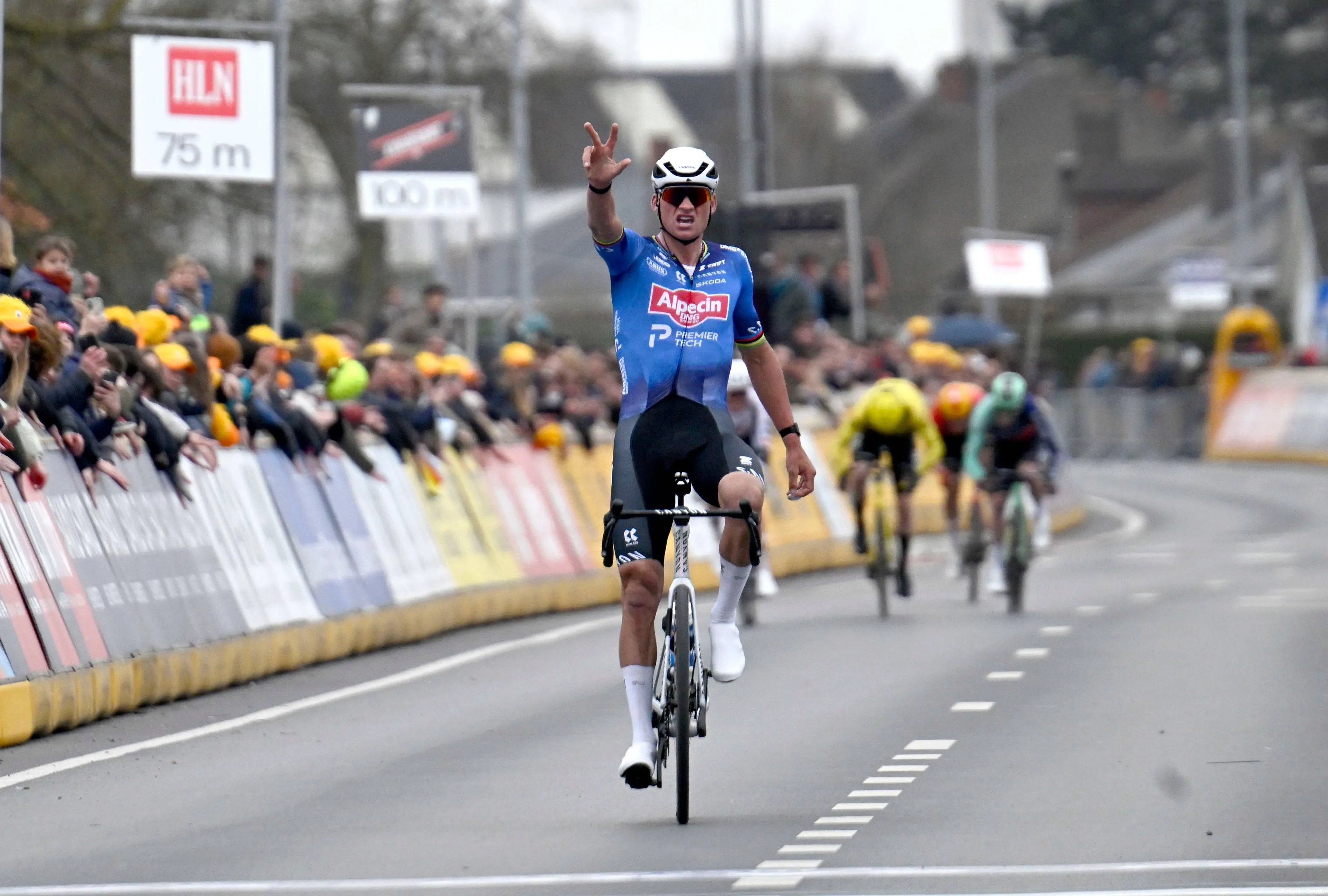
The chase group’s performance at the E3 Saxo Classic 2026 continues to draw criticism, none sharper than Patrick Lefevere’s. The veteran boss did not hide his bewilderment after watching the race unfold, especially the reaction - or lack of it - to the attack by Mathieu van der Poel.
In his column in Het Nieuwsblad, Lefevere went straight to the point: “I didn’t understand anything about the chase, or the lack of it.”
For Patrick Lefevere, the issue was not with the front group, which kept some coordination, but with what happened behind. The peloton, far from mounting an effective pursuit, looked chaotic and disorganised.
“Why not ride full gas with fifteen men?” In his view, there was no collective response to a situation that demanded the opposite: unity and clear tactics.
Individualism in today’s cycling
The former Belgian director goes further and points to a shift in peloton mentality as the root of the problem. “They’ve become individual projects. Riders and teams are too focused on their own chances instead of organising a clear chase together.”
A reading that, in his opinion, explains why attacks like Van der Poel’s end up sticking.
Doubts about the role of the team car
Lefevere also highlights in-race decision-making, questioning the influence of sports directors. “Is it decided by the riders or by what they hear in the earpiece?”
He also hints at constant mutual marking between teams that ultimately blocks any joint initiative. “That’s not how it works against those guys.”
His reflection also includes Tadej Pogacar, another of the current dominant forces.
Warning for Flanders
With an eye on the Tour of Flanders, Lefevere issues a clear warning to the peloton. “It’s not lost if they go early, but then everyone has to pull.”
His message is blunt: without genuine cooperation, stopping riders like Mathieu Van der Poel will be virtually impossible.

claps 2visitors 2
Just in
Popular news
Latest comments
- Sprint finishes are so heavily influenced by multiple factors (like crashes, boxing in) that it's difficult to know who's actually the one with the best raw power. I still think Milan is the strongest in this Giro, but he got derailed a couple times. So we might never know.Ride197424-05-2026
- Unlike Pogačar, Vingegaard can't rely on Pogačar crashing at Itzulia Basque Country. The Tour de Suisse is still coming though, with its dangerous roads.
 Rafionain-Glas24-05-2026
 - I wouldn’t say Jonas is being ‘extra’ conservative, but I stand by the belief he is being conservative to some degree. The team have pushed out official reports, and explained in interviews, how performance has been driven by a deliberate, low-stress tactical implementation by the team, allowing Vingegaard to maintain his composure and save energy until absolutely necessary (conservative compared to Tadej’s attack style). An example of this can been seen on Stage 9, where he produced a ~7.1 w/kg for the final 7:30 minutes of the climb. While impressive, it is below the ~7.7 w/kg range he usually reached in short, 7-10 minutes efforts last year, and in 2024. (Putting out the effort ‘only required’ to win the stage). (I want to reiterate, I have nothing but admiration for Jonas’ performance so far this Giro, and his conservative approach is nothing less than a clever, tactical approach ahead of the TdF)anonymouscyclist24-05-2026
- I don't see how he's being extra conservative. He didn't take pink until yesterday but he is still on course to winning 6 stages like Pogačar. It's not much less of a dominant performance.Rafionain-Glas24-05-2026
- Well said, MidnightRider. People only have to watch the interviews, in-team filming, how the riders talk about Jonas, and how they perform for him in an actual race, to learn how they respect him. I never ceases to amaze me how some people never let evidence interfere with their opinions, however.anonymouscyclist24-05-2026
- Hard to argue against Jonas’ approach if he’s doing exactly what’s needed to win the Giro. Fans might miss the fireworks of a Tadej-style approach, but if he’s eyeing a TdF win (or at least a podium), why spend needless energy? If Jonas walks away with both a Giro crown and a Tour podium, his tactical pragmatism will have clearly paid off.anonymouscyclist24-05-2026
- Yes, Visma did say it was an unfair portrayal of their team. But they still took part in the next series, while UAE declined to directly take part (so there was just a bit of footage of Pog, who some newcomers took to be the villain.) We can't know what really goes on!Hills3324-05-2026
- Remco doesn’t hide his identity per se, but the debate surrounding Remco’s trajectory into grand tour’s is one of the most polarising topics in today’s cycling.anonymouscyclist24-05-2026
- Yeah Vingegaard has changed a lot. In that season Netflix went overboard on the drama. Funnily enough it did make me start to watch cycling more, but watching the series I was absolutely convinced that Wally should change teams. Also Pogačar's side was not in the series, so he was presented as the bad guy. Wout was presented as the oppressed good guyRafionain-Glas24-05-2026
- Exactly how? Remco doesn't hide his identity. He's very forthcoming with it.Rafionain-Glas24-05-2026
Loading
3 Comments