COLUMN | Elon Musk bought Twitter for $44 billion. Here's what that money could do in cycling
Cycling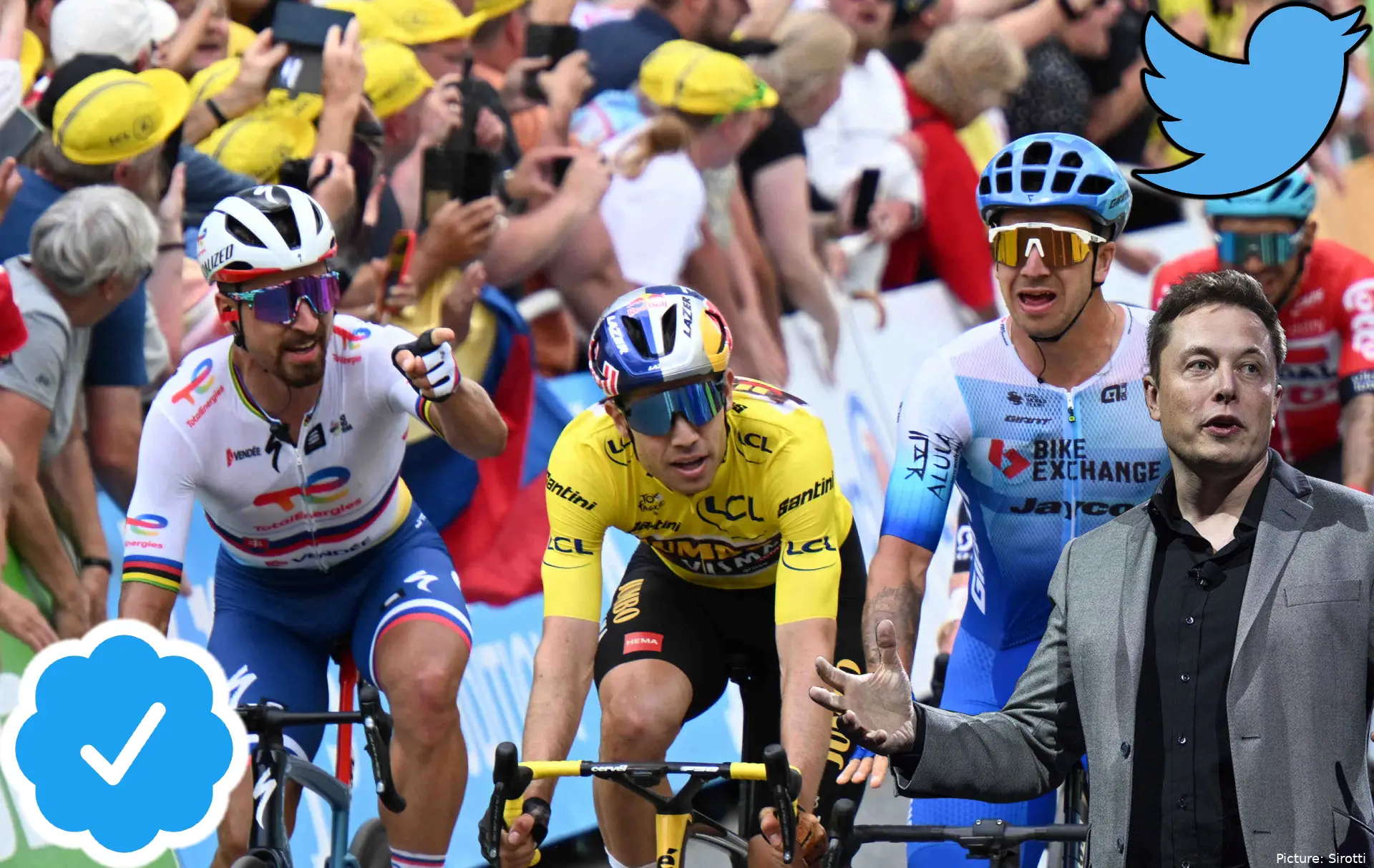
Twitter has been bought by Elon Musk for an amount of $44 billion dollars this week, and ever since the social media outlet has been in a flurry of activity as the South-African born entrepreneur promises to deliver changes to it. Here is, in numbers, what that amount of money could do in professional cycling.
Needless to say, $44 billion is an amount of money that 99.99% of the world's population could never even dream of seeing, let alone using. The purchase of Twitter was one of the world's largest ever deals, and it involves amounts of money that are hard for any regular person to grasp. That money is, for example, equivalent to 10.1% of South Africa's total GDP (CEOWORLD, 2022) - the 34th largest economy in the world.

The $44 billion billion spent on Twitter could make it the 92nd wealthiest nation on the planet. It is a value larger than the total GDP of develop nations such as Latvia, Estonia, Iceland. What that money could be used for or not, is not in debate, although it was certainly a questionable decision.
Musk has heavily indicated that blue (or white, however you see it!) check marks will stop being free, and will only be obtained if the user pays a small amount of $8 per month. According to Forbes, around 300,000 currently have checkmarks on Twitter. In the hypothetical (yet obviously not plausible) scenario that 100% of those users would pay the fee to keep the checkmark, it would give out $2.4 million per month - and $28.8 million per year.

Now let's put those into numbers comparison first. If 100% current checkmarks would be payed, those $2.4 million would not be enough to pay for the budget of INEOS Grenadiers and UAE Team Emirates (€4.16 and €2.9 per month respectively, according to 2021 data). It would however be enough to finance Jumbo-Visma, and all teams below.
If 100% of the users currently having a checkmark would pay the monthly $8 per month, it would give profit of $28.8 million in a year. That is equivalent to 0.065% of the total sum of money Musk payed. You begin to figure how meaningless the decision is even if it was to succeed. That is, if you could ignore the criticism coming from all sides over deciding to make users pay for something they already have for free.
However, the real figure to focus on here is $44 billion. Yes, I keep repeating it, it's a value that is still incomprehensible to me. If this money were to be applied in cycling, what could it do? How many World Tour teams could be bought? Throughout how many years could Tadej Pogacar's salary be payed with this sum? I will answer all the important questions.


The winner of the Tour de France for example is awarded €500.000 euros, split by the team. The total amount of prize money distributed throughout the whole Tour de France is of €2.282.000 euros. This is equivalent to 0.005%. Musk could've used this sum to pay the total prize money of 19.281 Tours, all the way into the year 21303 - by which point it would be hilarious to think bike racing would still be a thing.
What if this money was used to pay for the salary of monument, Grand Tour and World Championships winner Remco Evenepoel? Evenepoel's salary is said to be between €1-2 million euros, so effectively his pay would be secured for at least some dozen thousand millennia. What if Musk payed the full salary of the world's best payed rider Tadej Pogacar (€6 million)? It would be harder, his bank account would only be filled for a few 7333 years.
What if... We assembled the peloton's 30 best payed riders all in 1 team, and simply just pay off them all? According to a report from CyclingTips, the 20 riders with the highest salary in 2022 combined had a total sum of €52.2 million. Add another 10 riders with €1.5 million salary and that could be rounded out to €67 million. Imagine this, Musk assembles the 30 best riders in the peloton all in one team (excluding staff and logistics payments), how many times could he pay off the whole team?
656 times to be more precise. Yes, the salaries of the 30 best-payed cyclists in the world could be payed for 656 whole years, just with the sum that has been used to buy Twitter. Let's take it to the next level...

Rumored budget of teams participating in 2021 Tour de France. Via Statista.
This is, according to Statista, the budget of all teams that participated in the Tour de France peloton in 2021. $44 billion could finance the whole INEOS Grenadiers team 880 times. Yes, pay for the (by far) most resource-rich team in professional cycling a total of 880 times. But what if we take this to yet another level... The absolute ridicule, the most absurd comparison you could possibly make... What if Elon Musk wanted to buy the entirety of the Tour de France peloton?
In the 2021 Tour de France, the total amount of budget that all 22 teams combined led to was of a whopping €381.5 million euros. This is, by any sport's standards, a high value. What if Elon Musk wanted to buy the entire Tour de France peloton and guide all teams in the way he would want, in order to create a whole planned and synchronized Tour de France, under control of 1 single person.
Obviously the answer is yes, he could do that, easily in fact. If Musk wanted to pay for the entirety of the Tour de France peloton, he would be able to do it 115 times solely from the amount of money he payed for Twitter. To put into context, 115 years ago (1907) was the 5th edition of the Tour de France, at the time won by famous French cyclist Lucien Petit-Breton.
All of the following 115 Tours could on paper be ruled by 1 person. The next Anquetil, Merckx, Hinault, Indurain, Armstrong (maybe...), Contador, Froome, Pogacar could be orchestrated, as all riders would follow the orders of the person who would have absolute control over the teams!
But for now, let's just wait and see what the outcome is on the blue checkmark...
Rúben SilvaEditor-in-Chief
A founding contributor to CyclingUpToDate since its launch in January 2022, Ruben Silva has played a central role in shaping the site’s editorial direction and long-term growth. Before joining the project, he built his experience through independent blogging at Echelons Hub and by producing race previews for Ciclismo Internacional, developing a strong analytical voice rooted in daily engagement with professional cycling.
Beyond editorial work, he has been closely involved in the expansion and coordination of CyclingUpToDate’s wider network, helping establish and support sister platforms across multiple languages. This includes ongoing collaboration with CiclismoAlDia (Spanish), CiclismoAtual (Portuguese), WielrennenUpToDate (Dutch), and RadsportAktuell (German), contributing to a shared editorial vision and consistent international coverage.
He also helps oversee editorial governance across the network, setting standards for accuracy and consistency and coordinating updates or corrections when needed.
Originally from the Porto metropolitan area in Portugal, he holds a bachelor’s degree in Geography. His path into cycling journalism was shaped not through formal media training, but through independent reporting, community engagement, and sustained on-the-ground involvement in the sport.
Over the course of his career, he has conducted approximately 100 interviews across road cycling and cyclocross, ranging from one-to-one conversations and online formats to press conferences and on-site pre- and post-race coverage. His interviews include leading riders, team managers, and prominent figures within cycling media: Tadej Pogacar, Jonas Vingegaard, Mathieu van der Poel, Primoz Roglic, Wout van Aert, Joao Almeida and Tom Pidcock; managers like Patrick Lefevere and Joxean Matxin; and YouTube personality Bryan Kennedy (BKXC)...
Within 18 months of launch, he helped grow CyclingUpToDate’s English-language platform into one of the most-read cycling news websites, built entirely from the ground up. As both a professional journalist and lifelong cycling enthusiast, his focus remains on delivering accurate, timely, and well-contextualized coverage.
claps 1visitors 1
Just in


Popular news
Latest comments
- He is boring
 leedorney08-11-2026
- To Twoje przemyślenia te bla, bla :)
 Dariusz08-11-2026
- Uwielbiam patrzeć, jak wyjeżdża na czoło peletonu i zaczyna się rzeź...Dariusz08-11-2026
- Yeah, unreal.
 parisbound0008-11-2026
- there needs to be space in life for pointless comments!Ketterechts08-11-2026
- That is a very lazy way of putting it but so far on this website it seems like everyone is happy to look at everything lazily, even things that annoy them intensely. All they want to do is state their feeling and position but ask most to analyse a problem or come up with solutions or improvements and you’re stunned by silence. Nobody even really knows how this all happens. It’s very simple and quick to just say the UCI did it but I bet you they didn’t, I bet you not more than 2 people were involved, more likely just 1. The UCI may be ultimately responsible but it is not their decision, this is about hierarchy, power and delegation. The fact that protest is possible also means it isn’t over and that MORE people could get involved for a thorough review which could throw up anything. It is highly likely it was a sole commissar who decided and has that power in a first round. Therein might lie the problem the UCI has to consider, is it acceptable to give so much authority to one single person when it is quite possible for them to have a natural bias or be too easily susceptible to imposed bias. Who is to say an individual in this position isn’t susceptible to collaboration with outside players with interests in the results, nations, families, teams, betting companies, etc. On the one hand we have sports where these problems have been worked on way more to reduce such problems, on the other hand we have sports with far stricter and more draconian rules not even concerning safety or obstruction that nobody really questions like false starts or stepping out of lane or zones in athletics. If cycling hastowork on itself, it would be good if protagonists (all kinds) would start doing a little more than just moaning over outcomes.Jumpyjohn08-11-2026
- Yes, so why not make comments less pointless?Jumpyjohn08-11-2026
- What a race! I didn't expect Vanthourenhout to collapse like that, and Wyseure did take the fight to Nys, but there was no doubt at the end. I also wonder what Aubin Sparfel would be capable of were he to race in the elites now. In the U23 ranks he is making good work of Giel Lejeune, who himself is among the better riders in the elites, and a top 10 contender in the big races (3rd at Kleebergcross, 8th at Berencross and 5th at Heerderstrand). In the French Cup, Sparfel is significantly better than Romain Debord (8th at Koppenbergcross and 10th at the Euros) and Rémi Lelandais (12th at Koppenbergcross and 19th at the Euros).
 Rafionain-Glas08-11-2026
- There really was nothing in it. Schreiber was so much faster, and Brand was fighting to stay in the wheel in the sprint. Schreiber did move a bit, but to say she closed the door doesn't make sense because Brand couldn't enter it anyway, abd she wasn't impeded.Rafionain-Glas08-11-2026
- He should have been allowed to go to Movistar. Right now both arent a good fit for each other and are just wasting each other's time and effortabstractengineer08-11-2026
Loading

Twitter’s current lords & peasants system for who has or doesn’t have a blue checkmark is bullshit. Power to the people! Blue for $8/month.

Write a comment