ANALYSIS: Jonas Vingegaard faces major decision after Tour de France crash – Will he race again in 2026?
CyclingFriday, 31 July 2026 at 10:05
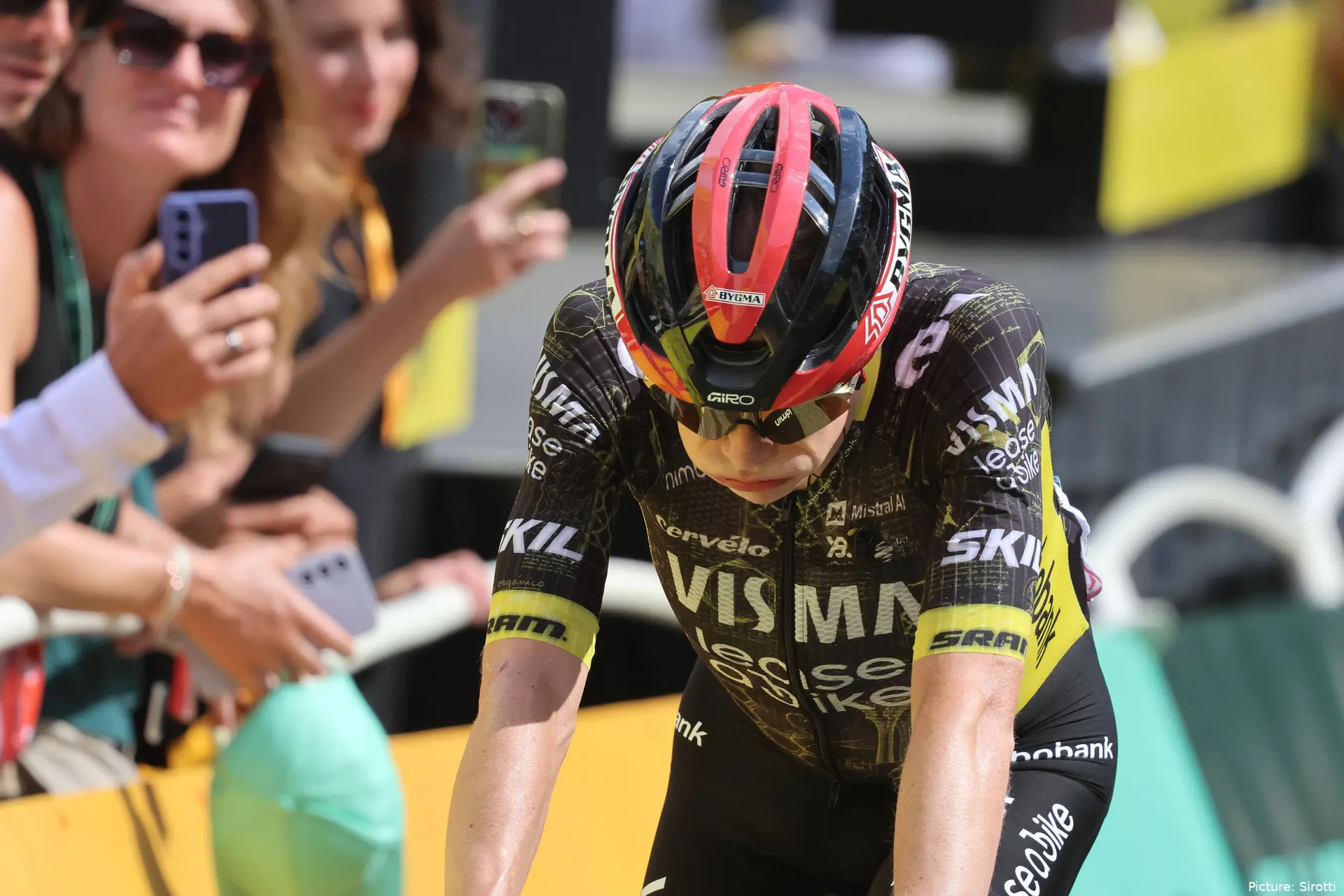
Jonas Vingegaard has not closed the door on racing again in 2026, but the Giro d’Italia winner is in no hurry to decide whether his season will extend beyond the crash that ended his Tour de France.
Vingegaard underwent surgery after fracturing his right collarbone on stage 15 of the Tour, where he had been sitting second overall behind Tadej Pogacar. Appearing in his hometown of Glyngore ahead of the Tour of Denmark this week, the Team Visma | Lease a Bike leader revealed that he had not yet returned to training. “I needed a break after the Tour,” Vingegaard told TV 2. “It’s been a tough year and a tough bike race, so in any case I needed a break because there’s been so much.”
The 29-year-old can now use his arm and reported that the pain had eased, although it had not returned completely to normal. Any decision over an autumn comeback will depend on how the fracture heals once he resumes riding.
The World Championships in Montreal remain possible. Vingegaard refused to commit to the September 27 road race, but his response was enough to keep one of the most intriguing potential comebacks of the autumn alive. “It’s not out of the question for me, but I also don’t want to say now that it’s going to happen,” he said.
That uncertainty leaves Visma and Vingegaard weighing a rare opportunity against the demands of a season that has already delivered one historic triumph, another failed Tour challenge and a second significant collarbone injury in three years.
No reason to rush after a historic Giro
Vingegaard’s 2026 campaign cannot be judged solely through the disappointment of his Tour exit. After a disrupted start to the year, he returned to competition by winning the Volta a Catalunya before making his Giro d’Italia debut in May.
Five stage victories and a final advantage of 5:22 over Felix Gall completed his collection of all three Grand Tours, adding the pink jersey to his Tour victories in 2022 and 2023 and his 2025 Vuelta a Espana success. He became only the eighth male rider to win the Giro, Tour and Vuelta during his career.
The Tour was the more ambitious half of his programme. Only seven riders have completed the Giro-Tour double in the same season, and nobody other than Pogacar in 2024 has managed it since Marco Pantani in 1998.
Vingegaard began well when Visma won the opening team time trial in Barcelona, putting him into the yellow jersey. Pogacar soon took control, however, and had built a lead of 4:30 by the start of stage 15.
The Dane later admitted that Visma may not have prepared him for the exact demands of the route. His Giro training had strengthened him for longer climbs, while the Tour repeatedly rewarded Pogacar’s greater explosiveness on shorter and steeper efforts.
“We may have misunderstood the Tour a bit this year,” Vingegaard said following his withdrawal. “We made me better on the longer climbs. But it could well be that we should have realised I needed to be a bit more explosive and look more closely at the route. Obviously, it’s difficult to be explosive when you’ve just ridden the Giro.”
His crash removed any possibility of testing whether the balance might shift on the longer Alpine climbs still to come. Visma had placed Bruno Armirail and Victor Campenaerts in the breakaway on stage 15 before dropping them back to assist Vingegaard, who the team said had been feeling extremely strong.
Instead of launching the planned attack towards Plateau de Solaison, Vingegaard lost control on a corner with approximately 20 kilometres remaining. His Tour ended at the roadside and required surgery two days later.
Read also
Montreal offers a rare one-day opportunity
The World Championships provide the clearest reason for Vingegaard to rebuild before the season ends. Montreal will host a demanding elite men’s road race on September 27, with repeated climbing and a course far better suited to Vingegaard than a flat championship decided by the sprinters. It represents a rare chance for one of the sport’s best climbers to chase the rainbow jersey on favourable terrain.
Vingegaard has never contested the elite World Championship road race. His appearance at the 2025 European Championships was his first race for Denmark at senior level in several years, but ended without a result after he was dropped and abandoned.
His stage-racing record offers little guarantee that he could immediately transfer that level to a championship race. Vingegaard has based almost his entire career around multi-day events, with comparatively little experience of the positioning, repeated accelerations and tactical unpredictability found in the biggest one-day races.
He would also be returning from injury to face riders whose autumn programmes had been designed around Montreal. Pogacar is expected to pursue a third consecutive world title, while the long distance would demand far more than simply recovering enough fitness to complete a conventional race.
The timing is at least workable. Almost ten weeks separate Vingegaard’s Tour crash from the World Championship road race. The Grand Prix Cycliste de Quebec on September 11 and Grand Prix Cycliste de Montreal two days later would offer obvious preparation should Visma and the Danish national team decide that a comeback is realistic.
Neither Canadian WorldTour race is currently part of a confirmed programme for Vingegaard. His first step must still be returning to the bike and discovering how the collarbone responds.
His caution is also informed by experience. Vingegaard’s 2024 Tour preparation began only weeks after the Basque Country crash that left him with fractures to his collarbone and ribs, a collapsed lung and a pulmonary contusion. He recovered quickly enough to finish second in Paris, but has since spoken about the physical and emotional cost of forcing his return. There is no Tour start date driving the process this time.

Could Vingegaard return to Danish colours for just the second time in his senior career?
Lombardia possible but Vuelta defence unrealistic
Il Lombardia is the other major race repeatedly linked with a possible Vingegaard comeback. Held in October, the final Monument of the season would give him more time to recover than the World Championships. Its long climbs also suit his physical strengths, even if his lack of major one-day results would leave him entering unfamiliar territory against the established Classics specialists.
The race has not been publicly confirmed as an objective by either Vingegaard or Visma. It currently stands as a logical possibility on the calendar rather than an established plan.
A defence of his Vuelta title is considerably harder to envisage. The Spanish Grand Tour starts on August 22, less than five weeks after his Tour crash and only three weeks after he confirmed that he had yet to resume training.
Even without the injury, riding all three Grand Tours would have been an enormous demand after Vingegaard had built his year around the Giro-Tour double. Attempting the Vuelta after surgery would require precisely the kind of accelerated rehabilitation he now appears determined to avoid.
Visma sports director Marc Reef left both outcomes open after the operation. Vingegaard could return before the end of the year, but the accumulated physical and mental demands of his campaign would be considered before another race was added.
The team does not need to manufacture an autumn objective. Vingegaard has already raced 51 days, won two stage races and completed almost five weeks of Grand Tour competition.
Read also
A decision shaped by 2027 as much as 2026
Montreal would give Vingegaard the chance to pursue one of the few major jerseys missing from his career. Lombardia would provide another prestigious target with a less compressed recovery period. Neither race is essential enough to justify compromising the winter that follows.
Vingegaard’s Giro victory has secured the place of his 2026 season in cycling history. Returning in September or October would not rescue a failed campaign, just as ending his year now would not amount to surrender after the Tour.
The larger challenge remains finding a route back towards Pogacar. Vingegaard was still the nearest rider to the yellow jersey when he crashed, but the gap between them had reached four and a half minutes before the final week. His comments since the Tour suggest that both he and Visma recognise the need to reconsider how they prepare for the explosive racing that has increasingly favoured Pogacar.
A complete recovery followed by an uninterrupted winter may carry greater value than a hurried attempt to add one more objective to an already exhausting season.
For now, the World Championships remain alive as a possibility rather than a plan. Vingegaard must first return to training, establish whether his body is ready to rebuild and decide whether the motivation exists to chase another major prize only weeks after the Giro-Tour campaign came to a painful end.
Should those answers arrive quickly, Montreal offers a route back into competition. Should they not, Vingegaard already has more than enough reason to draw a line under 2026 and turn his attention towards another Tour de France challenge.

Kieran WoodDeputy Editor-in-Chief
Kieran Wood is a sports journalist based in Wales and has been active in journalism since 2022. He regularly contributes to DartsNews.com and CyclingUpToDate.com, where he covers professional cycling and darts. In cycling, his work includes liveblogs from major races, including the Tour de France, the Giro d’Italia, and La Vuelta a España, alongside race reports and analysis. He has also conducted interviews with professional riders.
His reporting spans the full racing calendar, from one-day classics to stage races, with a focus on accurate, real-time coverage and clear contextual analysis. For statistics, results, and historical context, he regularly uses resources such as ProCyclingStats. To support reporting on rider activity and training context where relevant, he also references Strava.
In his work, Kieran places strong emphasis on careful sourcing, editorial accuracy, and updating articles as new, verified information becomes available.
claps 1visitors 1
Just in
Popular news
Latest comments
- for the better he doesn’t racemij30-09-2026
- true, but remco seemed to win in spite of WVA that day. they just are not getting great results when teamwork is needed.mij30-09-2026
- I kept thinking the same thing - that he was being isolated by his own team with pointless attacks so early. Especially when you know MVDP is going to thin out the herd with a big attack. He already said he was going to, and he did.mij30-09-2026
- It's not a great translation, but I think what he's saying is that Remco is exceptional when in training he can imagine the roar of the crowds as he wins, as he has said himself. With WVA as co-leader, he could not mentally prepare like that.Hills3330-09-2026
- Absolutely!Lozza30-09-2026
- Agreed. He has to say something controversial to justify his pay cheque.Cyclingsbestfan30-09-2026
- Why wouldn't your team boss congratulate you? It's a big deal to have a world champion on your team.Cyclingsbestfan30-09-2026
- As a World Tour team, surely Picnic Post NL will get an automatic invite to any and all grand tours and World Tour races regardless of their position in the pecking order of UCI points at the end of this season.Lozza30-09-2026
- Yes, this time I agree with you... the best team was the american team. Chapeau to them.PogiSloFans30-09-2026
- Yes, I bow to Pogi, with respect. You bow to your orange orangutan maga president... the most hated person in the world.PogiSloFans30-09-2026
Loading
1 Comments