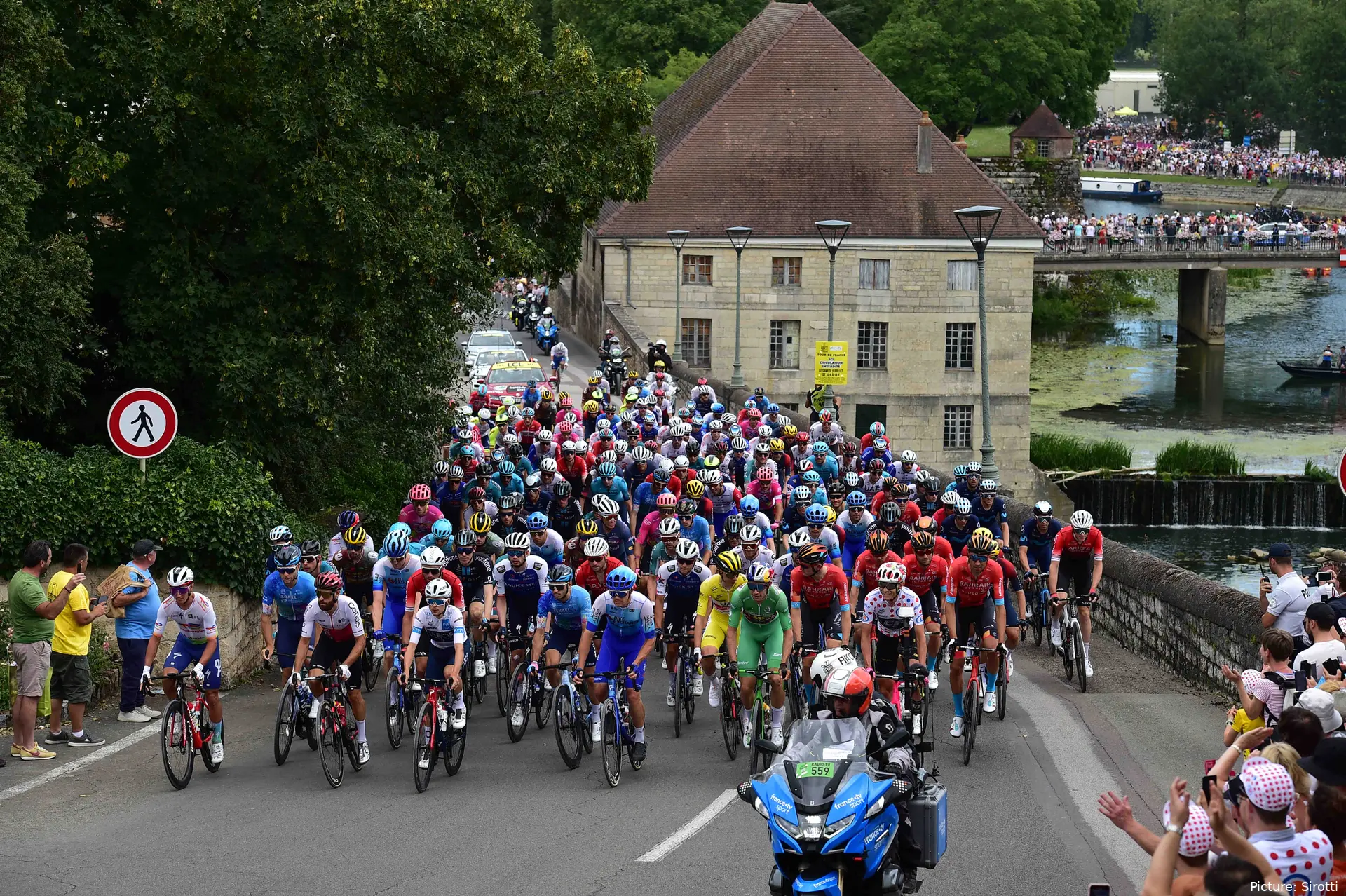
Professional cycling is increasingly shaped by the structural distortions of the UCI points system, a mechanism intended to organise the competitive hierarchy in theory, but which has gradually pushed the sport towards a one-day-race-dominated model. A change is needed, and a reform proposal is being drafted.
At present, the system heavily favors one-day events. A 1.1 race (one day race - third division) grants 607 points, almost matching the 735 points distributed across five days in a 2.1 (stage race - third division).
At the ProSeries level (second division), the gap persists: a 1.Pro event offers 1,120 points, whereas a five-day .Pro stage race yields only 1,405 (around 281 per day). At the World Tour the situation remains the same. A Tour de France stage win awards 210 points, while winning a one day WT race like the ADAC Cyclassics Hamburg gives 400 points to the winner, and monuments are even more profitable (800 points).
A reform proposal gains momentum
In response, according to Marca, various stakeholders in professional cycling (undisclosed who they are exactly) have drafted a reform proposal designed to correct these distortions without diminishing the importance of one-day races. The central idea is simple: stage races should award, per day, 70 percent of the points granted by an equivalent one-day event. This adjustment does not aim to equalise the two formats but to reduce the severe penalty currently imposed on stage racing.
The proposal also suggests recalibrating how points are distributed within stage races. The general classification would represent 50 percent of points, stages 40 percent, and secondary classifications 10 percent.
The reform will be presented to the Council of Professional Cyclists (CCP) and the Spanish Association of Race Organisers (AEOCC) before being submitted to the UCI, now presided over by Javier Guillén, who is also the the General Director of the Vuelta a España.
The current incentives have created what is described as a silent mutation of the sport. Basically, when teams look for new riders to recruit, they do not focus on sporting needs but on their ability to collect points in small one-day races.
Riders sprint for minor placings simply to secure top-20 finishes that improve contract leverage. In some cases, a modest result in a lesser classic provides more points than a stage victory in an established stage race, which does not make much sense.
Astana is the best example: tipped for possible WorldTour relegation entering the 2025 season, the team avoided danger by focusing on strategic points-gathering in targeted races.
We will have to wait to see if the reform is finally adopted or not. What is almost certain is that the change, if there is one, won't be implemented in 2026. Additionally, the next three-year WorldTour promotion-relegation cycle has already started, meaning any mid-cycle adjustment could raise new questions of fairness.

Félix SernaCycling Journalist
Félix Serna is a writer at CyclingUpToDate and has been part of the team since 2025. He covers professional cycling across both the men’s and women’s calendars, with a focus on UCI rankings, race developments, and rider performance. His work includes interview-based reports, liveblogs, and tournament coverage designed to provide clear, accurate context throughout the season.
In his reporting, Félix regularly uses ProCyclingStats for results, statistics, and historical reference. He places strong emphasis on careful sourcing, editorial accuracy, and updating articles promptly when new, verified information becomes available. He holds a bachelor’s degree in International Studies.
claps 1visitors 1
Just in
Popular news
Latest comments
- Very well thought out, perfectly worded statements. Hopefully nobody will need to subject these two to criticism for opening their mouthes this time.Jumpyjohn10-10-2026
- Omg, I can’t believe the mess the info in this text is going to create. Firstly, some facts are not given in context or are disputable like FT not being accompanied by a police motorbike, it was previously stated he was but was descending faster and the officer couldn’t keep up. The vehicle that was a car is now a van and the occupants convinced the road was clear were no longer told it was by spectators (there, apparently, being no official to answer their question). Later, it’s suggested a motorbike could be sent backwards, JUST after we.read of a crash occurring because a police motorbike was riding against the flow??? Then we have the issue of why before discussing gps nobody is questioning why important information like riders left behind seems not to be relayed by radio which everyone of importance has access to. Then there is the question of how gps will prevent a situation such as this or similar ones given the time it takes to organise an escort once a rider is defined as left behind and that still no-one has an emergency solution for this particular case where there apparently was an escort but it just couldn’t stay ahead of the rider on that stretch of the road (incidentally, after this, if I was I rider in exactly this situation, I’d no longer be cutting corners around blind bends anymore, ever, no matter how much catching up to do there was, just like after incidents like FC, very few riders remained stubborn about not wearing helmets). Then there is the issue of the gps itself, until now it was the teams and riders pretty against it but now the CPA is doing an about turn in public? I don’t have figures for many countries but I know that where I live, it costs around 1500€ for just 2hours of police motorbike participation (so good thing races are pretty punctual) whereas private motorbike helpers get more like a symbolic 50-100€, we would do well to ask where money for better accompanying should come from in the context of a sport dying at many levels. And finally, for now, what about the collective responsibility? In a race of this level, I imagine a rider left that far behind must have been overtaken by numerous support and other vehicles, could not one stick around, is it not possible to set up a closed Ways type group (perhaps even with spectator participation) where everyone can update on new dangers or changes in situations monitored by someone able to broadcast to all radios in case of emergency?Jumpyjohn10-10-2026
- Pogi would’ve completely demolished the field today in Il Lombardia. Not even remotely close. One and a half to two minutes is my estimate. I prefer Del Toro or maybe McNulty winning over Remco or Seixas. Anyway today Pogi would have won by a big margin... but 80% of cycling fools would be saying "What a boring race!!!"PogiSloFans10-10-2026
- Simple version. Moving objects look strange when using these cameras. Why? The horizontal axis is time, a cyclists proportions in the photo are entirely dictated by their speed relative to the camera's frame rate. The image stretches: If a cyclist is moving more slowly as they pass through the 1-pixel slot over a longer duration This makes them look horizontally elongated. Why do we see bending Spokes: In cycling finish line photos? Bicycle wheels often look oval or feature curved spokes. This happens because the top of a rolling tire moves forward twice as fast as the bicycle's hub,. It crosses the vertical scan line faster than the bottom of the tire. There is no reason for the actual finish line to not be shown. I would not know the reason why it is not shown. Bear in mind we are talking about several one pixel wide images stacked to show a more full image. The line the camera is on could be anywhere on the actual finish line. The cyclist was correct in asking to see the digital finish line in relation to where the actual finish line was. Alles klar?Prorodsandstuff10-10-2026
- "Death to fascism, freedom to the people!" ... was a motto of the Yugoslav Partisans. Slovenia used to be a part of Yugoslavia. "Death to UCI fascism, safety to the cyclists." ... should be the motto of all the cycling teams. Slovenia (a republic of former Yugoslavia) is Pogi's homeland. PS: This is what you call an artistic reasonable and political correct conclusion. Ad acta.PogiSloFans10-10-2026
- This! This is is how the riders get the UCI (and races) to pay attention! -An Economistacem8210-10-2026
- this team is loading up on talent.mij10-10-2026
- 💯% been too many 🙏
 leedorney10-10-2026
 - Why? The other guys skipped it, maybe they decided the rest would give them a better chance now so they’re not really racing on equal terms.Jumpyjohn10-10-2026
- Just want to see him riding again, anywhere! Come back soon Pogi!Lozza10-10-2026
Loading
Write a comment