Road cycling blends speed and unpredictability in ways few
sports can match. Riders spend hours in tight formations at 60 km/h or more,
balancing on slim tires and reacting instantly to every movement around them. A
minor lapse, someone braking too sharply, a wheel drifting sideways, can spark
a pileup. Yet despite the inherent risks, catastrophic crashes remain uncommon
across the huge volume of racing each season. How dangerous is this sport in reality?
Sprint finishes, mountain descents and time trials each pose
their own dangers, and continual changes to equipment, regulations and course
design reflect the sport’s evolving effort to protect riders. But, just how
safe is cycling today?
FAQ:
1. Sprint finishes
2. Mountain descents
3: Time trials
4. Weather
5. Political risks
1. Sprint finishes
2. Mountain descents
3: Time trials
4. Weather
5. Political risks
1. Sprint finishes
Sprint finishes are the most volatile moments. On flat
stages, dozens of sprinters and lead-out riders launch themselves toward the
line at 70–80 km/h, each searching for a clean path. One misjudged movement can
send several riders tumbling.
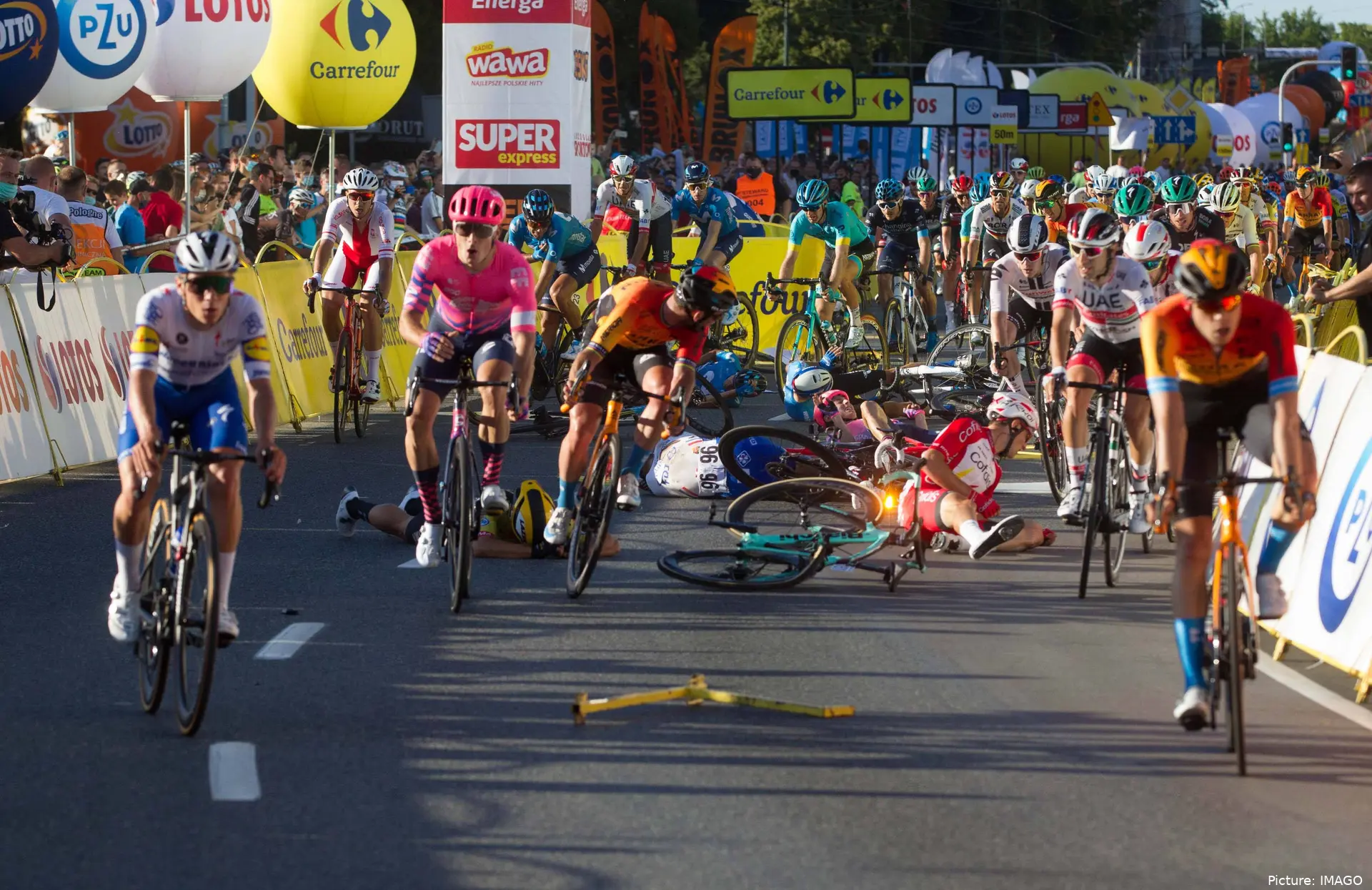
The 2020 Tour de Pologne offered a brutal reminder. In the
final meters, Fabio Jakobsen was thrust into the barriers when another rider
swerved off his line. The impact was brutal. Jakobsen later recalled, “we were
doing 84 km/h, so you don’t have a lot of time to react… The barriers didn’t
stop me. They just folded.” He suffered major facial injuries but survived. The
UCI condemned Dylan Groenewegen for the swerve and suspended him for nine
months.
Such incidents underscore how narrow sprint finishes can be.
Data from the UCI’s SafeR safety group shows nearly half of all WorldTour
crashes take place in the last 40 kilometers of a race, especially in sprint
approaches. Another UCI report attributes about 13% of crashes to the tension
building toward sprint or summit finishes, with slippery surfaces causing
roughly 11%.

Crashing is an unfortunate part of professional cycling
To reduce high-speed chaos, the UCI has expanded the
traditional 3 km time-protection rule to up to 5 kilometers on some stages, giving
riders more breathing room. Barriers have been redesigned as well, as after
years of using thin metal fencing, major races now deploy sturdier,
energy-absorbing structures proven not to collapse on impact. SafeR continues
testing new fencing standards to further increase reliability.
Teams also concentrate heavily on positioning and safe
sprinting techniques. Riders study the final kilometers in advance, team cars
issue warnings over race radio, and lead-out trains try to deliver their
sprinter cleanly into the last 200 meters.
Even then, some course designs remain questionable. Jakobsen
himself said, “We have to get rid of dangerous finishes like this,” making
clear that layout plays a major role in safety. Organisers sometimes widen
finishing straights or remove tight corners after safety reviews. The
combination of speed and congestion means risk can never be fully erased, and
many sprinters view an incident-free season as a genuine accomplishment.
Read also
2. Mountain descents
Mountain descents introduce a different scale of danger.
Cyclists often exceed 90 km/h on steep alpine roads and must navigate narrow
lanes, tight switchbacks and exposed drop-offs. The slightest misjudgment can
be catastrophic, as seen in the death of Wouter Weylandt during the 2011 Giro
d’Italia. Weylandt crashed on the Passo del Bocco, suffering fatal head
injuries, aged just 26.
The same vulnerability emerged in 2023 when Gino Mäder
crashed during a rapid descent in the Tour de Suisse and fell into a ravine. He
later died from his injuries. The stage finished at the base of the Albula
Pass, a decision criticised by many riders.

Gino Mader passed away after a crash in 2023. @Sirotti
Poor weather intensifies the threat. Rain transforms road
markings, steel grates and smooth tarmac into treacherous surfaces, and UCI
statistics consistently list descents as hotspots for crashes, especially in
wet conditions.
Teams now devote more training to technical descending,
while some leaders are instructed to dial back their aggression in the rain.
After Mäder’s death, conversations began about installing mountain-side nets
similar to those used in alpine skiing to prevent riders from tumbling into
ravines. Some races already neutralise dangerous sections or alter finishing
points to avoid steep drop-offs.
3. Time Trials
Time trials, though usually calmer than mass-start stages,
bring their own risks. Riders compete alone, often in aggressive aerodynamic
positions that limit vision and handling. Speeds are incredibly high, and a
misjudged corner can lead to serious injuries.
Time trials rarely produce large crashes, but when they do
occur the consequences can be severe because riders have little time to react
if they lose control. A review of crash factors found that while higher speeds
only marginally increase crash likelihood, they significantly increase the
force of impact.
This has prompted the UCI to experiment with gear-ratio
limits aimed at moderating maximum speeds. Equipment rules continue to evolve
as well, particularly regarding hookless rims, brake systems and handlebar
designs, all scrutinised to ensure safe performance.
Course planners increasingly avoid narrow mountainous roads
for time trials and position medical or neutral support vehicles at tricky
turns. These choices help keep time trials relatively safe, though the extreme
body positions and high speeds mean inherent risks remain.
Terrain and climate shape rider safety across all
disciplines. Many mountain roads were not built for racing bicycles and offer
minimal run-off, think of legendary climbs like the Stelvio or Tourmalet
present beautiful backdrops but also long sections without barriers, with sharp
drops meters from the racing line.
Just think of the drop off on Tom Pidcock’s 2022 descent of
the Col du Galibier…
Even flat urban stages can end dangerously if they funnel
riders through narrow chicanes or sharp bends. Organizers conduct
reconnaissance before races and sometimes reroute courses if a stretch proves
unsafe.
Read also
4. Weather
Weather remains a major factor. Rain is one of the leading
contributors to accidents, with UCI data indicating that hazardous wet or
slippery surfaces cause roughly 11–12% of crashes. On the other hand, heat
affects safety indirectly: extreme temperatures reduce concentration and slow
reaction times. To ease this, the UCI allows additional feeding zones during
heatwaves and on long climbs. Crosswinds present another hazard, capable of
blowing riders sideways or splintering the peloton into echelons, raising
tension and increasing the chances of contact.
Race dynamics also contribute heavily to crashes. The
peloton compresses and stretches constantly, and the most serious incidents
often occur near critical tactical points, including moments like approaching a
sprint, hitting the base of a climb, or navigating a cobbled sector.
Authorities estimate that pressure around such moments
causes around 13% of crashes. Furthermore, the presence of motorbikes and team
cars adds another layer of complexity. The UCI now penalises unsafe vehicle
driving with yellow card-style warnings, and the SafeR committee monitors
convoy behaviour to prevent cases where vehicles come dangerously close to
riders.
Several high-profile crashes continue to shape the sport’s
safety measures, but one we haven’t mentioned so far came in 2024.
The 2024 World Championships were shaken by the death of
18-year-old Swiss rider Muriel Furrer, who crashed on a rain-soaked descent
during the Junior Women’s road race and later died in hospital from severe head
injuries. The controversy deepened when reports emerged that she had lain
unnoticed in the woods beside the course for a prolonged period before being
found, prompting urgent questions about rider tracking, emergency response and
course safety. Riders, teams and fans demanded clarity on why warnings about
the hazardous descent were not more heavily acted upon.
5. Political risks
The 2025 Vuelta a España exposed a new kind of danger for
road cycling: political protests disrupting races and putting rider safety at
risk. Several stages were altered, neutralised or cancelled as large crowds
blocked roads and dismantled barriers while targeting Israel – Premier Tech.
On stage 10 protesters stepped onto the course, triggering a
crash. Stage 11 was halted near the finish in Bilbao because protesters invaded
the final metres, forcing organisers to declare no stage winner. The final
stage in Madrid was abandoned entirely after pro-Palestinian demonstrators
overwhelmed the course, tore down barriers and clashed with police, leaving
more than 10,000 protestors reportedly in the streets.

The Vuelta a España 2025 will forever be remembered for protests. @Sirotti
Police were heavily deployed, but the sheer scale of the
disruption showed how political unrest can swiftly turn a carefully controlled
race into a chaotic, unsafe environment. And, this incident truly exposed
cycling’s vulnerability to protest as such an accessible sport.
Overall, safety improvements over time have been
significant. The mandatory helmet rule introduced in 2003, following Andrei
Kivilev’s death, was a watershed moment and has prevented countless head
injuries. The expansion of the 3 km rule, stronger enforcement of neutralised
zones, and stricter oversight of dangerous riding reflect an increasingly
proactive approach. The SafeR initiative, launched in 2023, now audits courses,
recommends changes and reviews crashes weekly. In 2024, the UCI announced
further measures, including yellow cards for reckless behaviour, refined
sprint-timing rules and tighter radio communication norms.
These changes reflect a cultural shift. Riders increasingly
speak out about unsafe elements, and the UCI and organisers have gradually
shown willingness to modify routes, adjust procedures or cancel sections when
conditions are unacceptable. While the sport can never fully eliminate danger,
the combined effect of better regulation, smarter design, improved equipment
and constant monitoring has made racing far safer than it once was. But the
crashes of 2023 and 2024 highlight that the risk is still present.
*Main causes for crashes in pro cycling. Based on a Ghent University study in collaboration with the UCI, as of the end of the 2024 season.
| Cause | Percentage of crashes |
| Rider errors | 35% |
| Cobbled sectors/sprints | 13% |
| Wet/slippery roads | 11% |
| Road infrastructure | 9% |
| Poor road conditions | 4% |
| Vehicle behaviour | 1% |
| Unclassified/Other categories | 27% |

Fin MajorCycling Journalist
Fin Major is a UK-based writer at CyclingUpToDate and has been part of the team since 2024. He is the site’s main writer for FAQs and evergreen explainers and has written around 2,000 pieces for the platform. Alongside this work, he focuses on in-depth analysis and covers the biggest races on the calendar, including the Tour de France, the Giro d’Italia, and La Vuelta a España, providing clear context around performance trends, tactics, and key storylines.
In his reporting, Fin uses reputable data sources such as ProCyclingStats for results, statistics, and historical context. He places strong emphasis on careful sourcing, editorial accuracy, and updating articles promptly when new, verified information becomes available. Outside of writing, Fin is an active cyclist, which supports his practical understanding of the sport and its demands.
claps 2visitors 2
Just in

Popular news

Latest comments
- they should allow teams to add to the roster limit if they are adding riders in other disciplines. for example, you can have 30 road riders, 3 gravel, 3 mountain bike, 3 cyclocross. that way a team isn't penalized by losing road riders by expanding into other disciplines. of course it needs to be policed as does a team classify Pidcock, MVDP or WVA as cross, mountain, or what? But that is workable.mij27-10-2026
- great guy and a winner if he can stay healthy.mij27-10-2026
- Utter rubbish
 Rafionain-Glas27-10-2026
 - Ha! For “spring” read “sprint”.Lozza27-10-2026
- Well, for all the whinging about UAE’s massive budget allowing them to buy up all the talent at the expense of the other teams, just take a look at the last couple of seasons of transfers and I think you’ll find UAE aren’t the ones snapping up all the talent!Lozza27-10-2026
- It'll be like the much vaunted Glasgow Worlds legacy millions of pounds spent.. nothing to show for it. I'm sure that the UK Grand Depart will be exactly the same!slappers6627-10-2026
- Hey @acem, I'm not talking about the quality of your or mine statements... I'm talking about the quality of the riders. Capish? PS: And why is Jumping Grasshopper John speaking out? Who asked him anything? Tell him to shush, or I will !!!🤣🤣🤣PogiSloFans27-10-2026
- OK, the TdF 2027 is not built for Pogi. We've heard that at least 100X since the route came out. It's all BS!!! Here's my take on Pogi's 2027 season: Maybe not riding Paris Roubaix would be a smart move considering Pogi's crash and injuries. I think je will recover very well but nevertheless, why risk when he doesn't have to. PR really hits the body hard because of the cobbles. Maybe, just maybe, it could do some damage to his vertebra fracture or concussion, we never know. The upper-body strain, the hands, wrists, forearms, shoulders, NECK AND BACK must cope with repeated jolts. So if Pogi's priorities are the Tour, Vuelta and World Championships, and if he can win them all, the job is done. He will check off the Vuelta, become the first in history to have six TdF wins and take back the Rainbow Jersey. He can also do the Itzulia Basque Country race, to check it off (he would have the "Big Seven" one week races under his belt).... and of course he can still race some other one day races like LBL, Lombardia etc. With all these results under his belt, Pogi can concentrate on Paris Roubaix and the Olympic games in 2028... and maybe his seventh TdF, like Armstrong, but with one huge difference: Pogi would have seven official Tdf wins, Armstrong has none.PogiSloFans27-10-2026
- Tadej said it. and he also looked beleaguered after last year's tour, and came back in the world and Lombardia crushing it. and he is also the one that begged to race euros. and is racing a crit end of the month. and to the point below, it is irrelevant. his injuries do not hold a candle to the others mentioned in the headline. Roll's comment is idiotic.mij27-10-2026
- It will absolutely change his tt position. Call me out if I'm wrong, when we start seeing him training on the tt bike, you will see.awp27-10-2026
Loading
Write a comment