"The obsession with elevation gain is worrying" – French Tour stage winner questions increasingly challenging parcours of his home Grand Tour
Cycling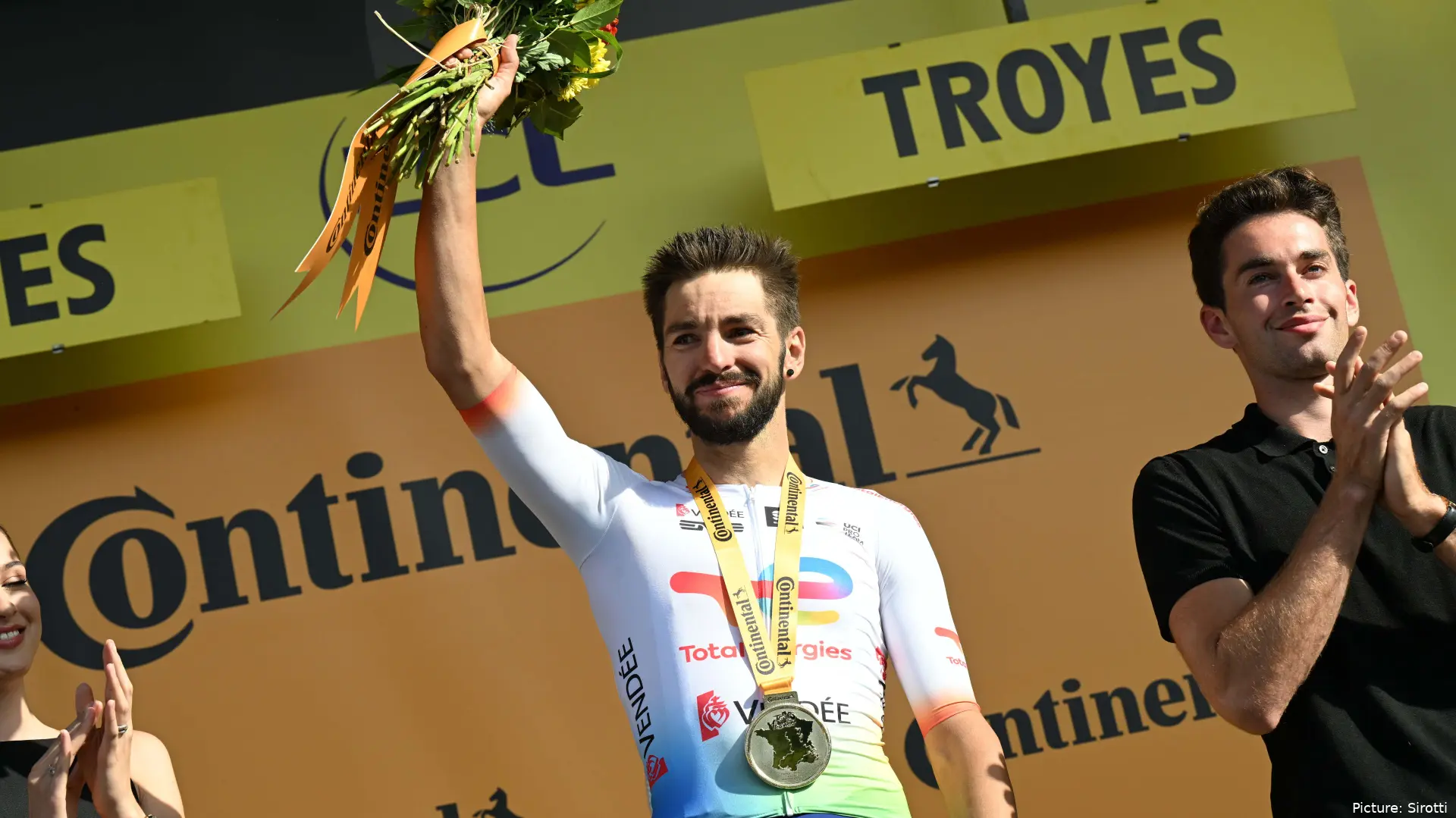
French rider Anthony Turgis has voiced unease at what he calls cycling’s “obsession with elevation gain”, arguing that the increasingly mountainous nature of the Tour de France risks alienating classics specialists and all-rounders.
Speaking to Cyclism’Actu following the official route reveal for the 2026 Tour, Turgis, himself a stage winner at his home Grand Tour in 2024, admitted that while the race’s design may thrill the climbers, it leaves riders of his profile with fewer realistic chances to shine.
“The Tour de France will once again be extremely demanding,” Turgis said. “The obsession with elevation gain is worrying for riders like me. The double ascent of Alpe d’Huez from both sides illustrates this perfectly.”
A Tour for pure climbers
The 2026 edition of the race, unveiled in Paris this week, will feature an unprecedented double finish on Alpe d’Huez – first via the Col de Sarenne, then the following day on the legendary 21 hairpins themselves. Across its 21 stages, the men’s Tour will include more than 54,000 metres of climbing, the highest figure in recent memory.
After a Grand Départ in Barcelona featuring a team time trial, the route threads north through the Pyrenees and central France before concluding with those back-to-back Alpine blockbusters and a technical Montmartre finale in Paris. It’s a route seemingly built for the all-conquering Tadej Pogacar, whose UAE Team Emirates - XRG will once again start as overwhelming favourites for both the general classification and the mountain stages.
That, says Turgis, means the remaining riders must target smaller opportunities. “The key in the mountain stages is to make it through within the time limit, without burning too many matches, so that I can be at my best on terrain that suits me,” he explained. “A Tour de France in the North, with its plains and undulating roads, would be ideal.”
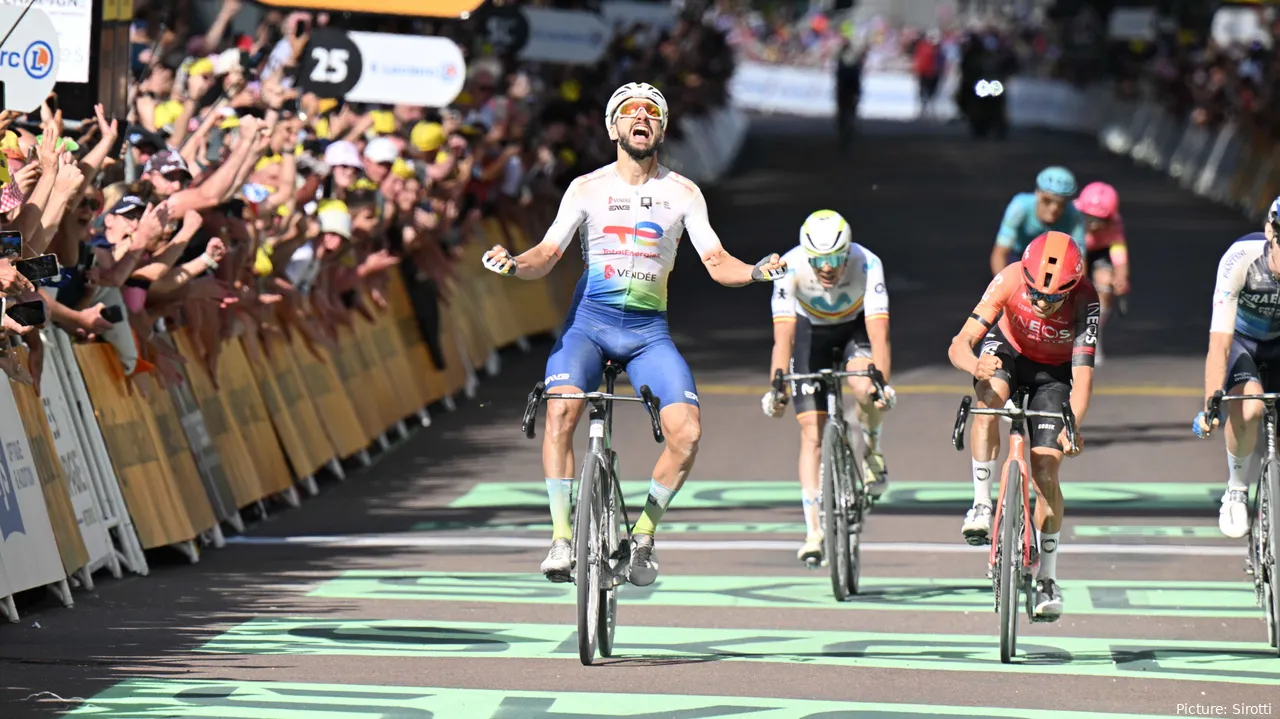
Turgis won a stage of the Tour back in 2024
Freedom on flatter stages
Turgis, who memorably won stage nine of the 2024 Tour de France, pointed out that the dominance of the GC favourites can open the door for outsiders on transitional or sprint-friendly days.
“Pogacar and his team are focused on the GC and mountain stages,” he noted. “As a result, we have more freedom on the flat stages. My victory last year showed that perfectly. If I want to raise my arms in celebration again, I’ll have to prepare as best I can.”
The TotalEnergies rider also reflected on the growing parity between men’s and women’s racing, noting that the Tour de France Femmes route – which in 2026 includes a Grand Départ in Lausanne and the first-ever ascent of Mont Ventoux – mirrors the rising standard of the women’s peloton. “The women’s Tour is also very tough,” he concluded. “We’re seeing levels becoming more even, with more races and higher stakes.”
Turgis’ comments echo a wider debate within the sport: whether the Tour’s evolution towards extreme altitude and vertical metres risks undermining its historical balance. With the 2026 edition now confirmed as one of the most mountainous in modern history, the conversation around what kind of rider the Tour de France truly rewards is unlikely to fade any time soon.

Kieran WoodDeputy Editor-in-Chief
Kieran Wood is a sports journalist based in Wales and has been active in journalism since 2022. He regularly contributes to DartsNews.com and CyclingUpToDate.com, where he covers professional cycling and darts. In cycling, his work includes liveblogs from major races, including the Tour de France, the Giro d’Italia, and La Vuelta a España, alongside race reports and analysis. He has also conducted interviews with professional riders.
His reporting spans the full racing calendar, from one-day classics to stage races, with a focus on accurate, real-time coverage and clear contextual analysis. For statistics, results, and historical context, he regularly uses resources such as ProCyclingStats. To support reporting on rider activity and training context where relevant, he also references Strava.
In his work, Kieran places strong emphasis on careful sourcing, editorial accuracy, and updating articles as new, verified information becomes available.
claps 11visitors 2
Just in

Popular news
Latest comments
- Predictable, sure! But boring??? OMG! Was Mike Tyson predictable and boring in his prime? Air Jordan? Schumacher or Senna? OMG!!!MajorPayne19-10-2026
- how it is "We’ve taken another big step forward for next year" he just lost in lombardia to a 20 year old, and two 30+ year olds. and not even top 10 for WCRR.abstractengineer19-10-2026
- This is similar to Lebron. first he said i need to consult my family , my daughter, need respectable money blah blah blah and then dont care about family , dont care about money, only onion rings, am off to Philly, very very far from family. Off season should be with family more, no?abstractengineer19-10-2026
- I hope he comes back strong for a proper battle with Tadejmij19-10-2026
- congrats to a great career and good retirement.mij19-10-2026
- Any artificial product should be reported.Any team that doesn't should be stripped of wins and fined.I know that this level of transparency does not and will never exist.All anyone can do is continue to test riders on a regular and surprise basis.If the test comes back clean then all any of us can assume is the rider is clean.
 Brucegel19-10-2026
 - Also, it's supposed to be hard to gain an advantage from drafting off Remco because he is so aero.Hills3319-10-2026
- How would stats back it up? You realise tactics involved could mean Vine saved his legs for a faster finish? Some riders can choose to go all out and fade later in the ride, others can hold steady state the whole way, and others can have a reserved start and power up later in the ride. You can't judge just by the stats unless you have power data to be able to prove Vine is riding faster even though he is putting out the same or less power (suggesting drafting). I'm sure the stats prove that Vine didn't cheat because UCI would monitor the stats to make sure this exact scenario doesn't happen (and disqualify them for drafting if the stats proved it).Pogboom19-10-2026
- Only one person would say such a thing here. Sorry to burst your bubble but I’m afraid that window of opportunity has now closed. You can beat some of the people all of the time and all of the people some of the time but you can’t beat all of the people all of the time.Jumpyjohn19-10-2026
- Both prizes are actually pathetic, almost amateur like, not even covering the cost of participatingJumpyjohn19-10-2026
Loading
1 Comments