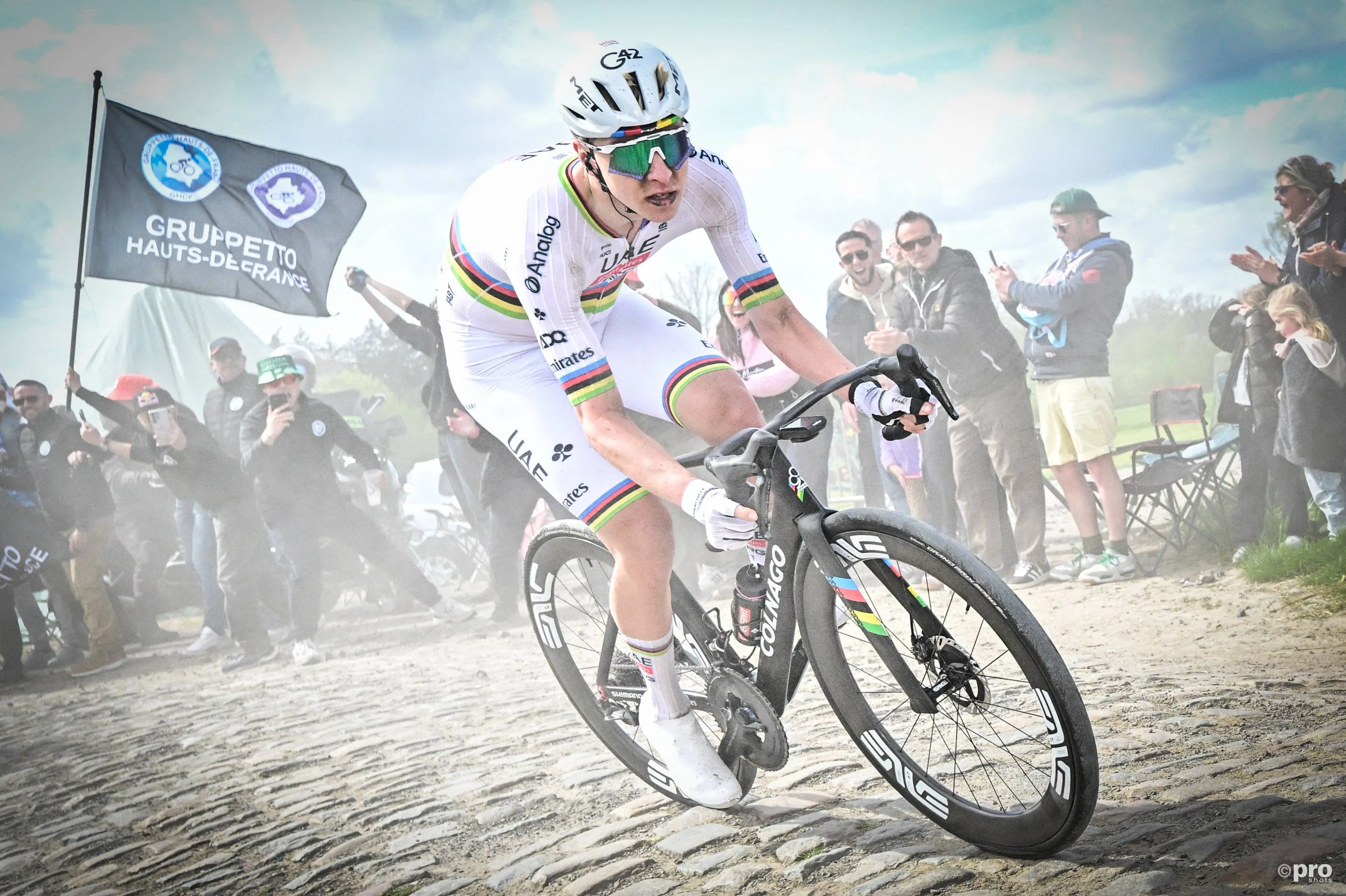
The 2026 Tour de Romandie will take place from the 28th of April to the 3rd of May and will make for Tadej Pogacar's debut in a stage-race this year. The Swiss race provides the final big test ahead of the Giro d'Italia whilst also following the spring classics, a period where many are looking to save their campaign. We take a look at its stages and profiles.
The race was first held in 1947 with Belgian Désiré Keteleer taking the first win. Taking part in the French part of Switzerland, it is a race that has had a very international list of winners, from several generations and also different types of riders. But many of the greats have marked their name on it such as Eddy Merckx, Bernard Thévenet, Bernard Hinault, Stephen Roche and Laurent Jalabert.
Alrrady this century we've had Cadel Evans, Bradley Wiggins and Chris Froome use Romandie ahead of their maiden Tour de France wins; whilst huge names such as Nairo Quintana, Richie Porte, Primoz Roglic and Geraint Thomas have also won the GC on what is considered to be one of the seven big non Grand-Tour stage-races.
Adam Yates won it in 2023, Carlos Rodríguez in 2024; and in 2025 it was João Almeida who won the race on the final day after dethroning Lenny Martínez from the yellow jersey.
Read also
Profile prologue: Villars-sur-Glane - Villars-sur-Glane

Villars-sur-Glane - Villars-sur-Glane, 3.1 kilometers
The race starts off with a prologue but in good Romandie fashion, it is anything but simple. In fact it is a hard one to pace, taking place fully within Villars-sur-Glane, the riders will have only 3.1 kilometers to tackle but they are not flat.
The first part is extremely fast, as the riders descend straight away after starting their effort, and then climb back up through a climb that is in total 1.3 kilometers long at 5%. There is an 800-meter long ramp at 7% where the main differences or the day are expected to take place. It's a short effort where the gaps will be minimal; with the pure power and aerodynamics being key to the outcome of the stage.
Profile stage 1 : Martigny - Martigny

Martigny - Martigny, 170.9 kilometers
The race moves into the Rhône valley for a stage with a profile that is typical of the region. That is because the riders have a beautiful region with roads extending through the massive valley, whilst the valley slopes are packed with steep climbs. These can be short, or they can be long, into the towns that are scattered over the mountains.
With the profile put into context, the riders will first take on a circuit just north of Martigny which on three occasions will have have the peloton tackle a 2.5-kilometer long climb at 8.5%. This will serve as a warm-up before the riders head east towards the main climb of the day.
And this is a brutal one, where we should see massive W/Kg displays. The climb to Ovronnaz is on the menu and it is the most difficult of the race, with 8.9 kilometers in distance and 9.8% average gradient. The riders should arrive at the bottom relatively fresh.
The climb is going to split the race to bits with its gradient and switchbacks, ending with 35.5 kilometers to go. The descent is very tactical and the riders head back to Martigny through the pan-flat valley once again for the finish.
Profile stage 2: Rue - Vucherens

Rue - Vucherens, 173.7 kilometers
Stage 2 of the race provides a slightly easier profile than the previous one, however one with more overall climbing throughout the day. It lacks a mountain, but the 173-kilometer day from Rue to Vucherens has 2700 meters of climbing, which start right from the first kilometers.
The riders then take a three-lap circuit finishing in Vucherens, with the finish line following a small ascent. It's a day for classics specialists to have a chance, although a sprint finish is quite likely from a peloton that includes only those who can survive the climbs - a breakaway can also well succeed.
In these rolling roads it's not easy to control, and the final climb may be made harder by the fatigue that will set itself throughout the day. 3.1 kilometers long at 5.4% will end with a mere 2.5 kilometers to go. The pace will be high, attacks are likely, and even an opportunist move can succeed here. If not, a reduced bunch sprint should provide the fast men with their only chance of the week.
Profile stage 3: Orbe - Orbe

Orbe - Orbe, 176.5 kilometers
Stage 3 is a mountainous day, however perhaps the easiest of the four mountain stages. A day for the 'baroudeurs', the breakaway specialists, without a particular focus as to whether they are climbers, rouleurs or classics specialists.
The hilly start will be quite explosive and is favourable to the formation of a strong group whilst the gaps at this point in the race will be big enough that most will be allowed up front. The finale is usually too hard for the sprinters but not easy enough for the climbers to really make a difference - which means it's a day where chaos and tactical knowhow can rule.
Most of the day is rather hilly but without any major climb, this will come in the final fourth of the race with the Col du Mollendruz - 9 kilomters at 6.7%. A difficult climb, but nothing crazy, and no sections that are uber-steep.
The climb ends with 33 kilometers to go, from there on mostly downhill until Orbe. Only the final 10 kilometers are flat, making it terrain where it is still possible to chase back a breakaway if there is an organized peloton behind.
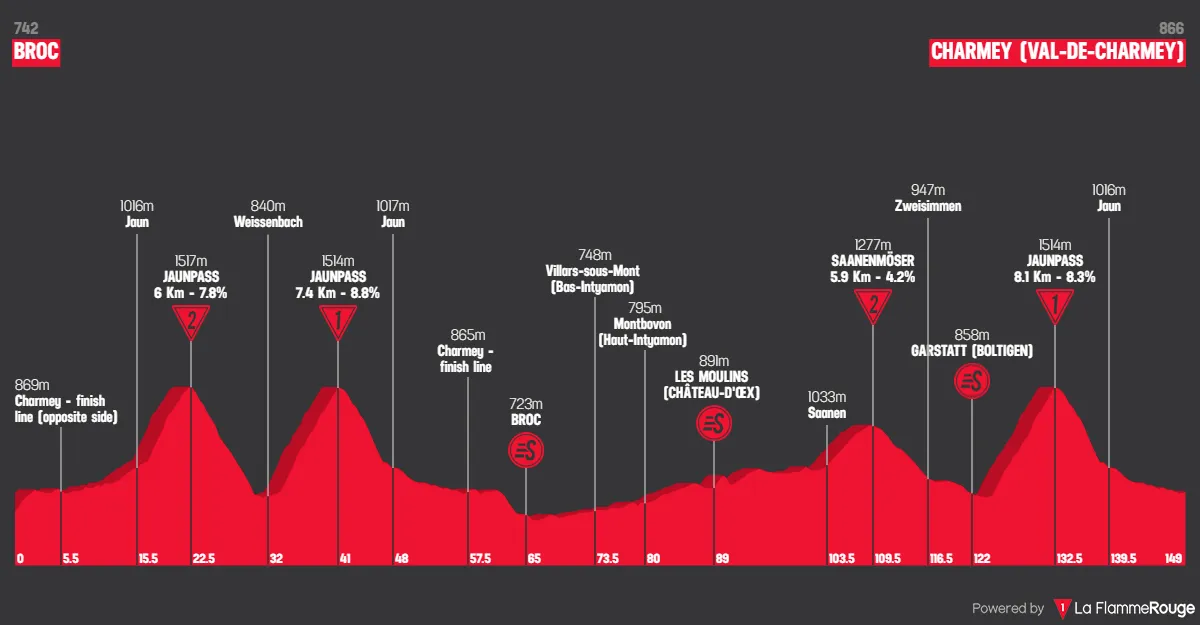
Profile stage 4: Broc - Charmey (Val-de-Charmey)

Broc - Charmey (Val-de-Charmey), 149.3 kilometers
Stage 4 is another day in the mountains, one with the particularity that the riders will be going up the same mountain three times, all of which through different sides. The stage takes place from Broc to Charmey, but it is the Jaunpass that's the star of the day.
The first kilometers are flat but after 15 of them, the peloton begins to climb. The first ascent is 6 kilometers long at 7.8% through Jaun and after descending, they go up it through Littisback which is 7.4 kilometers long at 8.8%. Both take place over 100 kilometers to the finish, but allow for the breakaway opportunists to try and surprise.
The riders then go back to the start line and back around the valley to return to the Jaunpass, but this time around climb it through the road they descended it for the first time - which is via Weissenbach.
This ascent is the toughest of the three, featuring 8.1 kilometers at 8.3%. The climb ends with just 16.5 kilometers to go and will be treated like a final ascent, since from the summit back to the finish in Charmey (through roads they will have already BOTH climbed and descended through earlier on) the road is half downhill and half a false-flat to the finish, making it very fast.
Profile stage 5: Lucens - Leysin

Lucens - Leysin, 182.6 kilometers
The final stage begins in Lucens and the start is rolling, making it explosive and good for a strong breakaway formation. It is a mostly hilly day, taking place in the northeast of Lausanne, before making its way south back into the Rhône Valley.
The climbers will take a detour deep into the Alps this time around however and head into the Leysin ski station, a regular finish location in the Swiss race.
The final ascent, this time around, will be tackled through a long side, which is 14.3 kilometers in total at 5.9% average gradient - with its base in Aigle, where the headquarter of the UCI is.
The hardest kilometers of the climb are in its final third and so this is an ascent where the action should be reserved towards the end, with the race finishing atop the climb.
claps 0visitors 0
Just in

Popular news
Latest comments
- I see the personality differences between Almeida and Ayuso as being similar to between Evenepoel and Lipowitz. One is more outspoken, heart-on-sleeve type, often criticised for that. The other speaks less, but seems much more cold and calculated.
 Rafionain-Glas23-04-2026
 - Won't be surprised if Pogačar wins it allRafionain-Glas23-04-2026
- Dear French friends, today we celebrate " Paul Seixas Day"!!! The 1st teenager to break all records completely clean, no doping. His drive and strength is a God-given talent, and not like that doped Slovenian, shame on him. But since we are French, a superior nation, we will manage to beat doped Slovenian-COMPLETELY CLEAN! PS: The French are my favorite nation, I simply adore them, such wonderful people who have no prejudices, no complexes of higher values the world has never seen. I think Macron and his girlfriend/boyfriend should be the leaders of the new world. Vive la France, the most "honest" people in the world. I want French citizenship. Ad acta!!!Dalmatian-Dog23-04-2026
- Almeida needs help in the mountains, Florian is for flats, there are other options for flatsabstractengineer23-04-2026
- Like every 19y old, you knew all that you knew, and then started the long journey of discovery and realisation that others too knew things and they were either different or not in line with you. Best of all is that you knew what was best and never got outfoxed by older more experienced people like parents, teachers, companies, governments, scammers, partners, etc.Mistermaumau23-04-2026
- French general media are finally picking up on him, albeit by distorting how the race progressed. Now the tdf build-up will truly start, especially if he impresses next week.Mistermaumau23-04-2026
- Almeida has a really warm and well-balanced personality.Hills3323-04-2026
- Aw c’mon, when I was 19 I knew it ALL. (Sigh. The definition of sophomore is “wise fool” or something like that, right?)RidesHills23-04-2026
- Very wise and mature for any age, much less 19.
 MarkFour23-04-2026
 - Almeida isn't a sour puss like Ayuso.awp22-04-2026
Loading
1 Comments