"Sometimes we forget that cycling is not about watts, it’s about speed": Dev team director on search for a rider who can beat Pogacar
Cycling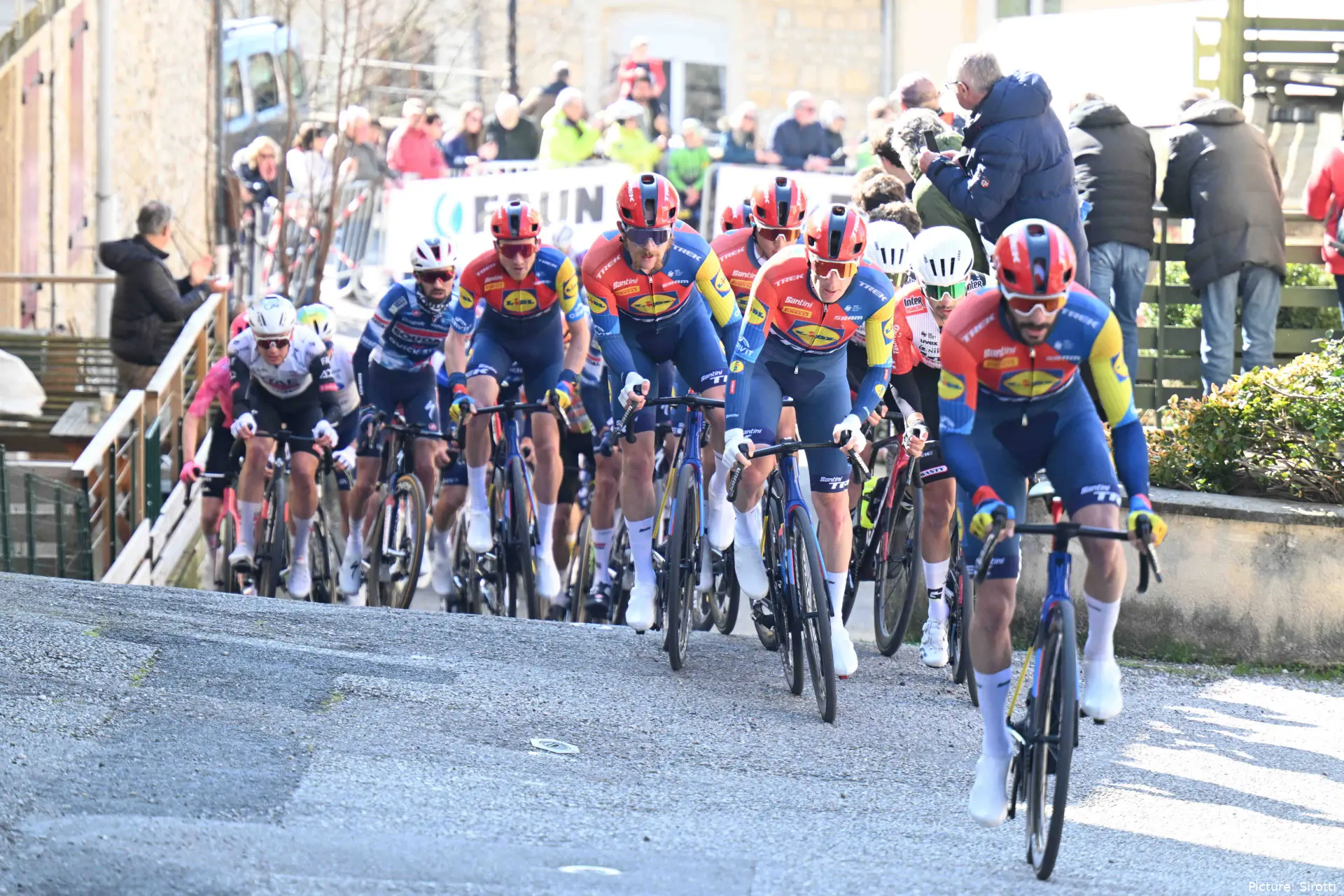
Lidl-Trek is growing to be one of the cycling's "super-teams", there's no doubt about that since the arrival of strong sponsor Lidl in 2023. The team has been quite active on the transfer market to secure two promising GC riders Derek Gee and Juan Ayuso. However their project extends far beyond just the present World team. Their development team Lidl-Trek Future Racing is entering the third year of its existence, and has so far produced several talented cyclists for both Lidl-Trek, and also other Pro and World Teams.
"It’s not only a team; it’s a whole development programme," sports director Markel Irizar tells Domestique. "The goal of the programme is to prepare the next generation, and the team has put a lot of resources into it."
The Spaniard emphasizes that the goal of their project is truly to develop riders, rather than having the best development team in the street. That is why we don't always see the shiniest junior prospects head to Lidl-Trek Future Racing, but with time and work every recruit grows into a valuable prospect.
And so far, two men have earned themselves a ticket to the WorldTour team through development programme - Tim Torn Teutenberg last year, and Jakob Söderqvist for this season. Needless to say that both have had (or are expected to have) immediate impact upon their arrival to the top division.

Long-term vision
And while the emphasis on GC racing is becoming more and more apparent in Lidl-Trek, the arrival of under-23 time trial world champion Jakob Söderqvist appears to be almost perfectly timed to replace the departing Jasper Stuyven and Alex Kirsch from the Classics team. But that's precisely the vision of Irizar:
"It’s true that we’re always looking for something that we are going need in the future, and we have some information of how we are going to develop the WorldTour team over the next two or three years," Irizar says.
"Based on age, we might assume that certain riders are going to retire, for example, or we might see that we need fast guys or climbers. For example, we lost two guys like Jasper Stuyven and Alex Kirsch for the Classics, but now Jakob Söderqvist is stepping up, and that’s the goal."

Jakob Söderqvist had become the under-23 time trial world champion, but he has many more perks
Hector Alvarez
There will be 15 riders wearing the Lidl-Trek Future Racing jerseys, one talent brighter than the other. The lineup for 2026 includes junior road world champion Harry Hudson, or track world champion Enaut Urkaregi. But the really exciting name for the season ahead is that of Hector Alvarez.
The 19-year-old finished 4th at the under-23 World Championships. And a week later improved his result by another place to complete the podium at the European Championships in the same category. For a moment there were doubts whether he wouldn't deserve an immediate promotion to WorldTour, but Lidl-Trek was already full to the brim with the late arrivals of Juan Ayuso and Derek Gee. There was simply no room for Álvarez anymore.
But the Spaniard was not forgotten and according to Irizar, Álvarez's promotion to WorldTour is merely a matter of time: "He’s going to race most of the season with the WorldTour team, because in the coming years, he will go to the World Tour, he has already signed," the sports director reveals.

Héctor Álvarez seems to destined to be Spain's next big star at Classics
Preferably no powermeters for young riders
The rider scouting has very much evolved in recent years. Nowadays all the riders in juniors, and even cadets are equipped with powermeters, collect all kinds of data and scouts simply have to determine whoever has the biggest growth potential. Lidl-Trek of course analyzes all the available data as well, but Irizar emphasizes that there are multiple aspects as to which rider turns out to be a great star and who doesn't.
"This is a difficult question, which we have asked ourselves too," Irizar says. "There is no tool to know how developed a rider is, because even if you now how much he’s training, that doesn’t mean he’s not going to keep improving. And we’ve seen that, where riders who have already trained a lot at a young age have kept improving like crazy. And I really think the question that nobody knows is, will these guys have long careers like we used to have before? I don’t know."
But powermeters are an overkill according to Irizar who could do with just speed-meter if it were up to him: "It’s enough that you have a device that can measure speed, because we can collect the info from that and estimate," Irizar says. "In the end, we sometimes forget that cycling is not about watts, it’s about speed. I don’t care how many watts a rider is doing, I just care that he’s fast. I mean, if you push 10 watts but you win and you beat Pogacar, then I’m happy."
Getting know the rider's personality and other unmeasurable atributes is key for Irizar who believes that the human side cannot be overlooked. And that's also the strong side of Lidl-Trek - a team well-known for its tight-knit group and great collective.
"Our strong point, I think, is the human side. There are not that many teams that bring the men’s, women’s and development teams together at the same training camp. Like we always say, we have three teams and one identity. I think we are very good at taking care of people. Of course we want to win races, but we don’t forget that they are 18 years old."
"I mean, of course, it’s important because winning races also shows they know how to handle pressure, they know how to react in certain conditions – but the goal isn’t to be very good Devo riders, it’s to be very good WorldTour riders," Irizar highlights before providing an example of where their strategical approach paid off massively in the long run: "For example, Mattias Skjelmose didn’t have a very good season in his last (second) year under-23, but we still decided to sign him. He had very good numbers, but it was also about his mentality. He’s a fighter."
Read also

Ondrej ZhasilCycling Journalist
Ondřej Zhasil is a cycling journalist at CyclingUpToDate and has been part of the team since 2023. He is based in Ostrava, the third-largest city in the Czech Republic, and covers professional cycling across the main UCI competitions, including the Tour de France, the Giro d’Italia, and La Vuelta a España. A key focus of his work is startlist analysis and pre-race coverage, where he examines team selections, rider line-ups, and tactical scenarios ahead of major events.
Alongside WorldTour coverage, Ondřej has developed specific expertise in junior cycling and in racing across East Asia, including competitions in China and Japan. He also maintains a broad working knowledge of other disciplines and levels, including cyclocross, while continuing to expand his understanding of mountain bike racing.
Ondřej holds a bachelor’s degree in Mathematics and Physics, which supports his analytical, data-driven approach to performance and race analysis. In his reporting, he regularly uses ProCyclingStats for results, statistics, and historical context. He places strong emphasis on careful sourcing, editorial accuracy, and updating articles promptly when new, verified information becomes available.
claps 0visitors 0
Just in
Popular news
Latest comments
- Well if UAE the best team in history comes knocking their the only team in the world who can get Seixas. Seixas will become incredible there. Lets see if he stays at decathlon or goes to UAE.miguel11-10-2026
- Ahem, stage 16 of the 2025 Giro
 Rafionain-Glas11-10-2026
 - Can we get a comment from the UCI on this. The silence from Aigle is deafening! Come on cycling journalists , start annoying them to get a comment please.Paul53111-10-2026
- A shame to see him retire, I really liked him as a rider. His dignified tribute along with Matej Mohorovic to Gino Mader after his death was class and will always live in my memory. Enjoy your retirement.GregT11-10-2026
- A shame to see him retire, I really liked him as a rider. His dignified tribute along with Matej Mohorovic to Gino Mader after his death was class and will always live in my memory. Enjoy your retirement.GregT11-10-2026
- I thought Seixas had hit the end of the road from a fatigue standpoint, after the WC meltdown - and he still finished ok. This was impressive and an amazing return.mij11-10-2026
- totally, eating crow for breakfast this morning. after the world championships I thought we were looking at a late season fade from fatigue. way to go Paul!mij11-10-2026
- Pogi would have won the Vuelta at around 10 min. But it would have been boring for fools like you. Capish?PogiSloFans11-10-2026
- Rather than me describing the technology at length on here, If you google. Line-scan cameras. They are also sometimes called Slit-Scan cameras. Either search will fill you in. You can read all about how they. work. Enjoy! Just to be clear the cyclist is saying he wants to see exactly where the digital finish line is in relation to the actual physical finish. At this point we only have the word of the authority that the digital line corresponds to the exact starting edge of the physical finish line. That seems like a reasonable request to me.Prorodsandstuff11-10-2026
- 100% @Jumpyjohn, good point well raised.anonymouscyclist11-10-2026
Loading
Write a comment