Eschborn-Frankfurt 2026 preview, profiles, favourites & predictions - Can Tom Pidcock win the final race of his spring?
Cycling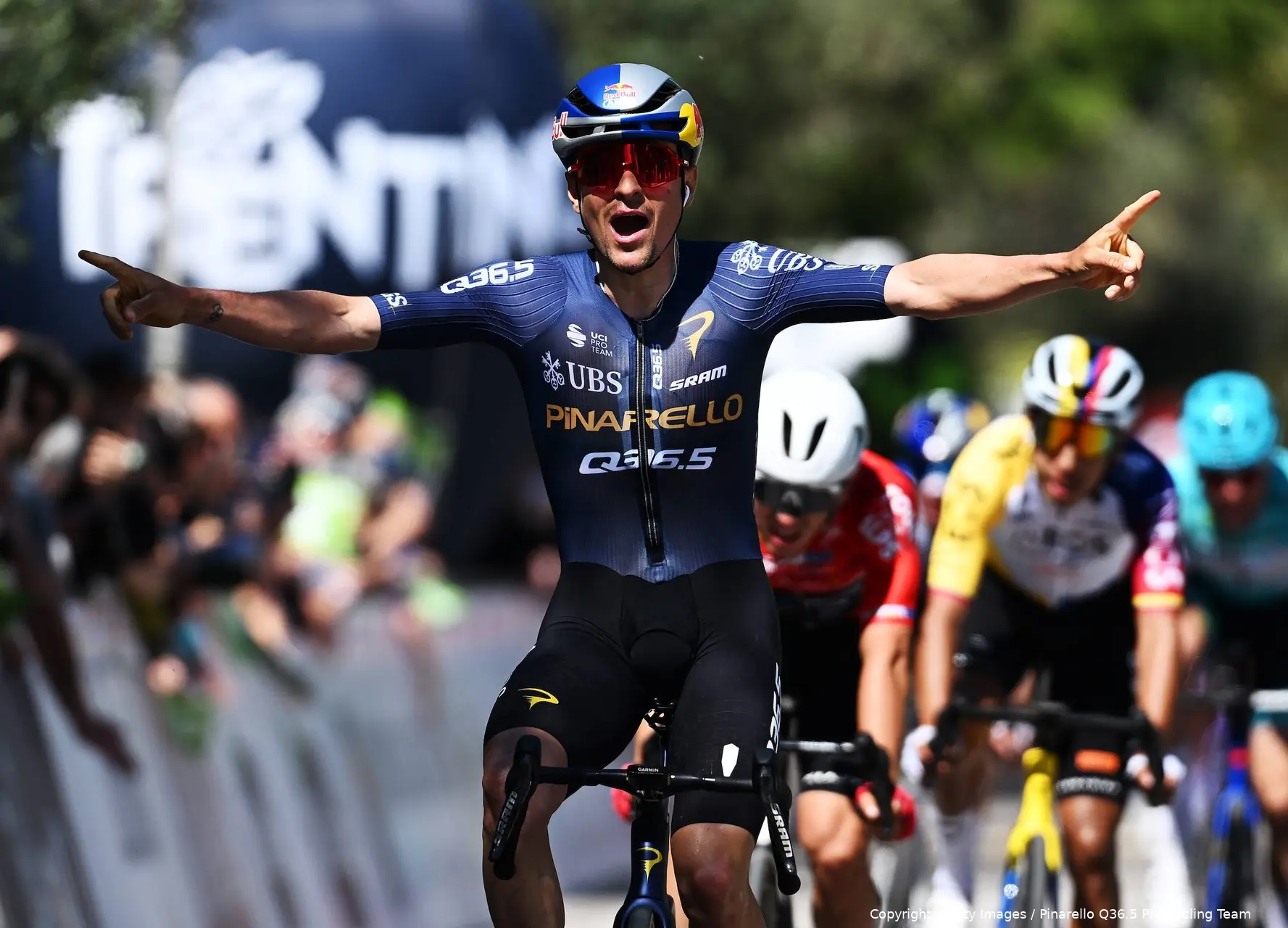
The 2026 edition of the Eschborn-Frankfurt classic will take place on the 1st of May. This one-day race is perhaps Germany's most popular cycling event of the year and, inbetween the season of the spring classic and the Grand Tours, provides a last-ditch attempt for the classics specialists and sprinters to save their spring or take a big win. We preview the race ahead.
The race has over the decades had different profiles and also different categories, leading to a very diverse palmarès. Its first edition dates back to 1962 and notoriously, it is a race in which Eddy Merckx sealed his name back in 1971 - although he attempted, without success, to win it several other times.
With many of Germany's biggest names over modern history being sprinters, it is a race that has also seen several of them target it with success - Erik Zabel, Fabian Wegmann, John Degenkolb and Pascal Ackermann have all won it. From 2014 to 2018 (there was no race in 2015) Alexander Kristoff won all editions, marking a period where the sprinters ruled over the race. After Covid, Jasper Philipsen and Sam Bennett continued the trend of the fast men.
However in 2023 the race was made more difficult, and over the past three editions it's been more difficult for the fast men to succeed. Soren Kragh Andersen and Maxim van Gils won from two small groups in 2023 and 2024; whilst from the survivors of the peloton, it was Michael Matthews who sprinted to victory in 2025.
Read also

Profile: Eschborn - Frankfurt

Eschborn - Frankfurt, 211 kilometers
The race is 211 kilometers long and it has been made even harder, pushing the balance even further away from the sprinters who used to rule over it until a few years ago. The final half of the race remains the same, whilst the first half brings in new ascents.
The opening 30 kilometers are flat, and lead to a sequence of three ascents which can create early damage in the peloton - if not cuts, then fatigue the sprinters. These will be difficult and come in quick sequence, making for a 40-kilometer period where if the pace is high, the peloton can be split to bits very quickly.
The riders go up the Mammolshain for the first time with 109 kilometers to go, 2.3 kilometers at 7.9%. And without rest, they go into the sole ascent of the Feldberg which is 7.7 kilometers long at 6%. Here the climbers can make the difference and the climb ends with 100 kilometers to go. Shortly after they go up the short and explosive Burgweg for the second time.
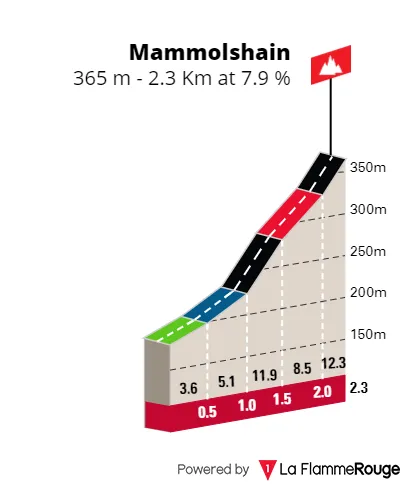
Mammolshain: 2.3Km; 7.9%; 112, 97 & 35.5Km to go
With 85 kilometers to go, they then descend into the final circuit and have a chance to regather themselves. But the Mammolshain will then be ridden two more times, where attacks are inevitable.
The 2.3-kilometer long climb has gradients that are hard enough to make differences and these may be difficult to bring back, if there is organization. They end with 50 and 35 kilometers to go. From there on its mostly flat to the finish so there is time for a proper organization and chase behind, but this is not easy at this point in the race.
Although the race can be somewhat selective, the dynamics usually tilt towards an organized chase between several teams who will not hesitate to work to bring in better chances for their leaders to fight for the win. If it comes down to the fast men they will have an urban sprint to tackle, with the finishing straight being 500 meters long.
The Favourites
The past two editions have been won in small peloton sprints and last year there were around 35 riders present. Ultimately that is the dynamic that makes this race interesting, as the outcome does not really depend on who are the best climbers or sprinters, but rather who has the best balance and how will the race situation influence the outcome. There is a very fine line. The sprinters have to do all they can to survive the climbs in one of the groups near the front, only then can they ambition a victory; whilst the teams who want to attack have to push the pace and make moves from early on in order to drop sprinters but also their teammates and ensure that there's as little of a coherent chase as possible in the final kilometers.
On the sprinter side there are a few teams who will be quite interested. Last year's winner Michael Matthews is absent but second place Magnus Cort Nielsen is here and after winning a stage at the Volta a Catalunya it can be said that the Dane can reach his best form again, and would be a clear leader and win contender here. Tobias Lund Andresen is also a very strong sprinter, who can indeed climb, and Decathlon has a key role to play. Paul Lapeira, Jordan Labrosse and Aurélien Paret-Peintre can attack, can cover attacks, and they can also protect Lund whilst chasing down attacks. Their tactics and Lund's legs can change the race entirely.
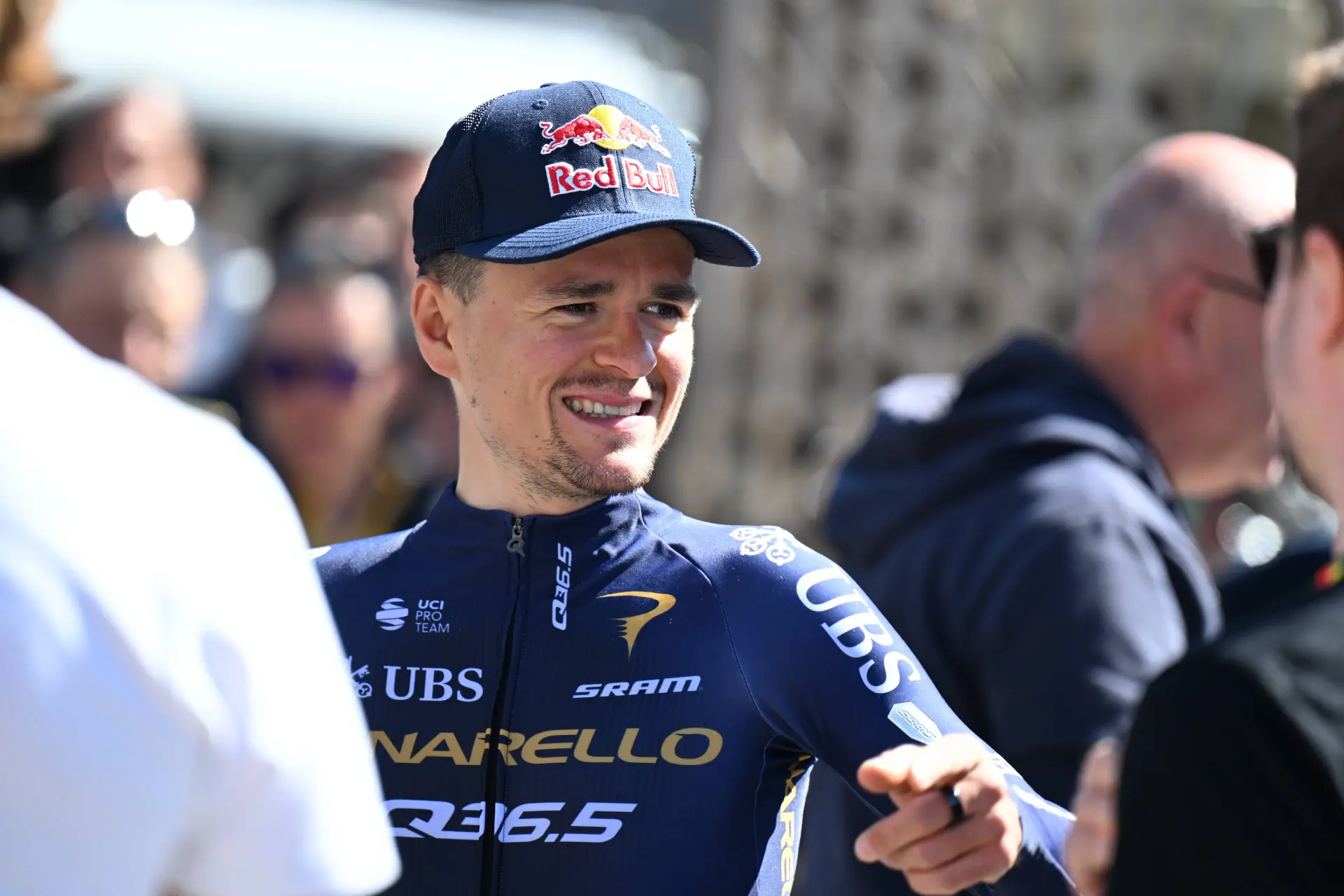
You have INEOS who have got Ben Turner, Sam Watson and Axel Laurance, all fast finishers who can climb well, meaning they will want a fast finish although they can for sure also be part of the winning attacks. I would argue Pinarello will want that too, as Tom Pidcock's form is not the best and I don't think he can make the difference uphill; but at the Tour of the Alps he showed a good sprint, whilst Quinten Hermans is also a similar style rider.
Jayco will want it too, having the only sprinter who's won this race in the past - Pascal Ackermann - however more realistically, De Brabantse Pijl winner Anders Foldager. NSN have Corbin Strong and Jake Stewart who fit well into the mix; whilst others such as Emiel Verstrynge, Danny van Poppel, Laurence Pithie, Rui Oliveira and Jon Barrenetxea can also perform in a fast finish.

Tobias Lund Andresen will be one of the main favourites to win the 2026 Eschborn-Frankfurt
On the other hand, you have some teams that will exclusively focus on the climbs and making the race harder. If done on the long ones, the pure climbers can benefit. If not, the explosive puncheurs have it suited to them on the final ascents. Bahrain is a case of a team who should want the long climbs being raced fast with Pello Bilbao, Afonso Eulálio and Jakob Omrzel as their options; Whilst the likes of Alex Baudin, Lennert van Eetvelt, Ben Tulett and Diego Pescador do make for a strong climber field who can surprise if the race breaks up early on.
For the shorter efforts several others will fit in. Lidl-Trek do have to make use of their men having Soren Kragh Andersen, Toms Skujins and Andrea Bagioli all as cards.
Tibor del Grosso, Mathieu Burgaudeau, Michael Valgren, Per Strand Hagenes, Mauri Vansevenant, Tim Wellens (still far from peak form), Alex Aranburu and Natnael Tesfatsion are all contenders for this race.
Prediction Eschborn-Frankfurt 2026:
*** Magnus Cort Nielsen, Tobias Lund Andresen, Ben Turner
** Axel Laurance, Tom Pidcock, Corbin Strong, Alex Aranburu
* Paul Lapeira, Aurélien Paret-Peintre, Sam Watson, Anders Foldager, Emiel Verstrynge, Jon Barrenetxea, Danny van Poppel, Alex Baudin, Ben Tulett, Soren Kragh Andersen, Tibor del Grosso, Michael Valgren, Tim Wellens
Pick: Tobias Lund Andresen
How: Small peloton sprint.
Original: Rúben Silva
Rúben SilvaEditor-in-Chief
A founding contributor to CyclingUpToDate since its launch in January 2022, Ruben Silva has played a central role in shaping the site’s editorial direction and long-term growth. Before joining the project, he built his experience through independent blogging at Echelons Hub and by producing race previews for Ciclismo Internacional, developing a strong analytical voice rooted in daily engagement with professional cycling.
Beyond editorial work, he has been closely involved in the expansion and coordination of CyclingUpToDate’s wider network, helping establish and support sister platforms across multiple languages. This includes ongoing collaboration with CiclismoAlDia (Spanish), CiclismoAtual (Portuguese), WielrennenUpToDate (Dutch), and RadsportAktuell (German), contributing to a shared editorial vision and consistent international coverage.
He also helps oversee editorial governance across the network, setting standards for accuracy and consistency and coordinating updates or corrections when needed.
Originally from the Porto metropolitan area in Portugal, he holds a bachelor’s degree in Geography. His path into cycling journalism was shaped not through formal media training, but through independent reporting, community engagement, and sustained on-the-ground involvement in the sport.
Over the course of his career, he has conducted approximately 100 interviews across road cycling and cyclocross, ranging from one-to-one conversations and online formats to press conferences and on-site pre- and post-race coverage. His interviews include leading riders, team managers, and prominent figures within cycling media: Tadej Pogacar, Jonas Vingegaard, Mathieu van der Poel, Primoz Roglic, Wout van Aert, Joao Almeida and Tom Pidcock; managers like Patrick Lefevere and Joxean Matxin; and YouTube personality Bryan Kennedy (BKXC)...
Within 18 months of launch, he helped grow CyclingUpToDate’s English-language platform into one of the most-read cycling news websites, built entirely from the ground up. As both a professional journalist and lifelong cycling enthusiast, his focus remains on delivering accurate, timely, and well-contextualized coverage.
claps 1visitors 1
Just in
Popular news
Latest comments
- Pogi would have won the Vuelta at around 10 min. But it would have been boring for fools like you. Capish?PogiSloFans11-10-2026
- Rather than me describing the technology at length on here, If you google. Line-scan cameras. They are also sometimes called Slit-Scan cameras. Either search will fill you in. You can read all about how they. work. Enjoy! Just to be clear the cyclist is saying he wants to see exactly where the digital finish line is in relation to the actual physical finish. At this point we only have the word of the authority that the digital line corresponds to the exact starting edge of the physical finish line. That seems like a reasonable request to me.Prorodsandstuff11-10-2026
- 100% @Jumpyjohn, good point well raised.anonymouscyclist11-10-2026
- The media keep stirring the soup.. or spitting in it
 leedorney11-10-2026
 - Yes, he has won many races... second class races. He isn't the real deal... Seixas is the real deal. Capish?PogiSloFans11-10-2026
- What are you guys talking about? I'm not the one you guys think I am. I'm a Slovenian Pogi fan, that's all... the guy you're talking about is a Croation Ustasha. Capish?PogiSloFans11-10-2026
- It would be epic if Seixas came to UAE. 3/4 of the commentators on this site would stop watching cycling... ha ha ha ha ha ha...PogiSloFans11-10-2026
- UAE's problem is Seixas wants to beat Tadej.Renz11-10-2026
- You are blinded by your infatuation with Pogi. IdT has done crazy good stuff. One of the strongest ever first three years in the peloton. poor showing in his last couple of races btu I don't think he is quite washed up yetmobk11-10-2026
- Absolutely not. The guy has finished so many races 2nd to Pogi so absolutely not a shocker that when Pogi isn't there he wins a fewmobk11-10-2026
Loading
Write a comment