"He spent all his time on the rollers, 37 hours in total..." - Mads Pedersen's coach on 'insane' training regiment to prepare 2026 spring
Cycling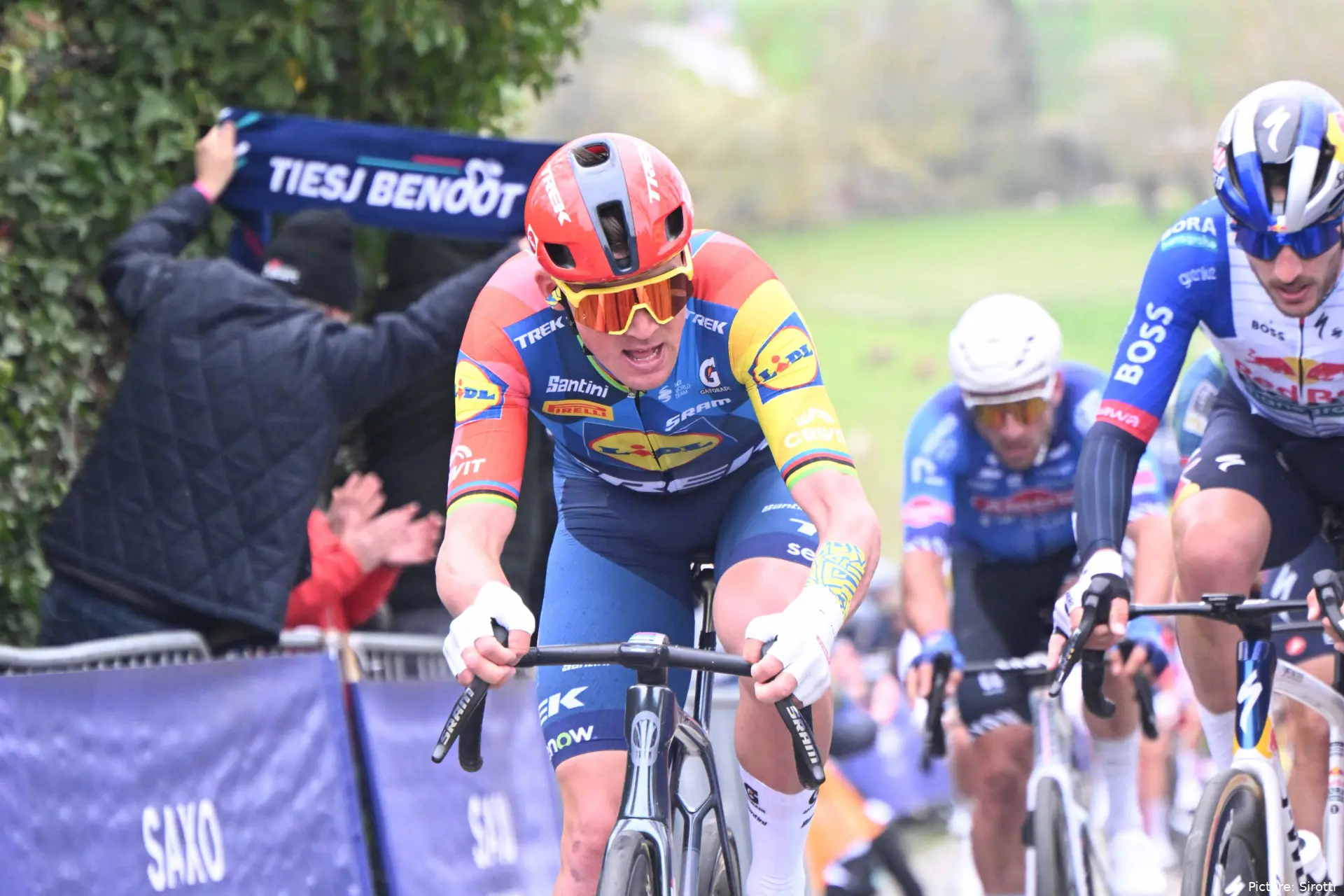
Mads Pedersen suffered a crash during the first stage of the 2026 Volta a Comunitat Valenciana and suffered a fractured wrist and collarbone - on different sides. It was a very hard fall which he described in detail before, which jeopardized his entire spring. But instead, what it led to were two months of brutal training, much of it indoors, in order to get back up to speed in time for the monuments.
Pedersen needed time off the bike following his injuries due to their severity, but since his legs were relatively unscathed, he was allowed to jump on the indoor bike. However, due to the lack of time in between that phase and the cobbled monuments in which he would be leading Lidl-Trek and aiming for a win, he had to put in the kilometers.
Since he could not do it out on the road, he did it indoors. A few weeks after the fall he travelled to Mallorca. “He trained eighty hours there in two weeks. In the first week, he spent all his time on the rollers, 37 hours in total," his coach Mathias Reck said in the Half Wheeling podcast.
That averages out to over 5 hours a day on the bike, all of it spent in a fixed location. For most this would be an impossible sacrifice, or an outright recipe for burnout. For Pedersen it was a worthy investment, taking into consideration his ambitions for the spring classics.
“And it wasn't just easy workouts; he also did intervals. Three hours in the morning and three hours in the afternoon, for six days in total. In between, he did a one-hour recovery ride.”
Crazy lead-up to the Tour of Flanders
Pedersen eventually began training on the road, although it was slowly, due to the stress it would put on his wrist. Ultimately, his comeback to racing was anticipated at Milano-Sanremo, after Jonathan Milan was forced to skip it due to illness. All the work he had done proved effective, as he sprinted to fourth place on the day - leading the peloton to the finish line.
But it only went up from there, as he continued combining his racing program with extra training in order to build towards the Tour of Flanders. “I think he did the toughest week ever for Flanders. It was insane. On Tuesday, he trained for five hours, with intervals, sections behind the scooter, and, if I remember correctly, also a heat workout. On Wednesday, he did seven hours. First Dwars door Vlaanderen averaging 48 kilometers per hour, and then another two hours at a high tempo back to the hotel – with a full headwind".
But Dwars door Vlaanderen was treated like part of his training block, and the recovery only came days after. "Thursday saw another five-hour training session, partly behind the scooter. And on Saturday, he really got his legs in shape for Sunday with a tough three-hour ride. To the people listening to this, I want to say don’t try this at home. Not many people recover from this after a cold and a fall.”
For Pedersen however, it was successful, as he rode to fifth place at the Tour of Flanders, the best he could realistically achieve taking into consideration the competition and factors he faced. Whilst later on in Roubaix he also did not achieve the win he looked for, another strong result led to a spring where he faced adversity and was able to recover incredibly from an injury that could've ended his spring right on his first race day.

Mads Pedersen ahead of Paris-Roubaix 2026
Mads Pedersen can handle more training than the average rider
The focus on Flanders (and Roubax later on) was full and it provided a drive that was carried out all the way. “But due to the frustration of him facing setbacks again, at a time when we really couldn’t afford it, it was mentally necessary to do more than ever before. He had to be right in the head. And it worked, because he was already better than expected in Dwars door Vlaanderen and even better in the Tour of Flanders.”
This spring period provided Reck with more insight on the Dane's physiological abilities, arguing that Pedersen can train more than what was believed and recover from it well. That is, in great part, a key to his success in cycling - as is the case with Tadej Pogacar. The ability to train hard constantly without suffering from the effects of fatigue leads to long-term improvement, whilst also allowing riders to properly prepare for their big goals with training, not necessarily gaining race rhythm in other events.
“It took me years to realize how much training Mads can handle. “It is totally crazy when you think about it. It is so much training. He has incredible recovery power. If he trains too little, his heart rate is high and his power output is low. That is why we do it this way," he explains.
"He does between 1,100 and 1,200 hours a year. To do that while also traveling and racing a lot, you have to put in a lot of 30-hour weeks. We are very lucky that he enjoys being on the bike.”
Read also
Rúben SilvaEditor-in-Chief
A founding contributor to CyclingUpToDate since its launch in January 2022, Ruben Silva has played a central role in shaping the site’s editorial direction and long-term growth. Before joining the project, he built his experience through independent blogging at Echelons Hub and by producing race previews for Ciclismo Internacional, developing a strong analytical voice rooted in daily engagement with professional cycling.
Beyond editorial work, he has been closely involved in the expansion and coordination of CyclingUpToDate’s wider network, helping establish and support sister platforms across multiple languages. This includes ongoing collaboration with CiclismoAlDia (Spanish), CiclismoAtual (Portuguese), WielrennenUpToDate (Dutch), and RadsportAktuell (German), contributing to a shared editorial vision and consistent international coverage.
He also helps oversee editorial governance across the network, setting standards for accuracy and consistency and coordinating updates or corrections when needed.
Originally from the Porto metropolitan area in Portugal, he holds a bachelor’s degree in Geography. His path into cycling journalism was shaped not through formal media training, but through independent reporting, community engagement, and sustained on-the-ground involvement in the sport.
Over the course of his career, he has conducted approximately 100 interviews across road cycling and cyclocross, ranging from one-to-one conversations and online formats to press conferences and on-site pre- and post-race coverage. His interviews include leading riders, team managers, and prominent figures within cycling media: Tadej Pogacar, Jonas Vingegaard, Mathieu van der Poel, Primoz Roglic, Wout van Aert, Joao Almeida and Tom Pidcock; managers like Patrick Lefevere and Joxean Matxin; and YouTube personality Bryan Kennedy (BKXC)...
Within 18 months of launch, he helped grow CyclingUpToDate’s English-language platform into one of the most-read cycling news websites, built entirely from the ground up. As both a professional journalist and lifelong cycling enthusiast, his focus remains on delivering accurate, timely, and well-contextualized coverage.
claps 1visitors 1
Just in

Popular news
Latest comments
- Rather than me describing the technology at length on here, If you google. Line-scan cameras. They are also sometimes called Slit-Scan cameras. Either search will fill you in. You can read all about how they. work. Enjoy! Just to be clear the cyclist is saying he wants to see exactly where the digital finish line is in relation to the actual physical finish. At this point we only have the word of the authority that the digital line corresponds to the exact starting edge of the physical finish line. That seems like a reasonable request to me.Prorodsandstuff11-10-2026
- 100% @Jumpyjohn, good point well raised.anonymouscyclist11-10-2026
- The media keep stirring the soup.. or spitting in it
 leedorney11-10-2026
 - Yes, he has won many races... second class races. He isn't the real deal... Seixas is the real deal. Capish?PogiSloFans11-10-2026
- What are you talking about? I'm not the one you guys are spitting on. I'm a Slovenian Pogi fan, that's all... the guy you're talking about is a Croation Ustasha. Capish?PogiSloFans11-10-2026
- It would be epic if Seixas came to UAE. 3/4 of the commentators on this site would stop watching cycling... ha ha ha ha ha ha...PogiSloFans11-10-2026
- UAE's problem is Seixas wants to beat Tadej.Renz11-10-2026
- You are blinded by your infatuation with Pogi. IdT has done crazy good stuff. One of the strongest ever first three years in the peloton. poor showing in his last couple of races btu I don't think he is quite washed up yetmobk11-10-2026
- Absolutely not. The guy has finished so many races 2nd to Pogi so absolutely not a shocker that when Pogi isn't there he wins a fewmobk11-10-2026
- GOATmij11-10-2026
Loading
Write a comment