Pedal Punditry #25 | Warmongering states, oil giants and gambling companies: Why money in cycling comes from controversial sources
Cycling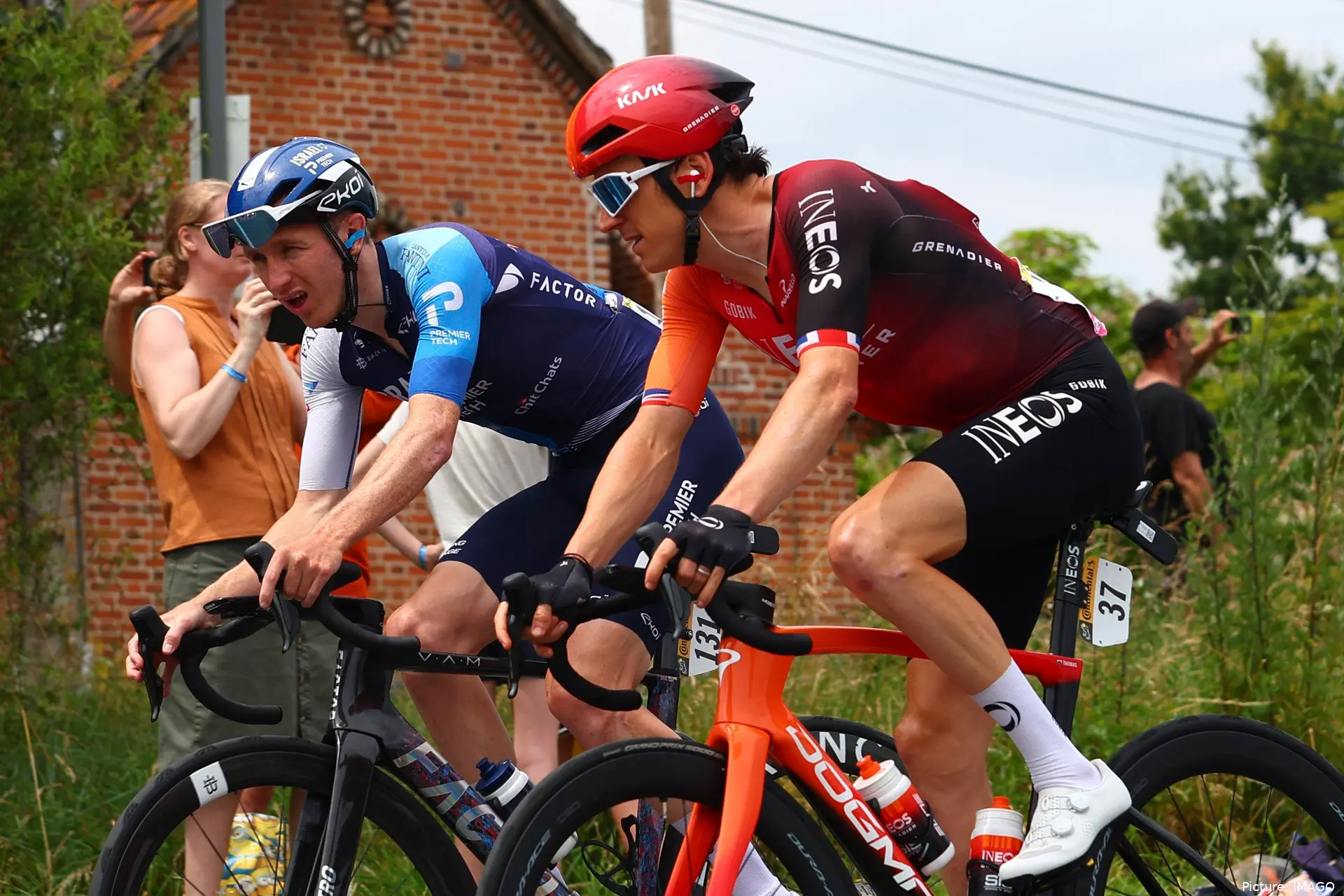
In cycling there is a serious argument to make that its top teams are, now more than ever, being financed by controversial entities. Many of the top teams in the sport currently are financed by petro-states such as UAE Team Emirates - XRG; billionaire oil companies such as INEOS Grenadiers, warmongering states as was the case with Israel - Premier Tech and gambling companies such as the upcoming Unibet Rose Rocket. We take a deep look into why the sport is finding itself in deeper and deeper connections with such entities.
Israel - Premier Tech
Elephant in the room: Israel - Premier Tech. Yes, the team has now come to an end - although its remnants remain in the form of the newly-named NSN Cycling Team. However for a full decade, the pro peloton had the Israeli flag firmly planted in it, and many argued strongly that it was an evident case of sportswashing. From 2015 to 2021, the team solely had the middle eastern nation as its title sponsor. From 2021 to 2025, Canadian waste and water management company Premier Tech as well.
Let's not be naive, the presence of a team that had as its sole finance source the state of Israel is not something that was ever fully ignored within the cycling community, but in 2025 it gained a whole new dimension.
The state of Israel was created in 1948, and ever since that year, it has been involved in conflict with with the Palestinian state. Throughout the decades, the land-grabs have grown larger and larger in size. Ultimately, the West Bank is territory that over time is under a larger Israeli ocupation, with the creation of new settlements seeing no stopping even as of December 2025. Meanwhile the Gaza Strip, the largest continuous slice of territory that is inhabited solely by the Palestinian population, has been subjected to what has been almost unanimously described as a genocide since October 2023.
On the October 7th, an attack from Hamas-led armed groups led to the deaths of around 1200 people in Israel. Ever since, cities like Gaza, Khan Yunis and Rafah have been razed to the ground. Whilst carrying out systemic destruction of the Gaza Strip's main cities, Israel also carried out several attacks on foreign territory in Iran, Lebanon and Syria - taking and maintaining territory in the latter two.
The multiple land incursions into the Gaza Strip, but above all the continuous airstrike campaigns have killed over 70.000 people in the territory. Several other dozens of thousands of people are believed to have died due to indirect consequences of the attacks, due to widespread hunger, destruction of health facilities and inadequate water and sanitation. The grand majority of these deaths occurred within civilian population, and a haunting percentage of it on women and children. Hundreds of journalists and humanitarian aid workers have been killed as well.
The closing of the borders to Gaza and prevention of humanitarian aid entering the territory further infuriated the international community. Public outrage was always understandable, and continued to escalate and reach new heights all the way into October 2025, when a ceasefire was reached. Israel has since continuously broken this ceasefire, although international tensions have de-escalated over the past few months.
In comes cycling; Israel - Premier Tech was directly sponsored by the state of Israel, and its owner billionaire Sylvan Adams had a strong pro-Israel stance as well as strong ties to Israeli prime minister Benjamin Netanyahu - currently under an arrest warrant by the International Criminal Court - and has always been attached to strong controversial statements. After the team failed to accumulate enough points to keep its World Tour license at the end of the 2022 season, Adams threatened to sue the UCI.
"To threaten our team and the other teams with this relegation, it’s just so harmful, and I don’t see the purpose of it," he said at the time. "Relegation is death," he argued. He did not sue the UCI, as there was no basis behind it. The team also did not die - due to sporting reasons, that is, rather due to political ones, in which Adams was strongly to blame.
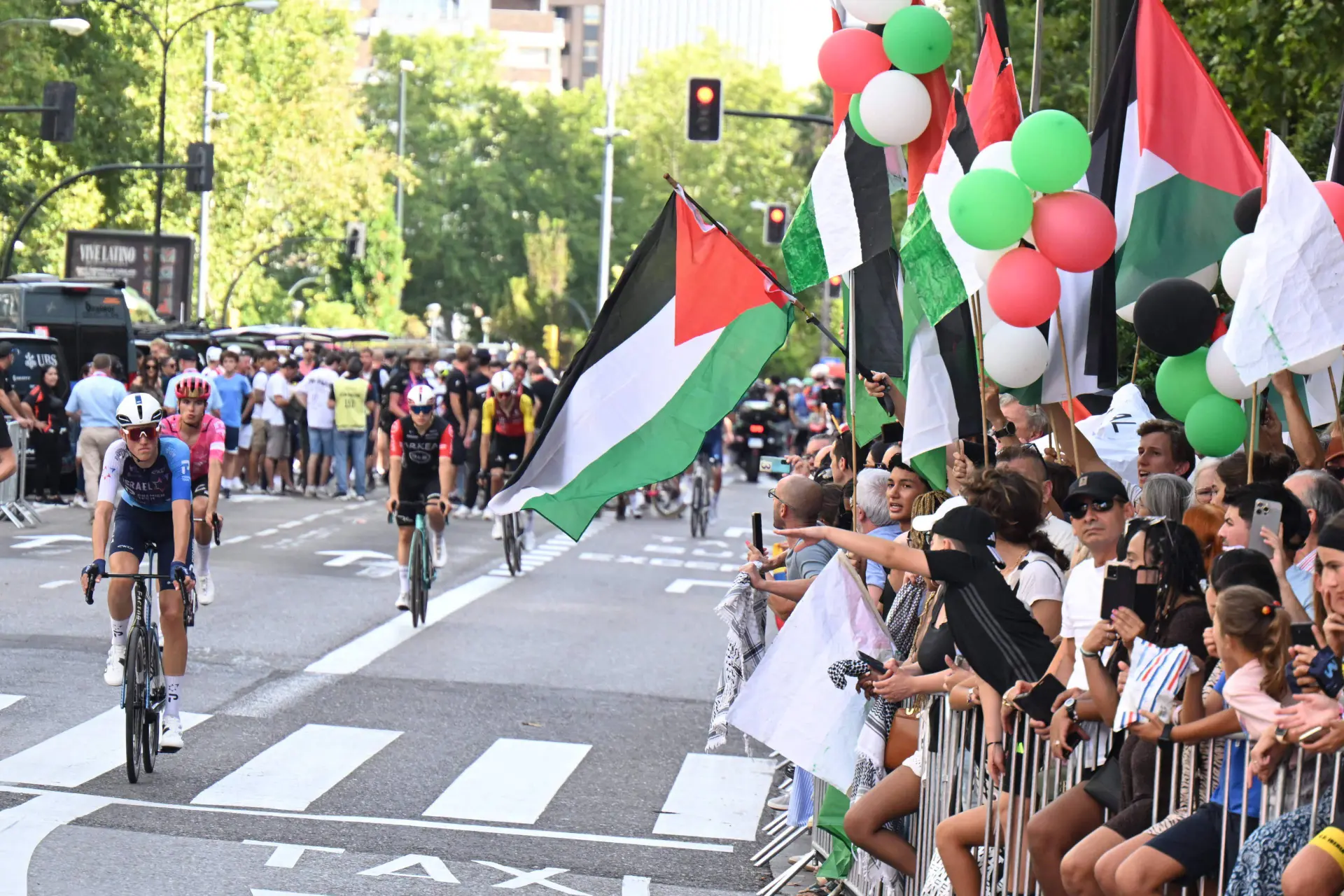
The lack of decisive action from most countries regarding Israel's aggressive and never-ending stance against Palestine has led to intense turmoil. Feeling helpless, many across the world have held protests to encourage an end to the war, or at the very least, implement a ceasefire. But in August and early September 2025, this wasn't yet a reality. And at the Vuelta a España, many took to the streets to protest the team's presence in the race. Many considered the team to be a tool of sportswashing from the Israeli state, a propaganda tool to improve the country's international image. The 2018 Giro d'Italia began in Israel much due to Adams' and the team's influence, in what was at the time a rather criticized decision by the cycling community.
Back to September 2025: The protests harmed other teams' riders more than IPT's however, with stages getting cancelled or cut whilst being raced; and crashes being caused by protestors running onto the road in front of riders. This had happened at both the Giro d'Italia and Tour de France, but it escalated to never-before seen levels at the Vuelta. Simone Pettili (Intermarché - Wanty), one of the riders who was affected by these crashes, plead on social media for the actions to stop harming the riders: "If it will continue like this our safety is not guaranteed anymore, and we feel in danger! We just want to Race! Please".

Simone Pettili crashed at the Vuelta a España due to protestors running onto the peloton
The very first incident was on stage 5 as the team was forced to stop during its effort in the team time trial, effectively the only protest that affected the team directly. However it was by far the most notable of the incidents.
Then, Netanyahu also provided a small statement on the team's situation in the Vuelta: "Great job to Sylvan and Israel's cycling team for not giving in to hate and intimidation. You make Israel proud!" This only stirred the pot even more, and connected the team more strongly to Israel's actions.
One argument that I have personally made is that whilst the removal of Israel from the world of cycling is completely justified, it would have virtually no real effect on the Israeli leadership's actions in Gaza, which was and is the ultimate goal. I believe in hindsight this can been agreed upon.
The team's continuation in the race was constantly a topic of discussion. Sylvan Adams held on to his beliefs firmly: "The region (Basque Country, ed.) is known as a stronghold of extreme left-wing activists and separatists who like to protest," he said after stage 11 into Bilbao was neutralized. Team DS Óscar Guerrero attempted to defend the riders in the matter, asking for the peloton not to be assaulted as happened several times: "We are having a bad time, they insult us, they verbally attack us.... The riders are afraid". Adams' stance and words further enraged the protests.
On stage 5 the Israeli team was blocked during the team time-trial; on stage 11 protestors broke onto the final straight and forced the organizers to neutralize the finale and have no finish line; stage 16 to Castro de Herville was also cut and finalized at the bottom of the final climb; the time trial on stage 18 was cut to less than half of its original distance in Valladolid and stage 21 was outright cancelled as thousands broke through the barriers in the capital of Madrid and forced the race to end somewhere in the outskirts of the Spanish capital. Several other stages saw incidents happen, such as crashes and road blocks. Images of Jonas Vingegaard staring into the distance whilst sitting on Visma's team car after being declared winner of the race will not be forgotten soon, and neither will Visma's 'improvised' podium ceremony at the team's hotel.

One of the official final images of the Vuelta a España was the race winner, Jonas Vingegaard, visibly upset after the riders were not allowed to reach Madrid in the final stage
After the Vuelta, several race organizers virtually forced Israel - Premier Tech into not taking to the start in their events, as threats of protests and blocks were very likely in several Italian autumn classics. The exact details of the agreements weren't public, but the team did not compete. And after the end of the season, it was announced that Israel would step away from the team as its sponsor, whilst title sponsor Premier Tech and bike supplier first threatened, and then decided to abandon their connections with the team due to the undeniable image that had been created - even as the team was going through an active rebranding.
The team's license was bought out by a new entity, and is now called NSN Cycling Team. Most of the riders and staff stayed on board. Although Sylvan Adams was initially still connected with the team, and no-one within it denied his connections in its early stages, Guerrero said in a latter interview that it was with a transitional guiding role, aiding the team's new owners.
Rwanda World Championships
Cycling's association with political figures within the sport is only increasing as recent years go by, and the Rwanda World Championships were a clear example of it. Whilst the event in the capital of Kigali proved to be a big and necessary boost for African cycling, much of the event was surrounded by politically-motivated controversies. Two in particular cannot be ignored:
VRT journalist Stijn Vercruysse was outright denied from flying to Rwanda and working in the World Championships. This was, almost certainly, due to him being vocal and critical in the past about the East African nation's authoritarian regime, as he was barred at the airport directly before the flight despite having all the necessary accreditation and clearance.
Rwanda is, almost by definition, an authoritarian state, with president Paul Kagame having hold of the country since the year 2000 (and where in 2024, he won the presidential elections with 99% of the votes), where he was coordinated a well-documented series of episodes that show the suppression of political opposition, assassination and persecution of detractors, and limited freedom of speech within the country. There is also overwhelming evidence that Rwanda is the main backer behind the M23 military movement, which has been capturing territory in the neighbouring Democratic Republic of the Congo since March 2022 and has displaced over 2.5 million people in the region, with thousands also dead as a result. This even led to concerns that the Tour du Rwanda could be held safely, as some stages were only dozens of kilometers away from an active battle zone.
These are incredibly serious concerns that overshadowed the World Championships, that earlier in the year, even looked to be at risk. But this wasn't a concern for David Lappartient, seemingly. The UCI president was questioned by Cyclingnews on the matter back in February - he gave a non-answer. Previously the British news outlet had reached out to the UCI to have information on the risk of the Worlds getting cancelled. The response then was that the UCI wished for "a swift and peaceful resolution of the situation."
The UCI and Lappartient's stance was that of a neutral position. At the end of the event this didn't seem to be the case anymore, as Lappartient personally awarded the dictator with an honorary medal for hosting the event, whilst Kagame himself on X called Lappartient a friend. A ceasefire was seemingly achieved in May of this year, only to be renewed strongly in December, and is ongoing at the moment.
However the argument that Lappartient is a politically neutral figure can never be truly a point in the conversation. Only a few months ago, he publicly supported former French president Nicolas Sarkozy, after he was sentenced to five years in prison for corruption - the first French president since WWII.
"The UCI is a text-book example of weak governance, calling them morally flexible might be an understatement," Benji Naesen argued in words to CyclingUpToDate.

Isaac del Toro and Tadej Pogacar ride the Mur de Kigali at the Rwanda World Championships
Petro-States dominate cycling
Saudi Arabia is increasing its presence in pro cycling more and more throughout the last few years, with the creation of the AlUla Tour and its sponsorship of Team Jayco AlUla, however this is still a small investment. Specially when comparing to the over €200 million euro salary that football player Cristiano Ronaldo reportedly earns a year with Saudi team Al-Nassr, which is partially state-backed. The money put in cycling is nothing but pocket change at the time being by the Arab state.
Bahrain - Victorious is the second-largest example of this taking place, with Bahrain being the team's main financial supplier since its creation in 2016. However its saying in the very top of the cycling world isn't, at the time being, overly dominant. But the same can't be said of UAE Team Emirates - XRG, created in 2017 as well, born out of the structure of the previous Lampre team.
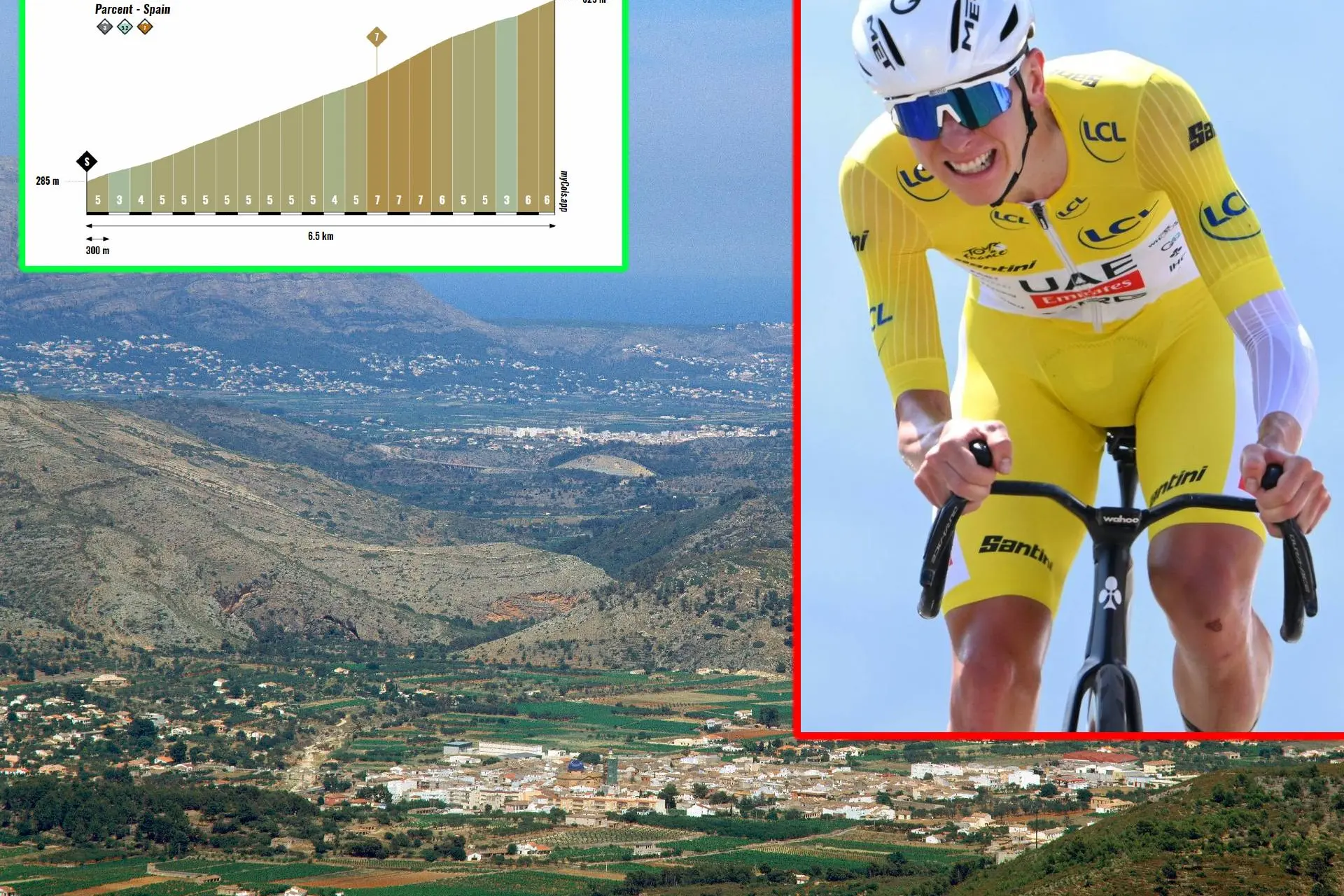
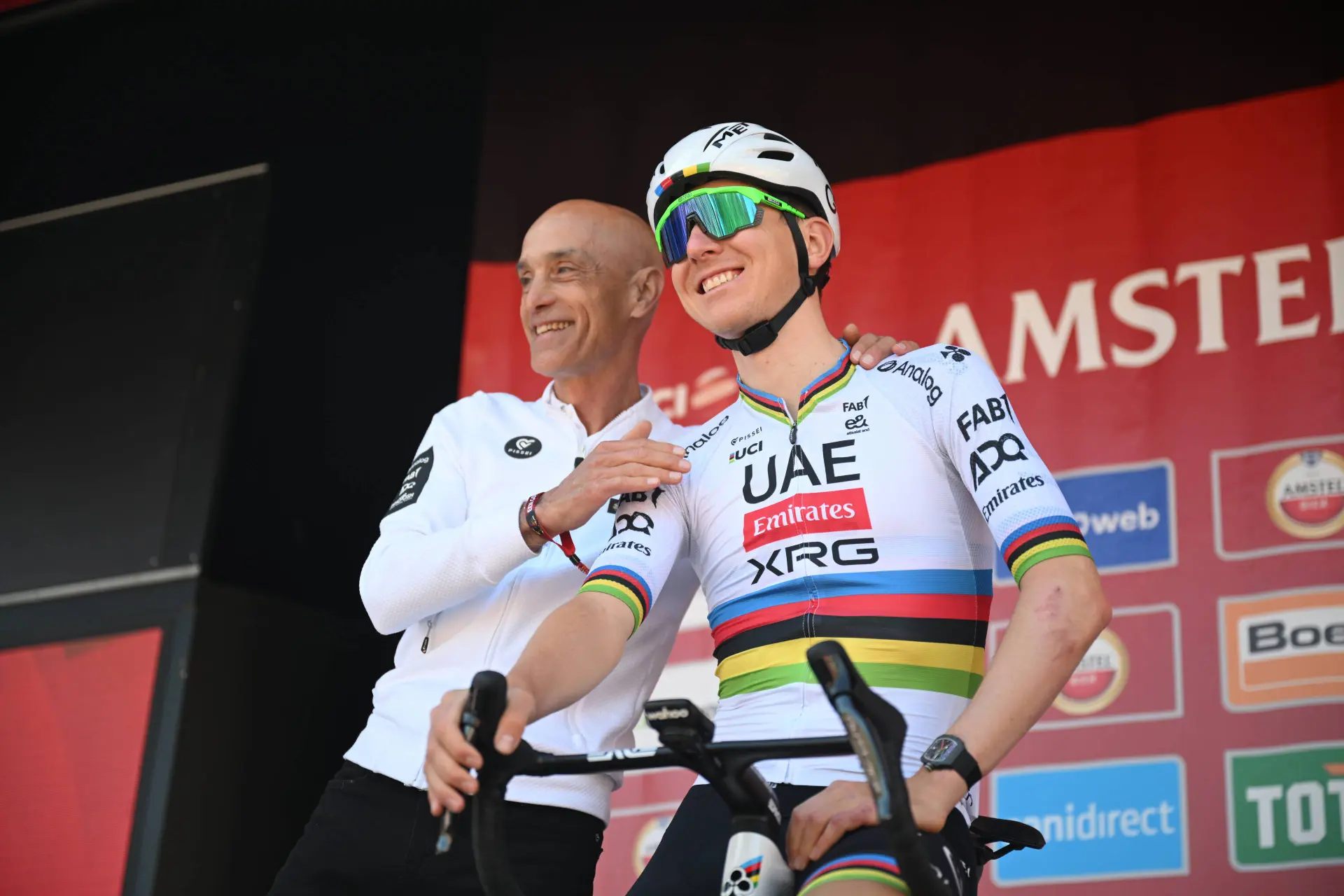
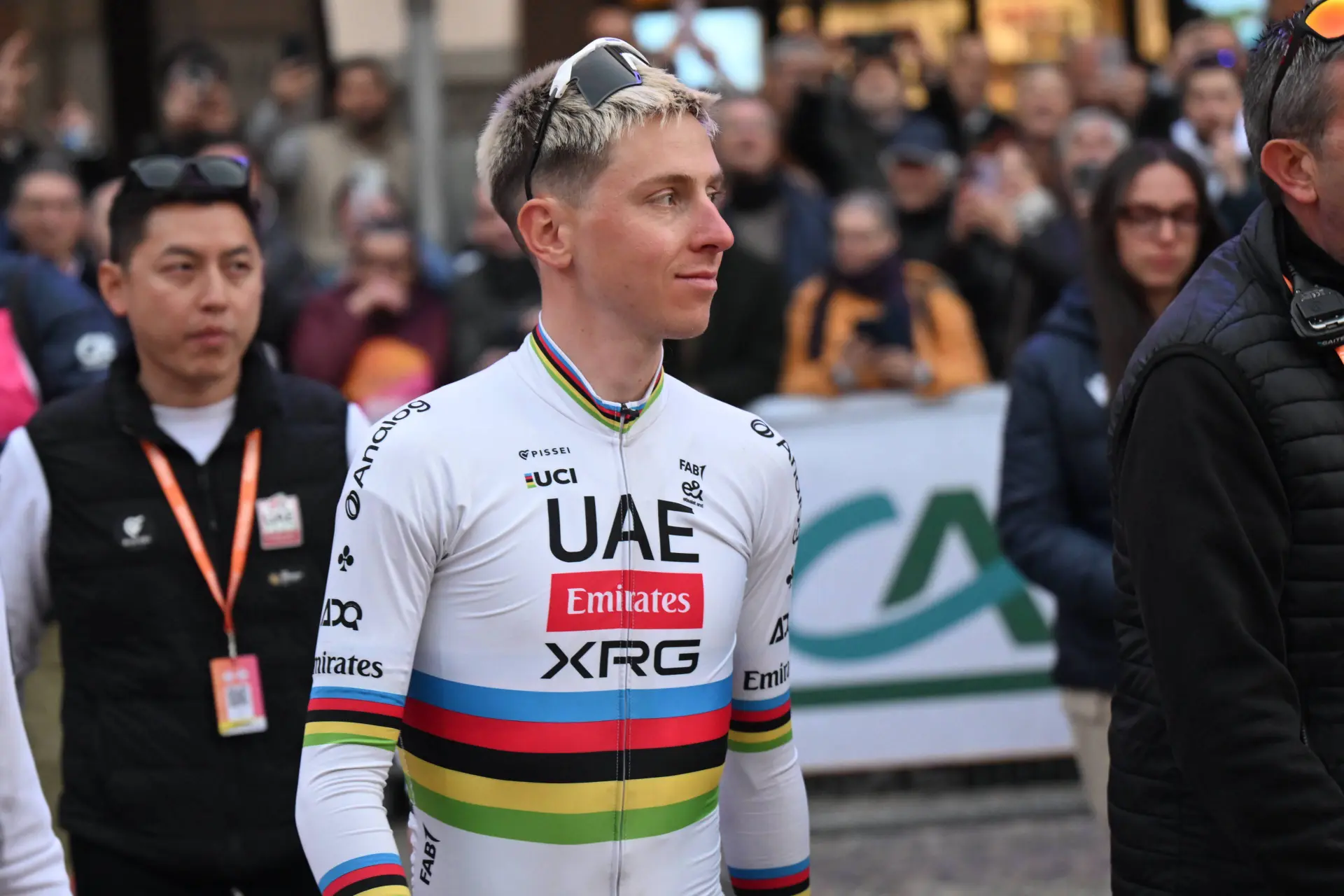
UAE started out as a mid-level World Tour team, but it began changing in 2019 when the team signed Tadej Pogacar. The Slovenian would prove to be the team's biggest game changer, winning the Tour de France in 2020, and then again in 2021. His success took the team to the top of the sport, and as the years passed, so did its collective success. As the years went by, the increased investment in the team became more and more clear, as the signings became more prominent, the transfers of the brightest young talents were more frequent; all this happening simultaneously. It is widely understood that as of 2025, UAE Team Emirates - XRG is the team in pro cycling that has the largest budget, with only INEOS Grenadiers (a separate topic for later) coming close, above the €50 million per season range.
But in terms of quality there is no comparison, with Pogacar winning Grand Tours, monuments and major titles left and right; some of the biggest talents in the world being signed yearly; whilst secondary leaders such as João Almeida and Isaac del Toro themselves being some of the very best in the world. The team was completely unmatched when it came to UCI points these past two seasons; Pogacar achieved the same at an invidivual level; and the team has reached new heights with a new victory record this year, with 97 triumphs - beating the 85 previously set by HTC - Columbia in 2009.
The team has reached previously unreachable heights in the world of cycling. But the UAE is not exempt from geopolitical issues. Whilst the team is not strongly questioned or affected by the nation's geopolitical affiliations, many over the years have been particularly critical of its riders being given Emirati flags to the podium in some of the major races, such as the Tour de France celebrations for example, and chanting 'UAE'. The claims of sportwashing have a strong base, when it comes to cycling's most dominant team of the decade.
United Arab Emirates plays a strong role in a potential genocide as well
On social media throughout the past few months, this is a topic that has come to light as well. The spotlight that was once on Israel - Premier Tech has, in some way shape or form, also moved towards UAE Team Emirates - XRG on a smaller note. It is also a state-sponsored team, and the state in question is involved with a separate war taking place in the African continent.
Not unlike the Israeli conflict, where American and European weapons were largely used against the Gazan population; in Sudan the involvement of the UAE has led to widespread destruction and death. Its supply of weapons and various supplies to the Rapid Support Forces (RSF) plays a major role in what is also widely argued to be a genocide. Over 150.000 people have been killed in this conflict since April 2023, around a dozen million have fled the affected regions. The capture and widespread massacre of civilians in the city of El-Fasher back in October 2025 is specially worrying, with estimates pointing towards 10.000 deaths. The country sees millions of inhabitants in a position of starvation and a massive refugee crisis due to the several ongoing conflicts.
INEOS Grenadiers are set to be fully financed by 2 oil giants
But the money that fuels UAE Team Emirates - XRG is not unlike that of a different team that, ironically, has the second largest budget in the peloton. Only INEOS Grenadiers isn't financed by a petro-state, but instead a petro-giant. INEOS is a British chemical company, which in their very own words, are a 'significant player in the oil and gas market'.
Now, there isn't necessarily a direct moral problem with a team being sponsored by a private oil giant, but it brings forward a separate issue with is the overall ability to finance a top team in the sport. Cycling is a sponsor-based sport, in which teams require the financing from companies or state entities in order to be able to pay its riders, staff and everything else that is necessary. Competing against the financial potential of a company that generates around €55 billion euros annually is simply not possible for most of the entities that have the interest of investing in professional teams.
Why is this an issue though? On the competitive side of things, it creates a dynamic where the strongest teams become stronger, and the more modest teams become... more modest. Not ideal.
On the moral side of things, you have companies which actively contribute greatly towards climate change and look to increase and expand on the use of fossil fuels. Whilst not directly a public issue with INEOS, there is a strong trend of such petro-giants having a big role in political lobbying, specially in countries in which the production and sale of oil plays a bigger role in the economy - of which there are several in the World Tour.

Once cycling's ultimate 'super team', INEOS Grenadiers has been demoted to a secondary level in the 2020's
Journalist Daniel Friebe firmly stands with this argument: "I mean, over the last 15, 20 years, the budgets have escalated hugely. And this has taken the sport out of the realms, out of the reach of small to medium sized companies. [...] It's undeniable that they have exerted a lot of pressure. The amount of investment in sports science is very, very significant in cycling now. But again, that's only happened because there have been people willing to fund it and willing to put up that money".
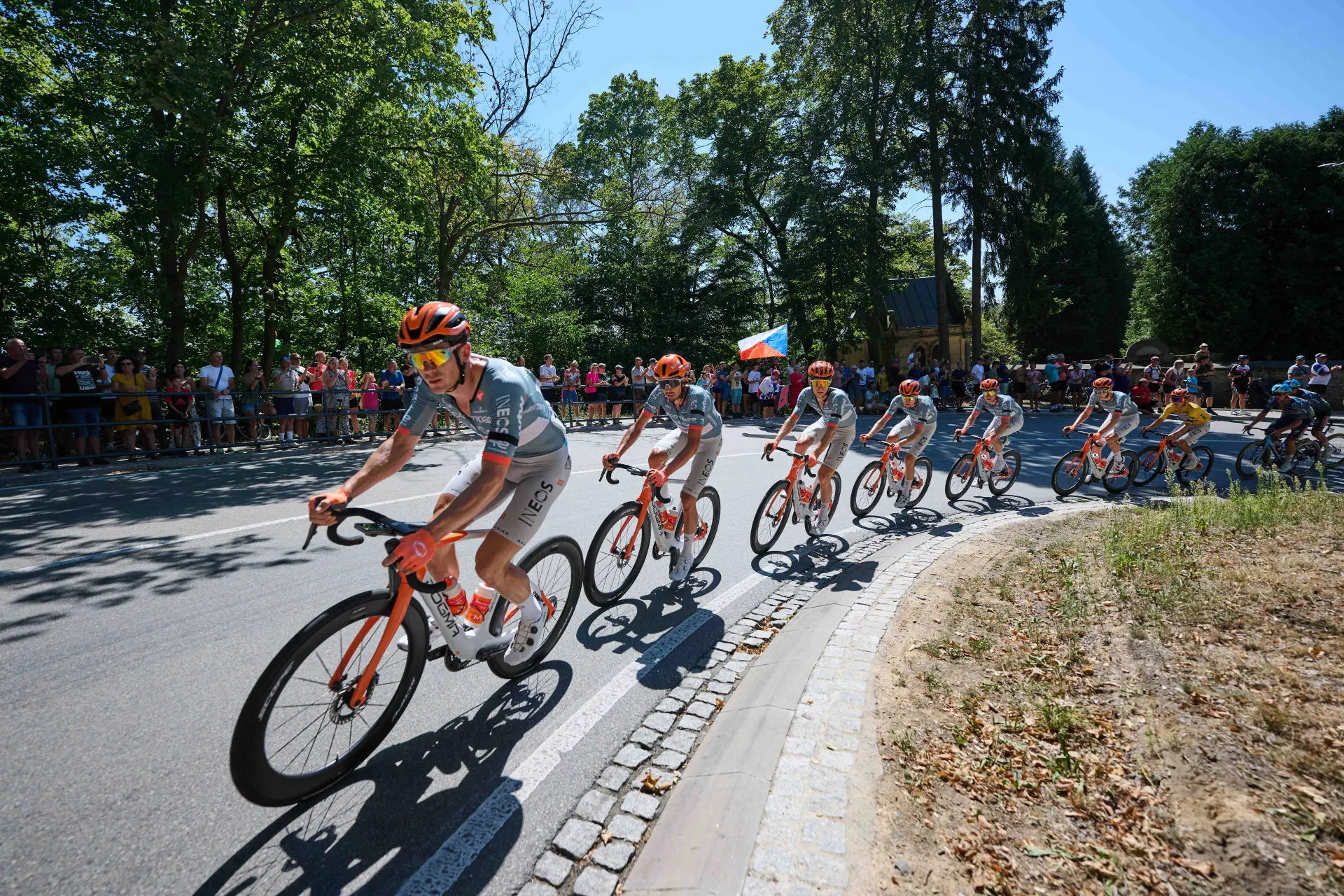
The British team is currently having INEOS as its sole title sponsor, but that is set to change in 2027 when it will be joined by... TotalEnergies: A French 'energy and petroleum company'. Two oil giants come together to finance a team that a decade ago was at the very top of the sport, and currently is fighting to return there. Whilst it is not the only team able to conduct such business, the rumoured €6 million that is recently spent to buy the contract of Oscar Onley (former Team Picnic PostNL) is simply out of reach for virtually any team. This value is above the budget of a high-level ProContinental team in 2010, the year Team Sky (now INEOS) was created: Dutch team Vacansoleil was valued at a €5.5 million budget that year, the year before it got its World Tour license.
The ability for one's company to finance a top cycling team is now only available to the 'big players'. This is an issue that was discussed with RAI's Stefano Rizzato, one of the most experienced voices in pro cycling, who has also seen this evolution happen in real-time in Italian cycling:
"Italy is a case study for this. In the past we had several teams at the top level, sponsored by national companies. Not necessarily huge ones. Mapei, Lampre, Fassa-Bortolo, Mercatone Uno, Polti - which is now back in the game with Basso and Contador. But now it's just too much money, they don't have the margin, and they are still scared to have a major scandal like in the late 90's to 2010".

Gambling companies invest heavily in the sport
Lastly, gambling companies are also involved in the sport. This isn't a recent development, but one that is still prominent. The Lotto team for example is financed by the Belgian state-sponsored lottery company. But there is a prime example in Unibet, main title sponsor of the Dutch-French team Unibet Rose Rockets. In fact that is a great part of the reason why the team got a French license, because it was in 2025 that the Netherlands implemented a nation-wide ban on sports gambling sponsorships.
But the team continues under the same management, with Youtuber Bas Tietema remaining the face of the team, with its priorities also in Dutch riders such as Dylan Groenewegen. However on a smaller-scale, the presence of gambling sponsorships in the jerseys of major pro cycling teams has been a constant throughout modern history. Take for example BetCity, a recent partner of none other than Team Visma | Lease a Bike, who has also had to cancel the partnership ahead of this past season.

Gambling companies sponsoring cycling teams is not new, but also still part of the sport
Why is this happening in pro cycling?
That is then the big question. But the answer is complex, nuanced, and has several different topics that influence it in some way shape or form. It can be split throughout several different points. The first is regarding the presence of political actors such as UAE and Bahrain in the sport, which can potentially be explained by their nature. As authoritarian nations, the countries do not fear backlash in the same way that most Western democracies do. In a country such as France or Italy, even with over a century of history at the top of the sport, the investment or €30 or 40 million euros a year to fund a cycling team could be used as a weapon against the ruling parties. This could lead to serious political backlash and consequences.
In authoritarian regimes, the fear for such backlash and consequences is inferior, as the information space is more often controlled; and the electoral process - if it exists at all - is often influenced by those already in power. Hence there could potentially be a larger availability to commit to such investments, even if the population feels the same type of negative emotion regarding the decision.
"The economic power is all there, and generally more available to actors that have less restrains," Rizzato argued. "Take Rwanda, generally speaking it's not a rich country at all, but as a dictatorship, the government can allocate money wherever they like. Ignore the poor and go for global sponsorships".
"It's one of the many ways they use to try and stay relevant for long, even when their natural resources and oil, gas, etc. will be gone. But in that frame, I think the idea that sports could or should be neutral is naive. They have not, never been, and therefore it's perfectly fair and needed to question sponsorship".

Bahrain - Victorious is also largely financed by a petro-state, with sums that few private companies are willing to pay in cycling.
But why is cycling in such a seemingly sensitive position against sportswashing actors? Benji Naesen argues: "Sponsorships are the reason pro cycling teams exist, so they’re morally flexible on accepting money from (almost) anyone if it means their team can survive. In return, they receive borderless exposure for a low cost, relative to other sports [...] Basically, pro cycling accepted sportswashing to fast-track the growth of the sport, but has to live with the consequences of that decision".
But it does not always go the way that is expected: "In the last 15 years, sportswashing has become a part of our sport. At La Vuelta, we saw the inevitable consequences of that, with Israel-Premier Tech".
The second point is regarding the dominance of billionaire companies at the top of the sport. It is possible to access that the budget for top teams currently is vastly superior than that of previous decades. This applies to the very top teams, but the technological and logistical evolution of the sport over the past decades has seen an increase on the requirements that teams have to 'keep up'.
Take a new team in the World Tour at the moment. The very minimum required budget is of around 15 to 20 million euros a season, already a very substantial investment, but one that will likely still lead to only moderate success. Salaries continue to increase as the sport gets more visibility - and lowering them is not likely in any upcoming future, whilst the top teams are taking 'marginal gains' to an extreme level, with their financial resources allowing them to work on the smallest of details that at the end of the day accumulate to make a meaningful difference.
"I think cycling has also become attractive because of the protagonists. As it's become more of a rich person's sport, then it has attracted more of the kind of protagonists which companies want to associate themselves with," Friebe added. "So kind of relatively clean cut, well educated, and so on and so forth. And that's made it more sort of palatable or appetizing to multinationals and even companies that want to partake in what we would call greenwashing or sportswashing."
A separate argument can also be made that as a result of the sport's better image currently, over a decade after the end of the Lance Armstrong 'saga' and the large-scale team raids that would frequently denigrated the image of cycling, giants from other fields such as Red Bull and Lidl as prime examples have been less doubtful when it came to going all-in on sponsorships of top teams.
"Why have even nation states and multinationals, why have they become more interested in professional cycling? Well, I think you have to say that cycling has become a more attractive product because of environmental reasons. And also cycling has done a pretty good job, at least from a PR point of view of cleaning itself up and making itself a lot more attractive than it was 20 or 25 years ago. And that's to do with, well, doping, obviously".

Rúben SilvaEditor-in-Chief
A founding contributor to CyclingUpToDate since its launch in January 2022, Ruben Silva has played a central role in shaping the site’s editorial direction and long-term growth. Before joining the project, he built his experience through independent blogging at Echelons Hub and by producing race previews for Ciclismo Internacional, developing a strong analytical voice rooted in daily engagement with professional cycling.
Beyond editorial work, he has been closely involved in the expansion and coordination of CyclingUpToDate’s wider network, helping establish and support sister platforms across multiple languages. This includes ongoing collaboration with CiclismoAlDia (Spanish), CiclismoAtual (Portuguese), WielrennenUpToDate (Dutch), and RadsportAktuell (German), contributing to a shared editorial vision and consistent international coverage.
He also helps oversee editorial governance across the network, setting standards for accuracy and consistency and coordinating updates or corrections when needed.
Originally from the Porto metropolitan area in Portugal, he holds a bachelor’s degree in Geography. His path into cycling journalism was shaped not through formal media training, but through independent reporting, community engagement, and sustained on-the-ground involvement in the sport.
Over the course of his career, he has conducted approximately 100 interviews across road cycling and cyclocross, ranging from one-to-one conversations and online formats to press conferences and on-site pre- and post-race coverage. His interviews include leading riders, team managers, and prominent figures within cycling media: Tadej Pogacar, Jonas Vingegaard, Mathieu van der Poel, Primoz Roglic, Wout van Aert, Joao Almeida and Tom Pidcock; managers like Patrick Lefevere and Joxean Matxin; and YouTube personality Bryan Kennedy (BKXC)...
Within 18 months of launch, he helped grow CyclingUpToDate’s English-language platform into one of the most-read cycling news websites, built entirely from the ground up. As both a professional journalist and lifelong cycling enthusiast, his focus remains on delivering accurate, timely, and well-contextualized coverage.
claps 0visitors 0
Just in

Popular news
Latest comments
- Nothing. Against Pogi nothingabstractengineer18-10-2026
- He didn't even try to sprint all outvappaxbipmv18-10-2026
- Campenaerts looked like a rolling pumpkin with that all orange leaders skinsuit !frieders318-10-2026
- He can take his dumb a$$ politics somehwere else !frieders318-10-2026
- good to have her back. fingers crossed she‘ll be able to stay!Ketterechts17-10-2026
- A tenner and he wins the Tour next year, too 😂anonymouscyclist17-10-2026
- the answer is either stick to classics or GTs but not bothabstractengineer17-10-2026
- the exodus already stared with Ciccone. Already they were struggling with two sprinters, now there are three. Also Ganna will demand leadership. Gall is the most proven GC, Ayuso has the most potential. GC leadership for everybody will be impossible. Literally a UAE style mess without pogi.abstractengineer17-10-2026
- I raced as an amateur for 12 years, including six years on my country’s national road cycling team. I secured two national titles and competed in three World Championships plus more than 15 international stage races. At 23, we travelled to Italy for a training camp—or so I assumed. On a rest day, we watched a presentation about adopting a more “professional” training approach. It was crystal clear what “professional” meant. That moment first exposed me to this dilemma. After returning from Italy, I left cycling—at least at the competitive level I had known. Over the following two years, the whole team was caught doping. I hold that everyone is innocent until proven guilty. In my view, current stakeholders operate on a different scale, and the sums involved are vast. I am unsure whether any doping would ever be revealed. I try to stay positive and enjoy the show. My 2c.
 vannpelt17-10-2026
 - Fiver he wins 🤣
 leedorney17-10-2026
Loading
1 Comments