Pedal Punditry #24 - I visited the Coll de Rates and looked to explain why it's cycling's most famous 'winter climb'. Tadej Pogacar helped me
CyclingWednesday, 31 December 2025 at 10:42
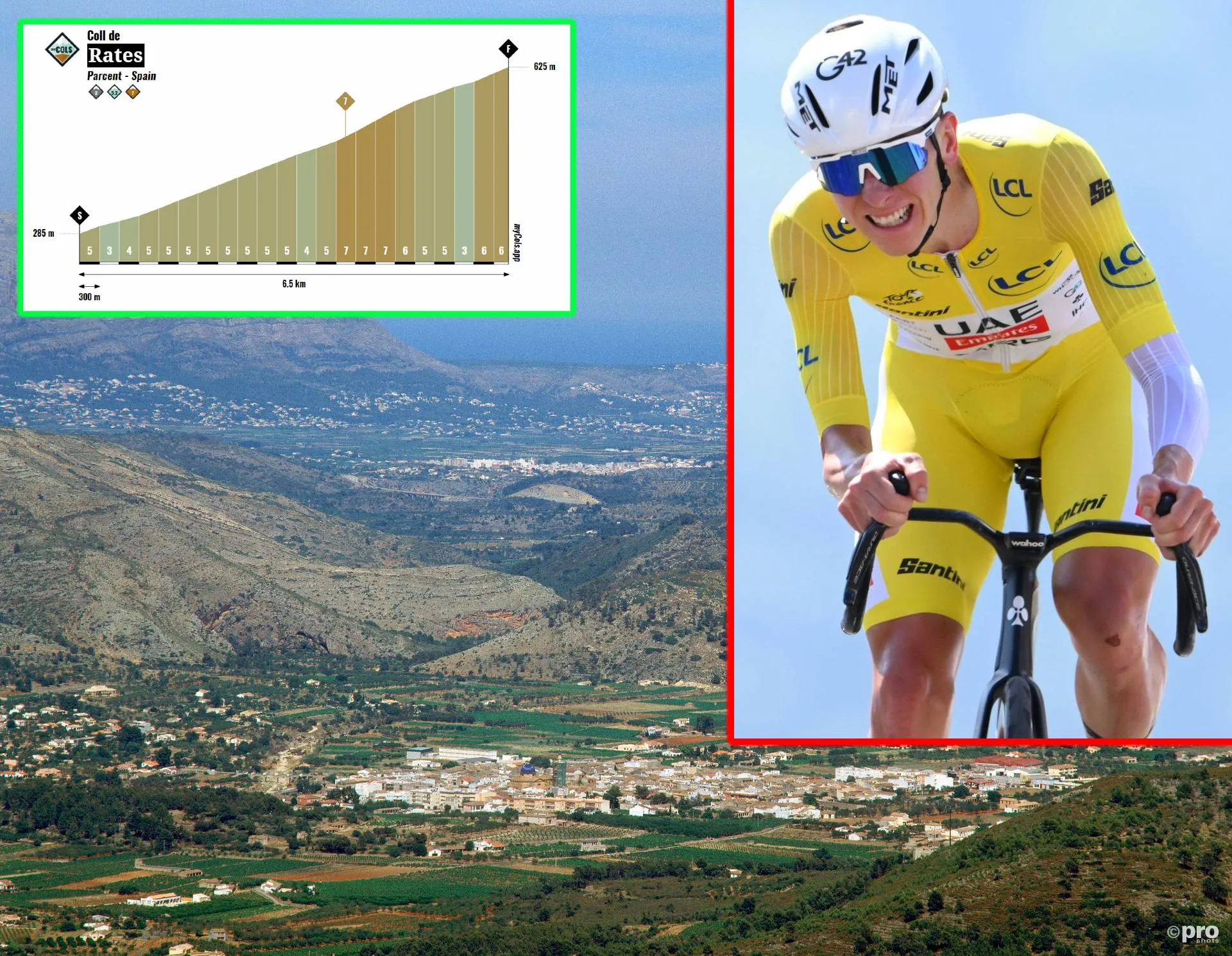
The Coll de Rates. It might be one of the 'easiest' popular climbs in pro cycling, but there are good reasons for its popularity. I have travelled to the Costa Blanca's most iconic climb and got the help of pro riders to explain why the climb is as famous as it is. And Tadej Pogacar ended up making the job easier for me...
The climb is famous due to several factors, Geography, climatology, demography and economy all play a role in this. There are very complex ways of explaining it, and also quite simple ones, depending on who asks. However for the diehard cycling community, a thorough explanation is due.
Geography
The Coll de Rates is a calm mountain road located between the Serra del Ferrer and the Serra del Carrascal de Parcent, a mountainous area within the eastern tip of the 'Costa Blanca'. This area is known for its tourism-based town such as Benidorm, Calpe and Xabia. The mountains in the area are mostly formed by limestone, which gives way to dramatic cliffs and views. However, the maximum altitude in the area is not too high, not comparable to the Sierra Nevada or Pyrenees.
This is by no means the only climb in the area, but it is a road that goes through a relatively empty area of the mountain range and is an obvious crossing point. With most teams based in towns that lead into or out of the climb, and usually an hour away from most of the top teams' hotels, then it makes sense for it to be part of many training rides.
Pro cycling teams have for a long time chosen this part of Spain for several reasons. Naturally, with most teams based in Europe, the proximity plays a key role. Pro Teams - both men's, women's and under-23 - are a constant in this area of the world in the months of December and January, where this stretch of coast becomes the hotspot for all things cycling related. You would be surprised to know that UAE Team Emirates - XRG and Team Visma | Lease a Bike are, in a straight line, less than 10 kilometers away from each other throughout this period.

Map of the Coll de Rates and Costa Blanca
Economy
One of the main aspects as to why pro teams come to this area are the prices. Spain is a strong economy, but the teams stay away from the big cities, and move away into more secluded areas for a calmer environment and also a less pricy option. Teams can easily spend dozens or even hundreds of thousands of euros to organize such a training camp. Two weeks in duration, flights and accommodation for about two dozen rider and several dozen staff members; the transportation of countless bikes, team busses, cars, and everything else that is necessary... And imagine the price on logistics, as everyone in the team must be well fed, have all the necessary supplies to do their job, and countless other details that are necessary for the wellbeing of a team.
When one small piece isn't in place. Let's say... UAE Team Emirates - XRG not having its own chef at the 2024 winter training camp... Then a few people in the team, including riders, do not take it the right way. Stories that roll around the hallways of the team hotel just outside Benidorm...
For logic reasons, I will not share the names or exact locations of the teams' hotels. But footage on social media spreads like wildfire, and often these are revealed. But these hotels, often outside these coastal towns, provide the perfect platform for the pro teams. The hotels in the Costa Blanca receive massive crowds during the summer, tourists who go on and seize the sun. There are five-star hotels, but also smaller budget hotels that are equally as big, fit to suit the wishes and needs to all financial spectrums of pro teams. There are sports-specific and even cycling-specific hotels. One such had, at the very least, six pro teams (again: men, women and under-23 included) staying there. But they are also far away from the big cities, and so the prices aren't as high as luxury hotels would be in the center of, let's say, places like Madrid or Valencia.
Instead, towns such as La Nucia, Altea, Calpe, Dénia and Oliva become hotspots.

During the winter, Tadej Pogacar and Jonas Vingegaard do not meet, but train on the same roads.
Demography
The province of Valencia has about 2.7 million people; whilst the population of the Alicante province is of 2 million. That is not a small number, that is certain, however the pro teams tend to stay away from them. UAE is a regular in Benidorm - population of about 70.000 people - but most teams stay in more local areas. La Nucia, where Team Visma | Lease a Bike have their winter base, is a town with 19.000 people. There are more people watching them on the road throughout the average pro race.
But these are the towns where the teams stay at. Logically, they are not located in the wilderness. But the riders, who can train up to 6 or even 7 hours a day during this time of year, get to enjoy a very vast mountainous area in the Costa Blanca that has a very low population density. Away from the coast, there are barely any meaningful-size towns in fact, and it provides the calm roads that the riders need.
Calm roads are one of the absolute main reasons why teams travel and train here during the winter. Specially, as its the only time of year where all (or most) riders in a team are all gathered in one place, and the training groups are quite big.
The Coll de Rates is a climb just outside the coastal hotspot of the Costa Blanca. The perfect mix between calm roads and proximity to the populated areas.

Population density in the Costa Blanca in the area around Coll de Rates
Climatology
Yes the weather, that is a big reason why the Costa Blanca is famous to begin with. Although in a few days the rain showers can be strong - extremely strong even - throughout most of the winter the area has some of the very best weather in continental Europe. Temperatures will usually be around 15 degrees maximum during the winter, with the minimum just below 10 degrees celsius. And the sun is often out. Ask anyone who lives in central, eastern or northern Europe... This is not common.
It is not by chance that many pro riders, including the likes of Mathieu van der Poel and Remco Evenepoel, live out of the Costa Blanca throughout most of the year. They have the means, and when you're a rider looking to perform at your best all-year long, staying away from the illness-inducing rain and cold throughout the winter sounds look a good option. Besides all the other factors previously mentioned.
The climb is easy, but that works in its favour
Yes, the climb... It really isn't anything special. I didn't ride up it, I drove... A nervous drive, with the incredibly dense fog and the high density of cyclists on the road making it a significant challenge for me on what are foreign roads. Unfortunately, I did not get to enjoy the fine weather the region is known for on that day.
The views from the slopes of the Coll de Rates are beautiful. At least that's what most say. I did not actually get to see them whilst climbing from the Parcent side. This is the famous one, but there are two sides through which you can climb it. The climb is 6.5 kilometers at 5.2%, and perhaps some of its popularity is due to the fact that it is 'doable' for most amateur riders with relative comfort.
You can actually climb higher when you reach the summit, in a road with a rough surface. The Tossal dels Diners provides 3 additional kilometers uphill with gradients that often go above 10%. Riders will at times choose to climb this as well, as was the case with Mattias Skjelmose in that morning, who yelled his change of plans to DS Kim Andersen who awaited the Danish rider from a Lidl-Trek car in the climb's summit.

Profile of the Coll de Rates
On that day, I had been confirmed by the American team that many of the riders would be training on its slopes. That was true, but most chose not to stop in the summit as the cold and strong wind; and the dense fog made it a bad idea to cool down the body before a fast descent. Despite the bad weather conditions, a good amount of amateur riders continue to flow by the summit from both directions.
After leaving the summit of the climb, I drove down the Tarbena side. Within 500 meters, the clouds began to clear, and the sun began to show up. The roads on the western side of the mountain are much different, it's not a constant climb where you can test your fitness, but instead rolling roads. After the scenic town of Tarbena there is a steep and relatively longer climb that I drove down, with plenty amateur and pro riders in sight who were heading in both directions.
Many riders take on this climb with the goal of testing their fitness. At this time of year they certainly won't want to take on big Alpine passes, and at the time, modern training doesn't yet seem to support that kind of training in mid-December. Hence, the modernization of pro cycling also means that riders of all levels are Strava users. And this is perhaps the biggest part of why the climb is so famous. A KOM... Not just any KOM, but perhaps the most famous KOM in the world at this point, on a climb that is rarely used in pro cycling, but during the winter it sees many high-quality riders go all-out.
In the Top10 of the climb, whose top riders reach 30Km/h average speed or even higher, we notice a few interesting details. The most distant date on the board is that of a certain Jonas Vingegaard from... March 2018. That was the year before he joined Team Visma | Lease a Bike, and that time was taken as a reference to the fact that he had talent that could be used for a top-level team. It is not ironic, the scouting process, even in modern times, can at times be based on platforms on Strava, as even in ideal conditions, riders won't just reach the top of leaderboards of such climbs based on luck.
Hence, a strong time or even a KOM up this climb could end up being a calling card for amateur or under-23 riders, who may not have agents, big names or have difficulties in getting their names out there. In March 2024, 18-year old Danish rider Peter Oxenberg, rider for Coloquick - where Vingegaard rode at the time of his KOM attempt - set a new record of 12:38 minutes up the climb. Three months later, he was signed by INEOS Grenadiers. The message is clear: Fly up the Coll de Rates, and the World Tour teams will come for you.
But there's more to the story... I was going to build on a story that hadn't had recent news for a while. But after my departure from Spain, the climb was back in the headlines only one day later. On the final day of their training camp, UAE Team Emirates - XRG had one of their groups go up the Coll de Rates and, like in December 2024, do a leadout for Tadej Pogacar up the climb. 'Bingo', I thought. Pogi just gave this story a new boost let's say, because more will be aware of why this climb has this reputation.
12 months ago he set a new record of 12:21 minutes up the climb, beating Oxenberg's record. This time around, they once again did a full-on leadout with at least Jan Christen, Tim Wellens and Isaac del Toro aiding the Slovenian and practicing for what they could be doing later in the year, more precisely in the Cipressa within the next three months.
Now, Pogacar rode up it in 11:57 minutes, beating the '12 minute mark', riding up the climb at an average speed of 32.3Km/h, a new record and one that should stand for many years - unless he himself goes on to beat it in the coming winter camps. His and the team's willingness to use the climb as testing grounds for their best riders' form and also put Pogacar in an all-out effort deep into the winter months shows just how big this climb is, figuratively speaking.
Bahrain - Victorious' Matevz Govekar brought the point home as to why so many amateur riders also ride up the climb. They know who they might see on its twisty bends: "You can go super close to your idols, if you are a big cycling fan".
Just imagine. You get to ride up a climb that the World Champion is riding at full speed, on the same day. Maybe even see him during the climb, or at the top. Cycling continues to have the proximity to athletes that very few other sports have, and here fans get to enjoy that in an unique way, which lures many to the area. And this might be one of the very few 'KOM's in cycling that people genuinely care strongly about, as features real-life full efforts from the pro riders, but outside of competition.
I would say that this is an absolutely key factor. This might be one of the very few places in the world where you know you can ride a climb at all-out pace, and on the same day the World Champion will do the same, on open roads. And you actually can see and talk to someone like him at the summit. Cycling races already have such a big exposure to its stars, but this sort of contact is just something special.

Top 10 times on the Coll de Rates as of December 26th
What do the riders think?
This wouldn't be a story without knowing what some cyclists think about the climb. Some that can climb is many times faster than I ever could, and that live and breathe the training aspect and why this mountain stands out above the rest. Something that I, as a first-timer on its slopes, wouldn't be able to explain.
The goal of talking to a local didn't actually come to fruition, which further illustrates the climb's popularity. It was swarmed with amateur and semi-professional riders that travelled to the area for training.
22-year old Spanish rider Lur Zufira, an under-23 rider for the women's Zatika team, was on her third year having a training camp in the area. Originally from the Basque Country, she ironically rode into the Costa Blanca to find worst weather than back home. "It's a beautiful climb, and there are lots of riders and that makes you come more often," she told me. The climb's popularity boosts further popularity, like a snowball, I can tell.
Gatien Le Rousseau was another rider who stopped at the summit, whom I've had a chat with. No, I did not know at the time that I was sharing words with a former world champion in Paracycling, and rider who was a bronze medal at the Paris Paralympics in the men's pursuit C4 event. But isn't that the perfect example of what this piece is about? You can literally go face-to-face with a World Champion on its slopes on a random day in December. That is why this is the world's most famous 'winter climb'.
In the colours of Cofidis, he shared that he also travels to the area every year so as to prepare for his racing calendar. "I mean, it's a quite easy one and also regular, so we can do many exercises (intervals, ed.) into them. And there is also the competition from the best rider to get the KOM of it". The Frenchman brought up the valuable point which is that, not only is it a climb where you can go all-out, but the gradients make it possible to do serious interval work but also be able to take it easy if that is the plan.

Antonio Tiberi shared with me what makes climbing so special to him, and why he enjoys it. @Sirotti
And why some riders go up there is just over a matter of enjoyment. A few enjoy the sensation of climbing, and that is crucial for the men who race for the best prizes in the sport. "The climb for me it's really something special because it's the part of the cycling that I always try to have like one of my strongest points and something that I work at really a lot even when I started to race on the bike," Antonio Tiberi, last year's fifth place at the Giro d'Italia, said when asked about why its special.
"When growing up I always keep keeping these like, how you say... These constants to always climbs do to maintain this good thing [...] You feel more connected to the bike with what you you really are doing as a cyclist and yeah for me it's like the best part of this job for sure".
At the end of the day, the Coll de Rates is and will continue to be part of many pro cyclists' menu during their winter training in the Costa Blanca. It will not fade anytime soon, and many more will continue to try and put their names out there via impressive displays of power. And whilst they do, many more will follow to try and follow on the footsteps of their idols.
claps 5visitors 2
Just in
Popular news
Latest comments
- Mads had a killer year for sure - and perhaps that’s what fans reacted to. One can also argue that while JV did well, he did as expected. Something tells me not winning this award will not bother JV one tiny bit.Crashjames31-12-2025
- Love seeing this - chapeau!Crashjames31-12-2025
- More then likely Visma whom Roglic was with got Movistar to ride that vuelta, so they could keep their placings in the Overall, don't forget, the Spanish are super proud nation, back in the day vueltas past', they worked over Kelly & Roche.. tho it was the same with the Italians in their home tour, they couldn't tolerate being upped by 'visitors' to their country...
 leedorney31-12-2025
 - I think they weighed more than Specialized's & others.. Colnago worked hard after that & now theyve got a design that's unique + stands out, it's not really the bike it's the rider, if all are on the same stuff..leedorney31-12-2025
- Great piece this!, 1 of the best 👍leedorney31-12-2025
- I think they want to break the 100 victory record. So he will mostly goto french racesabstractengineer31-12-2025
- Protesting is one thing, ruining one of the biggest races in the world is another... Why didn't they stop El Clasico???MajorPayne31-12-2025
- Protesting to highlight the suffering of others is NOT a disgrace…. Sitting on your arse and doing nothing about it is.Jezla31-12-2025
- you’re so right. I posted a support message on her IG to offset the haters. what bad people.mij31-12-2025
- happy for Lotte, what a great personmij31-12-2025
Loading
1 Comments