“It was a job and I was paid to win, so that’s what I did” – Lance Armstrong claims he was a victim of cancel culture after going from hero to zero overnight
Cycling
More than a decade on from the collapse of his career, Lance Armstrong has offered a candid reflection on how he processed the fallout, framing his experience as one of the earliest examples of what is now described as cancel culture.
Speaking on the Frodeno Going Mental podcast hosted by Jan Frodeno, Armstrong revisited the period surrounding his 2013 admission to doping, when his long-standing denials finally gave way in a televised interview that reshaped how he was viewed worldwide.
From dominance to downfall
Armstrong’s sporting peak remains one of the most defining periods in modern cycling. Between 1999 and 2005, he won seven consecutive Tours de France with the US Postal Service team, imposing a level of control that reshaped how Grand Tours were raced.
That era ended decisively in 2012, when the United States Anti-Doping Agency concluded its investigation and stripped him of his titles, issuing a lifetime ban from sport. The following year, Armstrong publicly admitted to using performance-enhancing drugs, bringing an abrupt end to one of the most carefully constructed careers the sport had seen.
Looking back, Armstrong described the immediate shift in perception as stark. “The day after I told the world, I realised how it worked: yesterday you were a hero, and today you’re a zero.”
‘I had to find a way to survive’
The podcast appearance, titled Built to Survive, centred on how Armstrong navigated that period. He spoke about his upbringing with a single mother, who had him at seventeen, and his earlier battle with testicular cancer, before turning to the years after his career unravelled.
“That’s when I really had to find a way to survive,” he said. “I had to tell myself: look, I am done, finished. Time will tell if that’s true, but I feel like I got caught up in the cancel culture that America has gone through. I was probably one of the first to experience that.”
Armstrong said the immediate priority was stability rather than rehabilitation. “The only thing I promised myself was that I would stay healthy and not become addicted to anything,” he explained, while acknowledging he later struggled with alcohol. He added that withdrawing completely was never an option. “I also knew I couldn’t just sit in a corner and cry. I had to keep going. Life’s messy and you just have to move on and sort things out.”
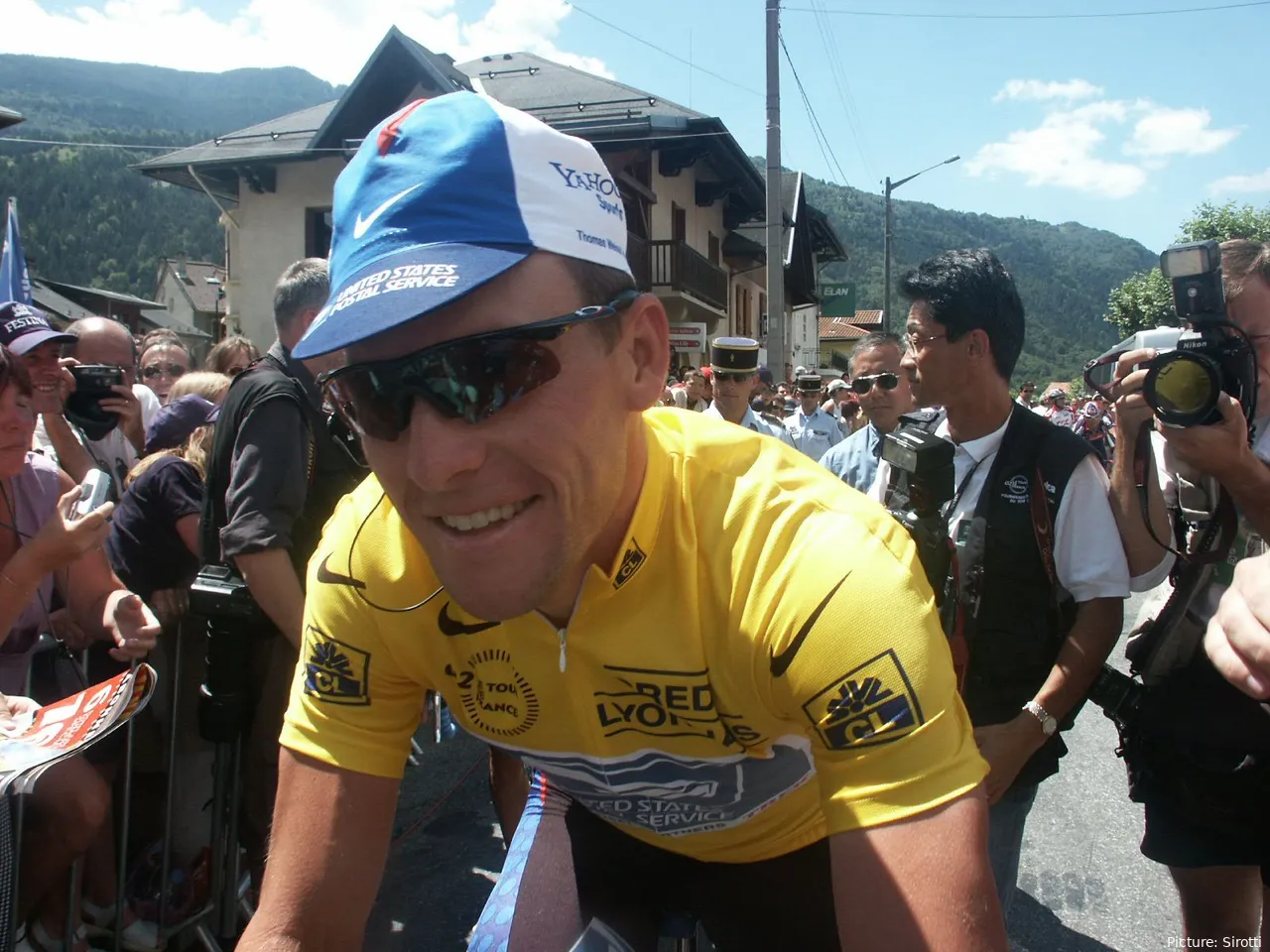
Lance Armstrong in the Tour de France Maillot Jaune for US Postal
Reflecting on his approach at the top
Armstrong also addressed long-standing criticism of his behaviour within the peloton, where he was often portrayed as an uncompromising and dominant figure. “But I think there were very few nice guys at the top of the sport at that time,” he said. “Looking back, maybe I should have enjoyed it more and taken time to appreciate what I achieved. In some ways, I pushed things to the extreme.”
That mindset, he suggested, was inseparable from the demands of elite sport. “It was a job and I was paid to win, so that’s what I did,” he said. “But I may have taken that too far, and in the end I paid the price for it. On the bike it worked, but off the bike it didn’t anymore.”
Armstrong’s comments arrive as interest in his story grows again beyond cycling, with a major Hollywood biopic currently in development. Whether that renewed attention alters how his career is remembered remains uncertain, but his latest remarks underline how he continues to interpret a period that reshaped both his life and the sport.
Kieran WoodDeputy Editor-in-Chief
Kieran Wood is a sports journalist based in Wales and has been active in journalism since 2022. He regularly contributes to DartsNews.com and CyclingUpToDate.com, where he covers professional cycling and darts. In cycling, his work includes liveblogs from major races, including the Tour de France, the Giro d’Italia, and La Vuelta a España, alongside race reports and analysis. He has also conducted interviews with professional riders.
His reporting spans the full racing calendar, from one-day classics to stage races, with a focus on accurate, real-time coverage and clear contextual analysis. For statistics, results, and historical context, he regularly uses resources such as ProCyclingStats. To support reporting on rider activity and training context where relevant, he also references Strava.
In his work, Kieran places strong emphasis on careful sourcing, editorial accuracy, and updating articles as new, verified information becomes available.
claps 12visitors 6
Just in
Popular news
Latest comments
- Arrieta I think has more potential than Frigo and Balderstone. Ramírez is one who can become a GC rider, Fabries is more of a diesel climber. He only really does well in MTTs. When you add Molano and Sivakov, it seems a transfer loss overall. However, comparing the transfer season of a stacked team like UAE to lower teams isn't fair anyway. Riders tend to diffuse outwards anyway
 Rafionain-Glas26-10-2026
 - There's quite a large range of time where van der Poel is less likely to race than not, possibly a month. The Worlds sit in that window. So it seems that its more likely than not that he'll not race.Rafionain-Glas26-10-2026
- Maybe ruben silva still dont get it but visma is broke they aint signing anyone. They desperately need tier one climberse but all they can buy is fabio jakobsen..Typing is on the wall there to say the least...:(miguel26-10-2026
- I didn't say Tadej should ride it. I'm stating HE wanted to ride it and as a matter of fact had to be talked out of it. The other accidents mentioned in this headline were so much worse.mij26-10-2026
- I'm not downplaying the impacts. He would have been a fool to ride EU. I'm commenting that Roll's position is idiotic - to compare Tadej's two broken bones and a concussion to what Froome/Bernal/Jonas went through and suggest it could hold Tadej back is equally foolish. As bad as it might have been, Tadej's accident was a joke compared to what the others went through.mij26-10-2026
- If others agree and you do the same, maybe we have a shot at getting them to reverse the obvious deterioration they’ve decided to embark on. It would also leave you know mou more or less in an echo chamber.Jumpyjohn26-10-2026
- if you have three leaders , it has never worked in cycling properly. If you have two, one attacks the other follows as the US did it to perfection in the worldsabstractengineer26-10-2026
- Besides Pogi they dont need anybody else. I think that UAE is a bad team for development. One is the race is done at Pogi's intensity which is bad for a developing rider and you can only do part of the race, no energy left for the rest.abstractengineer26-10-2026
- Very distorted headlineKatla26-10-2026
- Agreed, but nobody thinks ahead that much, especially so-called fans, they are the first to demand their rights to joy and entertainment, regardless of the price their hero pays. You only have to look at boxing/rugby research on past athletes’ problems in retirement to see how little their OWN fans really care.Jumpyjohn26-10-2026
Loading
22 Comments