Hollywood bidding war erupts over Lance Armstrong biopic with Austin Butler set to play cycling’s most polarising figure
Cycling
A major Hollywood bidding war has broken out around a biopic of Lance Armstrong, underlining how powerfully the most controversial name in cycling history still resonates far beyond the sport that cast him out.
The project, which will see Austin Butler, famous for playing Elvis in the 2022 biopic, portray Armstrong, has attracted intense studio interest at the package stage, a rare signal of confidence in a story many within cycling would rather leave untouched. For filmmakers, Armstrong remains compelling material. For cycling, his legacy remains far more uneasy.
The highest peak cycling ever saw
Armstrong’s rise was not simply a run of Tour de France victories, but a period of total control. Between 1999 and 2005, he dominated the Tour to such an extent that entire teams recalibrated their ambitions around second place. His US Postal Service squad set new standards for tactical discipline, preparation and mountain control, reshaping how Grand Tours were raced.
Coupled with his highly publicised comeback from advanced cancer, Armstrong became the most powerful figure the sport had ever produced. He drove unprecedented commercial growth, pulled American audiences into the Tour de France, and influenced training and team structures across the peloton.
Those years were foundational. They left a mark on cycling that extended well beyond his own results.

The fall that closed the door completely
The collapse was equally definitive. Following the 2012 USADA investigation and a public admission of doping on the Oprah Winfrey show, Armstrong’s seven Tour titles were stripped in full, and his lifetime ban was imposed. Unlike other riders from the same era, there was no path back into the sport, no gradual re-entry through media or management roles.
Cycling drew a hard line. Armstrong was not just sanctioned, but excluded, becoming a fixed point in the sport’s past rather than a voice within its present. That decision shaped how professional cycling attempted to rebuild credibility and distance itself from its most damaging chapter.
Why Hollywood is circling now
Armstrong’s story has already been told through investigation and exposure, most notably in The Program, which mirrored cycling’s own need to dismantle the myth.
This new project is positioned very differently. With Edward Berger directing and Zach Baylin attached, the focus is expected to shift towards character, power and belief rather than evidence and procedure. That approach, combined with Armstrong’s life rights now secured, explains why studios see this as prestige material capable of sustaining a bidding war.
For cinema, the scandal is settled. What remains is a study of dominance and collapse at the very top of sport.
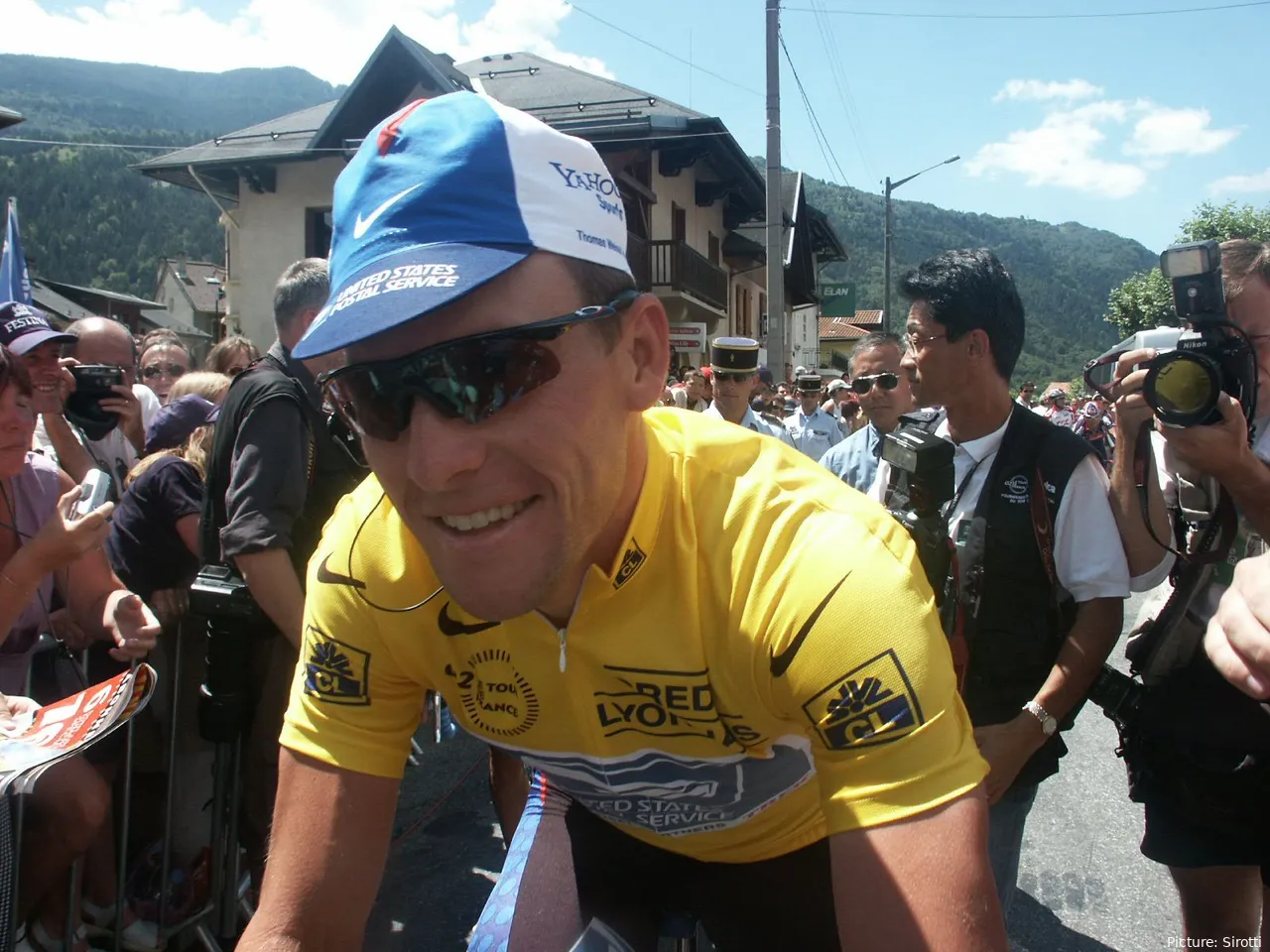
Armstrong is the most controversial figure in cycling's long and storied history
A legacy revived from outside the sport
For cycling fans, the discomfort lies not in revisiting old verdicts, but in watching one of the sport’s most divisive figures re-enter the spotlight through a medium that operates on very different terms.
Armstrong no longer belongs to professional cycling in any meaningful way. Yet the scale of Hollywood’s interest shows his story still carries extraordinary weight beyond it. The bidding war itself is the clearest indication that, even years after his exclusion, Armstrong remains impossible to ignore.
That tension between cycling’s desire to move on and cinema’s eagerness to look back is exactly why this biopic matters, and why it will land so awkwardly within the sport that produced him.

Kieran WoodDeputy Editor-in-Chief
Kieran Wood is a sports journalist based in Wales and has been active in journalism since 2022. He regularly contributes to DartsNews.com and CyclingUpToDate.com, where he covers professional cycling and darts. In cycling, his work includes liveblogs from major races, including the Tour de France, the Giro d’Italia, and La Vuelta a España, alongside race reports and analysis. He has also conducted interviews with professional riders.
His reporting spans the full racing calendar, from one-day classics to stage races, with a focus on accurate, real-time coverage and clear contextual analysis. For statistics, results, and historical context, he regularly uses resources such as ProCyclingStats. To support reporting on rider activity and training context where relevant, he also references Strava.
In his work, Kieran places strong emphasis on careful sourcing, editorial accuracy, and updating articles as new, verified information becomes available.
claps 6visitors 6
Just in

Popular news
Latest comments
- TT But he won by a minute so he could have cut down on some of it
 Rafionain-Glas13-10-2026
 - weight is measurable. power is measurable. So why didn't he prepare that way from the TDF if he wanted to beat Pogi and after Pogi wasn't going to be there, to win.abstractengineer13-10-2026
- I hope Thibau and Tibor don't do the sameRafionain-Glas13-10-2026
- Seixas is exactly what I would like Pogi to be mentally and in his statements. Both come across as shy and who don't talk much but with Seixas, you can see that he enjoys success, that it boosts his ego, unlike Pogačar who seems to feel increasingly uncomfortable the more he wins. He's won so many times, people are saying he's boring. The french media hate him for winning so much, the french cycling fans are booing him... etc. etc. But remember one thing, Seixas will never physically reach Pogi's level. He's excellent, but he isn't at that level nor will ever be. His talking to the media, his relationship with people is already at a high level.PogiSloFans13-10-2026
- Paul Seixas is now the second-best rider in the world.megasmacky13-10-2026
- When will they start dropping Pogi? Oh yeah, when Pogi reaches 40+ years, that's when young cyclists will start dropping him. But until then... eat your hearts out and cry. Pogi will remain the G.O.A.T. for years to come. Capish?PogiSloFans13-10-2026
- I figure he would have found out how to outsprint Paul and take the win, maybe. He's 28 now but I would say he's right at the peak of his powers. It was great race though, Paul showed me something different about himself.awp13-10-2026
- Slowly, very slowly... 5-7 yrs. ;)MajorPayne13-10-2026
- Up to this point: "It is just not yet at the level of Vingegaard and Pogacar." First Jonas, and then level of Tadej. Period!MajorPayne13-10-2026
- The sport has long had a divide between the more diesel-like riders and the more explosive riders. Where does Pogačar fit? His explosive attacks are followed by a high speed diesel climb and he's rarely been caught in the past 5 years (people can name the moments, it's so rare). Seixas is young and we have no idea where his body will end up on this spectrum (just like we didn't with Pogačar when he was 20 and being a diesel up the Vuelta mountains of 2019). Speculation is fun, being a fan while it unfolds is going to be more fun.RidesHills13-10-2026
Loading

Austin Butler is set to star in a movie about infamous cyclist Lance Armstrong from director Edward Berger (Conclave). 🔗 deadline.com/2026/02/austin…


4 Comments