"It started off peacefully, but that wasn't the case in the last week" - Visma DS recounts genuine safety fears during Vuelta protests
Cycling
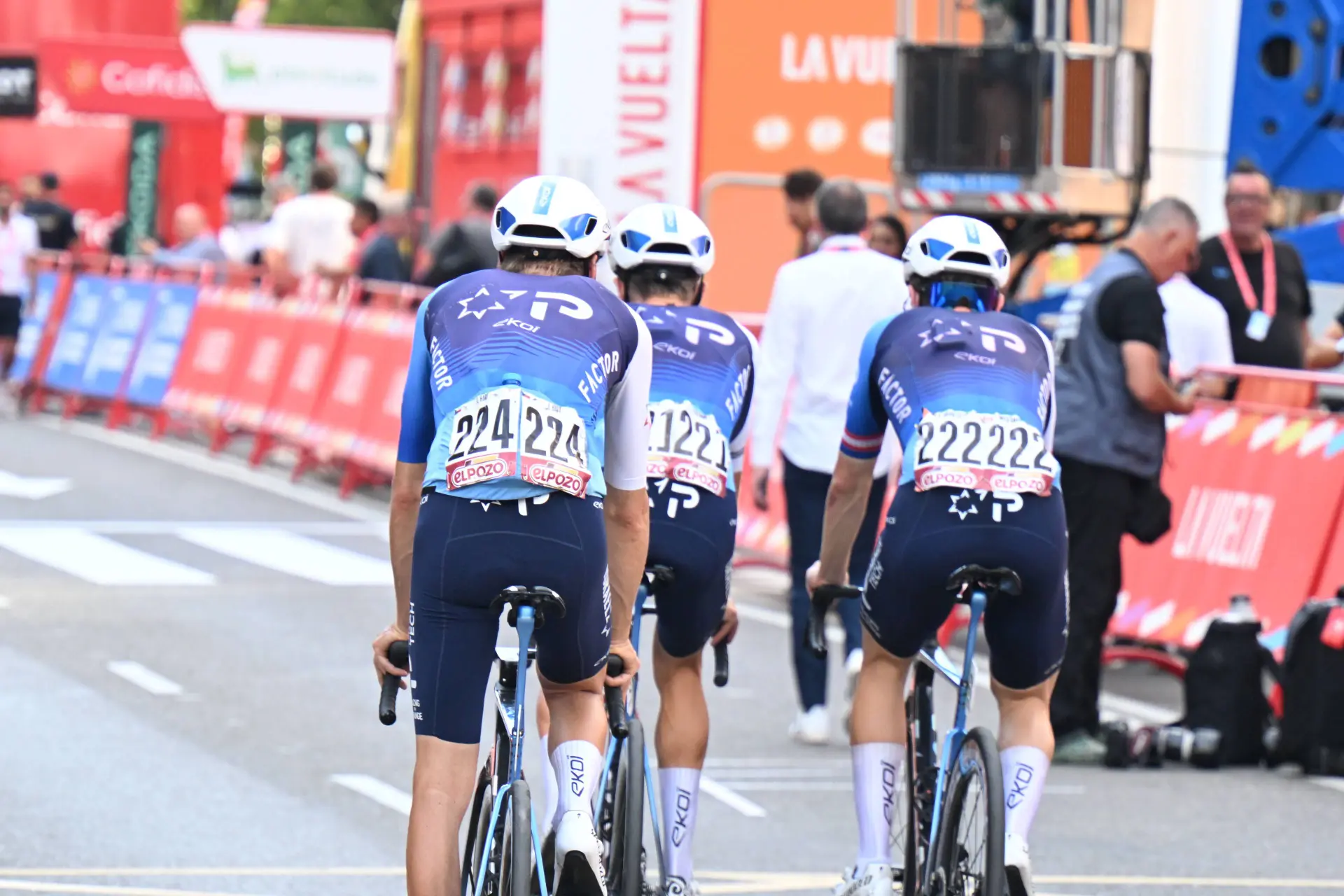
The Vuelta a Espana is no stranger to drama on the road, but in 2025, it was the scenes off it that dominated headlines. Pro‑Palestinian protests, triggered by the participation of Israel – Premier Tech, marred multiple stages of the race and raised serious questions about rider safety, freedom of expression, and the politicisation of sport.
For Team Visma | Lease a Bike’s sports director Jesper Morkov, the sense of unease wasn’t theoretical — it was uncomfortably real.
“We were meant to have a meeting on the team bus,” Mørkøv recalled on the Café Eddy podcast. “But then a rider messaged: ‘Are you sure we should be doing this on the bus?’ We looked outside and saw around 200 protesters and police all around us. So we decided to hold the meeting inside the hotel instead.”
It was just one of several moments during the three-week Grand Tour when the boundaries between elite sport and political activism collided head-on. From Bilbao to Madrid, demonstrators lined the roads with banners, flags, and megaphones, calling attention to Israel’s military actions in Gaza. Their target: Israel – Premier Tech.
"The Bahrain team car got smashed"
The tension escalated as the race wore on. By the final week, peaceful protests had morphed into something far more unpredictable. Stage 15 was interrupted when a protester attempted to step onto the course, triggering a crash. Stage 16 had to be shortened due to safety concerns. And most dramatically, the entire final stage in Madrid was abandoned midway, as over 100,000 demonstrators surged into the capital's streets.
“It started off quite peacefully, but that wasn’t the case during the final week,” Mørkøv admitted. “I think I’m quite good at blocking it all out when it happens. But I believe it was the Bahrain team car that got smashed the day before the final stage. That does make you stop and think.”
The most fraught moments came when teams were forced into close proximity. For Visma, sharing accommodation with Israel – Premier Tech brought added layers of discomfort. “We stayed at the same hotel as Israel on two separate occasions,” said Mørkøv. “And you could tell — this wasn’t like staying with Lidl–Trek or Quick-Step.”

Scenes in Madrid when Stage 21 was cancelled
Organisers struggled to contain the fallout. Extra police were deployed, routes were altered, and podium ceremonies were either scaled back or cancelled altogether. The peloton, meanwhile, pressed on under a growing cloud of uncertainty.
Israel – Premier Tech eventually removed the word “Israel” from their jerseys in an attempt to quell the protests, though it did little to calm the rising tensions. The UCI later condemned what it called “militant disruptions,” while race organisers labelled the scenes “absolutely unacceptable.”
In the end, Jonas Vingegaard claimed overall victory, but there was no final stage to celebrate it — no traditional laps around Madrid, no crowd-lined sprint finish. Just a race cut short, and a peloton left to ponder what it means when cycling intersects with world affairs in such a visceral, visible way.
As the dust settles, the 2025 Vuelta may well be remembered less for its GC battle and more as a watershed moment — a reminder that even in professional cycling, sport does not exist in a vacuum.


Kieran WoodDeputy Editor-in-Chief
Kieran Wood is a sports journalist based in Wales and has been active in journalism since 2022. He regularly contributes to DartsNews.com and CyclingUpToDate.com, where he covers professional cycling and darts. In cycling, his work includes liveblogs from major races, including the Tour de France, the Giro d’Italia, and La Vuelta a España, alongside race reports and analysis. He has also conducted interviews with professional riders.
His reporting spans the full racing calendar, from one-day classics to stage races, with a focus on accurate, real-time coverage and clear contextual analysis. For statistics, results, and historical context, he regularly uses resources such as ProCyclingStats. To support reporting on rider activity and training context where relevant, he also references Strava.
In his work, Kieran places strong emphasis on careful sourcing, editorial accuracy, and updating articles as new, verified information becomes available.
claps 0visitors 0
Just in

Popular news
Latest comments
- How broke is visma now? wtf they cant even fight moviestar and decathlon for riders and lose both their mid targets based on their budget and they cant even get those? Crazy...:/miguel13-10-2026
- TT But he won by a minute so he could have cut down on some of it
 Rafionain-Glas13-10-2026
 - weight is measurable. power is measurable. So why didn't he prepare that way from the TDF if he wanted to beat Pogi and after Pogi wasn't going to be there, to win.abstractengineer13-10-2026
- I hope Thibau and Tibor don't do the sameRafionain-Glas13-10-2026
- Seixas is exactly what I would like Pogi to be mentally and in his statements. Both come across as shy and who don't talk much but with Seixas, you can see that he enjoys success, that it boosts his ego, unlike Pogačar who seems to feel increasingly uncomfortable the more he wins. He's won so many times, people are saying he's boring. The french media hate him for winning so much, the french cycling fans are booing him... etc. etc. But remember one thing, Seixas will never physically reach Pogi's level. He's excellent, but he isn't at that level nor will ever be. His talking to the media, his relationship with people is already at a high level.PogiSloFans13-10-2026
- Paul Seixas is now the second-best rider in the world.megasmacky13-10-2026
- When will they start dropping Pogi? Oh yeah, when Pogi reaches 40+ years, that's when young cyclists will start dropping him. But until then... eat your hearts out and cry. Pogi will remain the G.O.A.T. for years to come. Capish?PogiSloFans13-10-2026
- I figure he would have found out how to outsprint Paul and take the win, maybe. He's 28 now but I would say he's right at the peak of his powers. It was great race though, Paul showed me something different about himself.awp13-10-2026
- Slowly, very slowly... 5-7 yrs. ;)MajorPayne13-10-2026
- Up to this point: "It is just not yet at the level of Vingegaard and Pogacar." First Jonas, and then level of Tadej. Period!MajorPayne13-10-2026
Loading
Write a comment