"I have exceeded all my expectations" - Pello Bilbao bids farewell to cycling with sense of satisfaction
Cycling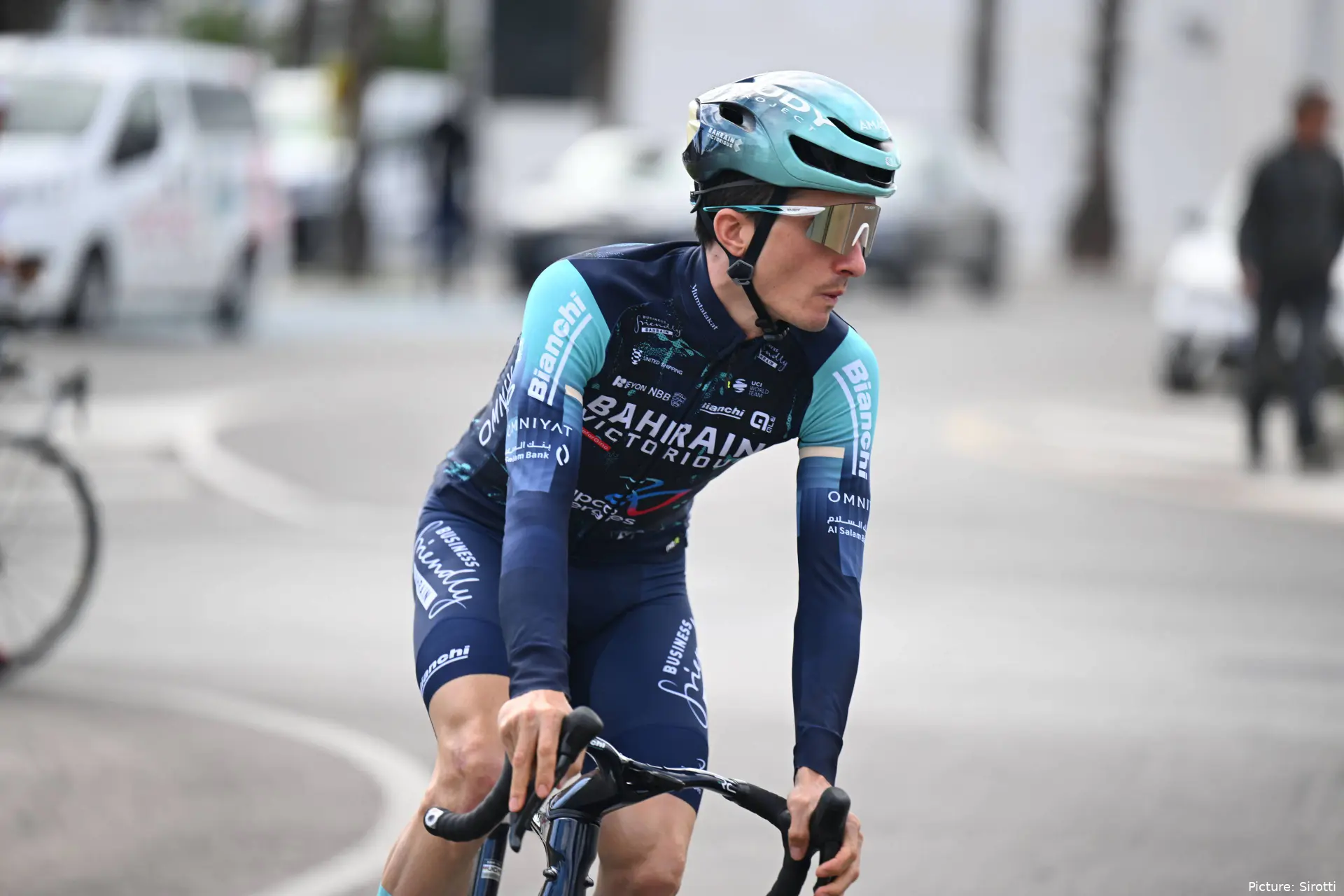
Pello Bilbao faces the final race of his professional career at Il Lombardia this Saturday. At 36, the Basque rider will bring a 15-season spell in the elite peloton to an end, a career that exceeded even the expectations he had set during his early professional years. Far from nostalgia or the need to secure one last major result, the Bahrain Victorious rider approaches his farewell with one very clear word: "Relaxed."
In an interview with Domestique, Bilbao looks back on a career of steady growth that reached its peak after he turned 30. A stage winner at the Giro d’Italia and a regular presence in major one-day races, he experienced one of the most special moments of his career at the 2023 Tour de France. His breakaway victory in Issoire marked the culmination of a goal he considered essential for a rider of his profile.
His last Vuelta a España also gave him an experience that went beyond individual results. Although he targeted victory in the final stage in Granada to complete a clean sweep of stage wins in all three Grand Tours, Bilbao ultimately prioritised a different mission: helping his young teammates compete at the highest level. Jakob Omrzel’s victory and Santiago Buitrago’s mountains jersey added significance to a farewell in which the collective legacy took on special importance.
The Basque rider also reflects on the profound transformation cycling has undergone since his debut in 2011. Speed, nutrition, pressure to score UCI points and safety concerns are all part of a sport that, in his view, must adapt to a new reality. Before closing the door on his professional career, Bilbao hopes to deliver one final strong performance in Lombardy. Afterwards, he wants to pause, enjoy time with his family and decide without rushing which path to follow.
A career that exceeded expectations
“I believe I have completely fulfilled my expectations. I have even achieved more than I expected, especially considering my early years as a professional, when I was nowhere near the front of the races.” Bilbao summarises his development since making his debut with Euskaltel Euskadi in 2011. His progress was constant until he reached his best level at around 33, a sporting maturity that enabled him to achieve some of the most important results of his career.
Two stage victories at the 2019 Giro d’Italia confirmed his ability to fight for wins in the Grand Tours, but the Tour de France provided his most special success. In 2023, Bilbao won the tenth stage, finishing in Issoire, after a day in the breakaway. “For a rider like me, winning a Tour de France stage is the biggest goal you can achieve,” he admits. Although he had come close on other occasions, that victory carried a different meaning: “For me, it was an obligation.”
The Vuelta represented his final opportunity to win a stage in all three Grand Tours. The Basque rider prepared specifically for the final day in Granada, aware that he would probably never have another similar chance. However, his strategy did not unfold as expected and the victory slipped away. Rather than regretting it, he believes completing that particular treble would not have substantially changed the memory he leaves as a cyclist. “If people remember me, it will not be because I joined that select group at the very end of my career,” he explains.
His farewell to the Spanish race ultimately acquired a different meaning. Bilbao devoted himself to helping his teammates, particularly Omrzel, who won a stage at Calar Alto, and Buitrago, who claimed the mountains classification. “For me, the most important mission was getting the team to that level,” he says. The Basque rider enjoyed his final Grand Tour by passing on his knowledge to the younger riders and contributing to their success. “When you help someone achieve an important victory, you create a connection for life,” he adds.

Pello Bilbao gives goodbye to professional cycling in 2026
Modern cycling: fast, demanding and dangerous
Fifteen seasons in the peloton have allowed him to witness a profound transformation of the sport. Bilbao identifies two fundamental factors: the aerodynamic development of equipment and advances in nutrition. As an example, he recalls that at the beginning of his career, energy gels were used almost exclusively for the final effort. The amount of carbohydrate consumed by riders was far lower than it is today. Now, he explains, he himself takes around 110 grams per hour, while some cyclists exceed 150.
The way riders compete has also changed. In the past, teams would usually divide their objectives between sprints, the general classification, or stage wins. Today, the major structures aim to control different scenarios and compete for virtually every stage. Bilbao believes that ambition, combined with the pressure to collect UCI points, has raised the demands and reduced the room for manoeuvre for many riders.
The points system has direct consequences for team planning. Finishing among the top five in a WorldTour classic can be a valuable result because of the points earned, even without reaching the podium. However, Bilbao warns that this dynamic can also undermine the confidence of some professionals. “Many riders have stopped believing in their abilities,” he laments, explaining how increasingly difficult it has become to win, even in lower-category races.
Safety is another of his concerns. He estimates that the average speed has increased by around three or four kilometres per hour since his early years, with the peloton now reaching speeds close to 70 km/h on flat roads. In Bilbao’s view, protective measures have not advanced at the same pace. He therefore calls for a review of some routes that, despite their historical tradition, are particularly dangerous in modern cycling. “Cycling is a different sport now, and I think we need to adapt some routes and move away from cycling history to a certain extent,” he argues.
Il Lombardia, the final page of his career
Bilbao approaches his fourth appearance in the Giro di Lombardia with different feelings from those that marked previous season finales. Usually arriving in October with considerable accumulated fatigue, he feels fresh and motivated this year after skipping the Tour de France and racing only the Vuelta as his major stage race. His 2026 results support that confidence: he finished sixth at Liège-Bastogne-Liège and fifth at the Clásica de San Sebastián. He also believes mechanical problems prevented him from showing his best form in races such as the Amstel Gold Race and Strade Bianche.
Read also
The Basque rider believes experience and maturity allow him to perform better in long, demanding classics that place a heavy emphasis on aerobic capacity. That is why he approaches Lombardy feeling he can still produce an outstanding performance. However, he does not need a victory to end his career satisfied. Having exceeded expectations during his early years, he does not feel he has any unfinished business to resolve before retiring.
His next chapter has yet to be written. Bilbao has not drawn up a professional plan for life after cycling and wants to spend the next year resting, sharing time with his children, family, and friends, and discovering what he wants to do in the future. “I simply want to breathe and stop,” he explains. It will be a chance to step away from the demands of the calendar and make decisions without the pressure of preparing for another season.
The farewell will come this Saturday, in one of the calendar’s great classics, but the result will not determine the overall assessment of a career that reached its finest level when many riders are already beginning to think about retirement. Bilbao leaves with victories in major stage races, prominent results in the classics, and the satisfaction of helping others achieve their goals. It is a career that has given him more than he imagined, summed up in a sentence that reflects his state of mind at the end: “I couldn’t ask for more.”

Ondrej ZhasilCycling Journalist
Ondřej Zhasil is a cycling journalist at CyclingUpToDate and has been part of the team since 2023. He is based in Ostrava, the third-largest city in the Czech Republic, and covers professional cycling across the main UCI competitions, including the Tour de France, the Giro d’Italia, and La Vuelta a España. A key focus of his work is startlist analysis and pre-race coverage, where he examines team selections, rider line-ups, and tactical scenarios ahead of major events.
Alongside WorldTour coverage, Ondřej has developed specific expertise in junior cycling and in racing across East Asia, including competitions in China and Japan. He also maintains a broad working knowledge of other disciplines and levels, including cyclocross, while continuing to expand his understanding of mountain bike racing.
Ondřej holds a bachelor’s degree in Mathematics and Physics, which supports his analytical, data-driven approach to performance and race analysis. In his reporting, he regularly uses ProCyclingStats for results, statistics, and historical context. He places strong emphasis on careful sourcing, editorial accuracy, and updating articles promptly when new, verified information becomes available.
claps 0visitors 0
Just in
Popular news
Latest comments
- Now that all the top guys are here, Remco has to win this to prove Euro was not a fluke.abstractengineer10-10-2026
- great dudemij10-10-2026
- they gotta get this fixed. it is atrocious.mij10-10-2026
- this team is stackedmij10-10-2026
- I would not put Paul Seixas as a fave over Remco.mij10-10-2026
- Skelly will be next. If the leader is far above, its simple like Pogi and ALmeida/Del Toro. But we saw Skelly beat Ayuso in the TDF where Ayuso was leader.abstractengineer10-10-2026
- Yes man that would draw a crowdwrsty10-10-2026
- That is what is called "dreaming". "The victory was quite close" . minutes is not close for a GT. anything above 2 minutes is a comfortable victory, above 5 minutes a overwhelming victory and Remco did not even tryabstractengineer10-10-2026
- Remco wins!
 DareDevil10-10-2026
 - I wonder if this had anything to do with the controversial finish at the Euros and Ciccone's Instagram post which followed?Cooldude10-10-2026
Loading
1 Comments