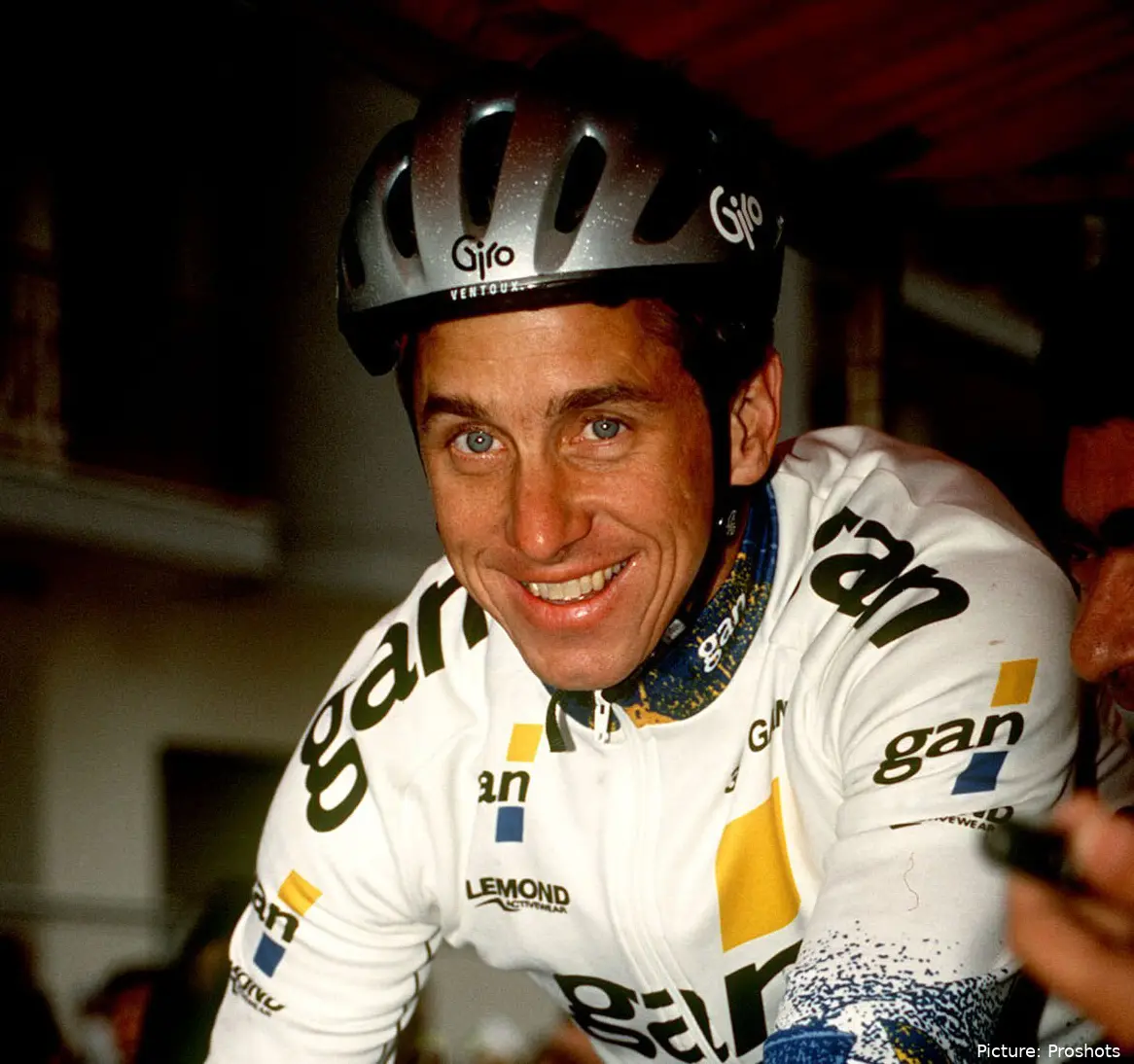
Former American pro Greg LeMond has recently spoken about the current standard of anti-motor doping protocols in professional cycling, addressing concerns over hidden motors in the sport.
The American legend has an impressive palmarès, including three Tour de France, two World Championships and 31 victories overall. He has often talked about doping rumours in the current peloton, and this time he did so at Rouleur Live.
"All of a sudden, the quality of bikes, derailleurs and batteries has gotten so much better over the last eight years," LeMond said in comments gathered by Domestique, highlighting how technological advances could make detection much harder. Despite this, he expressed confidence in current controls. "I don't think that's an issue now. You've got to keep at it. You've got to test it."
Motor doping, or mechanical doping, involves using a concealed motor on a bicycle to gain an unfair advantage. The first confirmed case came in 2016, when Belgian cyclist Femke Van den Driessche was caught with a hidden motor during the under-23 Women’s event at the UCI Cyclocross World Championships, resulting in a six-year ban. The Belgian rider did not defend herself and immediately announced her retirement after knowing the sentence.
One of the first allegations of mechanical doping can be traced back to the 2010 Tour of Flanders, when Fabian Cancellara dropped Tom Boonen after attacking in the steepest section of the Kapelmuur without leaving the saddle. The Swiss legend has always denied the accussations.
How to identify potential motor use?
LeMond explained that cadence analysis can help detect riders using hidden motors. "There's an RPM efficiency on power output. So if you're, if you see, even on climbs today, you'll see riders within five RPMs at the same power output," he said. "When you see somebody above that, five to 10 RPMs, that's not a good sign."
He also proposed more advanced detection methods in the past, but they were ultimately rejected by the UCI. "I actually did some research and I found these x-ray machines that weren't cheap, but you could test every bike at the peloton in 60 seconds," LeMond revealed.
He also explained how such technology could make anti-mechanical doping controls more efficient. "These are things at the border of control. And that means you don't even have to take the bikes," he said, drawing a comparison with security screening systems used in other industries.
Despite setbacks, LeMond expressed cautious optimism about the current system. "I do think you look at the RPMs of riders today, I know they're testing. So it gives me a lot of satisfaction," he concluded.
Read also

Félix SernaCycling Journalist
Félix Serna is a writer at CyclingUpToDate and has been part of the team since 2025. He covers professional cycling across both the men’s and women’s calendars, with a focus on UCI rankings, race developments, and rider performance. His work includes interview-based reports, liveblogs, and tournament coverage designed to provide clear, accurate context throughout the season.
In his reporting, Félix regularly uses ProCyclingStats for results, statistics, and historical reference. He places strong emphasis on careful sourcing, editorial accuracy, and updating articles promptly when new, verified information becomes available. He holds a bachelor’s degree in International Studies.
claps 0visitors 0
Just in

Popular news
Latest comments
- TT But he won by a minute so he could have cut down on some of it
 Rafionain-Glas13-10-2026
 - weight is measurable. power is measurable. So why didn't he prepare that way from the TDF if he wanted to beat Pogi and after Pogi wasn't going to be there, to win.abstractengineer13-10-2026
- I hope Thibau and Tibor don't do the sameRafionain-Glas13-10-2026
- Seixas is exactly what I would like Pogi to be mentally and in his statements. Both come across as shy and who don't talk much but with Seixas, you can see that he enjoys success, that it boosts his ego, unlike Pogačar who seems to feel increasingly uncomfortable the more he wins. He's won so many times, people are saying he's boring. The french media hate him for winning so much, the french cycling fans are booing him... etc. etc. But remember one thing, Seixas will never physically reach Pogi's level. He's excellent, but he isn't at that level nor will ever be. His talking to the media, his relationship with people is already at a high level.PogiSloFans13-10-2026
- Paul Seixas is now the second-best rider in the world.megasmacky13-10-2026
- When will they start dropping Pogi? Oh yeah, when Pogi reaches 40+ years, that's when young cyclists will start dropping him. But until then... eat your hearts out and cry. Pogi will remain the G.O.A.T. for years to come. Capish?PogiSloFans13-10-2026
- I figure he would have found out how to outsprint Paul and take the win, maybe. He's 28 now but I would say he's right at the peak of his powers. It was great race though, Paul showed me something different about himself.awp13-10-2026
- Slowly, very slowly... 5-7 yrs. ;)MajorPayne13-10-2026
- Up to this point: "It is just not yet at the level of Vingegaard and Pogacar." First Jonas, and then level of Tadej. Period!MajorPayne13-10-2026
- The sport has long had a divide between the more diesel-like riders and the more explosive riders. Where does Pogačar fit? His explosive attacks are followed by a high speed diesel climb and he's rarely been caught in the past 5 years (people can name the moments, it's so rare). Seixas is young and we have no idea where his body will end up on this spectrum (just like we didn't with Pogačar when he was 20 and being a diesel up the Vuelta mountains of 2019). Speculation is fun, being a fan while it unfolds is going to be more fun.RidesHills13-10-2026
Loading
Write a comment