“His physiology seems completely unimaginable to me” – why Tadej Pogacar’s domination defies science, according to Tudor nutrition expert Tim Podlogar
Cycling
Tadej Pogacar’s 2025 season left most of the peloton gasping. It also left one of cycling’s leading sports scientists slightly stunned.
“This year, what stuck with me most was the domination of Tadej Pogacar. I find it exceptional that he is capable of winning such different types of races – from stage races to the most demanding one-day Classics. His physiology seems completely unimaginable to me. It is incredible how he can maintain such high numbers, such a strong rhythm, for so long, and still not arrive at the finish totally exhausted,” says Dr Tim Podlogar, lecturer and head of the Centre for Sports Physiology and Exercise Testing at the University of Exeter, speaking to Slovenian outlet Siol. “It would be excellent if we could study Tadej’s physiology in the laboratory, for example with muscle biopsies, and find out how his muscles function,” he adds – fully aware that there is little chance of that while Pogacar is still rewriting the record books.
Podlogar is not an armchair theorist. He previously shaped fuelling plans at Red Bull - BORA - hansgrohe (including Jai Hindley’s Giro-winning strategy) and now works behind the scenes at the Tudor Pro Cycling Team, advising the team’s nutritionists and occasionally its coaches.
“In the Tudor team I work as a consultant to the nutritionists and occasionally the coaches. This is something I had wanted to do for some time, as it allows me to use my knowledge to help cyclists and leave my mark in the sport, while still dedicating most of my time to science,” he explains. “Our goal for now is not to win the Tour de France or the Giro, but to win a stage at a particular race or reach the podium. The team’s aim is learning, progressing from season to season, and that maybe in three years we become a team with a WorldTour licence.”
Why 200g of carbs per hour can be “shooting yourself in the foot”
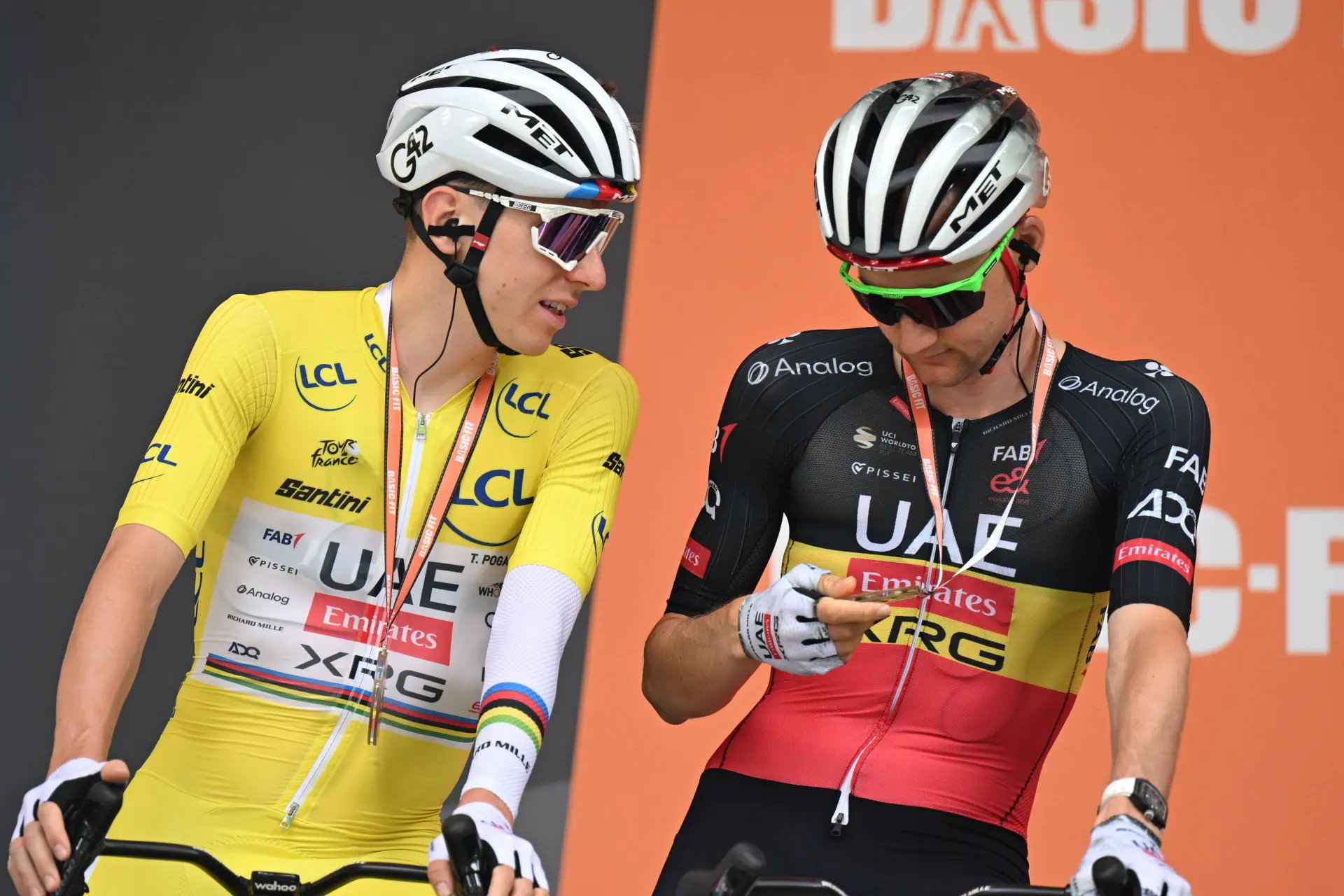
If Pogacar’s physiology fascinates Podlogar, the sport’s latest fuelling arms race worries him. “As for new developments: in the last year or two a trend of extremely high carbohydrate intake during races has transferred from triathlon into cycling. Ten years ago riders consumed around 80–100 grams of carbohydrate per hour; until recently they aimed for around 100–120 grams; today some riders are already talking about 150–200 grams per hour, which is huge even for professionals.”
On paper it looks simple: more carbs, more power, more performance. In reality, Podlogar sees teams drifting away from the basics and straight into trouble. “In cycling, especially in multi-day stage races, energy balance is extremely important. The problem can go either way – sometimes too few carbohydrates, for example in mountain stages, and at other times too many, for example in sprint stages. Finding the right ratio and distribution is a constant challenge and a topic of endless discussion.”
He gives a very concrete example: when sprinters are taking in 120 g per hour on a relatively easy flat day, “at the end of the day you find that the energy intake was too high – which means that in theory the rider would have to ‘skip dinner’, which the day before a hard mountain stage would be shooting yourself in the foot.”
For the sport’s very best climbers, he sees a clear sweet spot. “For riders like Tadej Pogacar and Primoz Roglic, who weigh between 60 and 70 kilos, an intake of around 100–130 grams per hour during the hardest stages is the most sensible, definitely not 180 or even 200.”
Vingegaard vs Van Aert: why two plates can look nothing alike
If Pogacar and Roglic are the obvious poster boys for high-performance fuelling, Podlogar is just as keen to stress how different riders within the same team really are. “Yes, intakes differ greatly between riders, so recently there has been more focus on individualising nutrition. I am currently researching how to determine the optimal carbohydrate intake for each individual rider during a race – the amount his body can actually absorb and effectively use during competition.”
That is why he is relaxed about Jonas Vingegaard and Wout van Aert – two riders doing the same race – sitting down to completely different dinners. Body mass, role in the race, the following day’s profile and individual gut tolerance all matter more to Podlogar than blindly copying a headline number like “150–200 g per hour”.
“The key is understanding the bigger picture – you must always know what comes the next day, not focus solely on the current stage. Energy balance in cycling is very delicate. Although it may seem that riders can eat everything they see, in reality this is not true – their food intake is also limited, so the distribution of energy between days is crucial for success.”
Heat adaptation slots into the same picture. For Pogacar, Podlogar believes it has been quietly decisive. “In the heat, carbohydrate needs are higher because certain enzymes work faster and the relative effort is higher. Even if absorption appears similar to normal conditions, the effectiveness of ingested carbohydrates in the heat is slightly lower, which Tadej Pogacar complained about at the 2023 Tour. The best preparation for heat is heat acclimation, which mitigates most of the negative effects."
“If I am correctly informed, this is also one of the things Tadej has recently focused on – he began working systematically on heat adaptation, which allowed him to regain his dominance.”
Ketones, REDs and why the UCI is looking in the wrong place
Away from rice cakes and gels, Podlogar is sceptical about the way the UCI has moved against ketones. “To be honest, I find it somewhat strange. It’s true that ketones have no proven effect, but at the same time they are not doping, so I don’t understand why they would be prohibited or discouraged. There are many other things that would deserve attention far more and might be more sensible to discourage.”
Instead of headline-grabbing supplements, he worries about the workload hidden in the small print of race calendars. “Some riders really accumulate a huge number of race days, which can lead to overtraining, health problems or even REDs, a syndrome in which the body begins to function worse due to an energy deficit – from hormonal balance to the immune system. These are things that deserve more attention in professional cycling, as they affect both health and performance in the long term.”
It is a neat contrast with ketones, cherry juice and bicarbonate – products that dominate conversations, even if the evidence is thin or context-specific. Podlogar is clear that the sport has not outgrown simple, boring basics. “The most important thing is having the basics of nutrition in order. This means having glycogen stores filled before races and important training sessions – only then does it make sense to think about supplements.”
And as for his own riding? “I personally don’t use any supplements in training except carbohydrates, because I simply don’t believe other supplements would bring enough benefit to make them worthwhile.”
From Pogacar’s “completely unimaginable” physiology to 200 g-per-hour fuelling trends and UCI ketone memos, Podlogar’s message through Siol is surprisingly simple: respect the basics, individualise the details – and do not mistake the latest fad for the real engine of performance.


Kieran WoodDeputy Editor-in-Chief
Kieran Wood is a sports journalist based in Wales and has been active in journalism since 2022. He regularly contributes to DartsNews.com and CyclingUpToDate.com, where he covers professional cycling and darts. In cycling, his work includes liveblogs from major races, including the Tour de France, the Giro d’Italia, and La Vuelta a España, alongside race reports and analysis. He has also conducted interviews with professional riders.
His reporting spans the full racing calendar, from one-day classics to stage races, with a focus on accurate, real-time coverage and clear contextual analysis. For statistics, results, and historical context, he regularly uses resources such as ProCyclingStats. To support reporting on rider activity and training context where relevant, he also references Strava.
In his work, Kieran places strong emphasis on careful sourcing, editorial accuracy, and updating articles as new, verified information becomes available.
claps 6visitors 6
Just in


Popular news
Latest comments
- JV is really slighting himself with not doing the 1 dayers.. 🤷
 leedorney02-11-2026
- Watch the interview on youtube. I don't speak French. I do speak English and Spanish and you can hear it in his voice. Years ago LeMond had real personal problems I imagine in no small part because of Armstrong. then Armstrong goes round "full blast" re: LeMond having drinking and drug problems. The same way Andreu was expelled from mainstream cycling so was LeMond. On the positive side the clips of the ride and chatting with old teammates and was good. To seemed like a fun day and experience and good reason brush up his French.atom02-11-2026
- and another no-news article around the ‚2 tokyo jogging rounds‘ headline, this time spiced with some days old ‚news‘ that the LA and japan vacation trips come during or after the tdf route release. i am getting more and more annoyed by this time-stealing no-news crap. but who am i to complain? nobody forces me to come back for more ‚news‘ day after day …Ketterechts02-11-2026
- It would likely be a very steep section of 4.1 km, not changing the average gradient considerably, with the climb remaining 10.1 km at 11.8%. It would reach 20% on the gravel. It would start 1.6 km in, and finish with 4.2 km left to climb (before the short final descent)
 Rafionain-Glas02-11-2026
- Welcome to the off-season.
 santiagobenites02-11-2026
- guillaume martin in this list is quite a surprise as a gc rider.Ketterechts02-11-2026
- Who cares what Bruyneel thinks. He and his best mate Lance, the biggest fraud in the history of sport, have no place commenting on anything but how to lie and cheat!whit2pet02-11-2026
- Eeesh!Lozza02-11-2026
- bravo! a rider likes jonas needs motivation and he needs to believe in being able to reach goals. he - like anybody else in the world - doesn't believe that he can win the tdf with pogi present. and what's it worth for when pogi is not there? second class victory only. he has checked all three grand tours, so what is left if not retire? the classics! go for it, jonas!Ketterechts02-11-2026
- i am sure that under the pretext of medical examination a lot worse has happened when they were under.abstractengineer02-11-2026
Loading
Write a comment