DISCUSSION - Giro d'Italia stage 3: Another controversy in Bulgaria, is the UCI doing enough, or is it turning a blind eye?
Cycling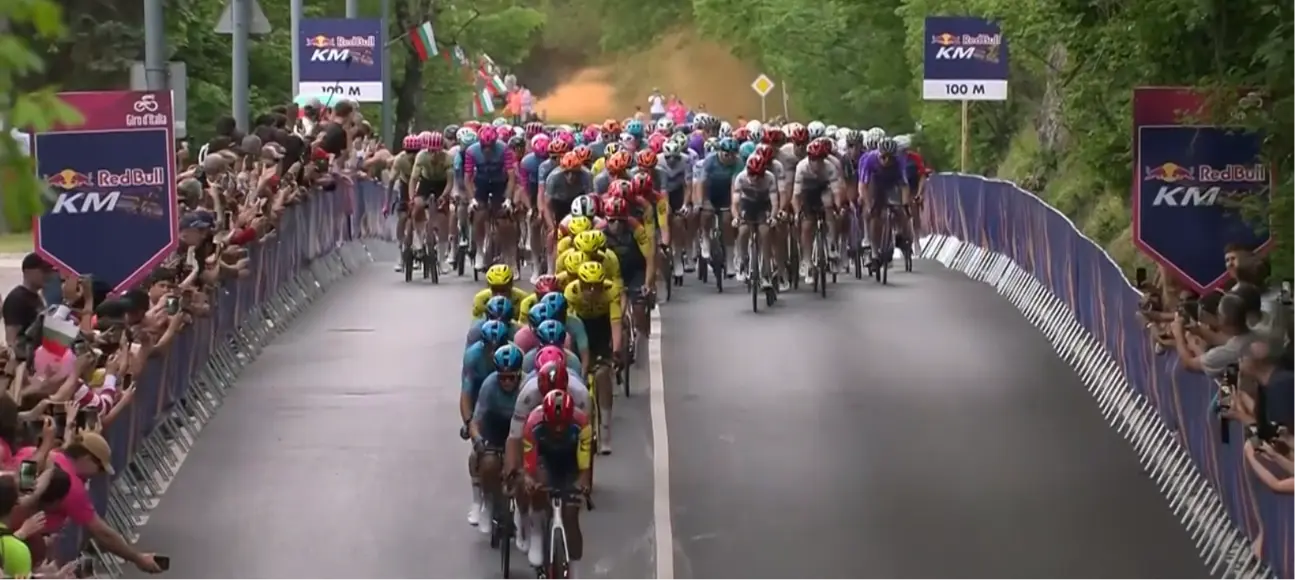
The final sprint stage on Bulgarian soil at the Giro d'Italia 2026 delivered another dramatic finish on Sunday, with Paul Magnier narrowly emerging victorious in Sofia after a high-speed dash against Jonathan Milan and Dylan Groenewegen.
The young Frenchman from Soudal - Quick-Step timed his effort perfectly on the rough finishing straight in the Bulgarian capital, taking his second stage victory of this year’s race by the smallest of margins after another powerful display from the sprinters.
The 175 kilometres stage from Plovdiv to Sofia had been expected to end in a bunch sprint from the moment the route was revealed. Although the peloton had to tackle the Borovets Pass midway through the day, the climb came too far from the finish to seriously threaten the fast men.
That scenario encouraged an early breakaway to form almost immediately. Manuele Tarozzi, Diego Pablo Sevilla and Alessandro Tonelli escaped clear and were quickly allowed several minutes by the bunch, despite little belief that the trio could stay away to the line.
Sevilla, already one of the most aggressive riders during the opening days in Bulgaria, once again collected maximum mountain points on the Borovets Pass to strengthen his grip on the climbers’ classification. Behind them, Christian Scaroni reacted sharply from the peloton to pick up the remaining points.
The climb also exposed familiar difficulties for Arnaud De Lie. The Belgian sprinter was dropped as the road tilted upwards and needed support from teammates Joshua Giddings and Jonas Rutsch to limit the damage. For a moment, there were serious doubts over whether the Lotto-Intermarché rider would make it back before the finale.
However, with more than 50 kilometres still remaining, the trio successfully rejoined the peloton, reviving Belgian hopes for the sprint finish.
Up front, the breakaway continued to resist longer than expected. Tarozzi claimed valuable bonus seconds at the intermediate Red Bull sprint, effectively removing any tension among the general classification contenders and allowing Guillermo Thomas Silva to safely defend the pink jersey for another day.
As the race entered the final ten kilometres, the pace inside the peloton rose sharply. Positioning became increasingly frantic on the wide roads approaching Sofia, while riders such as Jonas Vingegaard and Giulio Pellizzari carefully stayed out of trouble near the back of the group.
There was also misfortune for Casper van Uden, whose lead-out suffered a setback when Timo de Jong crashed during the nervous run-in.
Despite the increasing speed behind, the three escapees refused to surrender easily. Even inside the final three kilometres they still held around twenty seconds, forcing the sprint teams into a full-speed chase. Their resistance only ended shortly after the flamme rouge, setting up the expected showdown between the biggest sprint names in the race.
On Sofia’s uneven cobbled finishing straight, Paul Magnier launched alongside Jonathan Milan and Dylan Groenewegen in a perfectly balanced drag race to the line. The three riders thundered shoulder to shoulder across the final metres, with the result only confirmed after a tense photo finish.
Magnier ultimately held on by the narrowest of gaps, continuing his impressive start to the race and reinforcing his status as one of the fastest finishers of this year’s Giro. Milan had to settle for second place once again, while Groenewegen completed the podium after another encouraging performance following his crash earlier in the race.
Carlos Silva (CiclismoAtual)
Paul Magnier once again underlined why he is considered one of the brightest sprint talents in the peloton, taking victory on the final day of racing on Bulgarian roads, a stage that unfolded exactly as expected with a sprint from a reduced bunch. The young Frenchman managed to overpower both Jonathan Milan and Dylan Groenewegen in a chaotic finale that once again raised serious questions about the course design.
For me, the decisive moment came when Milan entered the cobbled section carrying too much speed. Despite his immense power and his 84-kilogram frame, it was obvious how violently his bike was bouncing across the uneven surface. He entered the worst side of the road and never truly looked comfortable. Magnier, meanwhile, approached through the middle of the street, where the surface appeared slightly cleaner and more stable, allowing him to come alongside the Italian and edge him out on the line.
Ironically, Milan was the first rider to hit the cobbles and probably had the opportunity to take the central line himself. That decision may well have cost him the stage victory.
As for Dylan Groenewegen, it was encouraging to see the Dutch sprinter back in contention after the crash he suffered on the opening stage. He looked competitive again and should still be a factor in the battle for the points classification against his main sprint rivals.
Guillermo Silva comfortably retained the Maglia Rosa, exactly as expected, and now heads to Italy wearing the leader’s jersey on his shoulders.
The final point, however, has to go to the organisation. Out of the three stages held in Bulgaria, two finishes were simply unacceptable for a race of this stature. First there was a highly technical sprint finish featuring dangerous obstacles and barriers that looked completely unfit for elite-level racing. Then today, the riders were thrown onto soft, slippery, irregular cobbles filled with holes in the closing metres of a bunch sprint.
It raises a serious question: how is it possible for the UCI to allow this in one of the three biggest races in the world and simply look the other way? Frankly, it is embarrassing.
From Tuesday onwards, the race will finally begin in earnest. Because, in my opinion, the peloton essentially travelled to Bulgaria for a block of active training rather than genuine racing.
The opening three stages were incredibly dull, completely lacking intensity, unpredictability and any real sense of spectacle. Hundreds of kilometres were covered, yet the amount of actual racing probably did not even exceed one hundred kilometres in total. The stages followed the same predictable script, with little tactical tension and almost no moments capable of truly animating the race.
Of course, these visits are positive for the promotion of cycling in countries that rarely host events of this magnitude, and that aspect should absolutely be valued. But from a sporting perspective, especially for cycling fans watching every kilometre, it often felt painfully sleepy.
Ruben Silva (CyclingUpToDate)
A finale that I enjoy. I enjoy this Paul Magnier, who has grown out of a punchy sprinter into a full-on fast man who can be in the discussion for the current best sprinter in the world. Soudal - Quick-Step deserve to be back at the top in what is essentially a transition year, where they deposit their focus once again on the sprints and classics.
Tim Merlier is of course one of the very best, but has had a very unlucky spring. Magnier in the meantime had his own mission to prove himself as a better sprinter, even in a team where opportunity won't always be on his side. Last year he won around a dozen races late in the year, but all in small races.
One could argue that he won because of the lack of competition. Now we see that may not have been the case, he has effectively taken a step up. At the Volta ao Algarve he already won two bunch sprints and that is one of the most competitive races of the year. After a spring where he wasn't as present, I had doubts. Now I have only confirmations: Magnier is at the top.
Beating Milan, Groenewegen and Lund Andresen in these two bunch sprints is not a matter of luck, but of great form, positioning and sprinting power. He places himself as the main favourite to win the Maglia Ciclamino, in a sprint where the best showed their best level.
He beat Milan and a resurging Dylan Groenewegen fair and square.It was good to see a day without crashes this time around, but it must be said that on a spectator point of view, the start in Bulgaria delivered similarly to last year's in Bulgaria, with teams reluctant to attack, to take risks, and ultimately with three stages where only a few minutes saw quite some action.
The riders will ultimately go into Italy fresher, but these three days were for the most part ridden at a very calm pace, which provided for a lot of hours in the peloton where there was nothing to show.I believe on stage 4 a new race will begin, with some order now established in the sprinter field.
We should see some teams trying out new tactics and beginning to try and flip the script on the top sprinters in a day where the race sees its first proper big climb.
Javier Rampe (CiclismoAlDia)
A textbook transition stage in a Grand Tour, a harmless breakaway allowed plenty of freedom before being carefully controlled by the peloton, although the escapees came surprisingly close to pulling off a major upset in the finale. What remains difficult to understand, however, is why the Volta a Itália continues to travel abroad only to deliver another spectacle that feels more punishing for the viewer than entertaining.
Stages like this are often ignored by the general classification contenders, but they can still prove valuable for riders targeting secondary classifications. A perfect example is Diego Pablo Sevilla. The Polti rider has made a habit of infiltrating every breakaway since the start of the race and now heads into the rest day wearing the blue jersey as leader of the mountains classification.
More than 170 kilometres were spent out front by the day’s breakaway trio, Manuele Tarozzi for Bardiani, alongside the ever-reliable Diego Pablo Sevilla and Alessandro Tonelli, both representing Polti. It almost feels as though the Italian squad signed an unwritten agreement to ensure they feature in every so-called “breakaway of the day” throughout the 2026 edition of the race.
Behind them, there was little else of real note. Arnaud De Lie once again looked like Arnaud De Lie, struggling whenever the road tilted upwards and arriving at the finish without any genuine chance of contesting the sprint. A similar fate could easily have awaited Tobias Lund Andresen after his incident with 15 kilometres remaining, but the Dane recovered impressively, even if he never came close to matching the speed of the day’s winner.
Paul Magnier claimed his fourth victory of the season on the streets of Sofia, further cementing his status as the virtual king of the Ciclamino classification. The Frenchman managed to defeat two sprinting heavyweights, Jonathan Milan and Dylan Groenewegen, snatching victory in a photo finish against both powerhouse sprinters.
The rest of the day, however, is best forgotten, much like this Bulgarian Grande Partenza itself, which has often felt more embarrassing than memorable.
And you? What’s your opinion on Giro d'Italia stage 3 ? Tell us what you think and join the discussion.
Carlos Silva is a writer for CyclingUpToDate.com, where he contributes race reports, interviews, analysis pieces, and live coverage of the international cycling calendar. Holding a degree in Sports from the Jean Piaget Institute, he combines academic knowledge of performance, training, and competition with hands-on journalism experience in professional cycling.
Throughout his career, Carlos has conducted interviews with leading figures in the sport, including Alberto Contador, Joaquim Rodríguez, Óscar Pereiro, João Almeida, Isaac del Toro, Derek Gee, John Degenkolb and Geraint Thomas. These conversations reflect direct engagement with Grand Tour winners, Classics specialists, and emerging talents.
He has provided on-site coverage at major events ranging from the Vuelta a España to the Tour de France, alongside stage races such as Vuelta a Andalucía, Volta ao Algarve, Volta a Portugal and O Gran Camiño. Covering the mythical climbs of the Giro d'Italia remains one of his professional ambitions.
Carlos is responsible for liveblog coverage of all major WorldTour races and beyond, including the Tour de France, Giro d'Italia and Vuelta a España. His reporting integrates verified data from ProCyclingStats to ensure statistical accuracy, contextual depth, and analytical precision.
A lifelong cycling enthusiast, he approaches storytelling across written, photographic, and video formats with a focus on credibility, tactical insight, and informed race interpretation.
claps 7visitors 7
Just in
Popular news
Latest comments
- how it is "We’ve taken another big step forward for next year" he just lost in lombardia to a 20 year old, and two 30+ year olds. and not even top 10 for WCRR.abstractengineer19-10-2026
- This is similar to Lebron. first he said i need to consult my family , my daughter, need respectable money blah blah blah and then dont care about family , dont care about money, only onion rings, am off to Philly, very very far from family. Off season should be with family more, no?abstractengineer19-10-2026
- I hope he comes back strong for a proper battle with Tadejmij19-10-2026
- congrats to a great career and good retirement.mij19-10-2026
- Any artificial product should be reported.Any team that doesn't should be stripped of wins and fined.I know that this level of transparency does not and will never exist.All anyone can do is continue to test riders on a regular and surprise basis.If the test comes back clean then all any of us can assume is the rider is clean.
 Brucegel19-10-2026
 - Also, it's supposed to be hard to gain an advantage from drafting off Remco because he is so aero.Hills3319-10-2026
- How would stats back it up? You realise tactics involved could mean Vine saved his legs for a faster finish? Some riders can choose to go all out and fade later in the ride, others can hold steady state the whole way, and others can have a reserved start and power up later in the ride. You can't judge just by the stats unless you have power data to be able to prove Vine is riding faster even though he is putting out the same or less power (suggesting drafting). I'm sure the stats prove that Vine didn't cheat because UCI would monitor the stats to make sure this exact scenario doesn't happen (and disqualify them for drafting if the stats proved it).Pogboom19-10-2026
- Only one person would say such a thing here. Sorry to burst your bubble but I’m afraid that window of opportunity has now closed. You can beat some of the people all of the time and all of the people some of the time but you can’t beat all of the people all of the time.Jumpyjohn19-10-2026
- Both prizes are actually pathetic, almost amateur like, not even covering the cost of participatingJumpyjohn19-10-2026
- It depends on how you define doping and you would do well to give your definition so we can see how against it you are. If you consider the use (as a hypothetical example) of a new beneficial artificial product unknown to anti-doping agencies ok without considering asking them if it would constitute doping if you told them about it then we’re never going to agree on who could be or couldn’t be doping and according to what threshold, moral, statistical, legal, comparative. In football even financial doping is now consideredJumpyjohn19-10-2026
Loading
1 Comments