"Did you make a mistake in Florence? No" - Joaquim Rodríguez on losing 2013 world title to Rui Costa
Cycling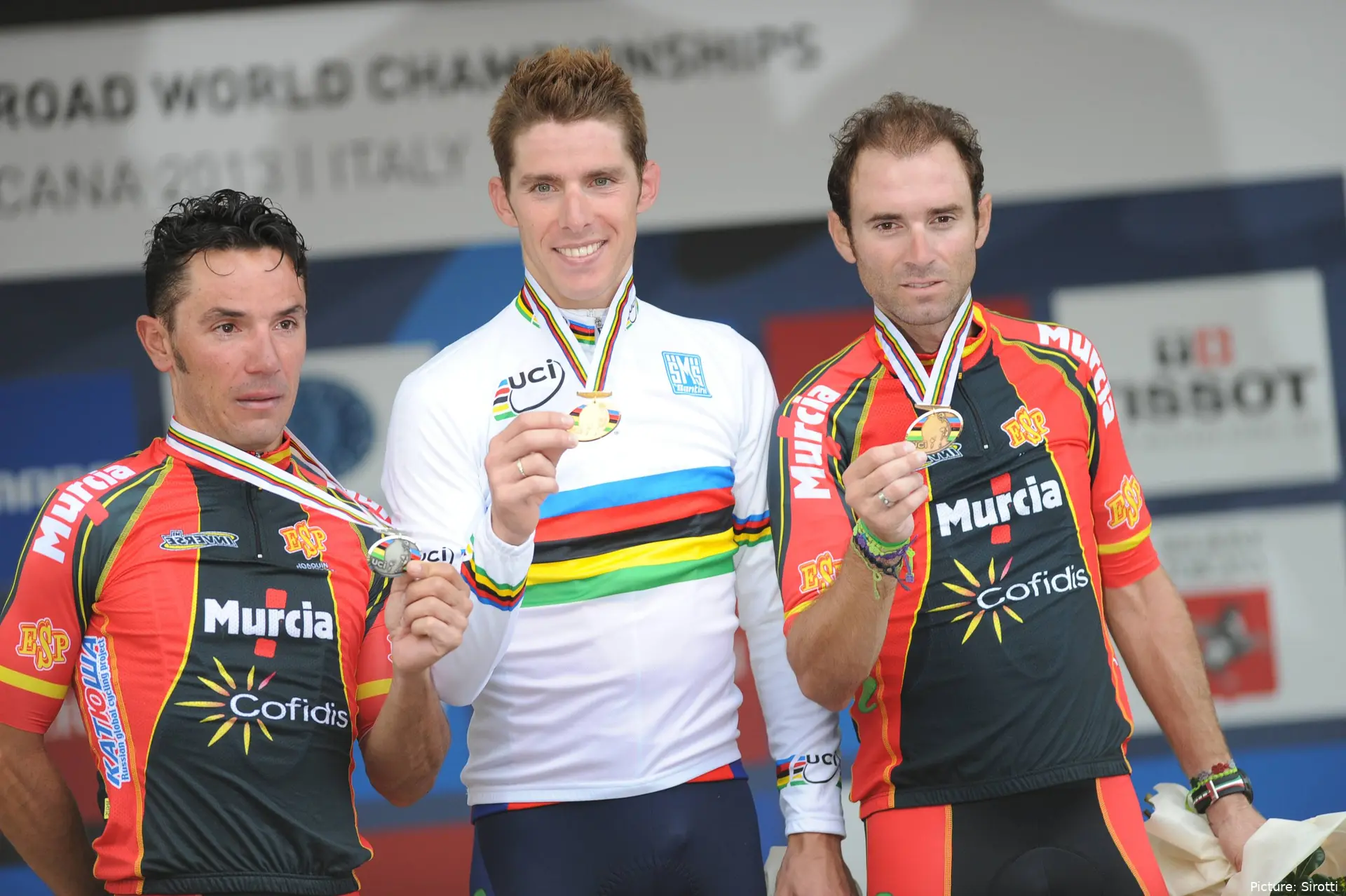
The 2013 Florence World Championships remain one of the races that can't be explained by a single image. It isn’t enough to watch the finale or isolate the last decisive move. Joaquim Rodríguez has broken down the race that shaped part of his career on his YouTube channel, dissecting an event that, for him, was decided long before the final phase. A Worlds race where Rui Costa ended up outfoxing the Catalan and Alejandro Valverde.
'Purito' always says a race like this has to be understood as a whole. It doesn’t start on the last climb or get decided only with the final acceleration. It starts from kilometer zero, when the bunch is still together but an invisible battle is already underway.
“People need context. For me, the race splits into three zones.” From the outset, the Catalan stresses a key aspect: positioning. At a Worlds, he explains, you can’t afford to ride chaotically if you are one of the marked names. Every poorly placed meter is paid for later, when there’s no room to make it back.
“If you’re a leader, you have to be well placed to avoid the whiplash, to prevent a split, so you don’t have to chase too much, especially early, because you must save plenty for the end.”
The opening kilometers are no formality. They’re a terrain of constant control, where national teams test each other without laying all their cards on the table. It’s when the break forms and, with it, one of the day’s most important decisions.
“Roughly around kilometre 15, 20, 25 the break usually goes.” That’s where a balancing act begins among the teams aiming to win the Worlds. It’s not just about letting riders go, but watching who slips up the road. Purito explains it from the perspective of someone who often lined up as a favourite.

Joaquim Rodríguez took a bittersweet podium at the 2013 Worlds
Balancing acts to win the Worlds
“You try to prevent any other team that wants to contest—Liquigas with Vincenzo in our case, Valverde with Movistar—from getting someone in the break, because otherwise you’ll be the one forced to work.”
Putting a rider up the road is no minor gesture. It’s a future investment. If you don’t, you accept a workload that, in such a long and hard race, can prove decisive. “Or if you put someone in there, you save yourself work at the end. In this case, we didn’t put anyone in.”
That detail shapes how the Worlds unfolds. From there, the race moves into a second phase where the terrain starts to bite and the margin for error shrinks to nothing. “Then you wait for the second part, which is usually in a very hard zone. One hundred to go, a very hard zone.”
Florence offered no rest, with the circuit having two difficult climbs and very rainy weather that also made the descents very dangerous. The route tightens while there’s still a long way to go, forcing riders to spend energy earlier than planned. Its difficulty isn’t just in the numbers, but in the constant tension to stay in position.
“Very hard and such a stressful fight to get in there, for the reasons we always mention.” At that point, Purito sketches a scene that captures how the race thinned out. A quick scan around, a snapshot of the front group, and the sense that many favourites were already out of place.
“We Katusha riders arrived there, and I looked around the top twenty—our eight guys—and I couldn’t see any leaders around me. And I kept looking and thinking 'damn, this one’s gone, that one too'.
The pace set early turned the Worlds into a race without pauses. There was no time to reorganise or recover what was lost. Everything moved too fast. “It was pretty quick that day. We didn’t have anyone in the break. The break wasn’t very far, either.”

Podium of the 2013 Florence Worlds: Rui Costa, Purito and Valverde
The Florence grind
Each of those factors stacked up fatigue, forced decisions, and knife-edge situations. Florence became an endurance contest where the winner isn’t always the strongest, but the one who best managed the entire day.
Over time, the 2013 Worlds has been analysed from many angles. Yet when Purito is asked directly about that race, his answer leaves no room for doubt or public regret. “Did you make a mistake in Florence? No.”
The Spaniard attacked in the final kilometers but was later on caught by Rui Costa. What was unusual is that in the small chasing group in which only Vincenzo Nibali joined them, Alejandro Valverde did not follow Costa's attack in the final flat section.
This mistake saw Costa catch Rodríguez and then sprint to the win, whilst Valverde sprinted to third behind. The tactical disaster by the Spanish saw both of their riders finish on the podium but miss out on the victory in Florence.
Read also
Juan LarraCycling Journalist
Juan Larra is a writer for Cyclinguptodate and editor-in-chief of Ciclismoaldia, where he has played a central role since its inception. Under his leadership, the website has become a trusted source for professional cycling coverage, offering in-depth analysis, news, and feature stories.
A sports journalist with over 20 years of experience, Juan earned his degree in Journalism from the University of Seville in 2007. He began his career covering a wide range of sports—including football, basketball, Formula 1, MotoGP, tennis, and cycling—for platforms such as the official La Liga app, Vodafone and Movistar websites, NBA Blogdebasket, and Cadena Cope, honing his skills in writing and editorial management.
In addition to his work at Ciclismoaldia, Juan contributes to Cyclinguptodate and serves as editor-in-chief for the tennis-focused site Tenisaldia. Throughout his career, he has conducted exclusive interviews with cyclists and sports figures, provided detailed analysis of competitions ranging from local Spanish races to major international events, and acted as a special correspondent at prestigious races including Paris-Roubaix, the Tour de France, and the Vuelta a España.
Juan’s combination of experience, expertise, and direct access to athletes has established him—and the platforms he leads—as authoritative voices in professional cycling.
claps 1visitors 1
Just in

Popular news
Latest comments
- He finished 2nd this year at the Tour. Pogacar crashed out of the Vuelta. If he had crashed out of the Tour, Remco would have won.acem8224-10-2026
- Lance never won a TdF, so not sure why he and Hincapie are listed here. I thought this was best domestiques for TdF winners.mij24-10-2026
- Pelizzaari is not Remco's domestiqueabstractengineer24-10-2026
- YetJumpyjohn24-10-2026
- Nibali got into the lead because he wanted the team car further forward in the caravan (I love this as a sign of tactical thinking). He solidified the lead on the rainy cobbles day when he was just brilliant, while other contenders crashed out on the wet roads. Strategic and skillful, yes, but the English roads weren’t as decisive as they might seem.RidesHills24-10-2026
- The Domedancy is the one designed for Seixas - anaerobic short climbs. Seixas isn't as good with the long climbs
 Rafionain-Glas24-10-2026
 - no i just type inivitable facts, nothing else. I wish UAE wasnt so damn good but hey the reality is they are. Visma on opposite direction crashing with no money and riders, coaches leaving mid contract ffs..i wish that wasnt the case but im not pretednig its not real when it is reality... RbH and Lidl i UAE cloesst opponents now thats clear. But if were real how can you stop that team with del toor and pogacar (greatest ever rider they made him) and you have mcnulty as a dom with (who would be captain in other teams and wins world and 10 more behind him..) history also says their the best team by far so what you want me to say? fake and be delusional and tell myself things? Its not a matter for praising anyone its a matter of beeing real nothing else, i wish visma for instance was better and like before but they cant buy any proper climbing guys cause their broke...heck they cant even keep their riders and coaches who flee mid contract what you want me to do lol.miguel24-10-2026
- Far as I recall, Nibali used the 2012 tdf UK stages to win it, most wanting to get them over with, cept he built his lead in them.. Armstrong's wrong, IF and it's an IF, the summers good in '27 like 26 then it'll be attritional.. if it's 'normal, then it'll be 50/50 on the weather, also the roads are VERY VERY narrow, very windng + on the 2nd steep short little climbs I know cause it goes thru my arse 👍
 leedorney24-10-2026
 - ❤️Lozza24-10-2026
- No, it's not about him crashing... he just won't win. Ad acta.PogiSloFans24-10-2026
Loading
Write a comment