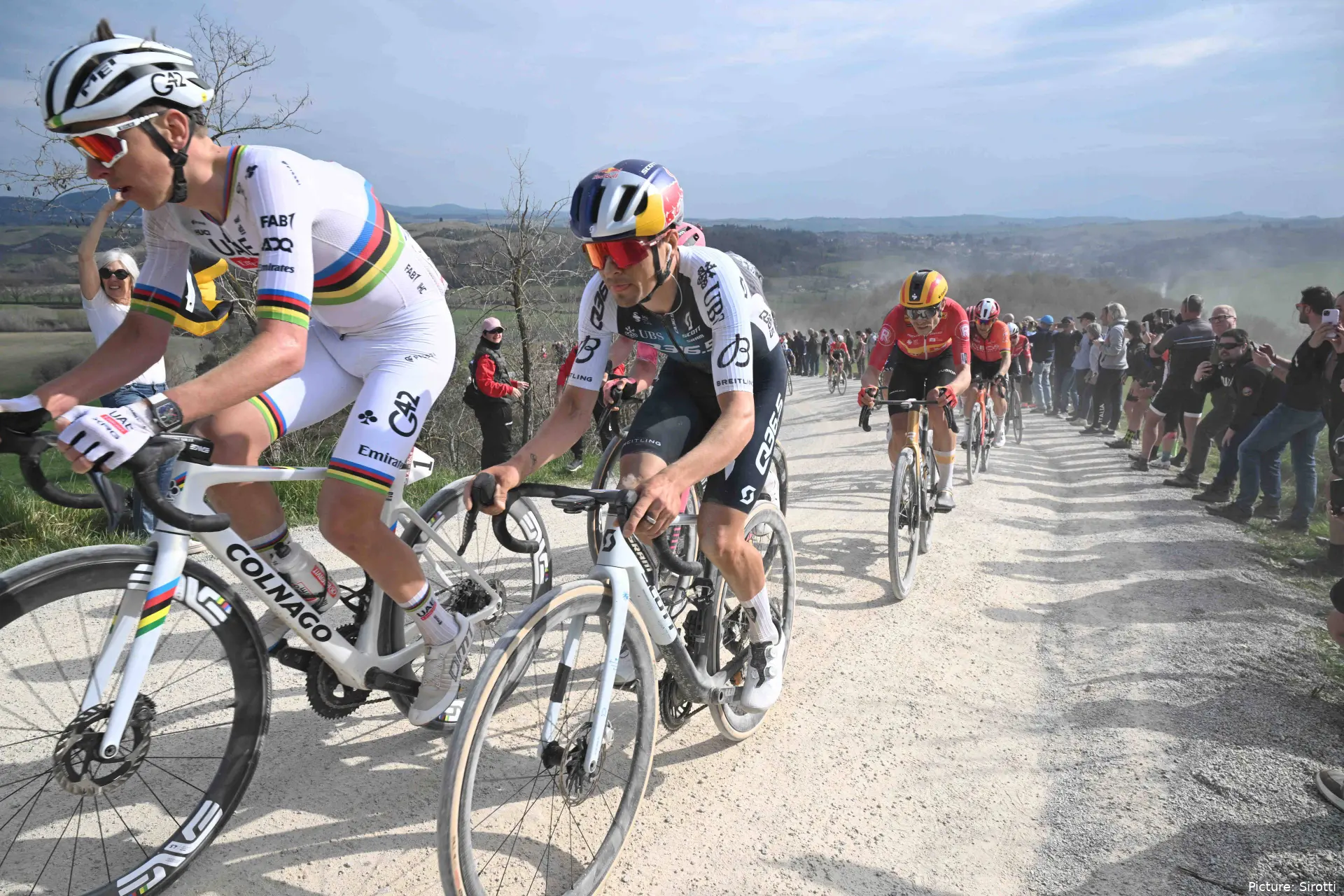
Strade Bianche has always sold itself as something different. Not a cobbled classic. Not a pure climbers’ race. A modern hybrid built around gravel, rhythm and repeated sharp efforts. But in the last two seasons, that balance shifted. The race was made longer, rougher and more extreme, and in doing so, it may have crossed a line.
The organisers’ answer is the 2026 route. Shorter. Less gravel. Fewer sectors. Not a full reset, but a clear step back from the most brutal version of the race yet. That change is not happening in a vacuum. It follows two editions that were not just selective, but brutally so.
In 2024, the organisers increased both the overall distance and the amount of gravel, turning Strade Bianche into a far more attritional race. In 2025, that same formula remained, and the result was familiar. Tadej Pogacar rode away to another long-range solo, even after crashing heavily, still beating Tom Pidcock, who himself finished well clear of the rest.
Two races. Two dominant solos. One rider type increasingly favoured. And quietly, some of the riders who once defined Strade Bianche stopped showing up.
Former winners Wout van Aert and Mathieu van der Poel have both skipped the last two editions. That absence is hard to ignore. These are riders who built reputations on handling, power and repeated short efforts. The newer Strade Bianche, longer and more climbing-focused, no longer fitted them in the same way. What was once a race that bridged Classics riders and Ardennes-style puncheurs had become something closer to a long early-season endurance test.
A step back for 2026
The 2026 route is not a return to the old Strade Bianche, but it is a clear easing of the hardest version.
The men’s race drops from 215km to 201km. The amount of gravel falls from around 80km to 64km, spread across 14 sectors.
Two long gravel sections disappear completely. La Piana, which measured 6.4km, is removed. Serravalle, at 9.3km, is also cut. The opening gravel sector, Vidritta, is shortened from 4.4km to 2.4km.
That is not cosmetic. That is a real reduction in both volume and fatigue.
What stays is just as important. The heart of the race remains untouched. Monte Sante Marie stays. Colle Pinzuto stays. Le Tolfe stays. The finale still runs through a 30km circuit that now also includes the new Strada del Castagno section and Montechiaro, before repeating Colle Pinzuto and Le Tolfe again on the way to the steep finish in Siena’s Piazza del Campo.
So this is not about making Strade Bianche easy. It is about making it less extreme.
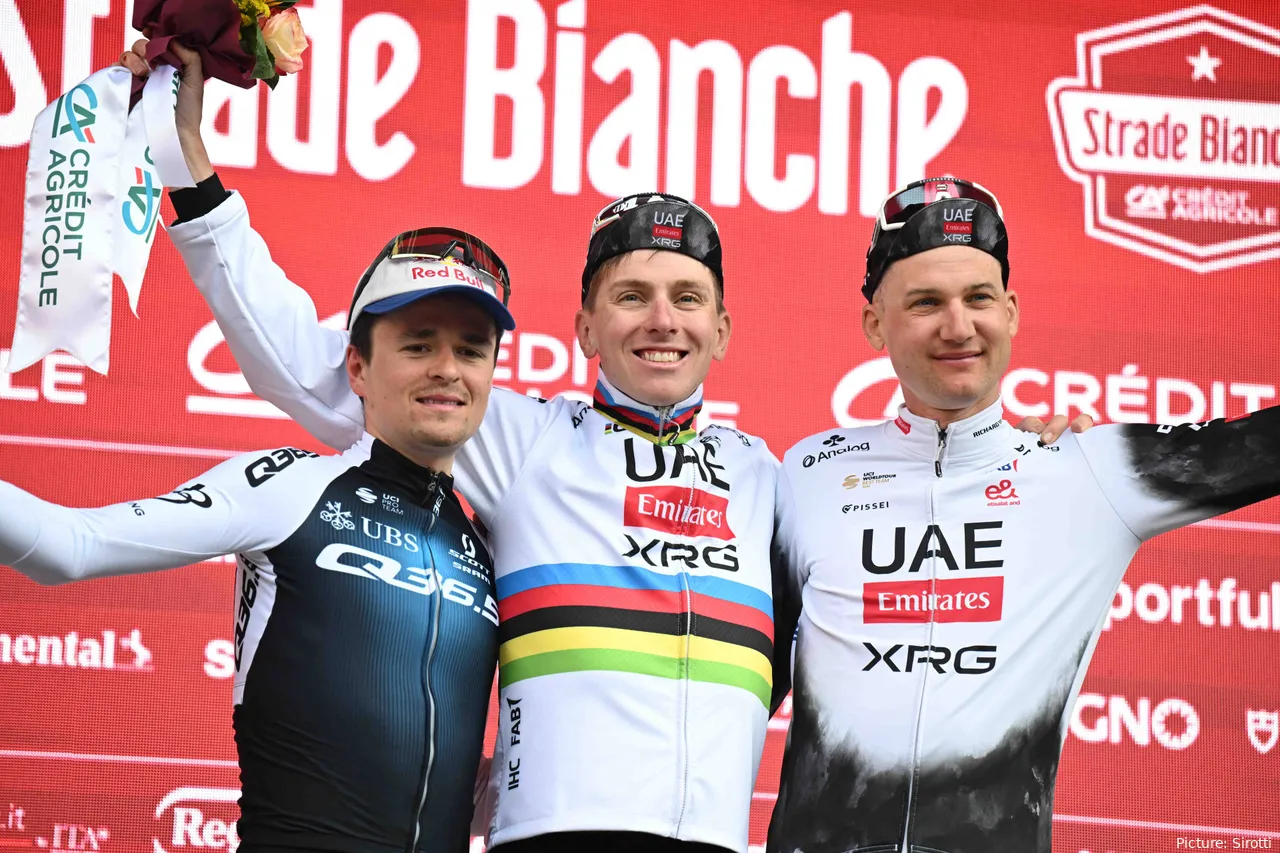
Tadej Pogacar (M), won Strade Bianche 2025 ahead of Tom Pidcock (L) and Tim Wellens (R)
What the changes really say
The 2024 and 2025 editions proved something very clearly. When Strade Bianche became longer and heavier on gravel, it narrowed the type of rider who could realistically win.
Pogacar thrived. Others faded earlier than they used to. The race became more predictable in shape, even if the riding itself was still spectacular.
That is the tension behind the 2026 changes. Spectacle is not the same as variety. A race can be hard and still offer multiple ways to win. When it becomes too hard in one specific way, it starts selecting the same profile again and again.
Cutting distance. Cutting gravel. Keeping the iconic sectors. That looks like an attempt to restore some of that lost balance.
Not a rejection of what Strade Bianche has become, but an admission that the hardest version of it may have gone just a little too far.

Kieran WoodDeputy Editor-in-Chief
Kieran Wood is a sports journalist based in Wales and has been active in journalism since 2022. He regularly contributes to DartsNews.com and CyclingUpToDate.com, where he covers professional cycling and darts. In cycling, his work includes liveblogs from major races, including the Tour de France, the Giro d’Italia, and La Vuelta a España, alongside race reports and analysis. He has also conducted interviews with professional riders.
His reporting spans the full racing calendar, from one-day classics to stage races, with a focus on accurate, real-time coverage and clear contextual analysis. For statistics, results, and historical context, he regularly uses resources such as ProCyclingStats. To support reporting on rider activity and training context where relevant, he also references Strava.
In his work, Kieran places strong emphasis on careful sourcing, editorial accuracy, and updating articles as new, verified information becomes available.
claps 1visitors 1
Just in

Popular news
Latest comments
- Nothing. Against Pogi nothingabstractengineer18-10-2026
- He didn't even try to sprint all outvappaxbipmv18-10-2026
- Campenaerts looked like a rolling pumpkin with that all orange leaders skinsuit !frieders318-10-2026
- He can take his dumb a$$ politics somehwere else !frieders318-10-2026
- good to have her back. fingers crossed she‘ll be able to stay!Ketterechts17-10-2026
- A tenner and he wins the Tour next year, too 😂anonymouscyclist17-10-2026
- the answer is either stick to classics or GTs but not bothabstractengineer17-10-2026
- the exodus already stared with Ciccone. Already they were struggling with two sprinters, now there are three. Also Ganna will demand leadership. Gall is the most proven GC, Ayuso has the most potential. GC leadership for everybody will be impossible. Literally a UAE style mess without pogi.abstractengineer17-10-2026
- I raced as an amateur for 12 years, including six years on my country’s national road cycling team. I secured two national titles and competed in three World Championships plus more than 15 international stage races. At 23, we travelled to Italy for a training camp—or so I assumed. On a rest day, we watched a presentation about adopting a more “professional” training approach. It was crystal clear what “professional” meant. That moment first exposed me to this dilemma. After returning from Italy, I left cycling—at least at the competitive level I had known. Over the following two years, the whole team was caught doping. I hold that everyone is innocent until proven guilty. In my view, current stakeholders operate on a different scale, and the sums involved are vast. I am unsure whether any doping would ever be revealed. I try to stay positive and enjoy the show. My 2c.
 vannpelt17-10-2026
 - Fiver he wins 🤣
 leedorney17-10-2026
Loading
Write a comment