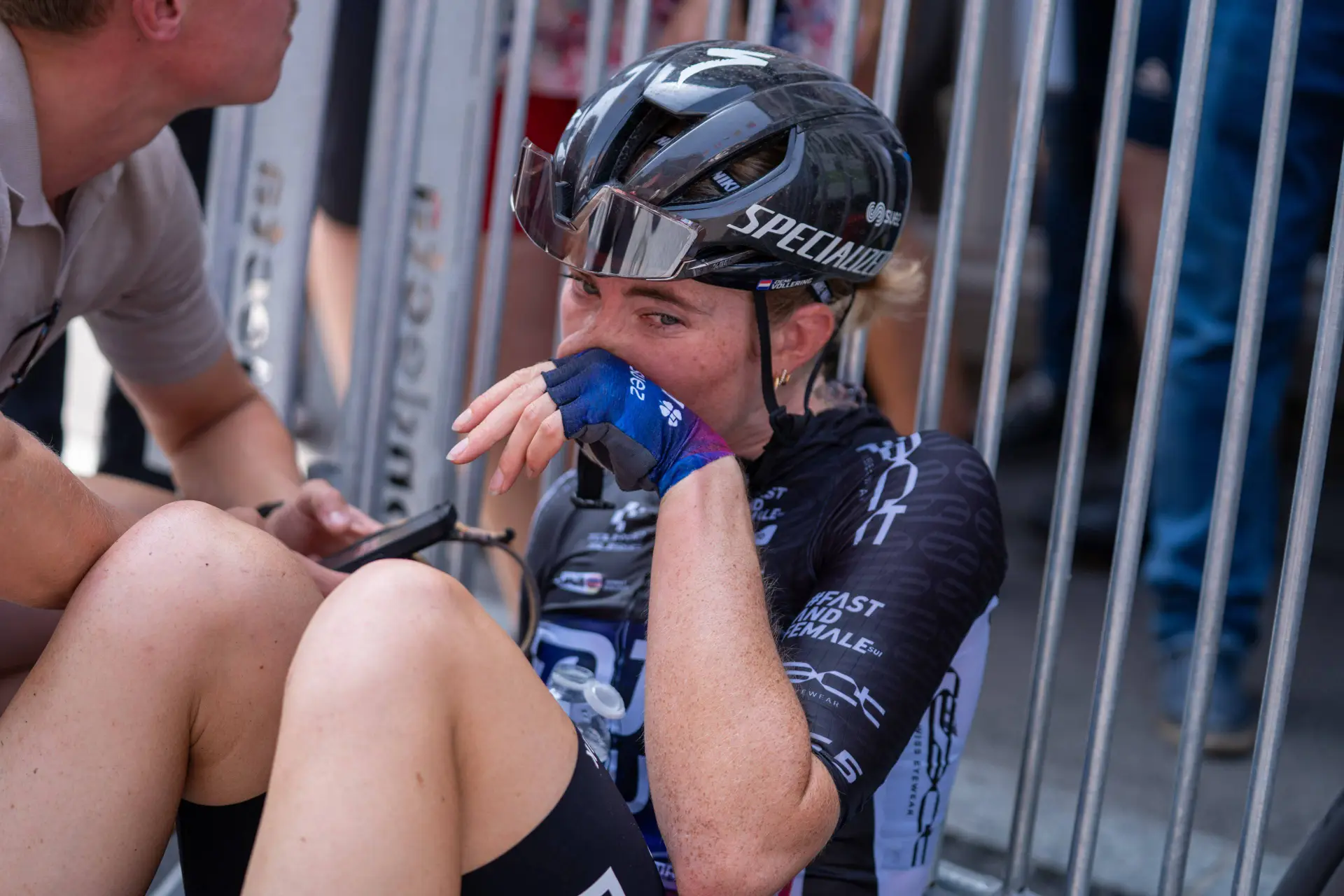
Stage 3 of the Tour de France Femmes was supposed to be a
calm sprint lead-in. Instead, it became a nightmare for yellow jersey contender
Demi Vollering, whose race nearly ended in an instant during a mass crash just
3.7 kilometers from the finish. Now, with new insight from former Grand Tour
winner Tom Dumoulin on the anatomy of the crash, and Vollering’s role in it, has
become clearer.
Dumoulin, speaking on De Avondetappe, reviewed the stage’s
final section and pointed immediately to the chaos that was always expected.
“I'll just take a look at the map of the last kilometer and there you go: bend
after bend after bend,” he said. “You knew beforehand that it was guaranteed to
be chaos. This is going to be misery.”
Yet surprisingly, the crash didn’t come in the technical
final kilometer. “Where do they ultimately fall flat, as we cyclists say...
Here, 3.7 kilometers from the finish at a narrowing,” Dumoulin explained.
“Every team said in the morning team meeting: watch out, it narrows here, it
goes from very wide to very narrow, make sure you're at the front, because then
it's just one straight line to the next narrowing, to the real sprint.”
The danger point was well known to riders and team staff
alike. It had been marked out in route briefings and hammered home over team
radios. Everyone was trying to be at the front, but not everyone could get
there. “Everyone hears the same story on the bus in the morning and later on
their radios: make sure you sit in the front. Well, what happens... it goes in
a funnel to the right and then it ultimately goes horribly wrong.”
According to Dumoulin, the decisive moment came when a rider
from Ceratizit moved up on the inside, gambling in a tight space. “We're racing
towards the corner in question. A Ceratizit rider appears on the right and
simply mows down the entire peloton, including Demi Vollering.”
Dumoulin said it was a case of overly aggressive timing. “In
a corner like that, it's a game of who brakes last. They all want to brake as
late as possible to still get ahead of the other rider. So she (the Ceratizit
rider) actually brakes too late and crashes into Vollering.”
Vollering, who had placed herself exactly where any GC
leader should be in such moments, stood no chance. “Demi was perfectly
positioned,” Dumoulin emphasised. “She probably never noticed anything and was
simply swept away from behind.”
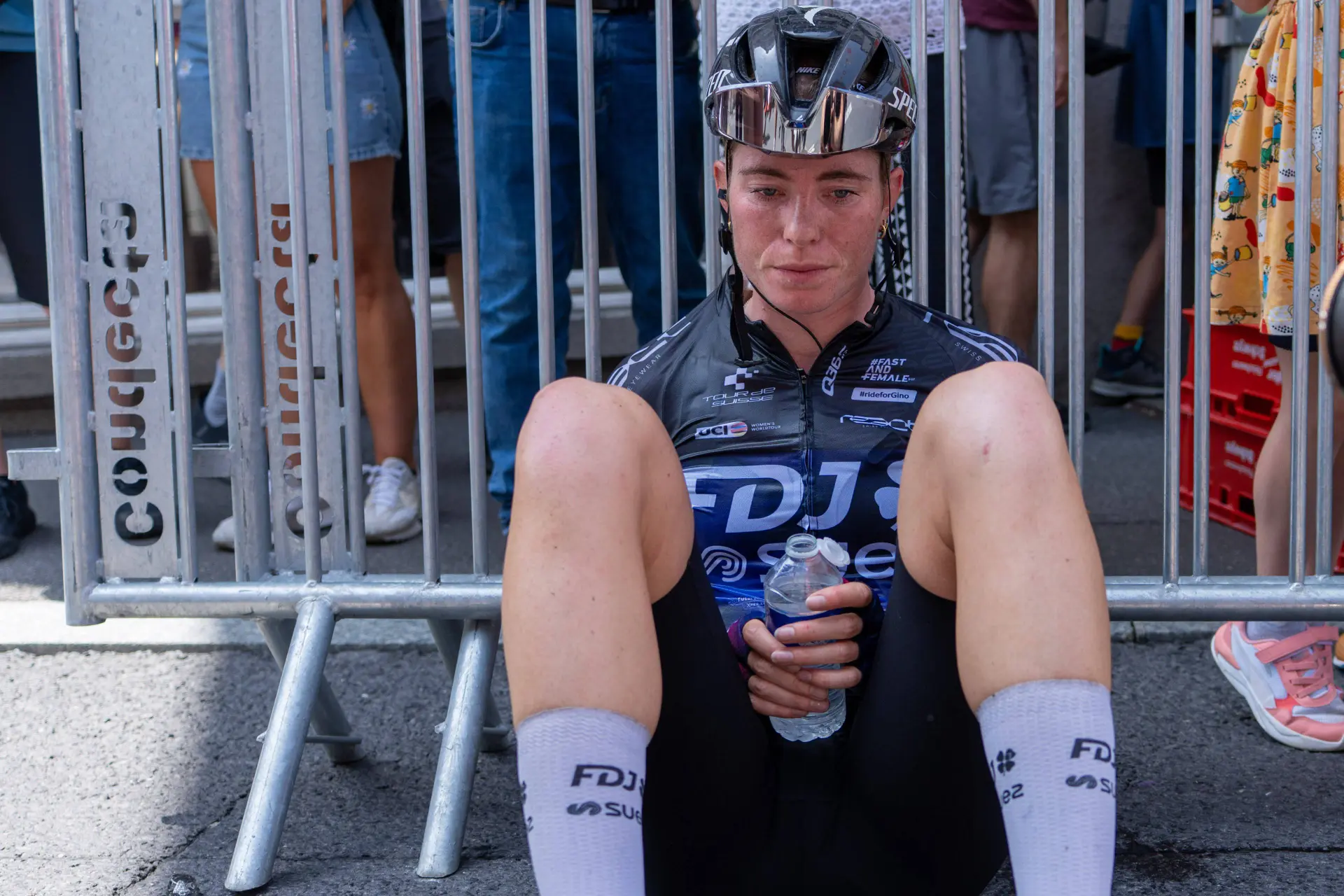
The impact was immediate. Vollering was in tears after the
crash, helped across the line by her FDJ – Suez teammates. She was taken first
to the team bus, then transferred to hospital for further evaluation. There
were fears of a concussion and serious injury, with her Tour hanging in the
balance.
Thankfully, those fears eased Tuesday morning. “This
morning, new medical tests and a second concussion protocol were performed on
Demi,” her team announced. “These showed that there is no risk of a concussion.
Demi will therefore start in today's stage. The team will remain vigilant and
will continue to monitor her situation.”

That medical green light means Vollering continues in the
race, but the crash has changed everything. Her body will still be recovering,
and any plans of attacking or responding in the mountains now come with more
uncertainty. One second she was a top contender; the next, she was nearly out
of the race.
Dumoulin’s breakdown makes it clear: the crash wasn’t
Vollering’s fault. It wasn’t the course's most dangerous section, and it wasn’t
even the final sprint. It was a known choke point, poorly navigated by one
rider, and it nearly cost Vollering her Tour. She’ll race on, but it remains to
be seen in what condition.

Fin MajorCycling Journalist
Fin Major is a UK-based writer at CyclingUpToDate and has been part of the team since 2024. He is the site’s main writer for FAQs and evergreen explainers and has written around 2,000 pieces for the platform. Alongside this work, he focuses on in-depth analysis and covers the biggest races on the calendar, including the Tour de France, the Giro d’Italia, and La Vuelta a España, providing clear context around performance trends, tactics, and key storylines.
In his reporting, Fin uses reputable data sources such as ProCyclingStats for results, statistics, and historical context. He places strong emphasis on careful sourcing, editorial accuracy, and updating articles promptly when new, verified information becomes available. Outside of writing, Fin is an active cyclist, which supports his practical understanding of the sport and its demands.
claps 2visitors 2
Just in


Popular news
Latest comments
- He is boring
 leedorney08-11-2026
- To Twoje przemyślenia te bla, bla :)
 Dariusz08-11-2026
- Uwielbiam patrzeć, jak wyjeżdża na czoło peletonu i zaczyna się rzeź...Dariusz08-11-2026
- Yeah, unreal.
 parisbound0008-11-2026
- there needs to be space in life for pointless comments!Ketterechts08-11-2026
- That is a very lazy way of putting it but so far on this website it seems like everyone is happy to look at everything lazily, even things that annoy them intensely. All they want to do is state their feeling and position but ask most to analyse a problem or come up with solutions or improvements and you’re stunned by silence. Nobody even really knows how this all happens. It’s very simple and quick to just say the UCI did it but I bet you they didn’t, I bet you not more than 2 people were involved, more likely just 1. The UCI may be ultimately responsible but it is not their decision, this is about hierarchy, power and delegation. The fact that protest is possible also means it isn’t over and that MORE people could get involved for a thorough review which could throw up anything. It is highly likely it was a sole commissar who decided and has that power in a first round. Therein might lie the problem the UCI has to consider, is it acceptable to give so much authority to one single person when it is quite possible for them to have a natural bias or be too easily susceptible to imposed bias. Who is to say an individual in this position isn’t susceptible to collaboration with outside players with interests in the results, nations, families, teams, betting companies, etc. On the one hand we have sports where these problems have been worked on way more to reduce such problems, on the other hand we have sports with far stricter and more draconian rules not even concerning safety or obstruction that nobody really questions like false starts or stepping out of lane or zones in athletics. If cycling hastowork on itself, it would be good if protagonists (all kinds) would start doing a little more than just moaning over outcomes.Jumpyjohn08-11-2026
- Yes, so why not make comments less pointless?Jumpyjohn08-11-2026
- What a race! I didn't expect Vanthourenhout to collapse like that, and Wyseure did take the fight to Nys, but there was no doubt at the end. I also wonder what Aubin Sparfel would be capable of were he to race in the elites now. In the U23 ranks he is making good work of Giel Lejeune, who himself is among the better riders in the elites, and a top 10 contender in the big races (3rd at Kleebergcross, 8th at Berencross and 5th at Heerderstrand). In the French Cup, Sparfel is significantly better than Romain Debord (8th at Koppenbergcross and 10th at the Euros) and Rémi Lelandais (12th at Koppenbergcross and 19th at the Euros).
 Rafionain-Glas08-11-2026
- There really was nothing in it. Schreiber was so much faster, and Brand was fighting to stay in the wheel in the sprint. Schreiber did move a bit, but to say she closed the door doesn't make sense because Brand couldn't enter it anyway, abd she wasn't impeded.Rafionain-Glas08-11-2026
- He should have been allowed to go to Movistar. Right now both arent a good fit for each other and are just wasting each other's time and effortabstractengineer08-11-2026
Loading
Write a comment