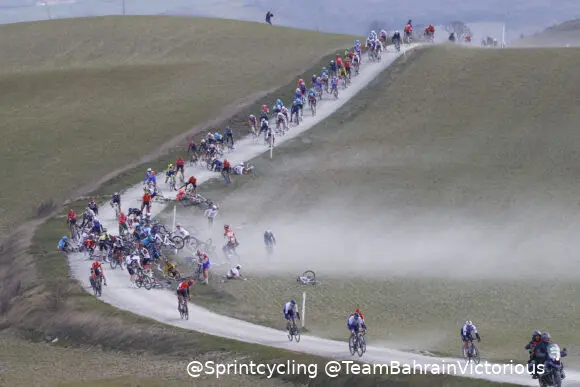
Gravel racing has seen an uptick in participants as more and more people invest in gravel bikes. Gravel races can be found on all the continents; however, it still remains a niche discipline in the greater cycling community.
But, 2026 is shaping up to be a big year for the sport, as the international calendar is packed with major events, new races are emerging, and there is an increased professionalisation of the sport.
What Is Gravel Racing?
Gravel racing has several formats and occurs across various terrains. It is a combination of road racing, mountain bike racing, and a bit of cyclocross racing. The races typically take place on gravel roads or jeep tracks, with some singletrack thrown into the mix. Some races also have short stretches on paved roads.
There are three main types of gravel race formats:
- Single-stage: Participants compete in a single race from start to finish. These races vary in distance, from a short sprint to those stretching hundreds of miles. Most single-stage races have a mass start where everyone sets off together. Some bigger events have split fields based on skill level, performance in previous races, or gender.
- Enduro-style: Participants compete against the clock instead of against each other on various segments of the course. This could be descents, climbs, or technical portions, much like mountainbike enduro races. There are also several sections of the course where riders can pedal more relaxed, since the race winner is the person who gets the lowest total time over the enduro portions.
- Multi-stage: These events are perfect for endurance riders. The race occurs across several segments and days, and participants are tested to their limits. Riders can be self-supported or have teams and accommodation supporting them.
As one of the newer racing formats, it is incredibly inclusive and attracts a variety of personalities, from serious athletes to those who enjoy cycling purely for fun. More fans are also getting involved, with major events now featuring on regulated UK bookmakers, allowing cycling enthusiasts to bet on their favourite riders and get live analyses as races unfold.
Although these races can become very competitive, especially as more ex-road cycling professionals enter major gravel events, the emphasis remains on participation and enjoyment.
Why Gravel Racing Is So Popular
Gravel riding and racing became increasingly popular due to several factors, which will likely make it more mainstream in 2026 and beyond.
Firstly, most riders make the switch from road to gravel because of traffic on paved roads. Gravel riding still happens on roads; however, these dirt roads have fewer cars and fewer moments of panic. The overall experience is more relaxed, and so the love of gravel riding is born. Thereafter, the leap to gravel racing is not too big.
It is also the perfect discipline for those who want adventure without risking their well-being. Mountain trails can be technical and steep, which can be daunting for more casual riders or beginners. Although gravel racing takes you off-road, it is perfect for most cyclists who want to enjoy the race without having to go over jumps or through tight turns at top speed.
Gravel bikes themselves have also made the sport more popular. These all-rounder bikes can be pedalled on pavement and off-road. They’re stable and give riders a lot of control. And it is this appeal of the gravel bike that has made more riders turn to racing.
The gravel biking culture is more inclusive than road or mountain biking. Instead of viewing other racers as competitors, there is an inclusive culture and camaraderie among riders that can’t be found in other disciplines.
The Future Of Gravel Racing
2026 is going to be a big year for gravel racing, and event organisers and riders are expecting it to become more mainstream as the year progresses.
Big highlights for 2026 include:
- Global expansion: The UCI Gravel World Series is growing to include 45 events in Europe, Asia, Africa, North America, South America, and Oceania. There are plenty of opportunities for amateur and professional riders to qualify for World Championships.
- Major events: Existing marquee races like the Unbound Gravel (US) and King Price Race to the Sun (South Africa) are confirmed, and thousands of riders are interested.
- New stage races: New events are constantly being added to the calendar, like Gravel Peaks, which is a six-day race through the Alps in May.
- Developing talent: Many initiatives are focused on investing and developing young, international talent, solidifying gravel races as a professional sport.
Gravel racing is continuing to boom in popularity, attracting pros from other disciplines (like road and mountain biking) as well as a growing community of amateur enthusiasts.
The future of gravel racing beyond 2026 also looks bright. There is an increasing number of stage races being announced, like the Garden Route Giro in South Africa. These races keep the sport exciting and are likely to attract a growing number of riders.
There is also a growing number of professional cyclists entering the sport, and this trend is unlikely to stall. Some have prior experience in gravel riding, while others are completely new to the discipline after retiring from road racing.
With all of this happening and gravel bikes becoming more affordable, it is likely that gravel racing will become more mainstream in 2026. Although it is unlikely that it will attract the same number of participants as major road events, the future for gravel riders is exciting and promises a lot more events across several countries.

Kieran WoodDeputy Editor-in-Chief
Kieran Wood is a sports journalist based in Wales and has been active in journalism since 2022. He regularly contributes to DartsNews.com and CyclingUpToDate.com, where he covers professional cycling and darts. In cycling, his work includes liveblogs from major races, including the Tour de France, the Giro d’Italia, and La Vuelta a España, alongside race reports and analysis. He has also conducted interviews with professional riders.
His reporting spans the full racing calendar, from one-day classics to stage races, with a focus on accurate, real-time coverage and clear contextual analysis. For statistics, results, and historical context, he regularly uses resources such as ProCyclingStats. To support reporting on rider activity and training context where relevant, he also references Strava.
In his work, Kieran places strong emphasis on careful sourcing, editorial accuracy, and updating articles as new, verified information becomes available.
claps 3visitors 3
Just in
Popular news
Latest comments
- Firstly, someone who says parenting is babysitting is delusional and shouldn't be taken seriously. Secondly, with pro athletes it is not the same as a normal worker. They are being rewarded for doing something for which they have a talent which doesn't actually help people (besides inspiration). It's quite a different dynamic
 Rafionain-Glas12-10-2026
 - only way for him to effectively learn to microdose is to go to uae. other than that there is no reason for him to go to uae.whkman12-10-2026
- that was a great win, and quite a surprise at the time. That was a loaded field, and he held of Valverde for the win. Still shocking that Valverde never won Lombardia. He seemed perfect for it. Mollema just went to work every day.mij12-10-2026
- I hope he races Volta a Majorca. We'll really be able to see if he can do one-day-races (but do they count?)Rafionain-Glas12-10-2026
- See, you can write a sensible comment without just slagging off everyone else! Well done!👏😆 🫣Lozza12-10-2026
- Seixas best chance is obviously UAE. They are the best team in history of the sport and they developed pogacar into the goat. They also developed Del Toro to be nr 2 in world. Seixas would become unstoppable at UAE. Lets see if Seixas stays at decathlon but if UAE comes knocking its impossible to say no. Barcelone and real madrid combined into one team, thats UAE in cycling it feels like..miguel12-10-2026
- I think he does or goes to whichever team gives him the scope to become the rider everyone thinks he'll be when Tadej stops.. that simpleslappers6612-10-2026
- I remember at one time he was mentioned in the same breath as Seixas. no more. Onley has a lot of work to do to be deserving of that.mij12-10-2026
- I hope he goes to Bahrain-Victorious to mentor JakobRafionain-Glas12-10-2026
- I hope he stays! Cycling is more fun with Primoz, even if he is not winning.mij12-10-2026
Loading