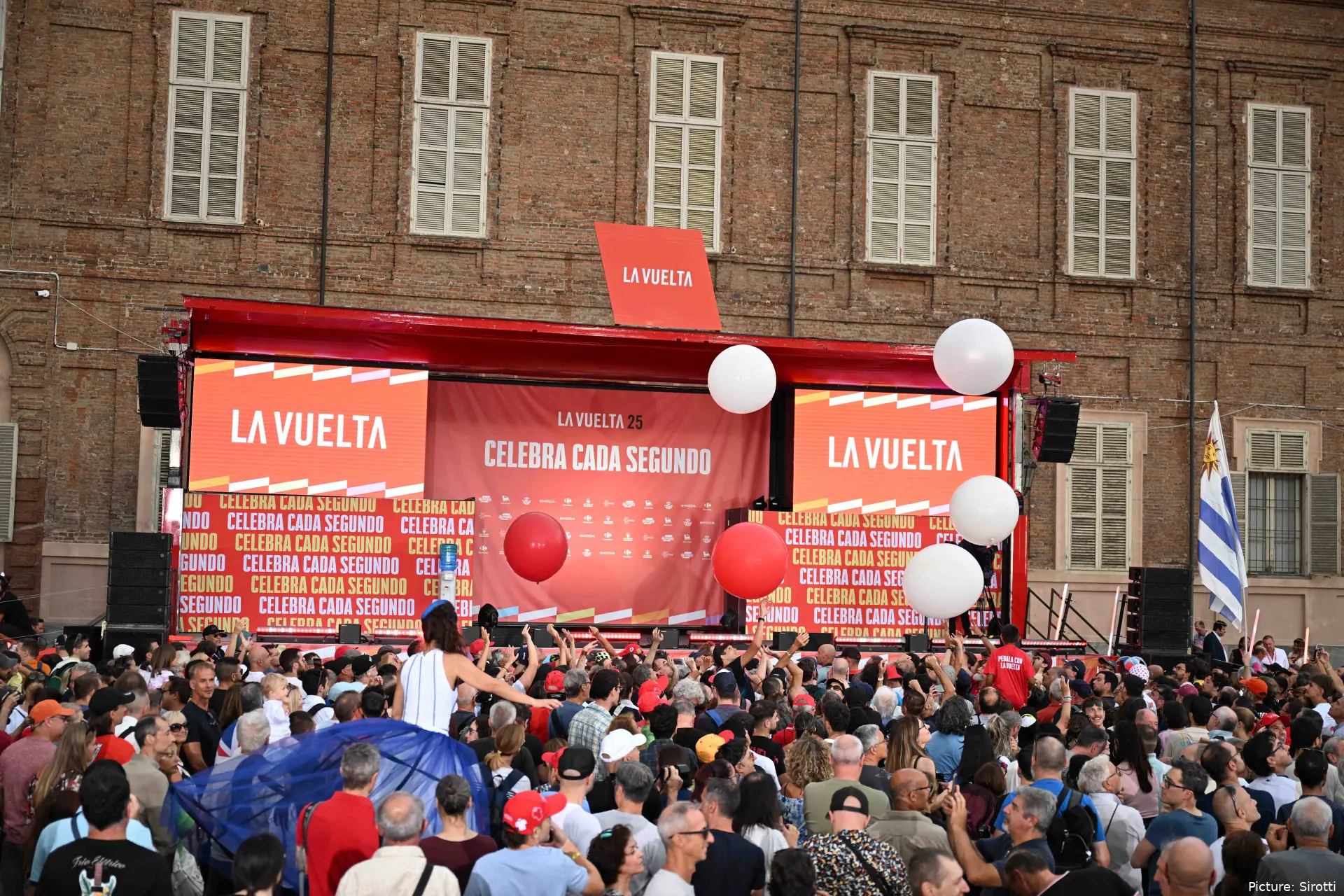
The route of the Vuelta a Espana 2026 is about to be revealed, with the official presentation scheduled for Wednesday 17 December in Monaco. From 19:00 local time, organisers will unveil the full course of next year’s race, including the host cities for all 21 stages, during an event that will be broadcast live.
RTVE will show the ceremony, which will provide full details of a Vuelta set to run from 22 August to 13 September 2026.
The edition is already shaping up as a notable one, following a series of key route details that have emerged in recent weeks.
As usual, full coverage of the presentation and the official stage profiles will be available via CyclingUpToDate as soon as they are released.

Early clues point to a southern focused Vuelta
While the definitive route will only be confirmed on 17 December, several elements are already known, offering a clear indication of the direction organisers have taken for 2026. The outline suggests a Vuelta with a strong emphasis on southern Spain and a noticeably different balance compared with recent editions.
Known features of the Vuelta a Espana 2026 route
- Start in Monaco with an urban time trial
- International opening across four countries: Monaco, France, Andorra and Spain
- No stages in Asturias, marking an absence of the traditional northern focus
- A decisive individual time trial in the province of Cadiz
- Overall finish in Andalusia, with Granada hosting the finale
- Summit finish at Penas Blancas in Estepona
- Return of La Pandera
- A stage held entirely within the province of Huelva
- No finish in Madrid and no passage through the capital
The race will begin in Monaco with an urban time trial passing through some of the Principality’s most recognisable locations, including the Casino area, the harbour and the Formula 1 Grand Prix straight. France and Andorra will then feature in the opening days before the Vuelta enters Spain.
The overall design confirms a clear shift towards the south, with the absence of Asturias marking the first time since 2009 that the region has not featured. Mountain stages will remain central to the race, but in different settings. One of the key moments is expected to come in Cadiz, where an individual time trial is set to play a decisive role in the general classification.
Granada set to host the finale
Another major change concerns the finish of the race. The Vuelta a Espana 2026 will not conclude in Madrid, nor pass through the capital at any point. Instead, the race will finish in Granada, with Sierra Nevada and the Alhambra forming the backdrop to the final stages, underlining the importance of Andalusia in this edition. Seville, Malaga and Cordoba were also considered as possible hosts for the finale.
Among the stages already outlined, the finish at Penas Blancas in Estepona stands out. Scheduled for Friday 11 September, it is expected to be more demanding than on previous visits. The return of La Pandera further reinforces the race’s mountainous identity, even with the shift in geographical focus. The Canary Islands will not feature in 2026, with a possible appearance now being discussed for 2027.


Kieran WoodDeputy Editor-in-Chief
Kieran Wood is a sports journalist based in Wales and has been active in journalism since 2022. He regularly contributes to DartsNews.com and CyclingUpToDate.com, where he covers professional cycling and darts. In cycling, his work includes liveblogs from major races, including the Tour de France, the Giro d’Italia, and La Vuelta a España, alongside race reports and analysis. He has also conducted interviews with professional riders.
His reporting spans the full racing calendar, from one-day classics to stage races, with a focus on accurate, real-time coverage and clear contextual analysis. For statistics, results, and historical context, he regularly uses resources such as ProCyclingStats. To support reporting on rider activity and training context where relevant, he also references Strava.
In his work, Kieran places strong emphasis on careful sourcing, editorial accuracy, and updating articles as new, verified information becomes available.
claps 1visitors 1
Just in


Popular news

Latest comments
- He finished 2nd this year at the Tour. Pogacar crashed out of the Vuelta. If he had crashed out of the Tour, Remco would have won.acem8224-10-2026
- Lance never won a TdF, so not sure why he and Hincapie are listed here. I thought this was best domestiques for TdF winners.mij24-10-2026
- Pelizzaari is not Remco's domestiqueabstractengineer24-10-2026
- YetJumpyjohn24-10-2026
- Nibali got into the lead because he wanted the team car further forward in the caravan (I love this as a sign of tactical thinking). He solidified the lead on the rainy cobbles day when he was just brilliant, while other contenders crashed out on the wet roads. Strategic and skillful, yes, but the English roads weren’t as decisive as they might seem.RidesHills24-10-2026
- The Domedancy is the one designed for Seixas - anaerobic short climbs. Seixas isn't as good with the long climbs
 Rafionain-Glas24-10-2026
 - no i just type inivitable facts, nothing else. I wish UAE wasnt so damn good but hey the reality is they are. Visma on opposite direction crashing with no money and riders, coaches leaving mid contract ffs..i wish that wasnt the case but im not pretednig its not real when it is reality... RbH and Lidl i UAE cloesst opponents now thats clear. But if were real how can you stop that team with del toor and pogacar (greatest ever rider they made him) and you have mcnulty as a dom with (who would be captain in other teams and wins world and 10 more behind him..) history also says their the best team by far so what you want me to say? fake and be delusional and tell myself things? Its not a matter for praising anyone its a matter of beeing real nothing else, i wish visma for instance was better and like before but they cant buy any proper climbing guys cause their broke...heck they cant even keep their riders and coaches who flee mid contract what you want me to do lol.miguel24-10-2026
- Far as I recall, Nibali used the 2012 tdf UK stages to win it, most wanting to get them over with, cept he built his lead in them.. Armstrong's wrong, IF and it's an IF, the summers good in '27 like 26 then it'll be attritional.. if it's 'normal, then it'll be 50/50 on the weather, also the roads are VERY VERY narrow, very windng + on the 2nd steep short little climbs I know cause it goes thru my arse 👍
 leedorney24-10-2026
 - ❤️Lozza24-10-2026
- No, it's not about him crashing... he just won't win. Ad acta.PogiSloFans24-10-2026
Loading
Write a comment