"This is not what we wanted": Picnic PostNL boss urges to reform the transfer system after painful loss of Oscar Onley
Cycling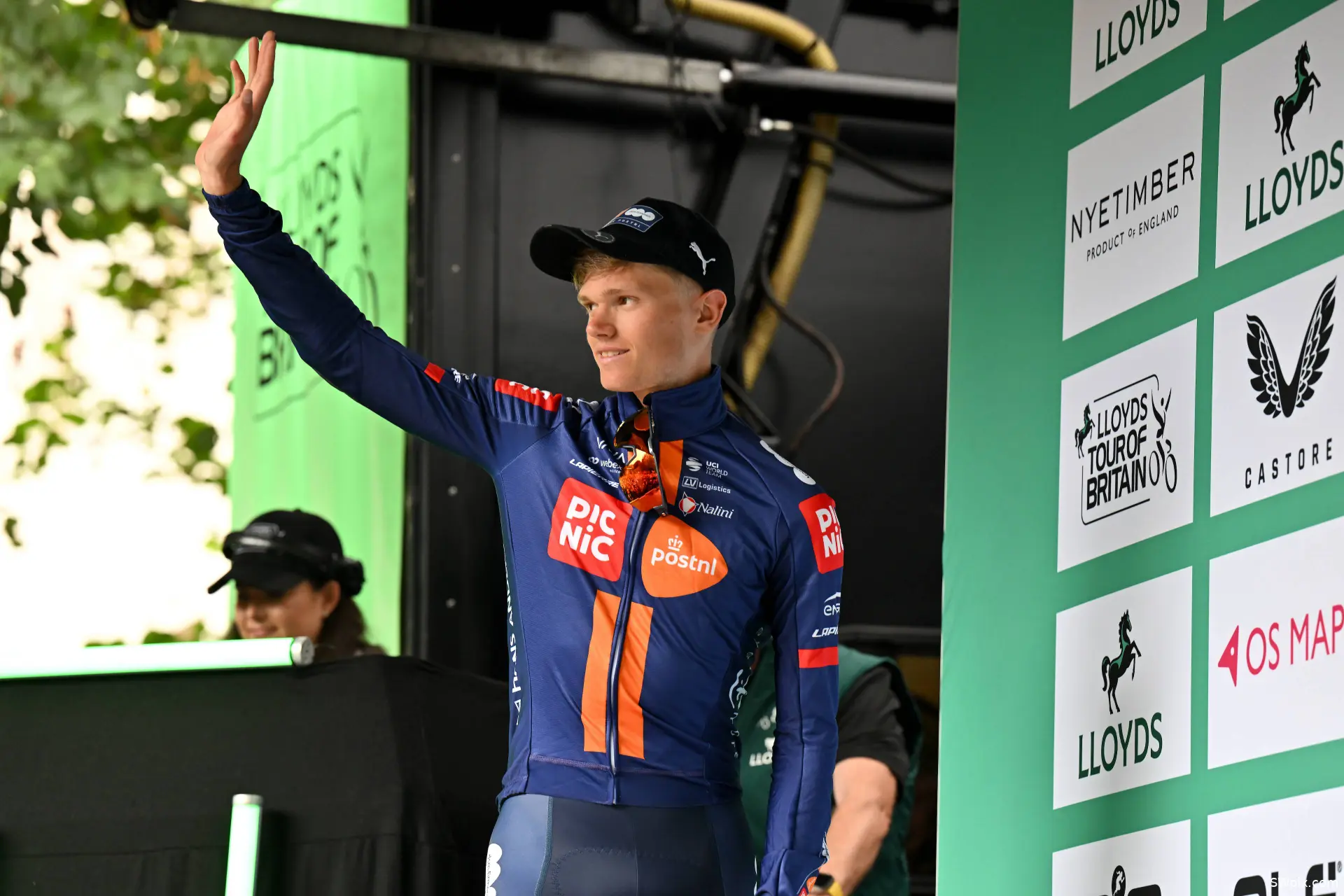
Back to square one. That's how the managers of Picnic PostNL must be feeling after the departure of Oscar Onley. By far not the first time this has happened in team's history. It's a tale old as time. A talented rider grows within the Dutch formation, only to spread their wings the second they get a taste of international success. Marc Hirschi, Ilan Van Wilder, and now Onley have all left the team sooner than the team owner Iwan Spekenbrink would've liked.
The Scot had a contract with Picnic PostNL running until 2027, but following his 4th place at Tour de France, the only British team in WorldTour - INEOS Grenadiers - could no longer sit idly while their own GC leaders continued to be hit and miss. With much larger budget, the best course of action for INEOS was then to swing their wallet and try to improve their climbing department, with Onley in the center of their attention.
And as Picnic PostNL operates on one of the smallest budgets in the peloton, a team willing to pay up to €6-7 millions to buy out Onley's contract ultimately couldn't have been rejected.
"On a personal level, when it happened, I had three or four days of saying 'shit', this is not what we wanted," Spekenbrink admitted when speaking to Cyclingnews and Daniel Benson's Cycling Substack in Calpe.
Painful goodbye
Spekenbrink further highlights that there was no sourness in their farewell. Even though it took some time for the Dutchman to deal with the loss of their homegrown star. "When you build something, when you have success, and when there is a really good connection, it's always hard."
Besides his on-bike performances, the 23-year-old was also growing to be a natural leader of the team, a quality that made work with Onley so smooth. And it adds to the reason why it will be difficult to replace him. "Oscar has integrity; he is an honest guy, he gives his all for his job, so it was nice to work with him."
"But if you leave that aside, if you constantly build teams, and if you look at what we do, we're good at recruiting riders and at rider development. Two years ago, few people knew about Oscar. We have a way of finding talent, and we invest a lot in it," he says with pride. "What happened with Oscar is not a result of working poorly; it's a result of working well. It's a confirmation of work."
"When you are successful, a lot of riders can do well. It's like in soccer, when you do a good job, a lot of people are successful, and you have to make choices. That happened with Oscar, and we had to put the best interests of the team first."
The system must change
Spekenbrink is convinced professional cycling needs new, stringent rules to regulate rider trading and transfers. He puts his faith in UCI to find a solution that will protect smaller formations from "predatory" superteams with virtually unlimited budget options. Because otherwise, Pavel Bittner, Casper van Uden or Max Poole could soon be on the radar of bigger teams.
"We need a transfer system like in football," Spekenbrink said, admitting that despite the loss of Onley and other riders over the years, he's not opposed to a system where riders can be bought out of their contracts. But the rules need to be set the same way for all teams then.
"In football, you can change teams, but you have to agree to a transfer fee. Now, too many games are being played in cycling, especially by agents. It's chaos. Whether we like it or not, we need to have a system in place where if you have a contract, then there's also an agreed-upon fee. For that fee, you don't have to even negotiate; you can go. But if the fee isn't paid, the rider has to stay and respect the contract."
Ondrej ZhasilCycling Journalist
Ondřej Zhasil is a cycling journalist at CyclingUpToDate and has been part of the team since 2023. He is based in Ostrava, the third-largest city in the Czech Republic, and covers professional cycling across the main UCI competitions, including the Tour de France, the Giro d’Italia, and La Vuelta a España. A key focus of his work is startlist analysis and pre-race coverage, where he examines team selections, rider line-ups, and tactical scenarios ahead of major events.
Alongside WorldTour coverage, Ondřej has developed specific expertise in junior cycling and in racing across East Asia, including competitions in China and Japan. He also maintains a broad working knowledge of other disciplines and levels, including cyclocross, while continuing to expand his understanding of mountain bike racing.
Ondřej holds a bachelor’s degree in Mathematics and Physics, which supports his analytical, data-driven approach to performance and race analysis. In his reporting, he regularly uses ProCyclingStats for results, statistics, and historical context. He places strong emphasis on careful sourcing, editorial accuracy, and updating articles promptly when new, verified information becomes available.
claps 3visitors 3
Just in

Popular news
Latest comments
- We also don't know how much Pog was really putting into gaining time. Feels like watching Usain Bolt, where you can only wonder how much faster he'd have gone if he was sprinting 100% to the line, instead of being two feet ahead and starting to pull up with ten yards to go. If any of the other riders really started to close in on Pog, I do think he'd simply have gone even deeper and crushed them. I would really like that kind of race though, none of this "4 minutes lead by the first rest day" trouncing. So if introducing more TT and less summit finish makes the race go more to the wire, I'm all for that. I don't think it'll change the outcome necessarily, but it'll make the whole thing less of a foregone conclusion by week 2.wrsty23-10-2026
- That nearly is 7 mins and you win GTs comfortably by 2 mins. Remco fans - he almost won the TDF, He beat Pogi twice in the mountains this year.abstractengineer23-10-2026
- What would be your preferred Tour design then? Just out of interestwrsty23-10-2026
- I like Remco but even I'll admit he didn't get anywhere close to Pogacar, just like everyone else.megasmacky23-10-2026
- That's what y'all said this year, "remco will come fifth"bruins3022-10-2026
- That used to be the norm, 100 kms of TTs. Now look at the '87 route...acem8222-10-2026
- Well, crashes can happen, so it's not impossible...acem8222-10-2026
- that would be kinda cool. there is a lot of untapped potential. which I'm sure the UCI will overlook. in order to get sock length correct.mij22-10-2026
- Nice! Now Remco can finally show that he cannot win the Tour!!! 😂😂😂PogiSloFans22-10-2026
- Nice! Now Remco can finally show that he cannot win the Tour. 😂PogiSloFans22-10-2026
Loading
Write a comment