“There are riders who, whatever happens, never lose or get dropped, not even when they crash” - Matteo Trentin ready for the Spring Classics
Cycling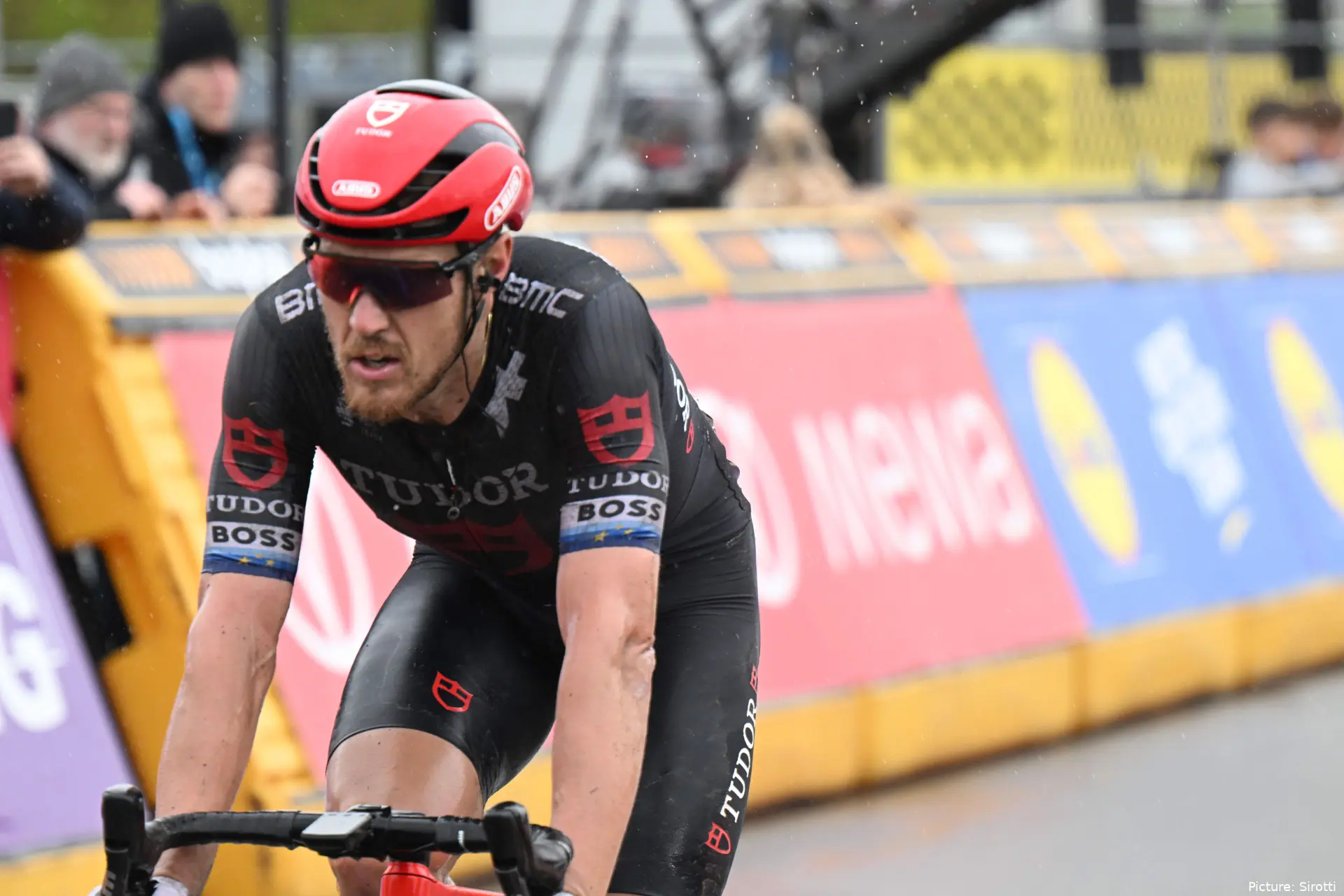
Matteo Trentin is back in Belgium. For the fifteenth time as a professional, the Italian tackles the Northern Classics campaign after travelling from Munich, where temperatures hovered around 20 degrees, to a very different scene in Harelbeke, with forecasts of just 11 degrees for the E3 Saxo Classic.
The rider admits the first-time butterflies are gone, though he still cherishes these races. Jokingly, he says he prefers good weather and leaves the epic images in rain and mud to the youngsters. Either way, he arrives ready, backed by his third place at Kuurne - Bruxelles – Kuurne and ninth at Milano–Sanremo.
Trentin is pleased with his condition, but stays grounded given the current high level. “I’m certainly not unhappy, but I’m keeping my feet on the ground. Right now there are riders who, whatever happens, never lose or get dropped, not even when they crash. To stay with them you need a special day.”
The Italian stresses that racing at that level also means measuring your efforts. “It’s not impossible, you never start thinking you have no chance, but you must know when to ease off. We’ve seen many riders blow up trying to follow them.”
The era of dominators
The presence of big names is decisive in these races. Trentin draws a parallel with other eras. “To win you have to race the races, otherwise only they would turn up. Before, Sagan was taking the green jersey at the Tour again and again. Now it’s riders like Van der Poel or Pogacar who are making history.”
In that vein, he believes his generation will remember competing against figures such as Mathieu van der Poel and Tadej Pogacar, and he even adds Wout van Aert if injuries hadn’t halted him at key moments.
Asked to name a favourite race, Trentin refuses to pick just one. He feels each event has its own identity, though he highlights Harelbeke as a kind of “mini Flanders” that is a touch more open.
He also points to the uncertainty at Gent–Wevelgem, especially with the wind, and notes that this year’s route brings tweaks that could change the usual script. “The finish is the same, but the start changes. There will be new roads and fewer reference points, so it will be an unknown for everyone.”
A Tudor side hit by absences
Within Tudor Pro Cycling Team, Trentin will lead the classics squad, although the team has faced significant setbacks. The absence of Stefan Küng since the opening race has affected the structure. Even so, he will have support from riders like Pluimers and Luca Mozzato, runner-up at Kuurne and recently fifth at the Ronde van Brugge.
Reviewing his career, Trentin reflects on leaving Quick-Step after his first major results. He believes his progression has been positive, despite the team’s own changes over the years.
He recalls stints with other squads where he achieved strong results, though he concedes that in teams with marquee leaders like Pogacar, collective work often eclipses individual achievements. On the state of Italian cycling in the classics, Trentin finds it hard to single out a clear standard-bearer.
He mentions Alberto Bettiol, a Tour of Flanders winner, albeit without consistent follow-up results, and also Filippo Ganna, whom he sees with potential if he fully commits to these races. “He has the level, but he must decide if he truly likes these races, because they are very demanding mentally. Without motivation, they feel even tougher.”
Experience banked on the pavé
After 15 years in the peloton, Trentin feels he no longer needs long Belgian blocks to prepare. “Bikes have improved a lot and are more stable on the pavé. I’d recommend a neo-pro to stay longer, but I already know these roads better than many locals.”
In fact, he says that, after his home region and Munich, the area he knows best is around Kortrijk, Ghent, Oudenaarde, and Ronse.
Despite a demanding calendar, the Italian also values balance with family life. With the Tour of Flanders followed by Easter Monday, Trentin admits that heading home to be with his family is also a strong pull.
Enjoying that time with his children, even something as simple as sharing a chocolate egg, is part of a routine that, after years of experience, matters more and more.
Read also
Carlos Silva is a writer for CyclingUpToDate.com, where he contributes race reports, interviews, analysis pieces, and live coverage of the international cycling calendar. Holding a degree in Sports from the Jean Piaget Institute, he combines academic knowledge of performance, training, and competition with hands-on journalism experience in professional cycling.
Throughout his career, Carlos has conducted interviews with leading figures in the sport, including Alberto Contador, Joaquim Rodríguez, Óscar Pereiro, João Almeida, Isaac del Toro, Derek Gee, John Degenkolb and Geraint Thomas. These conversations reflect direct engagement with Grand Tour winners, Classics specialists, and emerging talents.
He has provided on-site coverage at major events ranging from the Vuelta a España to the Tour de France, alongside stage races such as Vuelta a Andalucía, Volta ao Algarve, Volta a Portugal and O Gran Camiño. Covering the mythical climbs of the Giro d'Italia remains one of his professional ambitions.
Carlos is responsible for liveblog coverage of all major WorldTour races and beyond, including the Tour de France, Giro d'Italia and Vuelta a España. His reporting integrates verified data from ProCyclingStats to ensure statistical accuracy, contextual depth, and analytical precision.
A lifelong cycling enthusiast, he approaches storytelling across written, photographic, and video formats with a focus on credibility, tactical insight, and informed race interpretation.
claps 0visitors 0
Just in

Popular news
Latest comments
- Man, I'm really looking forward to next season. Seeing these new line-ups, it's going to be VERY interesting.wrsty23-10-2026
- This Remco-friendly (and Seixas-friendly?) route was almost certainly designed to reduce Pog's dominance. But as Prudhomme has said straight out, now he thinks Pog's accident will have reduced his dominance anyway.Hills3323-10-2026
- We also don't know how much Pog was really putting into gaining time. Feels like watching Usain Bolt, where you can only wonder how much faster he'd have gone if he was sprinting 100% to the line, instead of being two feet ahead and starting to pull up with ten yards to go. If any of the other riders really started to close in on Pog, I do think he'd simply have gone even deeper and crushed them. I would really like that kind of race though, none of this "4 minutes lead by the first rest day" trouncing. So if introducing more TT and less summit finish makes the race go more to the wire, I'm all for that. I don't think it'll change the outcome necessarily, but it'll make the whole thing less of a foregone conclusion by week 2.wrsty23-10-2026
- That nearly is 7 mins and you win GTs comfortably by 2 mins. Remco fans - he almost won the TDF, He beat Pogi twice in the mountains this year.abstractengineer23-10-2026
- What would be your preferred Tour design then? Just out of interestwrsty23-10-2026
- I like Remco but even I'll admit he didn't get anywhere close to Pogacar, just like everyone else.megasmacky23-10-2026
- That's what y'all said this year, "remco will come fifth"bruins3022-10-2026
- That used to be the norm, 100 kms of TTs. Now look at the '87 route...acem8222-10-2026
- Well, crashes can happen, so it's not impossible...acem8222-10-2026
- that would be kinda cool. there is a lot of untapped potential. which I'm sure the UCI will overlook. in order to get sock length correct.mij22-10-2026
Loading
Write a comment