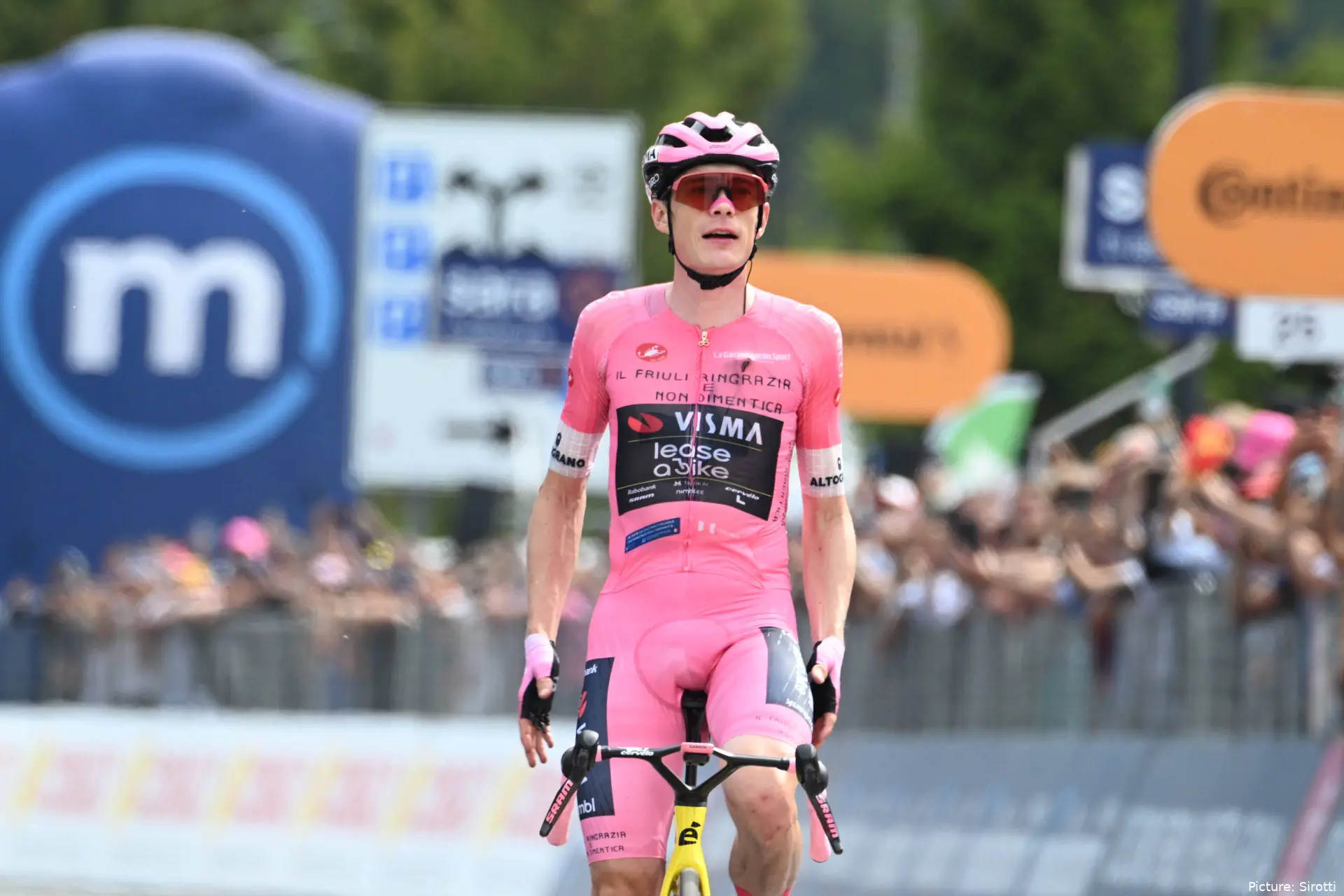
The 2026 Giro d’Italia is already in the books. An edition marked by emotion, by chaotic stages, and by moments cycling fans will struggle to forget. Yet it was also a race with relatively little suspense for the general classification. Jonas Vingegaard made it clear he was a step —or several— above the rest.
Visma - Lease a Bike’s dominance was absolute during much of the race. The Dutch team controlled the peloton with an iron grip, hardening stages relentlessly and cutting breakaway chances to a minimum. Rarely in a recent Giro have we seen such an evident collective superiority, especially in the mountains.
The race was also shaped by the huge early mass crash, an incident that completely conditioned the course of the GC. Riders like Adam Yates, Jay Vine, and Marc Soler were forced to abandon early, badly weakening UAE Team Emirates XRG and wiping out several key contenders in one go. That crash changed the Giro for good.
Amid so much tension there was also room for the surreal, like the now-unforgettable episode of Lorenzo Milesi rolling down the start ramp in the time trial wearing a Movistar Team training gilet. An absurd yet iconic scene in a race that, beyond the anecdotes, confirmed the five standout riders of the edition.
Jonas Vingegaard
With the race done, there’s no room for debate: Jonas Vingegaard is the outstanding winner of the 2026 Giro d’Italia.
The Dane arrived at the Corsa Rosa as the top favourite and delivered exactly what was expected. Probably more. He didn’t just win the Giro d’Italia; he did it while projecting an utterly crushing sense of superiority. Across the three weeks he seemed to ride with headroom, never needing to empty the tank, which is even more troubling for his rivals ahead of the next Tour de France.
The truth is, this Giro looked like part of a meticulously planned trajectory. Vingegaard needed to conquer the only Grand Tour missing from his palmarès to cement his place in cycling history. He had already won the Tour de France in 2022 and 2023, plus the Vuelta a España in 2025. Only the maglia rosa was missing. And now he has it.
With this victory, Jonas Vingegaard officially joins the exclusive club of riders who have won all three Grand Tours. A list reserved for the sport’s true legends: Jacques Anquetil, Eddy Merckx, Felice Gimondi, Bernard Hinault, Alberto Contador, Vincenzo Nibali, Chris Froome, and now the Dane as well. That single fact neatly captures the scale of his career.
Beyond the historical stat, the truly striking part is how he won this Giro. Vingegaard ruled the mountains with effortless authority. Every time he attacked, nobody could follow. Felix Gall tried the hardest, but even the Austrian was ultimately overwhelmed by the Visma leader’s firepower.
The final margin of 5 minutes 22 seconds over Gall speaks for itself. In modern cycling, where gaps between the top favourites are usually tight, taking more than five minutes in a Grand Tour borders on the outrageous. And Vingegaard didn’t just control the race. He also racked up stage wins.
The Dane ends the Giro d’Italia with five stage victories, an even more striking figure when set against his Tour de France record. In fact, he had only four Tour stage wins across his entire career. Here he bagged five in one go. That shows just how superior he was.
More worrying for the rest is that he often looked short of peak form. With the Tour de France around the corner and the anticipated duel with Tadej Pogacar and Paul Seixas on the horizon, Vingegaard seemed to be riding with a gear in reserve. His Giro was that of an undisputed champion. A rider who now belongs, definitively, to cycling’s Olympus.

Jonas Vingegaard, in the maglia rosa at the 2026 Giro d’Italia.
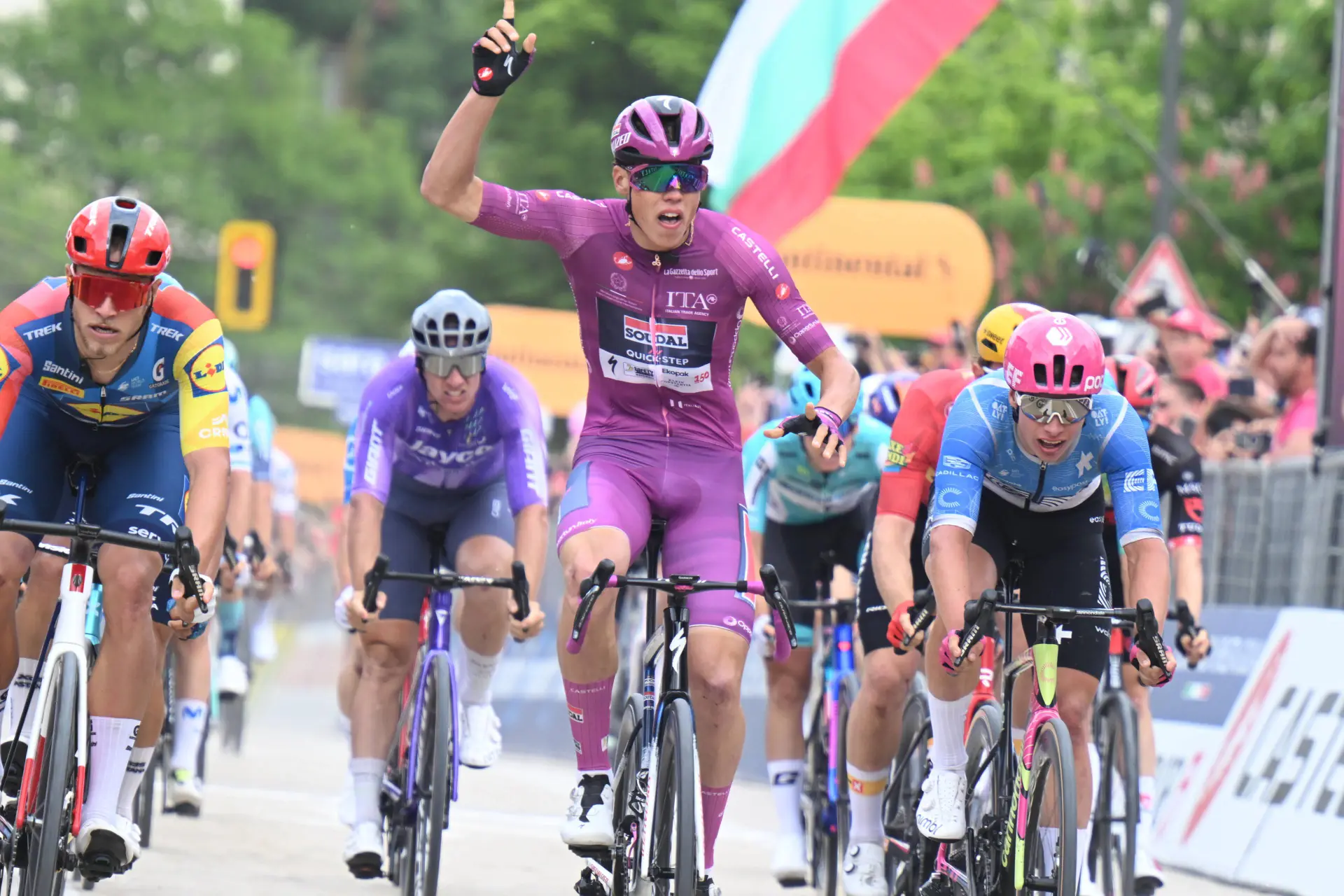
Paul Magnier
If Jonas Vingegaard was king of the mountains, Paul Magnier was the undisputed emperor of the sprints. The 22-year-old Frenchman completed a Giro d’Italia of full-fledged breakthrough. Although already seen as one of the most talented young sprinters in the world, this Corsa Rosa elevated him straight into the top tier of the international peloton. And he did it by completely blowing the competition to pieces.
Especially Jonathan Milan, who arrived as one of the prime favourites to dominate the bunch sprints and yet ended up as one of the race’s biggest disappointments. Magnier beat him in virtually every head-to-head, showing far greater punch, consistency, and positioning.
The win on stage 1, raced in Bulgaria, was probably the moment that changed everything for him. That day let him pull on the first maglia rosa of the Giro and confirm from the outset that he was ready to lead Soudal Quick-Step outright.
From there he just kept growing. Magnier ends the race with three stage wins —pending whatever might happen in Rome— and the maglia ciclamino as winner of the points classification. A huge success for such a young rider and for a team that desperately needed new attacking reference points.
It is true that Jhonatan Narváez’s withdrawal on stage 19 made his victory in the points classification significantly easier. The Ecuadorian had been a very dangerous rival and had even led the classification at several points in the race. But that should not detract from what Magnier achieved.
Because his consistency has been outstanding from day one. Moreover, one of the most impressive things about his Giro was seeing how he held his own not only in pure sprints but also on tougher, more explosive stages. Magnier no longer looks like just a fast finisher. He’s starting to feel like a much more complete rider.
And that is exactly what makes his future so daunting for the rest of the peloton. Soudal Quick-Step had been searching for a new leading light after the golden years of Julian Alaphilippe and Remco Evenepoel. All signs point to them having found it in Paul Magnier. The “Wolfpack” has a major star on its hands.
Jhonatan Narváez
Probably no one salvaged their team’s Giro d’Italia as much as Jhonatan Narváez. UAE Team Emirates XRG arrived as one of the strongest squads, with Adam Yates as their big card for the general classification. However, the opening mass crash completely wrecked the Emirati team’s plans.
Yates, Jay Vine, and Marc Soler abandoned early, leaving UAE down to barely five riders and with no real chance of fighting for the maglia rosa. At that point many teams would have folded mentally. But UAE reacted brilliantly. They completely changed strategy and went all-in for stage hunting.
That’s where Narváez stepped up. The Ecuadorian likely delivered the best Grand Tour of his career. He was aggressive, explosive, and tactically razor-sharp. In virtually every stage suited to breakaways or to powerful riders from reduced groups, Narváez was up front.
The final return is spectacular: three stage wins and multiple top-10 finishes. Beyond the numbers, what really stood out was the sense of control he conveyed whenever he made the break. Few riders seemed able to follow him when the road tilted and the pace bit.
His duel with Paul Magnier for the maglia ciclamino also became one of the Giro’s most engaging storylines. Narváez even led the classification for several days and looked to have a real shot at winning it.
Unfortunately, cycling also has that cruel edge that makes Grand Tours so unpredictable. An illness or a minor physical issue can ruin weeks of work. That is exactly what happened to the Ecuadorian on stage 19, when he was forced to abandon the race. But even that withdrawal does not tarnish his Giro d’Italia in the slightest.
In fact, Narváez’s level was so high that, as journalist Beppe Conti reported on Rai, UAE Team Emirates XRG have already decided to renew him for three more seasons. That is especially significant given months of speculation about a possible return to NetCompany INEOS.
In the end, Narváez not only stays. He does so as one of the team’s key riders. And frankly, after the Giro he just produced, he has earned it completely.
Afonso Eulálio
Every Grand Tour needs an unexpected revelation. And at the 2026 Giro d’Italia that role has a clear name: Afonso Eulálio.
The Portuguese rider reached the Grande Partenza as another domestique for Bahrain Victorious. No pressure, no spotlight, and almost unknown to much of the international public. But everything changed radically on stage 5.
That day looked set to become Igor Arrieta’s big celebration after his stage win, but Eulálio’s second place ended up having huge consequences for how the race unfolded.
Thanks to that performance, the Portuguese rider pulled on the maglia rosa. The most striking part was that no one expected him to keep it for long. Even less so after the marathon 42-kilometre individual time trial that looked tailor-made to shatter the hopes of a young, relatively inexperienced rider.
But he survived. And not only survived: he held the lead for a total of nine days. That stretch completely changed his career. As the Giro progressed, Eulálio began to race with growing confidence. What initially felt like a neat first-week fairy tale turned into a fully credible bid to finish high on the general classification.
When he lost the maglia rosa, many expected him to ease off and switch focus to hunting a stage win. That never happened. The Portuguese chose to keep fighting for the GC, and it was absolutely the right call.
Eulálio ends the Giro d’Italia in an outstanding sixth overall, and also as winner of the young riders’ classification, taking the white jersey ahead of talents like Davide Piganzoli. The step forward he has taken over these three weeks is enormous.
Perhaps more important than the final result is what it signals for the future. Eulálio does not look like a rider who simply capitalised on a fleeting scenario to shine for a few days. He gives the impression of having the genuine potential to establish himself as a major name in Grand Tours.
Bahrain Victorious may also have stumbled upon an unexpected gem.
Felix Gall
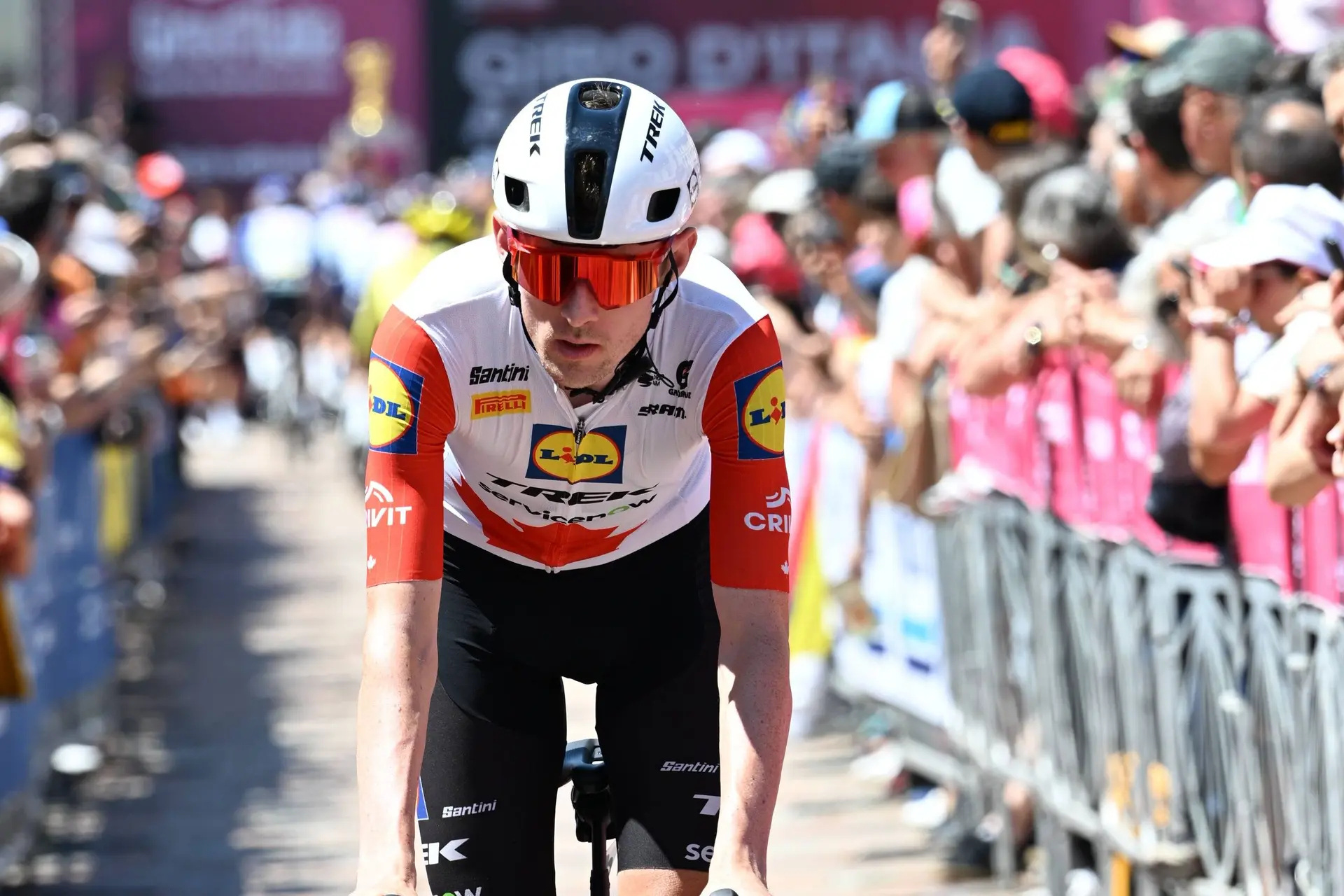
Felix Gall closes this list, arguably the clearest illustration of what it means to fight a monster like Jonas Vingegaard. If anyone tried to follow the Dane during this Giro, it was Gall.
The Austrian knew full well he probably couldn’t win the race, yet he never stopped swinging. Every time Vingegaard attacked in the mountains, Gall was almost always first to try and respond. Often he would be distanced, yes, but he was the only one consistently willing to risk blowing up to stay with the Visma leader.
And that deserves huge credit. Gall didn’t claim a stage win, the one thing missing from an otherwise unforgettable Giro. Even so, his consistency was superb.
No fewer than five second places sum up his race perfectly: always near the win, always competitive, always present when it mattered. That steadiness delivered second place overall, likely the best result of his career to date.
Beyond the podium, this Giro also carried another layer of meaning for Gall. At Decathlon CMA CGM, the figure of Paul Seixas—one of the brightest young talents in world cycling—is rising fast. Many were starting to wonder if the French team’s future lay more with the young Frenchman than with the Austrian.
Gall answered in the best possible way: by delivering a superb Grand Tour.
He showed he remains a fully valid leader for three-week races and still has room to compete with the world’s best climbers. Obviously, Vingegaard was out of reach for everyone, but Gall was clearly the best of the rest. That carries real weight, too.
Read also

The Austrian also leaves stronger mentally. This Giro gave him the feeling of truly competing against one of the best riders of the modern era. And although he couldn’t beat him, he proved he belongs to that group capable of fighting for Grand Tour podiums.
In an edition dominated by Vingegaard’s superiority, Felix Gall perfectly embodied the role of the “best possible human.” Sometimes that deserves recognition, too.

Jorge BorregueroWriter
Jorge Borreguero is a journalist with a degree from the Complutense University of Madrid and has been a writer for Cyclinguptodate and Ciclismoaldia since early 2023. In this role, he has played a key part in the evolution of the website, particularly as a specialist covering Movistar Team. He regularly writes race reports, analytical pieces, and in-depth features about the team, and has conducted exclusive interviews and attended multiple team presentations, providing readers with firsthand insights into one of the leading professional cycling squads.
Throughout his career, Jorge has maintained a strong focus on sports journalism, gaining experience across a variety of disciplines, including basketball and football. However, his current work is almost entirely dedicated to cycling, contributing extensively to Ciclismoaldia and its sister website Cyclinguptodate. For these platforms, he combines thorough research with detailed reporting to deliver high-quality content, ranging from race previews and results to expert analysis of teams and riders.
Jorge’s reporting is marked by accuracy, depth, and a commitment to providing readers with reliable and authoritative information. His direct engagement with teams, athletes, and events ensures that his coverage reflects firsthand knowledge and professional insight. Through his work, he has established himself as a trusted voice in professional cycling journalism, bridging the gap between the sport and its global audience while maintaining rigorous editorial standards.
claps 12visitors 6
Just in
Popular news

Latest comments
- although he'll never be able to beat a healthy pogi in a grand tour, this year's tdf has demonstrated that in his absence he can probably win any grand tour...Ketterechts07-10-2026
- Nothing has changed, even after all these deaths. The UCI has blood on its hands.Pogboom07-10-2026
- I'm a retired pro photographer. We have been having a debate on this issue on a photography forum. Is the image we see that the ECF has issued accurate? In truth it is debatable. Why? What they are describing is basically high speed photography using a camera that shoots at 13000 frames per second. That is thirteen thousand single images every second. They are than using a process that most keen photographers know as "stacking." Each image taken within the set time period that the camera is set to shoot is then laid one on top of the other to get a single high resolution image. Does it tell the truth about the winning bikes position? Therein is the debate! My opinion is that unless you see the actual line on the road and its position relative to the actual finish line on the road and not a manufactured digital line purporting to be the finish line, there will always be questions on the accuracy of the image that the ECF has produced.Prorodsandstuff07-10-2026
- Take the thrown? Really?Trooph07-10-2026
- Maybe consider that it helps him work himself up into pushing his energy? A lot of people never start or do anything without some catalyst based on or created through negative feelings. Saying all continents is no longer acceptable without qualification, it must now be starred ;-) The amateur world of pioneers and seekers of thrills and fame has long since declared you have not been or won on all continents until you’ve included Antartica, to the great and sad loss of that place’s merit of having stayed more or less undiscovered by useless visitors.Jumpyjohn07-10-2026
- Now Hills33, don't you turn your back on me... you hear? They're all against me, because together they think, they have more power, but it ain't working for them. They keep losing out.PogiSloFans07-10-2026
- McEnremcoe?Jumpyjohn07-10-2026
- You make a statement like that and provide zero evidence or argument to back it up?Jumpyjohn07-10-2026
- For good measure, I would add a case of nuts tooJumpyjohn07-10-2026
- I don’t think anybody here is confused about who the real Mous are, they’re unmistakable so don’t worry too much about that.Jumpyjohn07-10-2026
Loading
Write a comment